

Paris Bordone
b. 1500, Treviso
d. 1571, Venice
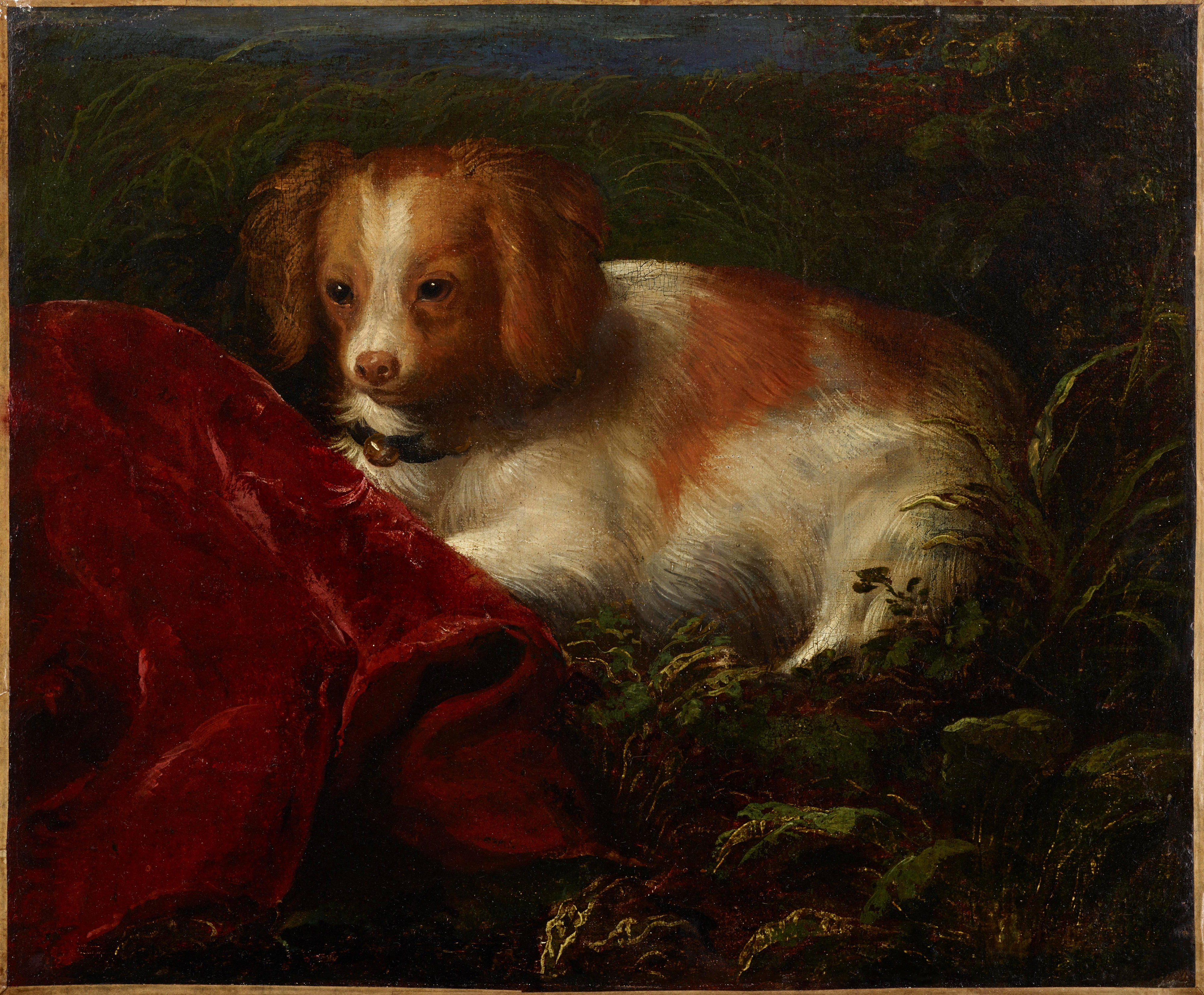
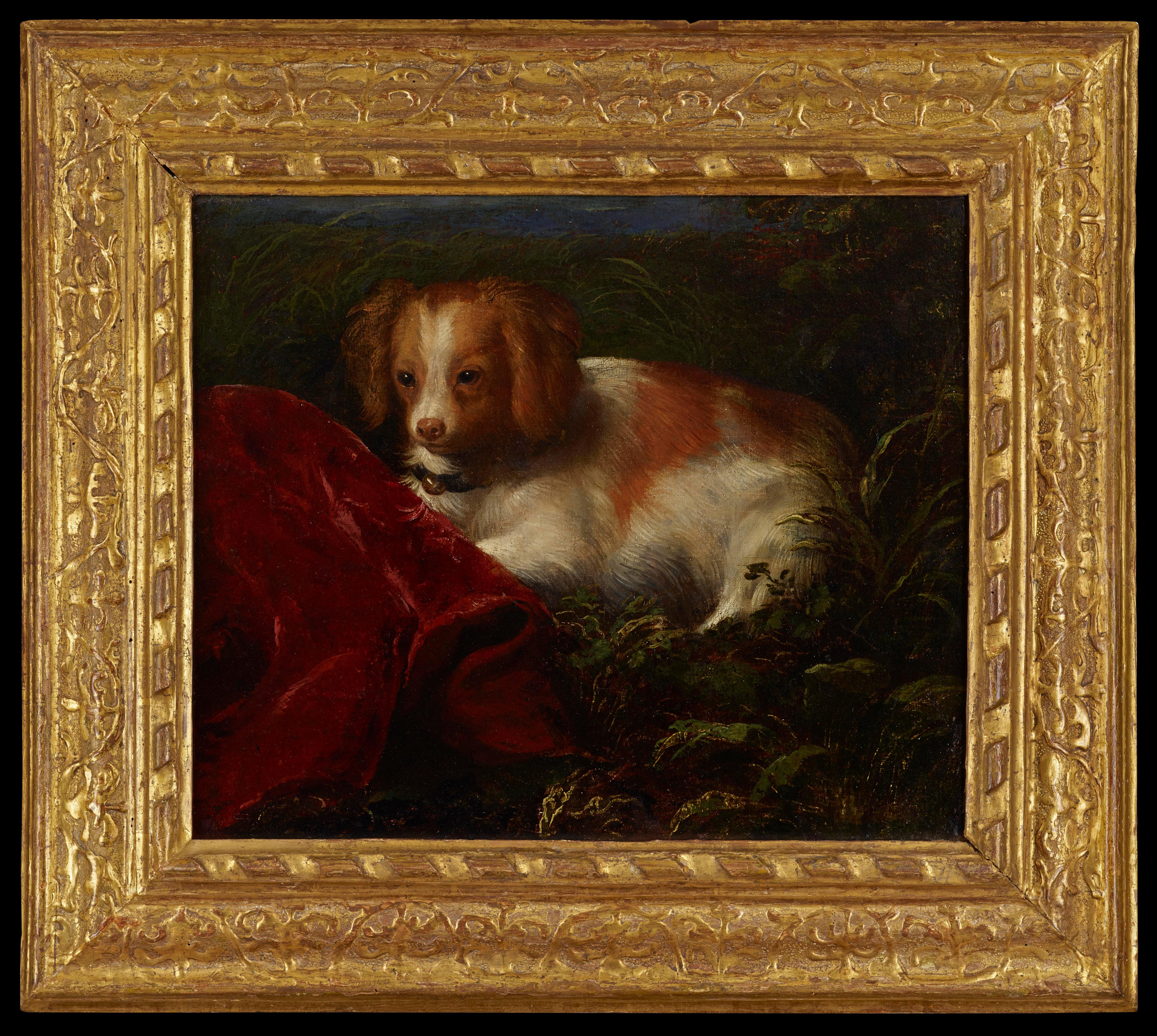
A Cavalier King Charles Spaniel seated in a landscape
mid-sixteenth century
Oil on canvas
33.4 x 39.8 cm (13 1/8 x 15 5/8 in.)
Framed: 49.5 x 56 x 4.5 cm (19 1/2 x 22 x 1 3/4 in.)
Provenance
Private collection.
Description
Paris Bordone, the renowned sixteenth-century Venetian artist who worked at the time of Titian, Veronese and Tintoretto, is best known for his beautiful depictions of women in portraiture and in historical compositions. He was also celebrated for his monumental architectural settings for narrative paintings, and worked across easel and decorative paintings. He mainly produced works for the wealthy elite of northern Italy and Bavaria, and also for the courts of France and Poland.
Bordone was born in Treviso but after his father’s death moved with his mother to Venice in 1508, where in 1516 he entered the studio of Titian. With a prodigious talent, within two years he had left the studio presumably due to Titian’s hostility towards a student who assimilated his style so successfully. In this early period, Bordone’s work was also influenced by Giorgione, as evident in religious paintings such as his Madonna and Child enthroned with Saints Christopher and George (c. 1525-6, Lovere, Accademia di Belle Arti Tadini), enlivened in a manner evocative of Titian and his greatest rival in Venice, Pordenone.
Bordone’s first public recognition came in 1534, winning a competition for the Scuola Grande di San Marco to execute the Presentation of the Ring to the Doge (Venice, Accademia), which marked the achievement of artistic maturity. In 1538, the artist was present at the court of Francis I in Fontainebleau, where he executed several paintings of mythological, religious and secular subjects, synthesising Venetian, Central Italian and French Mannerist elements. Bordone returned for a while to Italy (likely Venice and Milan) before travelling to Bavaria, probably between 1540 and 1543. During this time he undertook decorative cycles for churches and established a successful portrait enterprise. From 1543, he was active in the Veneto, and then Milan from approximately 1548, during which time his style began to incorporate the influence of Lorenzo Lotto, whom he had encountered in Venice. Working for private patrons such as the King of Poland, Candiano, the physician to Mary, Queen of Hungary, and the Marchese d’Astorga, he executed paintings on religious and mythological subjects.
During Bordone’s late period, after 1550, his style changed once again, owing a debt to Leonardo and his Milanese school, as can be seen in his extensive fresco cycle in Saint Simon di Vallada, Venice. In the 1550s he was once again active in Bavaria, while also undertaking commissions in Venice and Milan. After 1560, Bordone worked mainly from his Venetian studio, with the majority of his commissions coming from Treviso. These later years witnessed a certain repetitiveness in his oeuvre, mainly producing altarpieces with figures copied from his own model-book.
This charming painting of a spaniel in an outdoor setting demonstrates the master’s ability to capture the physicality and character of his subject. The fur is rendered in rapid brushstrokes with sensitive attention to the fall of light and shadow across the animal’s coat; its alert countenance is captured through cocked ears and keen gaze. Small dogs such as this were commonly included at the fringes of large Venetian compositions, as was especially popularised by Titian, accompanying ancient goddesses or contemporary women, such as in the master’s Venus with the Organ Player (c. 1550, Gemäldegalerie, Berlin, fig. 1), where a small white dog appears in the lower right corner. Also in the collections of the Gemäldegalerie and adopting a similar format, Venus in a landscape attributed to Bordone’s studio shows a reclining nude goddess with a small shaggy dog at the left edge of the painting.[1] The artist also depicted these animals on occasion in religious compositions, as appears in the bottom corner of the aforementioned Madonna and Child enthroned with Saints George and Christopher (fig. 2) or in the predella in the altarpiece in the Chapel of Carla da Rho in the church of Santa Maria presso San Celso, Milan, depicting Saint Rocco lying down. Such canine subjects enhanced the sense of scale, aggrandising the protagonists of the paintings, or added an amusing and relatable touch to mythological or religious subjects. Dogs also appeared in portraits, especially of women and children, a notable example being Titian’s Portrait of Clarissa Strozzi, executed in 1542 (now in the Gemäldegalerie, Berlin, fig. 3). An example of such a portrait featuring a canine companion given to Bordone is the Courtesan with a Little Dog (c. 1545–50), now in a private collection in Bari.[2]
It is likely that the present painting was a fragment for a larger composition.
This painting is accompanied by an expertise by Andrea Donati.
[1] A. Donati, Paris Bordone. Catalogo ragionato, Soncino, 2014, pp. 352-3, no. 143.
[2] Donati, Paris Bordone. Catalogo ragionato, pp. 397-8, no. 198.
Fig. 1 – Titian, Venus with the Organ Player, c. 1550. Staatliche Museen zu Berlin, Gemäldegalerie.
Fig. 2 – Paris Bordone, Madonna and Child enthroned with Saints George and Christopher, c. 1526–27. Galleria dell’Accademia Tadini, Lovere.
Fig. 3 – Titian, Portrait of Clarissa Strozzi (1540 – 1581), at the age of two, 1542. Staatliche Museen zu Berlin, Gemäldegalerie.