

Achille Etna Michallon
b. 1796, Paris
d. 1822, Paris
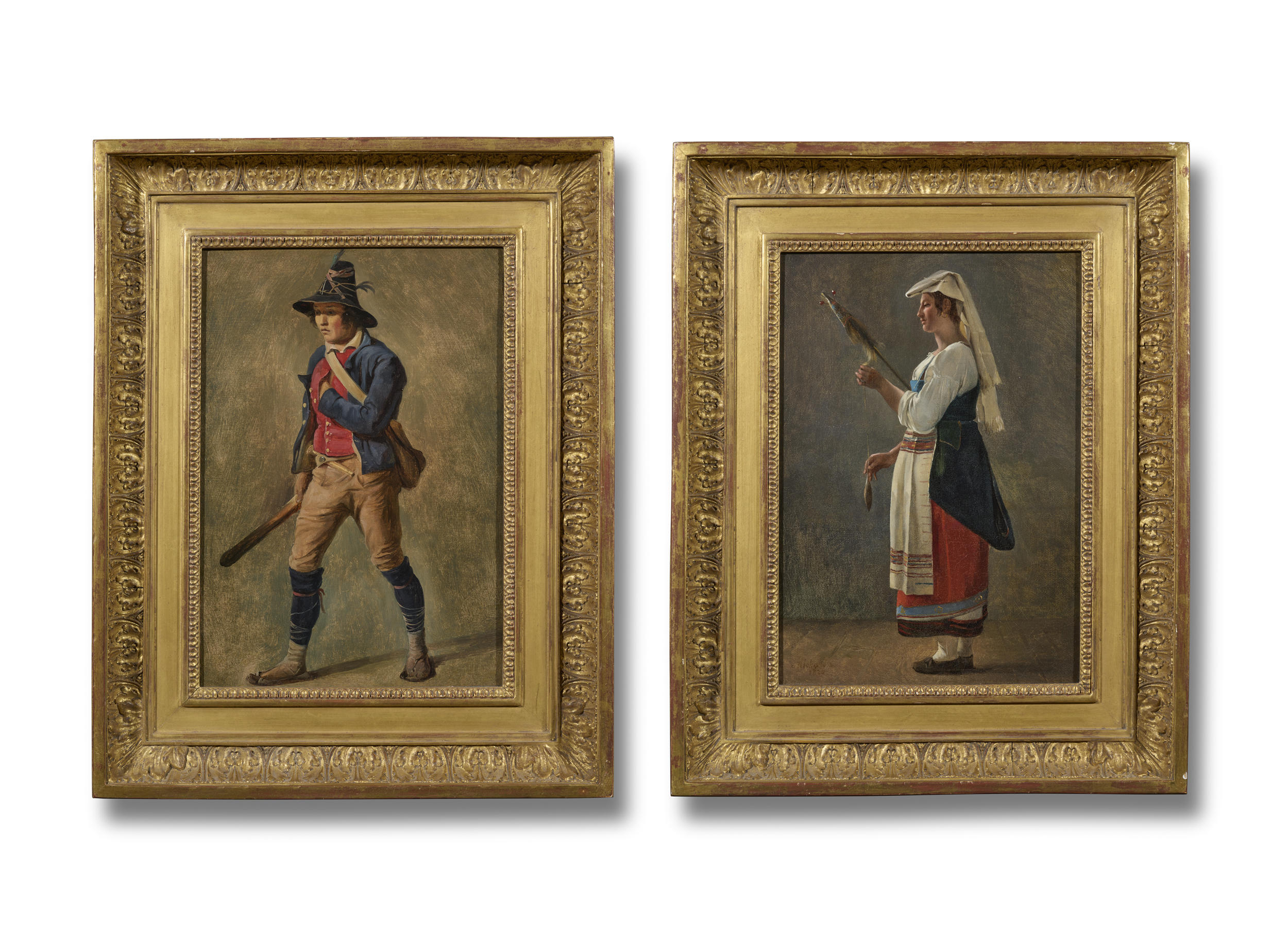
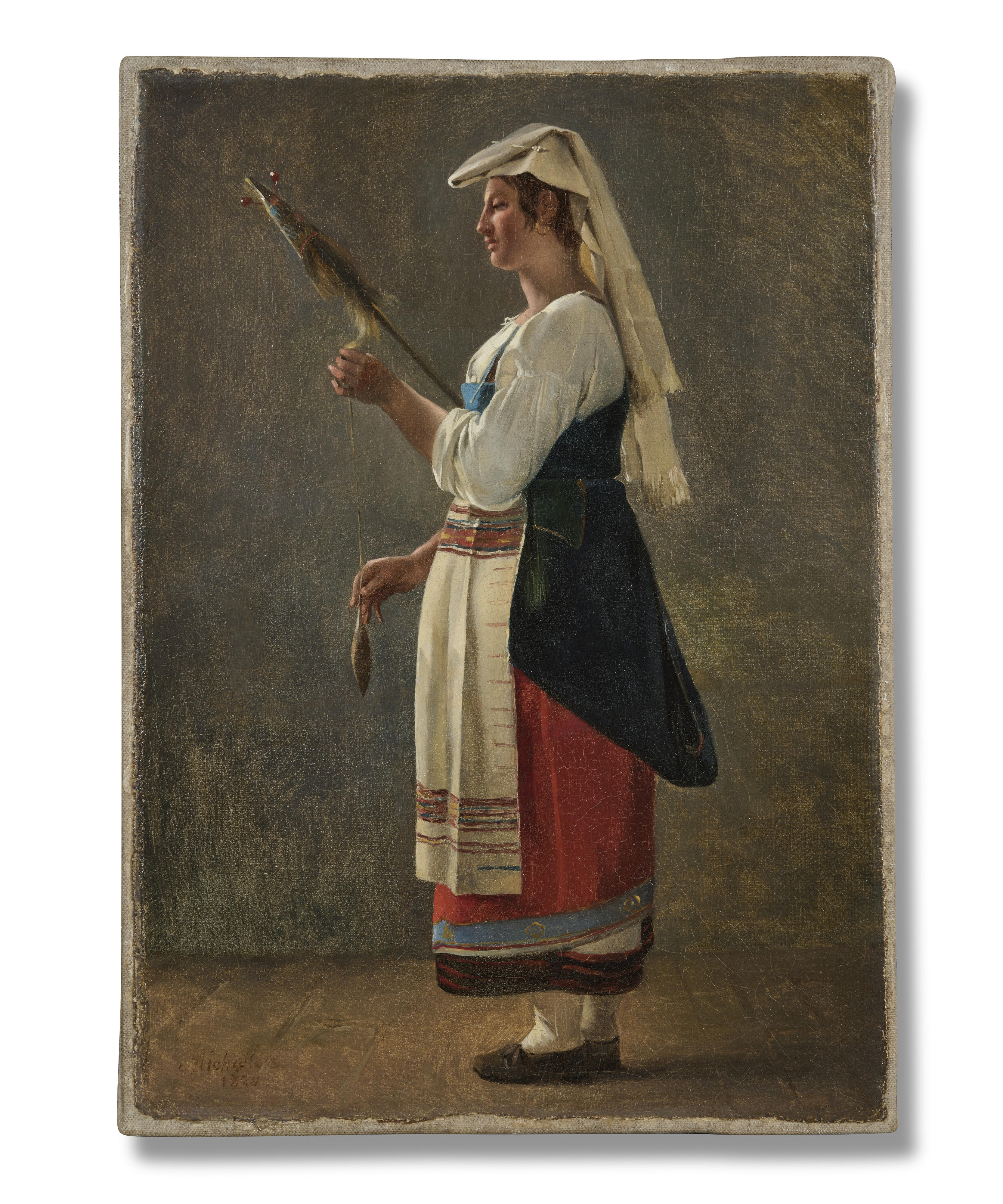
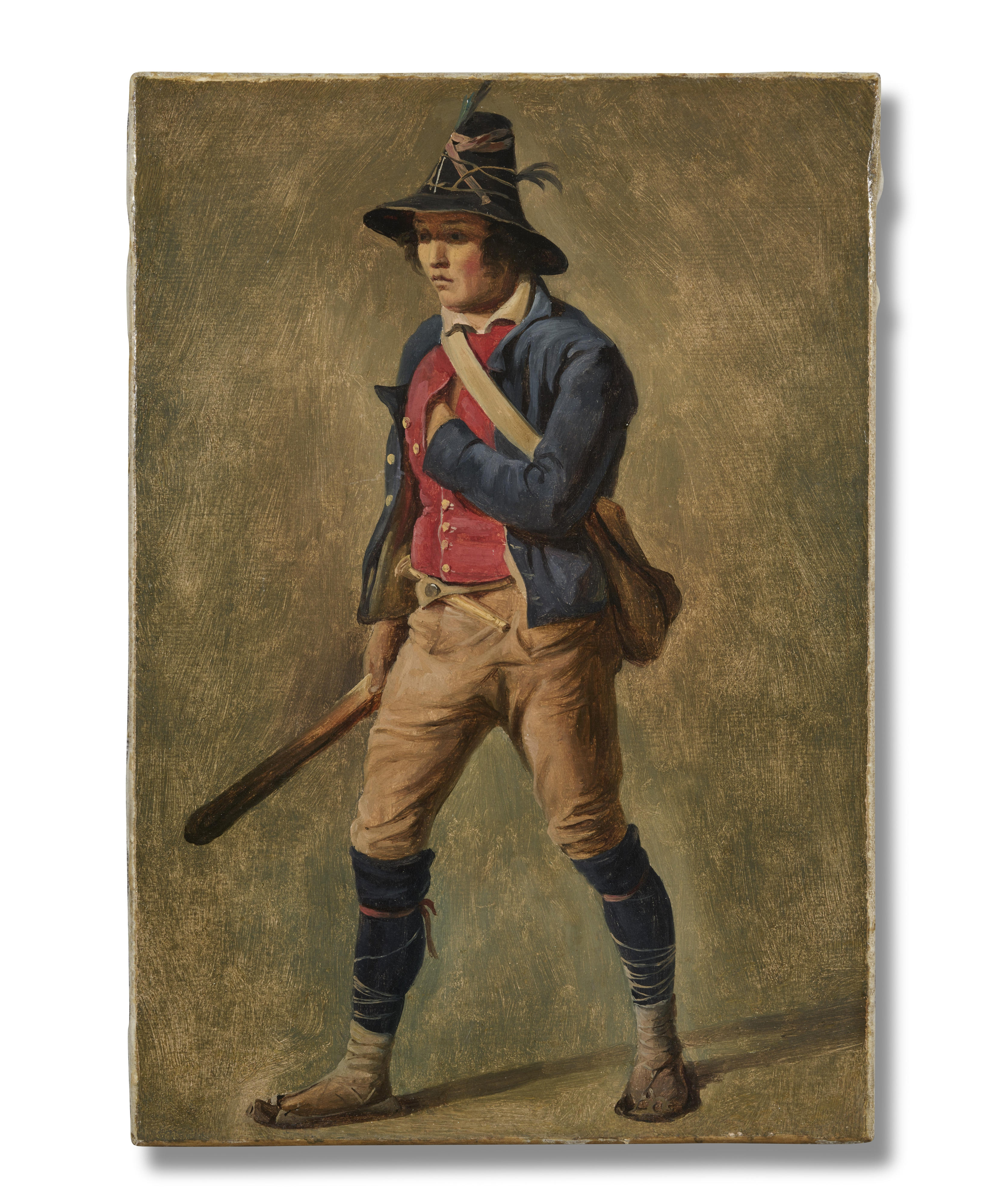
A Pair of Studies of a Peasant Girl and an Italian Man
1820
Oil on paper on canvas
Girl: 35.1 x 24.3 cm (13 7/8 x 9 5/8 in.)
Man: 34.3 x 23.8 cm (13 1/2 x 9 3/8 in.)
Both framed: 50.5 x 40 cm (19 7/8 x 15 3/4 in.)
Provenance
Galerie Martin du Nord, Paris 1977,
Sale, Christie’s, London, 20 April 1979,
Galerie Heim-Gairac, Paris,
Galerie Nystad, Den Haag 1980,
Sale, Sotheby’s, London, 29 May 1985,
Private Collection, Germany.
Literature
J. Valout, Notices historiques sur les tableaux de la Galerie de S.A.R. Monseigneur le duc d’Orléans, dédiée à S.A.R. Madame la duchesse d’Orléans, Paris, 1826, vol. 1.
Blandine Lesage, Achille-Etna Michallon (1796−1822), Catalogue de l`œuvre peint, extrait de la Gazette des Beaux-arts, October 1997, no. 49, Abb. S. 127.
Description
Achille Michallon, the son of the sculptor Claude Michallon (1751-1799), who had won the prix de Rome in 1785, grew up in the Louvre where his parents had an apartment adjacent to his father's studio. At the age of six, while the Louvre was being renovated, they moved to artist's lodgings in the Sorbonne. Already exhibiting a precocious talent, Michallon first entered the studio of David, where he studied the art of drawing the human form, before joining that of Valenciennes. Under the latter's tutelage he developed his interest in landscape and took instruction from two of Valenciennes' pupils, Dunouy and Bertin.
In 1812, at the age of fifteen he exhibited for the first time at the Salon, receiving a second prize gold medal - an astonishing achievement which excited much comment at the time. With such critical attention at an early age it is hardly surprising that Michallon attracted the patronage of the enormously wealthy Prince Yussoupoff (who returned to Russia in 1814), then of the Duchess of Berry, daughter-in-law of the future King Charles X, as well as the Count de L'Espine, the finance master of Louis XVIII. In 1817 he exhibited two major works at the Salon, our painting and A Landscape with Democritus and the Alberitons, for which he received the newly founded prix de Rome for historical landscape (paysage historique), founded to honour Valenciennes. It was hoped that the institution of this prize would confer on landscape painting a similar standing to that long bestowed on history subjects.
As one contemporary art historian wrote, "the young artist who devotes himself to a career of landscape painting will not attract the attention of such generous patronage without exerting himself to meet the expectations of an august protector or fully achieving the hopes of the nation .... Historical landscape is henceforth called to contribute, along with the high forms of the arts, to the maintenance of the supremacy of the French School and to the realization of its brilliant future".
Michallon re-energized the art of landscape painting, avoiding the repetitiveness of Dunouy, Bidauld and Bertin, and soon established his own circle of artist admirers, of whom the most eminent was the young Camille Corot. He introduced into this genre a hint of the romanticism which was to dominate the succeeding two decades, while still combining "the nobility of figures who populate the pictures, and elevation of ideas - all of which combine to give life to a subject capable of moving the soul or exalting the imagination...". The Democritus and our landscape may both manifest the sense of drama and grandeur found in the work of Poussin, which was to become even more apparent in his works produced in Rome between 1817 and 1821.
Michallon died before his talent was fully realized at the age of twenty six, leaving only a modest output of finished works and a number of brilliant sketches and drawings. These two studies, part of a series the young artist painted while at the Academy in Rome, Michallon’s prize for winning the 1785 competition, and while traveling in Italy, were painted towards the end of Michallon’s journey.
The trip produced an elementary change in Michallon’s development as an artist; in these figure sketches we see the extraordinary talent that had earned the young artist the prix de Rome, but also the loosely modeled, yet detailed and richly-colored style, that anticipates Corot. Struck down at the onset of what would have been a glittering career just two years later, we know, from letters, Michallon’s exact course through Italy in 1820: these sketches were painted either in Sicily at the beginning of 1820, or outside Rome, where Michallon had returned by September of that year.
In 1812, at the age of fifteen he exhibited for the first time at the Salon, receiving a second prize gold medal - an astonishing achievement which excited much comment at the time. With such critical attention at an early age it is hardly surprising that Michallon attracted the patronage of the enormously wealthy Prince Yussoupoff (who returned to Russia in 1814), then of the Duchess of Berry, daughter-in-law of the future King Charles X, as well as the Count de L'Espine, the finance master of Louis XVIII. In 1817 he exhibited two major works at the Salon, our painting and A Landscape with Democritus and the Alberitons, for which he received the newly founded prix de Rome for historical landscape (paysage historique), founded to honour Valenciennes. It was hoped that the institution of this prize would confer on landscape painting a similar standing to that long bestowed on history subjects.
As one contemporary art historian wrote, "the young artist who devotes himself to a career of landscape painting will not attract the attention of such generous patronage without exerting himself to meet the expectations of an august protector or fully achieving the hopes of the nation .... Historical landscape is henceforth called to contribute, along with the high forms of the arts, to the maintenance of the supremacy of the French School and to the realization of its brilliant future".
Michallon re-energized the art of landscape painting, avoiding the repetitiveness of Dunouy, Bidauld and Bertin, and soon established his own circle of artist admirers, of whom the most eminent was the young Camille Corot. He introduced into this genre a hint of the romanticism which was to dominate the succeeding two decades, while still combining "the nobility of figures who populate the pictures, and elevation of ideas - all of which combine to give life to a subject capable of moving the soul or exalting the imagination...". The Democritus and our landscape may both manifest the sense of drama and grandeur found in the work of Poussin, which was to become even more apparent in his works produced in Rome between 1817 and 1821.
Michallon died before his talent was fully realized at the age of twenty six, leaving only a modest output of finished works and a number of brilliant sketches and drawings. These two studies, part of a series the young artist painted while at the Academy in Rome, Michallon’s prize for winning the 1785 competition, and while traveling in Italy, were painted towards the end of Michallon’s journey.
The trip produced an elementary change in Michallon’s development as an artist; in these figure sketches we see the extraordinary talent that had earned the young artist the prix de Rome, but also the loosely modeled, yet detailed and richly-colored style, that anticipates Corot. Struck down at the onset of what would have been a glittering career just two years later, we know, from letters, Michallon’s exact course through Italy in 1820: these sketches were painted either in Sicily at the beginning of 1820, or outside Rome, where Michallon had returned by September of that year.