
Jean-Baptiste Greuze
b. 1725, Tournus, Burgundy
d. 1805, Paris
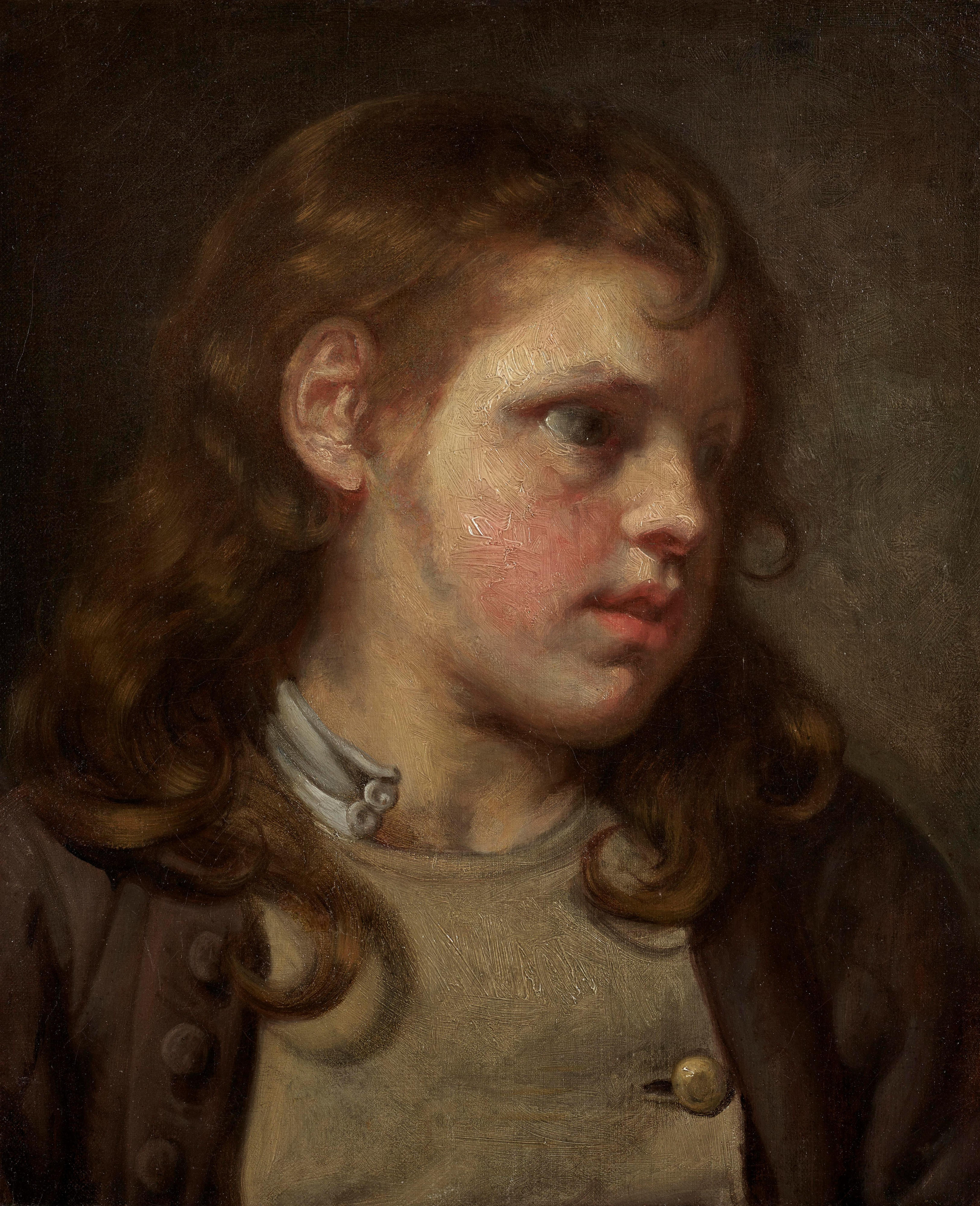
A Savoyard Boy
1760s
Oil on canvas
49 x 40 cm (19 1/4 x 15 3/4 in.)
With frame: 65.7 x 57 cm ( 25 3/4 x 22 1/2 in.)
Provenance
Description
Greuze’s masterful depictions of children are some of his most beguiling works. The present Savoyard exemplifies the artist’s interest in a specific genre of allegorical portraiture—pictures not meant to be pure likenesses of a specific sitter, but instead to evoke an emotional response in the viewer. As with the têtes de fantasie, painted by artists such as Fragonard, these “portraits” were creations of Greuze’s imagination.
“Savoyard” boys and girls were a fashionable theme for painters other than Greuze in the age of Louis XV and Louis XVI. François Hubert Drouais, for example, produced famous paintings with boys in Savoyard dresses. Such works were conceived as images of an idealised rustic countryside of France, much like the one Marie-Antoinette attempted to recreate with her farm village, Les Hameaux, in the park of Versailles.
The boy here depicted, in his simple grey jacket and brown gilet, appears to be from the poorer classes, which was a common subject for Greuze in the 1760s (it was only later, in the 1770s and 1780s, that the artist started to depict children of the elite). However, what Greuze has perfectly instilled in his portrayal, through the direct and guileless gaze of this young boy, is the unadulterated innocence of childhood.
A close comparison may be found in one the most famous paintings by Greuze, the Head of a Young Boy (fig. 1) that the painter exhibited at the Salon of 1763 (where it was described by Diderot as 'un petit paysan') and that is presently in the collections of the Metropolitan Museum of Art, which it entered in 1932 via a bequest from the Michael Friedsam collection. A similar date in the 1760s also seems suitable for the present painting, placing Greuze at the height of his mature career.
The present painting, hitherto unpublished, has a notable provenance: it comes from Chateau de Villepreux (fig. 2), the seat of the Bertin des Veaux, a distinguished noble French family whose members served as politicians and generals of the French Army during the Orleans kingdom and empire of Napoleon III.
We are grateful to Dr Yuriko Jackall for confirming the attribution of the work based on first-hand inspection of the work.
Fig. 1. Jean-Baptiste Greuze, Head of a Young Boy, 1763, Metropolitan Museum of Art, New York.
Fig. 2 An image of the present painting in the Salle Vert at the Chateau de Villepreux.