

Laura Coombs Hills
b. 1859, Newburyport, Massachusetts
d. 1952, Newburyport, Massachusetts
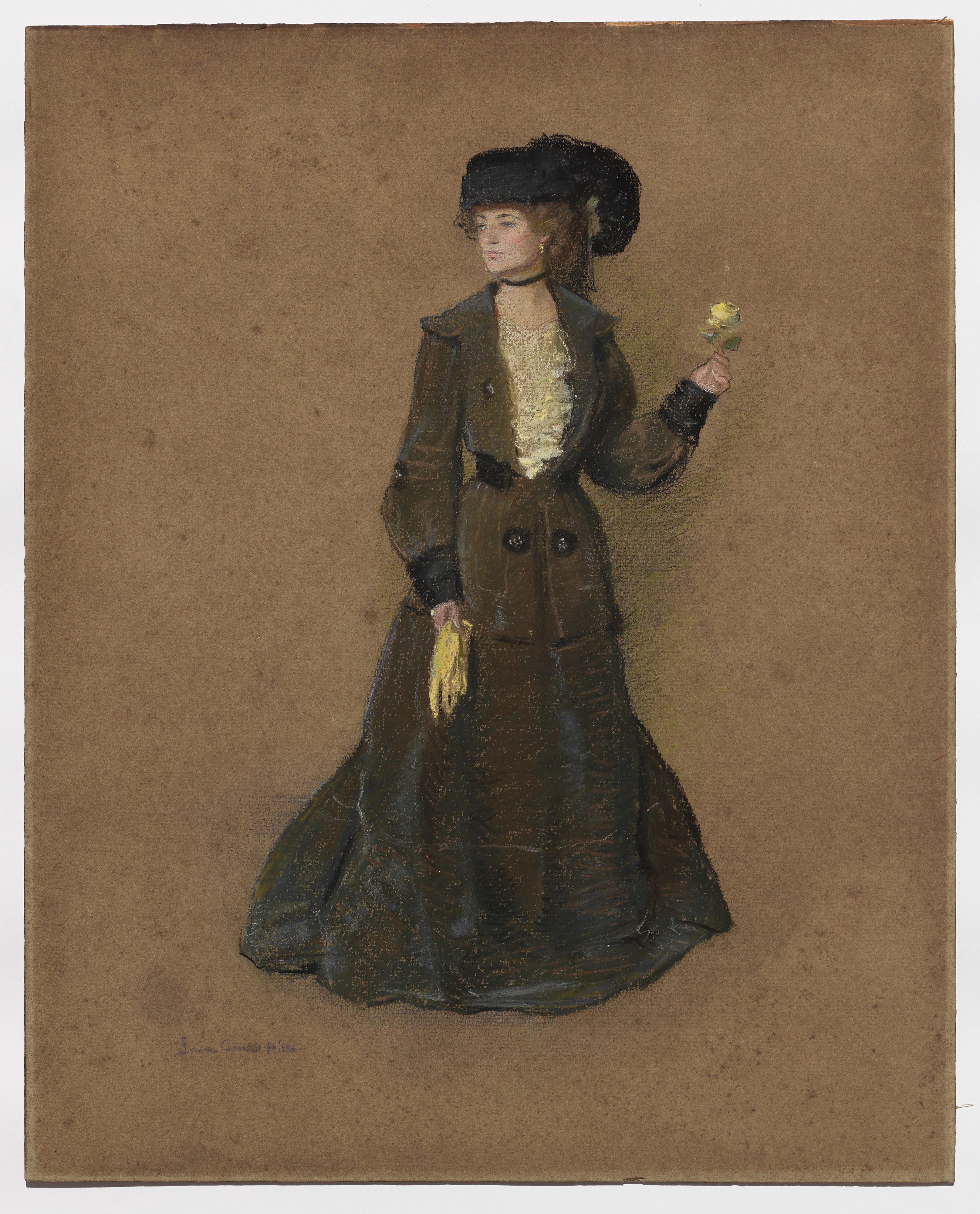
A Suffragette (Wedding Portrait of the Artist’s Cousin)
c. 1900
Pastel on dark brown pastel paper
38 x 22.8 cm (15 x 9 in.)
Provenance
Description
While this intimate pastel portrait was created principally a family memento, it may be also be considered an essay in early twentieth-century American feminism. The Coombs Hills family, in which the pastel remained for close to a century, recounts that the work was created by the artist as a gift to her cousin in commemoration of her impending marriage.
Portraits made to commemorate marriages are of course a centuries-old tradition, but Hill’s interpretation diverges significantly from traditional expectations. For one, the groom is nowhere to be seen. Instead, the bride serves as the work’s focal point, and is moreover portrayed holding a yellow rose, a prominent symbol of the suffragette movement. Proudly held aloft, this flower powerfully evokes the fervent struggle on behalf of so many courageous women to achieve the right to vote, a victory achieved in 1920—two decades following the execution of the present work.
Coombs Hills’ image of her cousin strikingly commemorates her cousin’s identity and fervently held beliefs, asserting her individuality prior to her marriage, her commitment to the causes of social justice she held dear. While red is the traditionally considered the color of the romantic rose, yellow is often read as its opposite. Yellow often symbolised independence and defiance—doubtless a disruption to traditional assumptions of the wedding portrait. Indeed Coombs Hills is best known for her floral still lives and was thus intimately familiar with the symbolic and allegorical language of flowers. Moreover, the flower offers the otherwise somewhat austere sheet’s single burst of color, drawing attention to itself as a symbol of the spirit of the young woman depicted.
The elegance of the sitter’s costume proffers a dignity closely aligned with the seriousness of her political views. The modesty of her attire—despite its fine fabrics and lace chemise—denotes the intensity of her commitment to her cause. She stands in solidarity with her sisters, even at a moment when, in the very act of marriage, she is essentially choosing to forfeit something of her independence. For a woman of good breeding, as the sitter certainly was, independence was a rare commodity—the period between leaving her father’s household and joining that of her husband was often nil. She may have enjoyed the privilege of a education at an all-women’s’ college prior to marriage, but a full life of independence, and of the mind, was a virtual impossibility.
The present sheet offers a rare glimpses into the limited, but nevertheless extant, realms of female independence and freedom of expression in the early twentieth-century America. Although never intended for public presentation, this highly personal work, with one cousin portraying another, with not only dignity and sympathy, but a sincere appreciation for and support of a cause both women held dear, expressed with a sense of solemnity and symbolic secrecy only two family members could have enjoyed.