

Alighiero Boetti
b. 1940, Turin, Italy
d. 1994, Rome, Italy
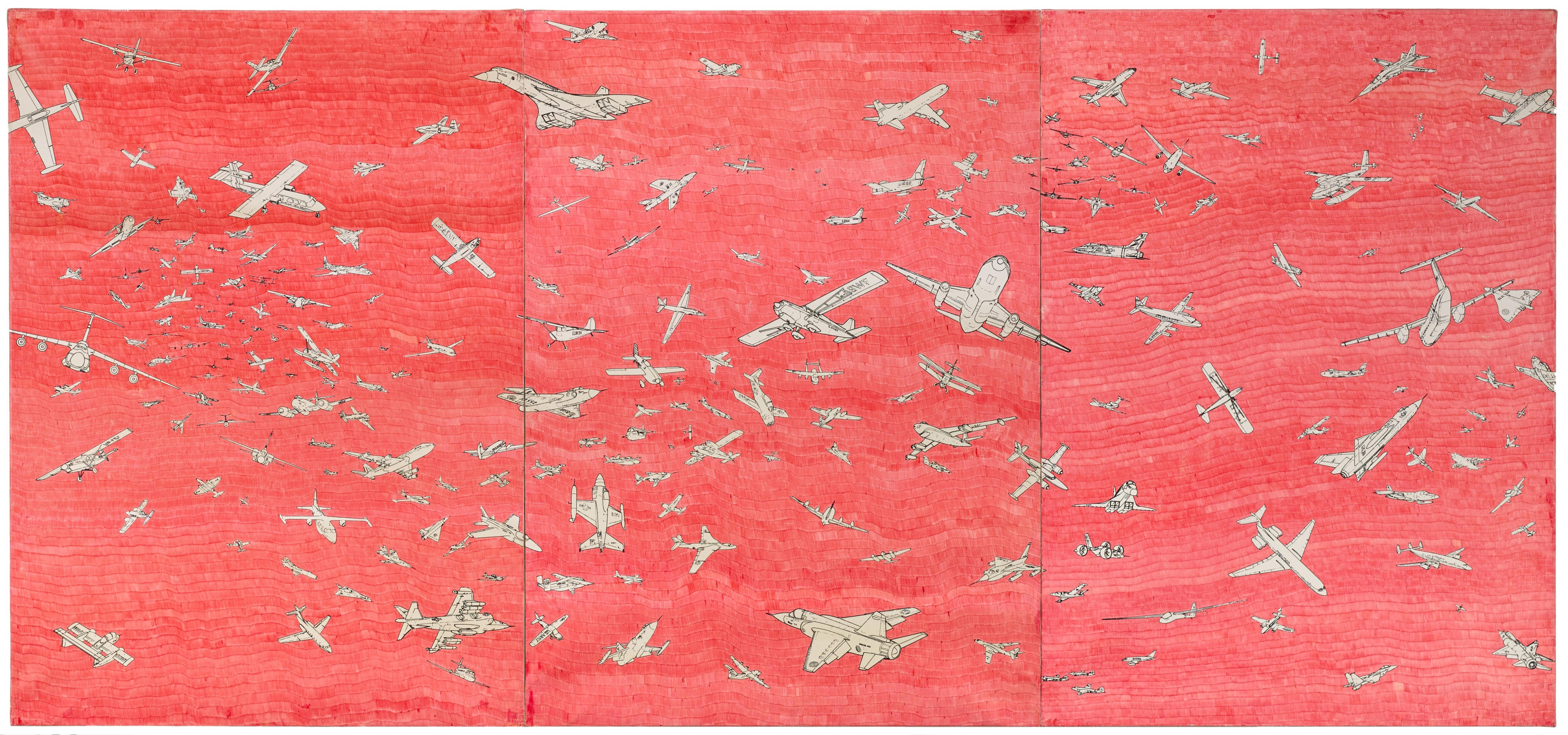
Aerei (Aeroplanes)
c. 1987
Ballpoint pen on paper laid down on canvas
Three parts, each: 139 x 100 cm (54 3/4 x 39 3/8 in.)
With frame: 145 x 306.5 x 7 cm (57 x 120 33/50 x 2 3/4 in.)
Provenance
Sergio Casoli, Milan,
Acquired from the above in 1988 by the former owner,
Sotheby's Milan, Lot 27, 19th December 2021.
Description
AGATA BOETTI, IL GIOCO DELL’ARTE. CON MIO PADRE, ALIGHIERO, MILAN 2016. P. 99
In the Aerei series, created starting from 1977 and conceived following a meeting with the architect, cartoonist and illustrator Guido Fuga, Boetti enclosed several fundamental elements of his poetics, making use of a compositional formula that is as simple, in the perception and in the optical analysis of its figurative elements, as articulated, in the vastness and depth of the meanings that emerge subtly from the work. In this type of ballpoint pen work - in red, blue, black or green – usually composed of three panels, we see in fact how the simplicity in the representation of the planes - drawn in negative, that is devoid of colour, above a sky coloured monochromatically - leads the observer to walk lightly, almost in a playful way, on the barbed wire of the complexity of reality. Specifically, Boetti presents us with studied simplicity a set of planes of different types which, gathered chaotically within a defined pictorial space, lose their specific qualities and functions and lead us into a state of "pre-oriented dis-orientation ”, recalling in this way the famous and fundamental theme of the artist based on the union-contrast between order and disorder.
But in Aerei, the study on conceptual contrasts does not end here, as the artist pushes the more reflective gaze of the observers to a biunivocal or, more precisely, bipolar analysis, on time and space, which are two elements on which the artist's research and expression are more concentrated. In fact, in front of Aerei we notice how the apparent uniqueness of the conception of time is actually child of a tension generated by two opposing forces: on the one hand there is the dimension of possibility and freedom of the infinite, expressed by the several routes and by the incalculable destinations that the numerous planes depicted in the painting can travel and reach; on the other hand we perceive the rigor and impossibility of the limit, defined both by the material "boundaries" of the pictorial surface - which, being delimited in turn in three panels, interrupts and separates not only the future routes not yet travelled but also the planes and the sky space that are already present and immediately visible in the work - and by the technique with which the artist represents the sky, which, defined and coloured with a repetitive and almost geometric hatching, gives shape, and therefore sets a limit, to the airy atmospheric abstractness.
As anticipated, together with space, time also finds its burst and its embankment in the work, since, if the speed and mobility of airplanes present us the uncertain, fragile and mobile condition of temporariness, it is at the same time true that the nature of the work of art, with its "signs" and its "traces" imprinted in a physically and emotionally irreversible way on the pictorial support, brings us back to a dimension of firm and certain stability, in which time, having entered into a relationship with art, is no longer able to condition the flow and evolution of reality. And in this latter concept, in the comparison and contrast between mobility and stability, between the finite and the infinite world, that we can find and listen to the rhythm of Boetti's beats, a rhythm marked by long and numerous "traits" of a life lived in a nomadic and wandering way, which has found its linearity and a definite direction in the pursuit of a precise and tireless "artistic mission".