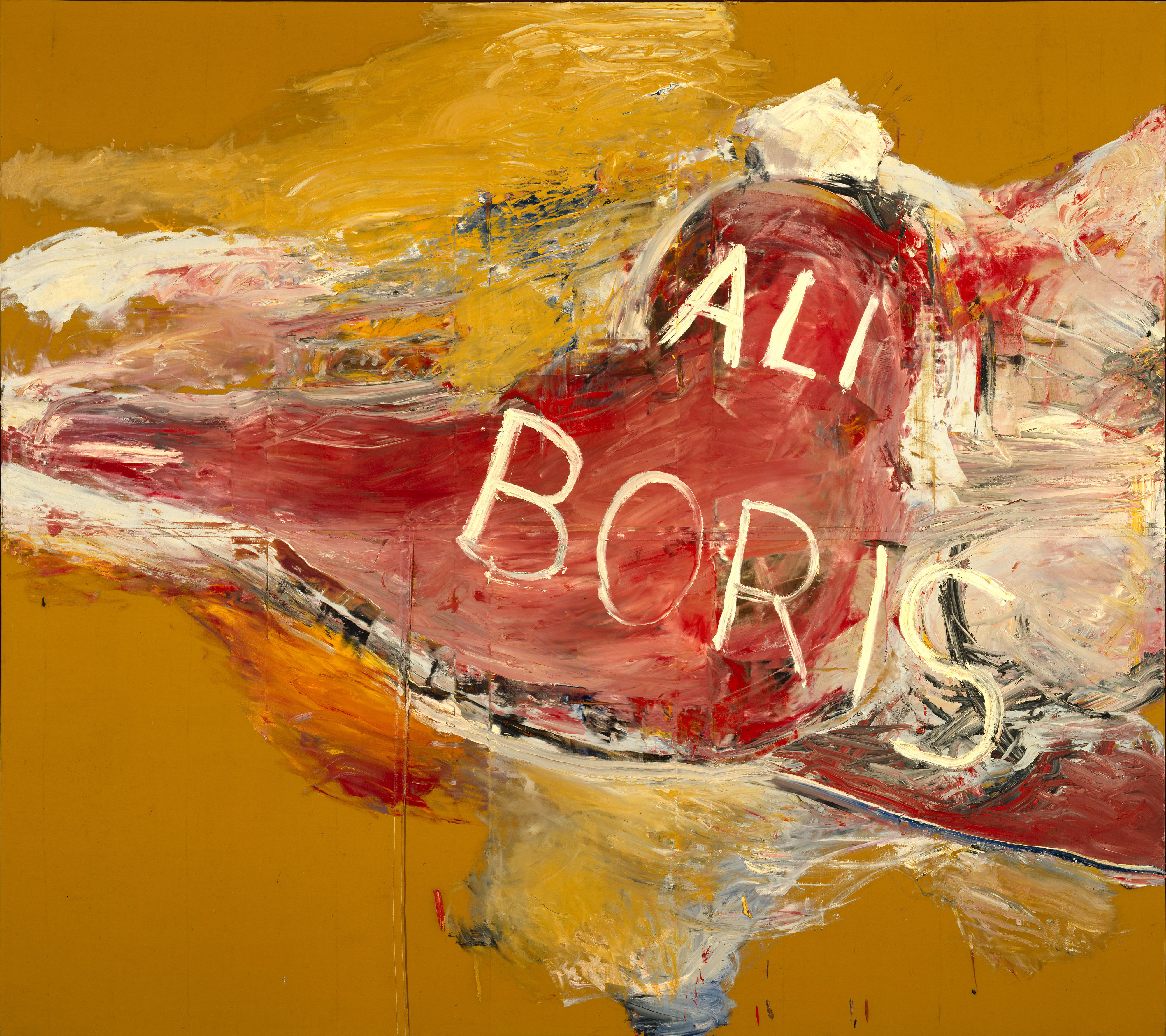


Julian Schnabel
b. 1951, New York, NY
Ali Boris
2000
Oil and wax on tarpaulin
243.8 x 274.3 cm (96 x 108 in.)
Provenance
Acquired directly from the artist.
Description
Julian Schnabel’s works are characterised by strong autobiographical imprints which form themselves in his paintings like pages of a figurative diary. In the present painting, red and white brushstrokes create thick and unrestrained masses of colour which strikingly contrast with the flat pure ochre background. In the middle of the painting appears the inscription ALI BORIS, written in capital letters, which recalls an episode of the painter’s private memory. With his second wife, Schnabel had twins sons, Olmo and Cy (named after the painter Cy Twombly). When he was a toddler, Olmo was struck by a scene from the Disney movie ‘Dumbo’, in which the circus’ train caravan was ready to move to continue its tour and the train whistles ‘All aboard!’. The little child, who was not able to speak properly, just repeated the words’ sounds and exclaimed ‘Ali boris!’.
As Giandomenico Romanelli explains in the introduction to the catalogue of Schnabel's 2011 exhibition at the Museo Correr, Venice, 'The superimposing (of elements like images, writing logos and daubs) and ‘interruptions’, ‘interventions’ in the shape of narrow sickle-shaped lines that expand or lengthen like elastic, plastic materials, are two of the recurrent features in the turbulent precipitation of Schnabel’s figurative and formal universe. While providing some pointers for interpretation, they certainly do not account for all of the sudden swerves, both formal and semantic, through which he develops the constant shifting of his discourse and representation, his plunging and resurfacing, and his explosions of colours.'
(G. Romanelli, Julian Schnabel: Permanently Becoming and the Architecture of Seeing, curated by Norman Rosenthal, exhibition catalogue, Venice, 2011.)
Schnabel, born in New York in 1951, began his artistic career in the late 1970s and was part of a contingent of 1980s artists including Jean-Michel Basquiat and David Salle, who endeavored to restore painting to its pre-abstraction status. In contrast to the pervasive intellectualism of Minimalist and Conceptualist art of the time, they returned to portraying recognizable objects, although sometimes in an abstract manner, in a rough and violently emotional way, often using an highly textural and expressive brushwork and intense colours. As a Neo-Expressionist, Schnabel returned to a sensuousness of painting, filled with excess, heaping materials onto an endless variety of unconventional supports, which became his manifesto. ‘Besides the plates glued to wood or hardboard as a ground of oils, there are: paintings made on velvet; on tarpaulins; on sails; on found wood salvaged from many different places in the world; on evocative and poetic photographs and other images screened onto canvas; on nautical maps and charts; not to mention shop awnings, carpets and other fabriques old and new’.
(N. Rosenthal, ‘Julian Schnabel. The unique sea of incalculable and bottomless history’, in Julian Schnabel. Permanently Becoming and the Architecture of seeing (Venice, Museo Correr, 4 June-27 November 2011), edited by N. Rosenthal, Milan 2011, pp. 16-39.)
As Giandomenico Romanelli explains in the introduction to the catalogue of Schnabel's 2011 exhibition at the Museo Correr, Venice, 'The superimposing (of elements like images, writing logos and daubs) and ‘interruptions’, ‘interventions’ in the shape of narrow sickle-shaped lines that expand or lengthen like elastic, plastic materials, are two of the recurrent features in the turbulent precipitation of Schnabel’s figurative and formal universe. While providing some pointers for interpretation, they certainly do not account for all of the sudden swerves, both formal and semantic, through which he develops the constant shifting of his discourse and representation, his plunging and resurfacing, and his explosions of colours.'
(G. Romanelli, Julian Schnabel: Permanently Becoming and the Architecture of Seeing, curated by Norman Rosenthal, exhibition catalogue, Venice, 2011.)
Schnabel, born in New York in 1951, began his artistic career in the late 1970s and was part of a contingent of 1980s artists including Jean-Michel Basquiat and David Salle, who endeavored to restore painting to its pre-abstraction status. In contrast to the pervasive intellectualism of Minimalist and Conceptualist art of the time, they returned to portraying recognizable objects, although sometimes in an abstract manner, in a rough and violently emotional way, often using an highly textural and expressive brushwork and intense colours. As a Neo-Expressionist, Schnabel returned to a sensuousness of painting, filled with excess, heaping materials onto an endless variety of unconventional supports, which became his manifesto. ‘Besides the plates glued to wood or hardboard as a ground of oils, there are: paintings made on velvet; on tarpaulins; on sails; on found wood salvaged from many different places in the world; on evocative and poetic photographs and other images screened onto canvas; on nautical maps and charts; not to mention shop awnings, carpets and other fabriques old and new’.
(N. Rosenthal, ‘Julian Schnabel. The unique sea of incalculable and bottomless history’, in Julian Schnabel. Permanently Becoming and the Architecture of seeing (Venice, Museo Correr, 4 June-27 November 2011), edited by N. Rosenthal, Milan 2011, pp. 16-39.)