

Angelica Kauffmann
b. 1741, Chur
d. 1807, Rome
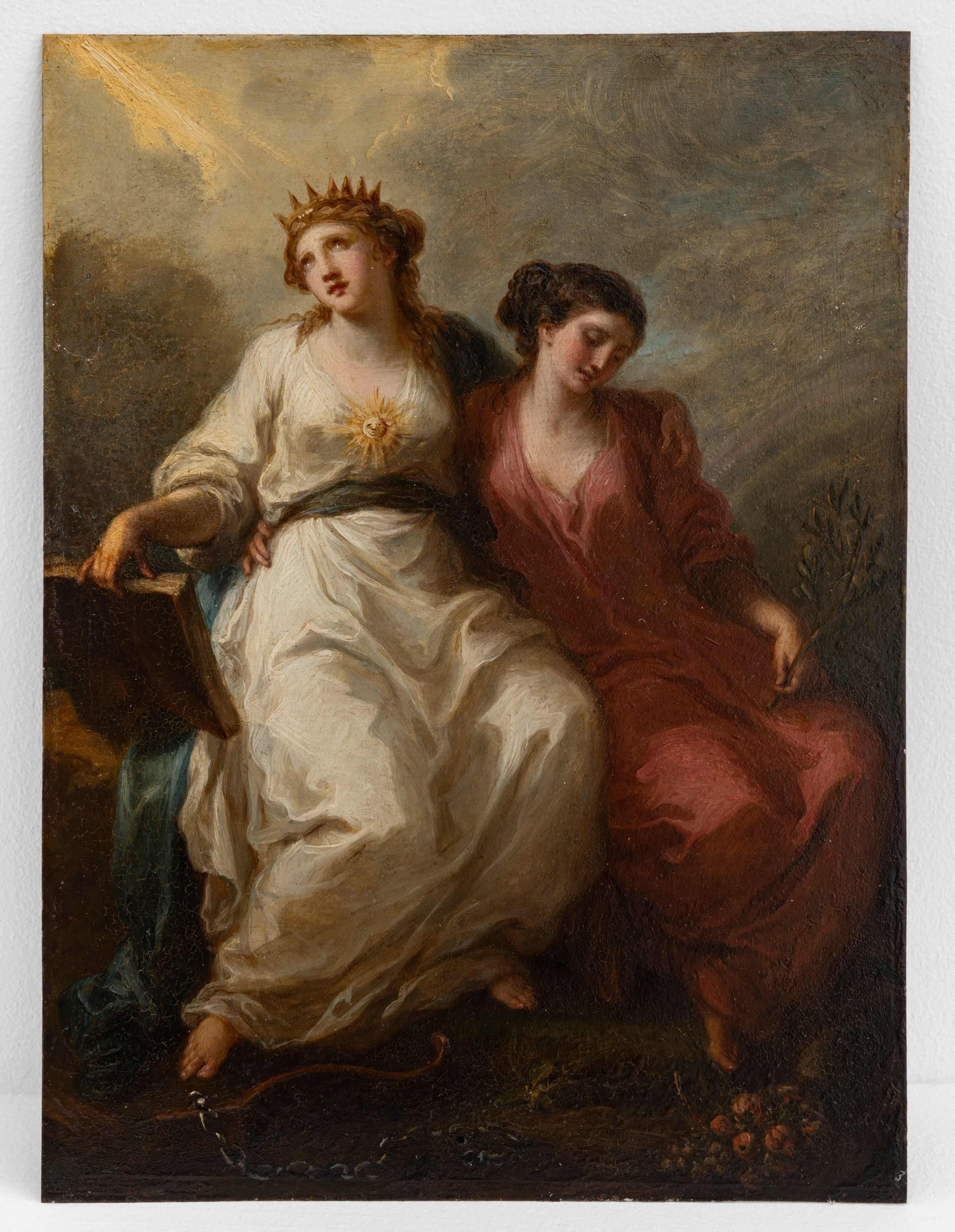
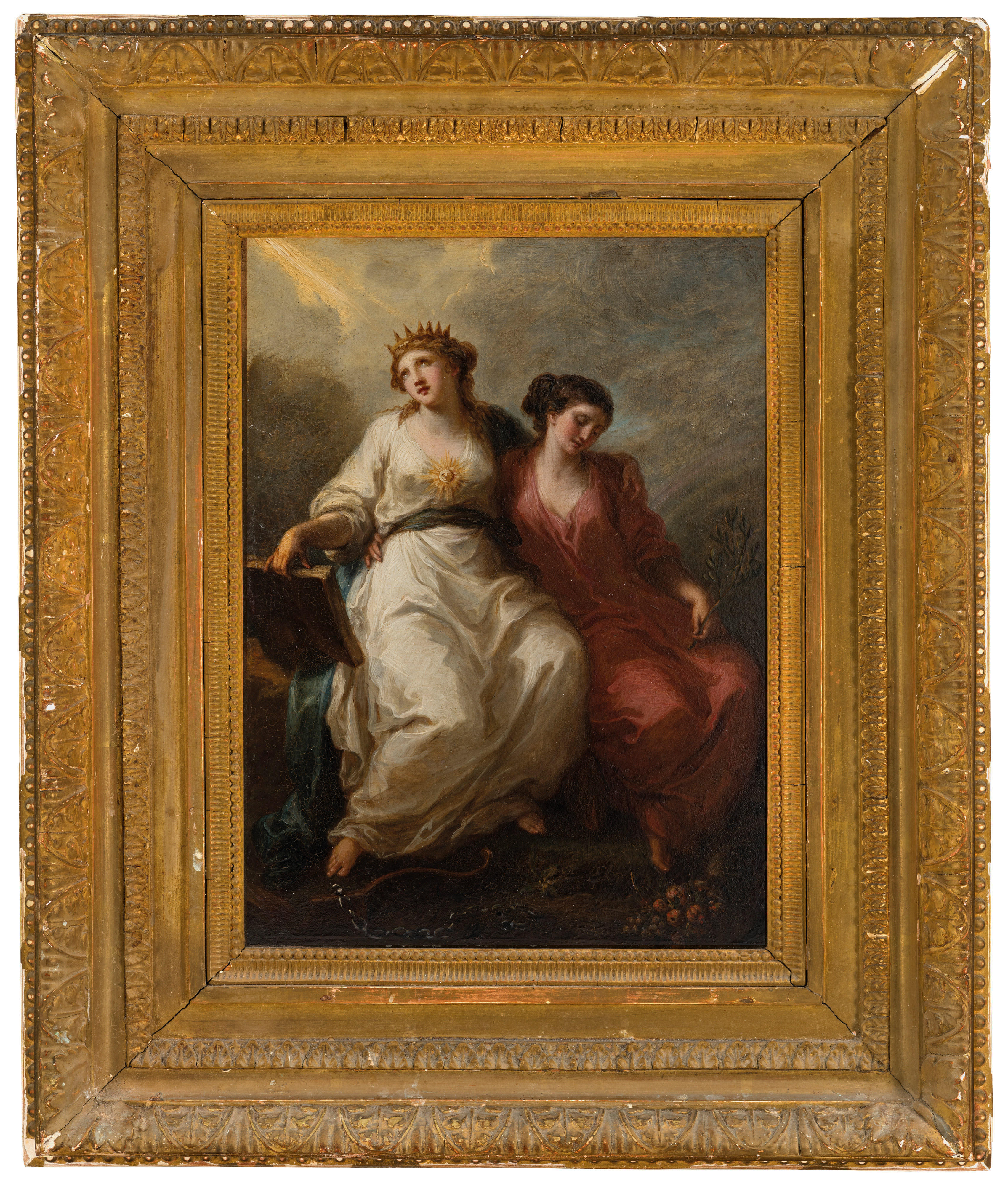
Allegories of Mercy and Truth
before 1780
Oil on metal panel
29.2 x 21.5 cm. (11 1/2 x 8 1/2 in.)
Provenance
The Honourable Robert William Morgan-Granville (1892–1988), United Kingdom;
By descent to his son Robert Plantagenet Morgan-Grenville (1916–1993), Kenya;
By descent to a private collection, Kenya.
Literature
This work will be included in the forthcoming catalogue raisonné of the artist by Dr. Bettina Baumgärtel.
Description
Previously only known through their engravings, the Allegory of Prudence and Allegories of Mercy and Truth are significant rediscoveries for the œuvre of Angelica Kauffmann. With their fluid compositions and the delicate execution, such works were coveted in eighteenth-century aristocratic circles, whose sophisticated tastes appreciated her distinctively original combination of the cult of sensibility with emergent neoclassical styles.
Born in Switzerland and trained in Italy, Kauffmann moved to London in 1766, where she soon became one of the most important and influential artists of her time, and one of only two founding female members of the Royal Academy. Unusually for a female artist in the eighteenth century, Kauffmann, who also enjoyed great success as a portrait painter, primarily defined herself as a history painter. At the time, history painting was considered the most distinguished category of academic painting and, under the leadership of Joshua Reynolds, a close friend of Kauffmann’s, the Royal Academy sought to promote it with an audience that more broadly favoured portraits and landscapes. The British apathy towards history painting ultimately motivated Kauffmann’s decision to leave England following her marriage to the artist Antonio Zucchi in 1781; she returned to Italy where this genre was more sought after.
History painting, the depiction of themes drawn from history, mythology, and literature, required extensive study of writing, knowledge of art theory, and specialised technical training including the study of anatomy from the male nude. The last of these was forbidden to women at the time, yet Kauffmann managed to break through this gender-defined barrier. It is presumed that she replaced the study of the male nude with the study of ancient sculptures, but this lacuna in her training perhaps accounts for why the male figures in her works are often considered more feminine than those of her peers at the Royal Academy.
As noted above, both of these charming small works, painted on zinc and housed in their original frames, were long known only through a series of engravings after Kauffmann by Charles Taylor entitled The Moral Emblems, published in London in 1780. The series comprised six individual subjects likely conceived as a group, which also included Wisdom, Hope, Instruction, and Life (Wisdom was sold at Sotheby’s, New York, 26 January 2012, lot 202; the whereabouts of the other works in the group remain unknown).
The personification of Truth holds a book in hand and wears a robe embellished at the waist with the sun. She raises her gaze to the sky and embraces the personification of Mercy with her left arm. Mercy holds an olive branch in her hand, and glances demurely at the fruit by her feet. The subject of this allegorical composition is drawn from the Book of Psalms: “Mercy and truth are met together; righteousness and peace have kissed each other” (Psalms 85:10).
Meanwhile, in the accompanying panel, the personification of Prudence, clad in red robes, holds a placid dove in one hand and a writhing snake in the other. The inclusion of the snake in this allegorical subject can be traced to antiquity, was revived during the Renaissance, from the painting by Piero del Pollaiolo commissioned in 1469 for the courtroom of the Tribunale di Mercanzia in the Piazza della Signoria, Florence, to the engraving included in Cesare Ripa’s famous Iconologia by Cesare Ripa (1603), which remained one of the most important iconographic sources for European artists through the eighteenth century. However, in most representations of the subject, Prudence holds a mirror instead of a dove. This variation is closer to the biblical verse which inspired the subject: “Behold, I send you forth as sheep in the midst of wolves. Therefore be wise as serpents and harmless as doves" (Matthew 10:16). This passage is paraphrased at the bottom of Taylor’s engraving after Kauffmann’s painting, reading “Be prudent and benevolent”.