
Michelangelo Cerquozzi, called Michelangelo delle Battaglie
b. 1602, Rome
d. 1660, Rome
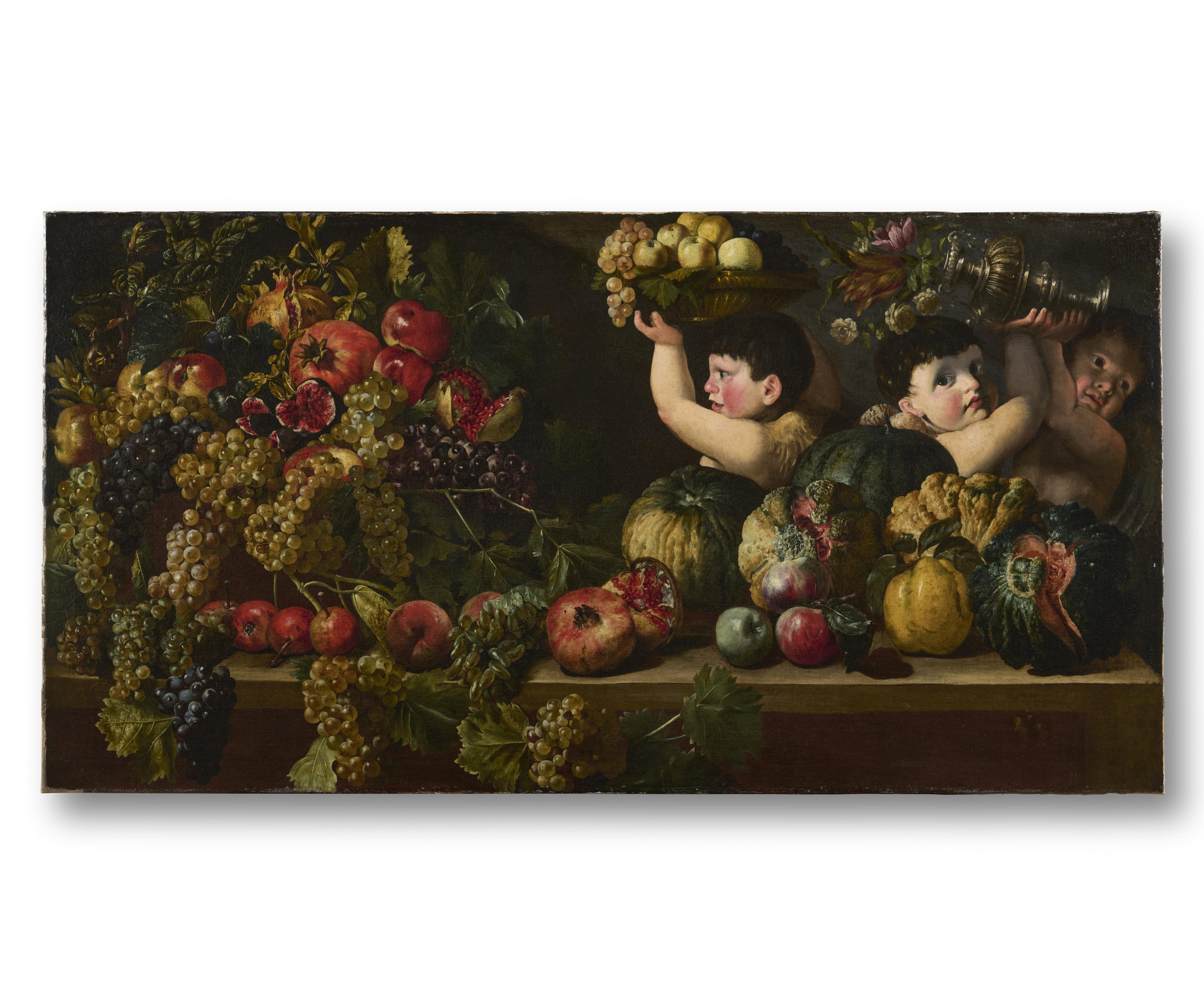
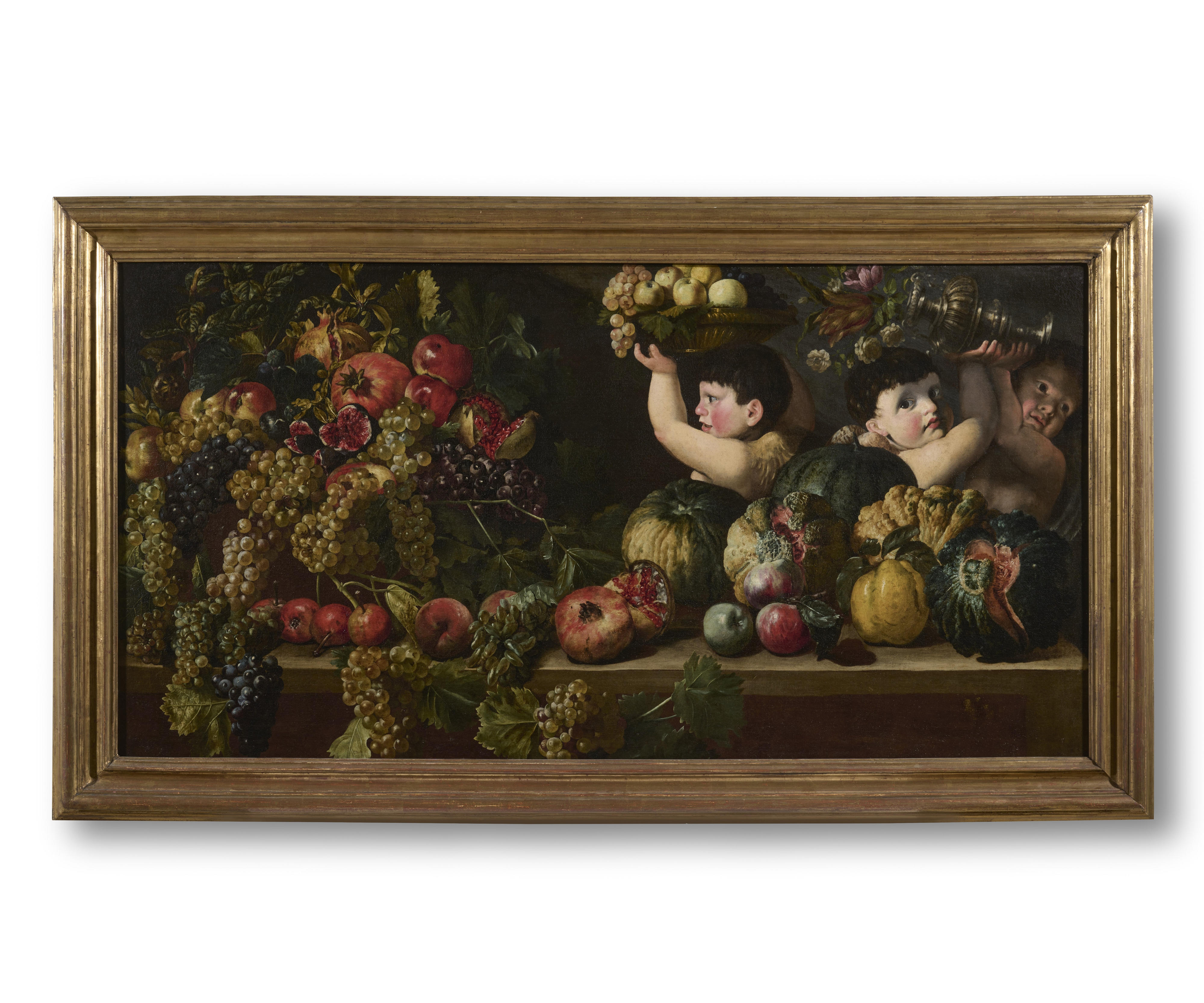
Allegory of Autumn
early to mid-17th century
Oil on canvas
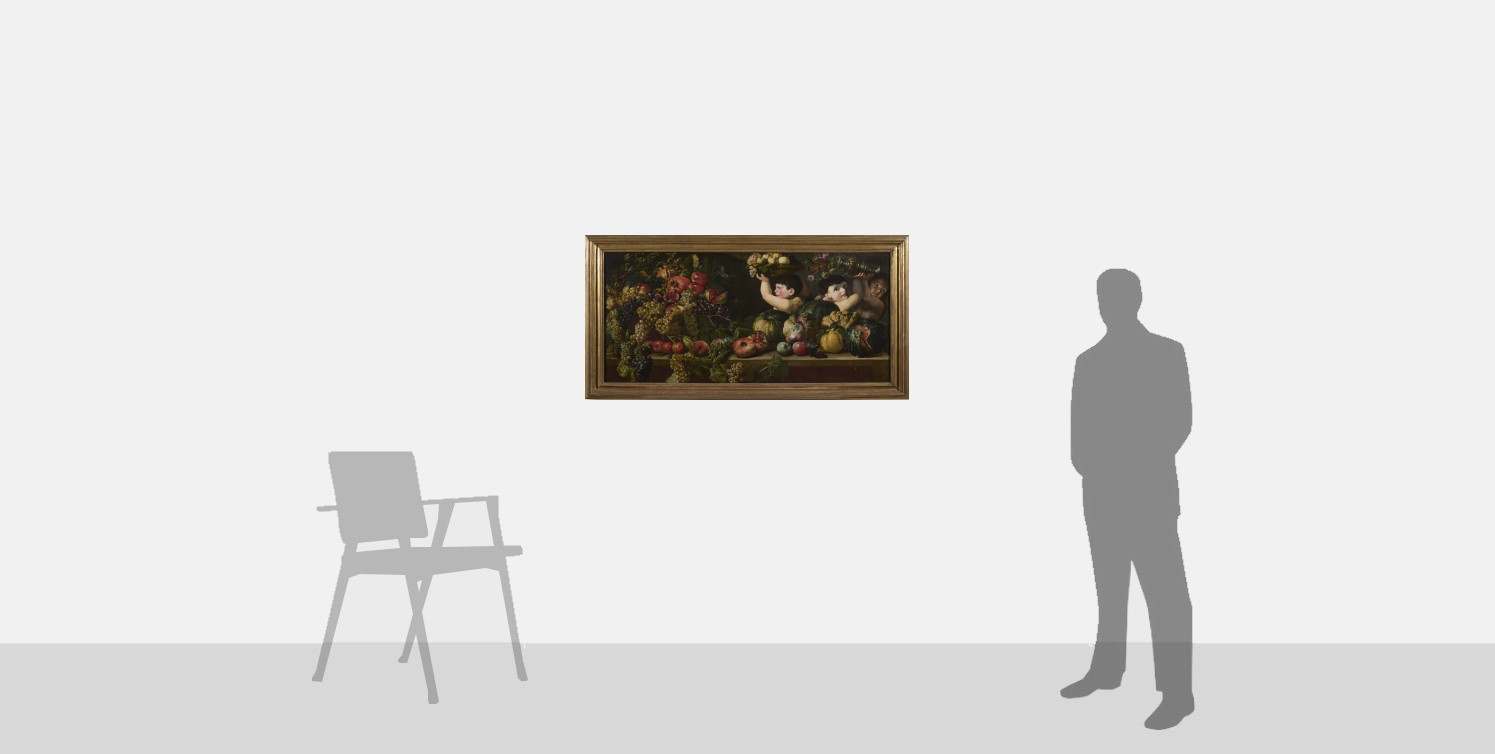
73.5 x 144 cm (29 x 56 3/4 in.)
With frame: 91.5 x 161 cm (36 x 63 1/5 in.)
Provenance
Private collection, Liechtenstein.
Description
This
imposing and sumptuous still life of a wooden table laden with fruit was
painted in Rome in the seventeenth century. On the left, black and white grapes,
figs, pomegranates, and apples spill forth from a large bowl, while on the
right, apples, pomegranates, a large citrus fruit, pumpkins, and melons, some
split open to show their colourful interiors, crowd every inch of the table. In
the background to the right are three putti; one carrying a basket of apples
and grapes on his shoulders, while the other two hold aloft a silver vase filled
with flowers.
The horizontal format of the canvas suggests that the painting was originally
part of the furnishings of a grand palazzo, perhaps serving as a sopraporta, or overdoor picture. It is likely
that it formed part of a series representing the four seasons, as representations
of putti bearing baskets or frolicking amidst flowers and fruits were generally
interpreted as allegories of that subject in the seventeenth century. According
to the Iconologia of Cesare Ripa, the
most important iconographical repertoire of the early modern period in Italy
and across Europe, representations of the four seasons could depict:
“…four beautiful lads, one older than the other. The first one [thus the representation
of Spring], bears on his shoulders a basket full of flowers. The second [the
representation of Summer], holds sickle in his right hand. The third [the
representation of Autumn], carries a basket filled with fruits in his left
hand, while in his right he has a dead animal. These boys are naked. The fourth
[the representation of Winter] is clothed and has his head covered. He carries
a cane on his shoulders from which a dead bird hangs; with his left hand he
carries another dead bird different from the other one.”[1]
The scene described by Ripa derives from a medal coined during the reign of the
emperor Caracalla, and although the subject was adapted over the course of the
following centuries, it remained nonetheless recognisable and was particularly
popular in the context of palatial interior decoration.
Allegorical representations of the seasons personified by putti with flowers
and fruits appear in a number of inventories of Roman collections of the
seventeenth century. One example can be found in a list of the works belonging
to Alessandro Vittrice, Bishop of Alatri, compiled in 1650, which recorded an
anonymous painting “di tre putti chiamati primavera con diversi fiori, e frutti
con cornice nera filettata d’oro” (“three putti called spring with various
flowers and fruits with a black and gold frame.”)[2]
Alessandro Vittrice was the heir of Gerolamo Vittrice, a significant figure
patron and collector in Rome in the early 1600s, who himself owned an extremely
rare still life attributed to Caravaggio: “un altro quadro mezzano di fiori e
frutti corniciata bianca mano del Caravaggio (“Another half-painting of flowers
and fruits in a white frame, made by Caravaggio.”)[3]
Such was the cultural ambient of Caravaggesque Rome in which the present still life
was created. In the Vittrice’s painting, three putti with flowers and fruits
represent Spring, whereas in the present work, Autumn is portrayed, identifiable
given the fruits represented—grapes, figs, pumpkin, apples, and so on—are grown
in that season. The putti themselves represent the months of the season:
September and November hold the vase of flowers inaugurating the season, while
December carries away the basket of mature fruit, marking its close.
From a stylistic point of view, the superb quality with which the fruits on the
table are represented, the bold chiaroscuro, the ray of light penetrating the
background of the painting, and the firm flesh of the putti are all indications
that the present work is a masterpiece by a Caravaggesque still life painter.
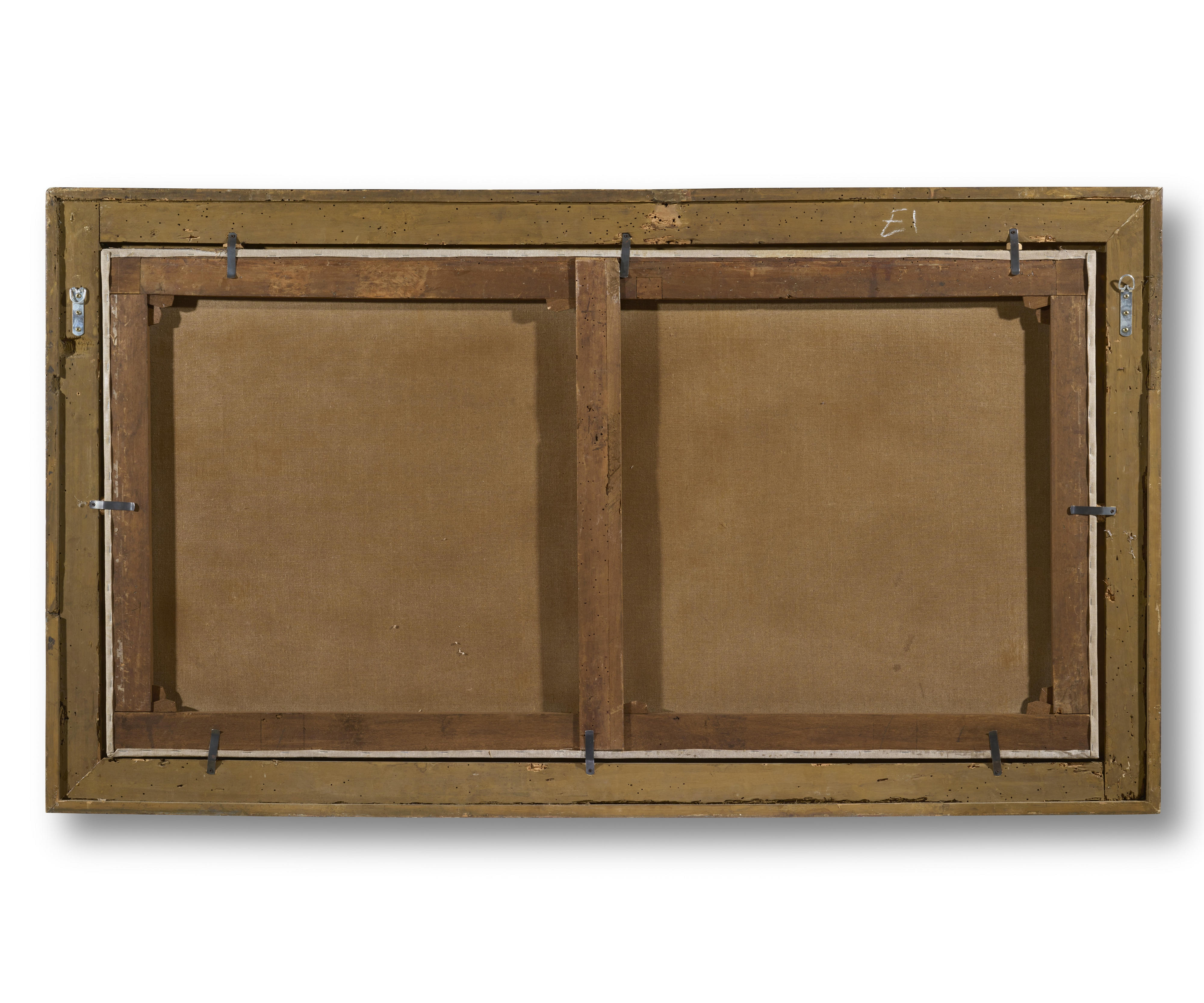
An early inscription on the back of the work, “G.B.V. / DI MICHELANGELO DELLE
BATTAGLIE / O DI CAMPIDOGLIO”, is suggestive of the work’s authorship. While
“di Campidoglio” could refer to the painter Michele Pace, who kept his studio
in that neighborhood. Maria Cristina Terzaghi has argued convincingly that the
painting should be more correctly attributed to Michelangelo Cerquozzi, often
referred to in contemporary documents as Michelangelo delle Battiglie.[4]
Cerquozzi was a leading member of the Bamboccianti, a group of mainly foreign
artists active in Rome who worked in the manner of Pieter van Laer, called il
Bamboccio, producing small genre pictures related to contemporary Italian
street-life. Cerquozzi’s most accomplished works blend the naturalism of the Bamboccianti
with narrative and anecdotal elements. In addition to his genre subjects, and
sometimes in combination with them, Cerquozzi produced high quality and
similarly naturalistic still life compositions. The artist biographer Giovanni Battista Passeri wrote in the
seventeenth century of Cerquozzi’s connections to Pietro Paolo Bonzi, one of
the pioneers of Roman still lifes, but his importance in the field was not
sufficiently appreciated until Giuliano Briganti’s groundbreaking article of 1954. In
the light of more recent research, Cerquozzi has emerged as a pivotal
personality in the development of Roman still life painting.
Cerquozzi painted still life compositions throughout his career. His early works
imitated the work of Pietro Paolo Bonzi, a still life specialist, and his early
works in the genre were moreover clearly indebted to Caravaggio’s famous Basket
of Fruit on a Stone Ledge (now in the Pinacoteca Ambrosiana, Milan). Even
early on, he began to compose large still life paintings including life-size
figures. For example, in both Youths Picking Fruit (1640–45, Museo del
Prado, Madrid) and the Harvest of Pomegranates (after 1640, Museum
Boijmans Van Beuningen, Rotterdam), figures and fruit alike evoke the memory of
certain early works of Caravaggio, though the sumptuousness of the pumpkins,
the open pomegranate, and the presence of a landscape visible in the background
point to a more advanced phase in the evolution of the genre towards a fully
Baroque idiom. Indeed, the Baroque freedom of vision and plein air setting of
these compositions help us to understand Cerquozzi as a mediating figure
between Caravaggio and the full-blown Baroque in the genre of still life
painting.
Terzaghi has noted that the letters “G.B.V” inscribed on the reverse of the canvas
might refer to a patron or later owner; so too might the inscription “Cardinale
Giuseppe”, in whose collection the work was registered with the number 136,
indicated by the two labels affixed to the back of canvas. Although these clues
are not sufficient to solve the mystery of the painting’s commissioning and
provenance, the inscriptions nonetheless indicate the Roman context in which
the work was created and first received.
[1] Ripa 1593, p. 476.
[2] Luigi Spezzaferro, Archivio del collezionismo romano, Pisa, 2009, p. 538, no. 23.
[3] Spezzaferro 2009, p. 540, no. 122.
[4] See attached essay, in which Terzaghi uses the present work as critical evidence in reattributing the entire late oeuvre of the Master of the Acquavella Still Life to the young Cerquozzi.