
Rutilio Manetti
b. 1571, Siena
d. 1639, Siena
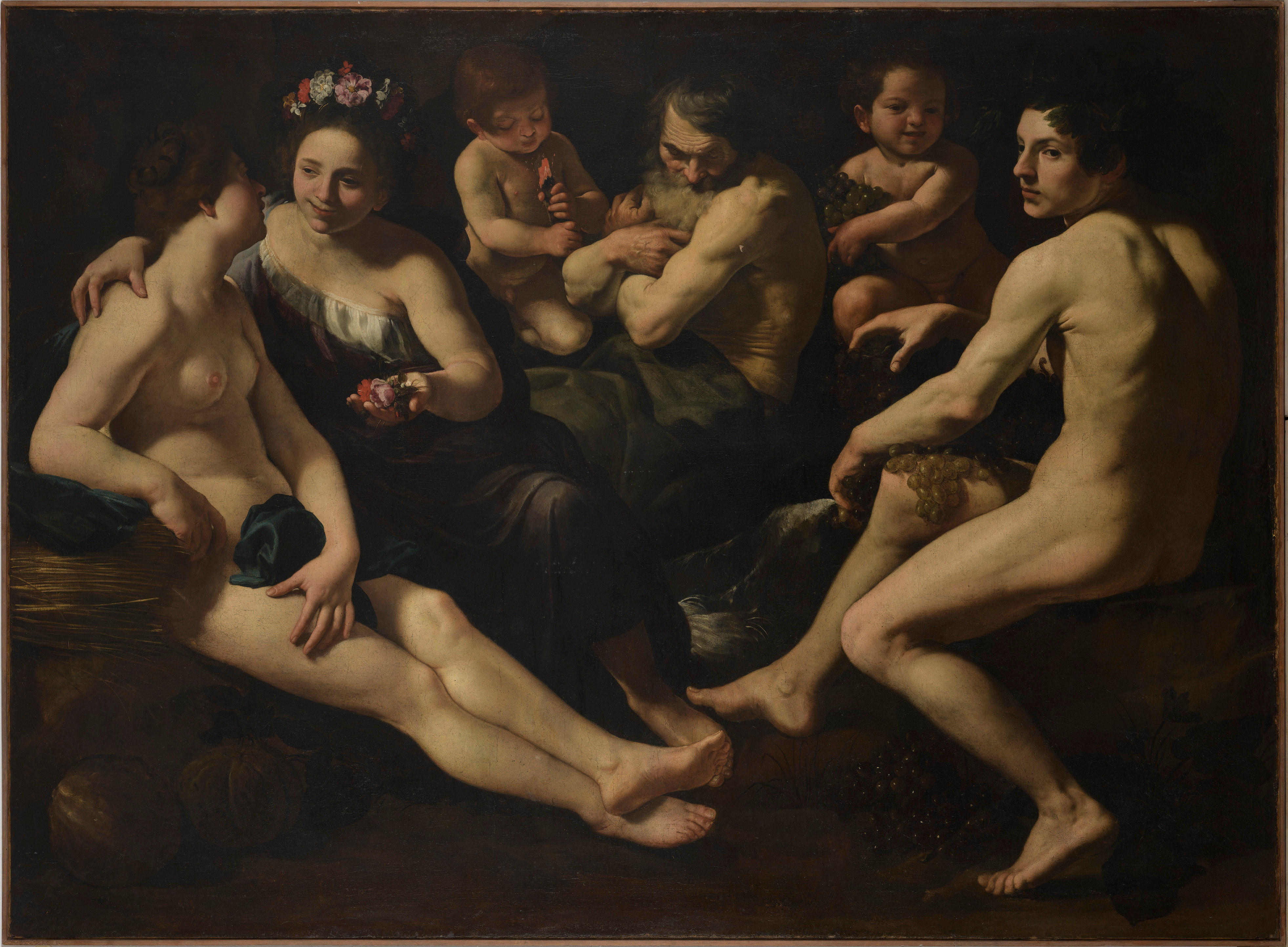
Allegory of the Four Seasons
c. 1620
Oil on canvas
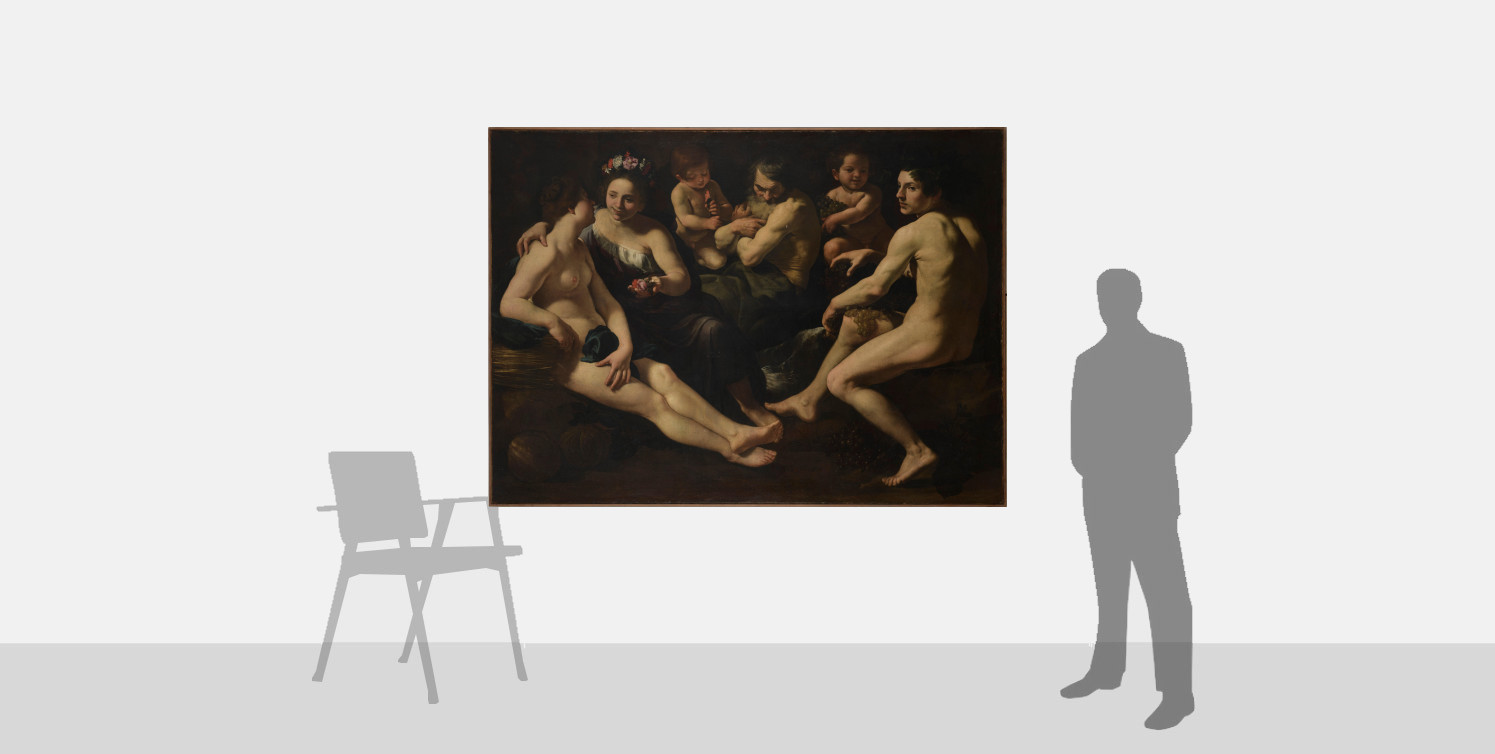
169 x 231 cm (66 1/2 x 91 in.)
Provenance
Art market, Genoa, before 1927,
with Galleria Il Fiorino, Florence, 1967,
Finarte, Milan, 6 May 1971, lot 26,
Private collection.
Literature
R. Longhi, ‘Ter Brugghen e la parte nostra’, Vita Artistica, 1927, pp. 105-116 (reproduced in R. Longhi, Saggi e ricerche, 1925–1928, Florence, 1967, pp. 163–178).
R. Longhi, ‘Ultimi studi sul Caravaggio e la sua cerchia’, in Proporzioni: Studi di Storia dell'arte, I, Florence, 1943, pp. 5–63.
U. Galletti and E. Camesasca, s.v. ‘Manetti, Rutilio’ in Enciclopedia della Pittura Italiana, Milan, 1950, p. 1533.
C. Del Bravo, ‘Su Rutilio Manetti’, Pantheon, 1966, pp. 43–51.
E. Borea, Caravaggio e caravaggeschi nelle gallerie di Firenze, Florence, 1970, p. 59.
T. Trini, ‘Recensioni e informazioni’, Arte Illustrata, 1971, p. 61.
Catalogo Bolaffi della pittura italiana del ‘600 e del ’700, Turin, 1974, p. 123.
S. Prosperi Valenti, s.v. ‘Manetti, Rutilio’ in Dizionario Enciclopedico Bolaffi dei pittori e degli incisori italiani, Turin, 1975, p. 140.
A. Bagnoli, Rutilio Manetti, exhibition catalogue, Florence, 1978, pp. 15-16, 99.
C. McCorqdale, ‘Current and forthcoming exhibitions: The Manetti Exhibitions in Siena’, The Burlington Magazine, 1978, pp. 885-889.
B. Nicolson, The International Caravaggesque movement, Oxford, 1979, p. 141.
A. Bagnoli in L’arte a Siena sotto i Medici, exhibition catalogue, Rome, 1980, p. 176.
A. Bagnoli, ‘La Pittura del Seicento a Siena’ in La Pittura in Italia. Il Seicento, Milan, 1989, p. 339.
B. Nicolson, Caravaggism in Europe, 2nd edition, Turin, 1990, p. 141.
M. Maccherini, ‘Novità sulle Considerazioni di Giulio Mancini’, in C. Volpi (ed.), Caravaggio nel IV centenario della Cappella Contarelli, Città di Castello, 2002, pp. 123–128.
A. Bagnoli, ‘Rutilio Manetti e Crescenzio Gambarelli: due pittori per le “Storie di San Rocco”’, in Il Cappellone di San Rocco. I dipinti murali di Rutilio Manetti e Crescenzio Gamberelli in Vallerozzi, Siena, 2007, pp. 5-27.
L. Bortolotti, s.v. ‘Manetti, Rutilio’ in Dizionario Biografico degli Italiani, LXVIII, Rome, 2007, pp. 621-625.
M. Ciampolini, Pittori Senesi del Seicento, Siena, 2010, pp. 246, 261.
Description
Per fornire un esempio dello stile “misto” che il Manetti usava pur con pretese di caravaggismo, si pubblica qui una pittura bellissima con le “Età della Vita”, ascritta, quand’era sul commercio antiquario di Genova, al Velásquez, per una delle solite iperboli tante care a quell’ineducabile ceto.
R. Longhi, Ter Brugghen e la parte nostra, in 'Vita Artistica', 1927
To provide an example of the 'mixed' style that Manetti used, albeit with pretensions to Caravaggism, we publish here a beautiful painting of the 'Ages of Life', ascribed, when it was in the antiquarian trade in Genoa, to Velásquez, with the usual hyperbole so dear to that ineducable class.—R. Longhi, 'Ter Brugghen e la parte nostra' in Vita Artistica, 1927
Almost a century ago, with this elegant turn of phrase—and taking a jab at the art world’s mercantile class—a still very young Roberto Longhi defined the salient features of Rutilio Manetti’s artistic personality. His analysis of this 'beautiful painting' continued in the following lines: 'in Manetti’s painting there is an assembly that, though of quite real flesh, nevertheless intends, with snobbishness, to arrange itself in a "Raphaelesque" semicircle'. Thus did Longhi evoke Manetti’s debt to paintings of the previous century on the one hand, while at the same time noting the influence of Vanni, his first master, as well as discerning a sprinkling of Caravaggesque naturalism. Beginning with Longhi, the present painting has been consistently cited as one of the pinnacles of Manetti’s career. It was included in the major monographic exhibition that the painter’s hometown dedicated to him in the summer and autumn of 1978, the last occasion on which the work was exhibited in public.
Born in 1571 (or 1570) Rutilio Manetti was almost the same age as Ventura Salimbeni, born in 1569, and slightly younger than Francesco Vanni, who came of age in 1564, and in whose workshop, as Giulio Mancini reported in the early 1600s, Manetti completed his apprenticeship. All of the artist’s youthful production is marked by a refined elegance derived from models supplied by Vanni, though already in the cycle dedicated to Saint Roch, painted between 1605 and 1610 for the company of the same name, Manetti displays a lively approach to narrative and an attentive naturalism that set him apart from his Sienese contemporaries.
Works Manetti produced in the early 1610s reveal his contact with some of the most celebrated artists of those important years, foremost among them Annibale Carracci, but also Cavaliere d’Arpino, so much so that it seems likely to posit a Roman sojourn for Manetti. To this period belongs such fine works as the Three Graces and the Andromeda now in the Galleria Borghese and the Rest on the Flight into Egypt now in the museum in Kassel.
The second half of the 1610s and the early 1620s witnessed decisive changes in the features of his production: now mature (Manetti was approaching his fifties) the artist reached his definitive stylistic idiom. Reinforcing his darks, the chiaroscuro contrasts in his works became increasingly pronounced, though, as Longhi noted, his figures never lost the elegance of late Mannerism. Scholars have viewed this stylistic shift in varied ways. For Longhi, it indicated a sort of updating, a kind of catching-up to younger painters like Riminaldi and Rustici. Alessandro Bagnoli, on the other hand, in an essay accompanying the aforementioned 1978 exhibition, instead related these developments in Manetti’s style to the youthful production of Guercino and to works that Gerard van Honthorst was sending from Rome to the Grand Duke of Tuscany in Manetti’s native Siena. All subsequent criticism has adhered to Bagnoli’s premise, scholarship which has culminated in Marco Ciampolini’s impressive repertory of Sienese painters of the seventeenth century.
In any case, in those years from about 1618 to 1628, Manetti was at the height of his career. To this period belongs the lion’s share of his masterpieces in both sacred and profane subject matter, ranging from the Magdalene in the Palazzo Pitti to the Rest on the Flight into Egypt in San Pietro alle Scale in Siena (1621), from the painting that is the subject of the present essay to Ruggiero and Alcina in the Palazzo Pitti, from Pope Alexander I freed from prison by an angel painted for Sant’Ansano in Greti (1625) to the Ecstasy of Saint Jerome in the Monte dei Paschi collection in Siena (1628).
Returning to the present painting, an important discovery was made by Michele Maccherini. During the conference held in Rome in 2001 to celebrate the fourth centenary of Caravaggio's paintings in the Contarelli Chapel, proceedings from which were published in the following year), Maccherini noted the existence of a letter from Giulio Mancini dated 2 January 1621 (Siena, Archivio della Società di Esecuzioni di Pie Disposizioni, Eredità Mancini, Carteggio 169, c. 893v) in which the arrival of the painting in Rome is mentioned. The document was more extensively discussed in Maccherini’s 2017 lecture at the conference in Pienza dedicated to Francesco Rustici, and will be published in the forthcoming volume of proceedings entitled Giulio Mancini e i pittori senesi a Roma (we would like to thank Professor Maccherini for generously sharing his contribution with us).
According to Mancini’s letter: 'There has appeared here a block of figures from nature of the four seasons, hand of Rutilio, which indeed is beheld here a very beautiful thing and I like it and Master Astolfo also. And if you, at a convenient price, could have such a thing, I would have it very dearly, nor would I think that, after having enjoyed it a few years, anything would be surpassed by it, rather that a few dozen scudi would be gained by it.' ('È comparso qua un quadrone di figure del naturale delle quattro stagioni, mano di Rutilio, che invero è tenuto qua cosa molto bella e a me piace e a Maestro Astolfo anchora. E se voi, a prezzo conveniente, potesse haver una cosa simile, l'haverei molto cara, né penzarei che, doppo haverla goduta qualche anno, ci si scapitasse niente, anzi che ci si guadagnierebbe qualche decina di scudi.')
Thus did the Sienese Mancini—a passionate collector, erudite writer on art and history, most famously the Considerazioni sulla Pittura, 1617–21, as well as a celebrated medical professional chosen by Pope Urban VIII Barberini as his personal physician—announce to his brother Deifebo the arrival of the painting in Rome. Another letter, penned a few weeks later (16 January 1621, also part of the correspondence preserved in Siena, p. 897 verso), also reveals the name of the person who commissioned the painting. Surprisingly, it was neither an aristocrat nor a clergyman, but a tapestry embroiderer called Andrea: 'Of Rutilio not everything succeeded, but only this, not for Cardinal Orsino, but for one Andrea raccamatore and a Cupid in the Borghese Gallery; for a Saint Mary Magdalene for Cavaliere Saracini I do not like.' ('Di Rutilio non ogni cosa è riuscito, ma sol questa, che non per il Cardinale Orsino, ma per Andrea raccamatore e un Cupido ch'è nella Galleria di Borghese; ché una Santa Maria Magdalena per il Cavaliere Saracini a me non piace.')
In fact, Andrea the embroiderer seems to have been a figure of some significance, so much so that his name did not escape scholarly study in the nineteenth century (see A. Bertolotti, Artisti subalpini in Roma nei secoli XV, XVI e XVII ricerche e studi negli archivi romani, Mantua, 1884, p. 173 and A. Bertolotti, Artisti francesi in Roma nei secoli XV, XVI e XVII ricerche e studi negli archivi romani, Mantua, 1886, p. 205). Mancini’s letters reveal other interesting points as well. On the one hand, the Sienese scholar makes distinctions between Manetti’s different works and holds the Allegory of the Seasons in particular esteem; on the other hand, Mancini seems almost surprised that such an impressive and important work was not intended for a prominent personality of the Roman curia but for a mere craftsman. This in turn also places the painting at the centre of a kind of intrigue that took place at the papal court: as Maccherini has related, Mancini spent his word to obtain the Knight’s Cross for Manetti through the recommendation first of Cardinal Scaglia and then of Cardinal Maurizio di Savoia.
Often selected throughout the Renaissance as a subject for frescoes and other decorative cycles, the Allegory of the Seasons was decidedly less popular as a subject for early seventeenth-century naturalistic paintings. Within the Caravaggesque sphere the only other example is perhaps Bartolomeo Manfredi’s painting preserved at the Dayton Art Institute in Dayton, Ohio; a comparison of the two paintings shows how the Mantuan painter opted for a tighter composition and a starker realism whereas Manetti achieved a more harmonious composition with softer transitions between shadow and light.
In depicting the Seasons, Manetti, as indeed did Manfredi, followed Ripa’s prescriptions only in part. Spring, the second figure on the left of a young woman wearing a flower crown, proffers, as Ripa indicates, a handful of flowers to Summer, shown here as a naked young woman seated with sheaves of wheat and melons beside her. This figure differs most from Ripa, who describes Summer as 'A Young Woman of ample form crowned with sprigs of wheat. Dressed in yellow, she holds a lighted torch in her right hand.'
At the right side of the painting Autumn is depicted as a young man crowned with vines and holding bunches of grapes in his hand; towards him turns a putto also carrying bunches of grapes. Here, too, the Sienese painter chose not to follow Ripa’s prescriptions for Autumn: 'A woman of manly age, fat, & richly dressed, has on her head a garland of grapes with its leaves, with her right hand holds a Cornucopia of different fruits.' At the centre of the canvas a shivering old man represents Winter; beside him a putto with a burning log tries to warm him, according to a well-known iconography though different from the one suggested by Ripa.