
Antonio Canal, called Canaletto
b. 1697, Venice
d. 1768, Venice
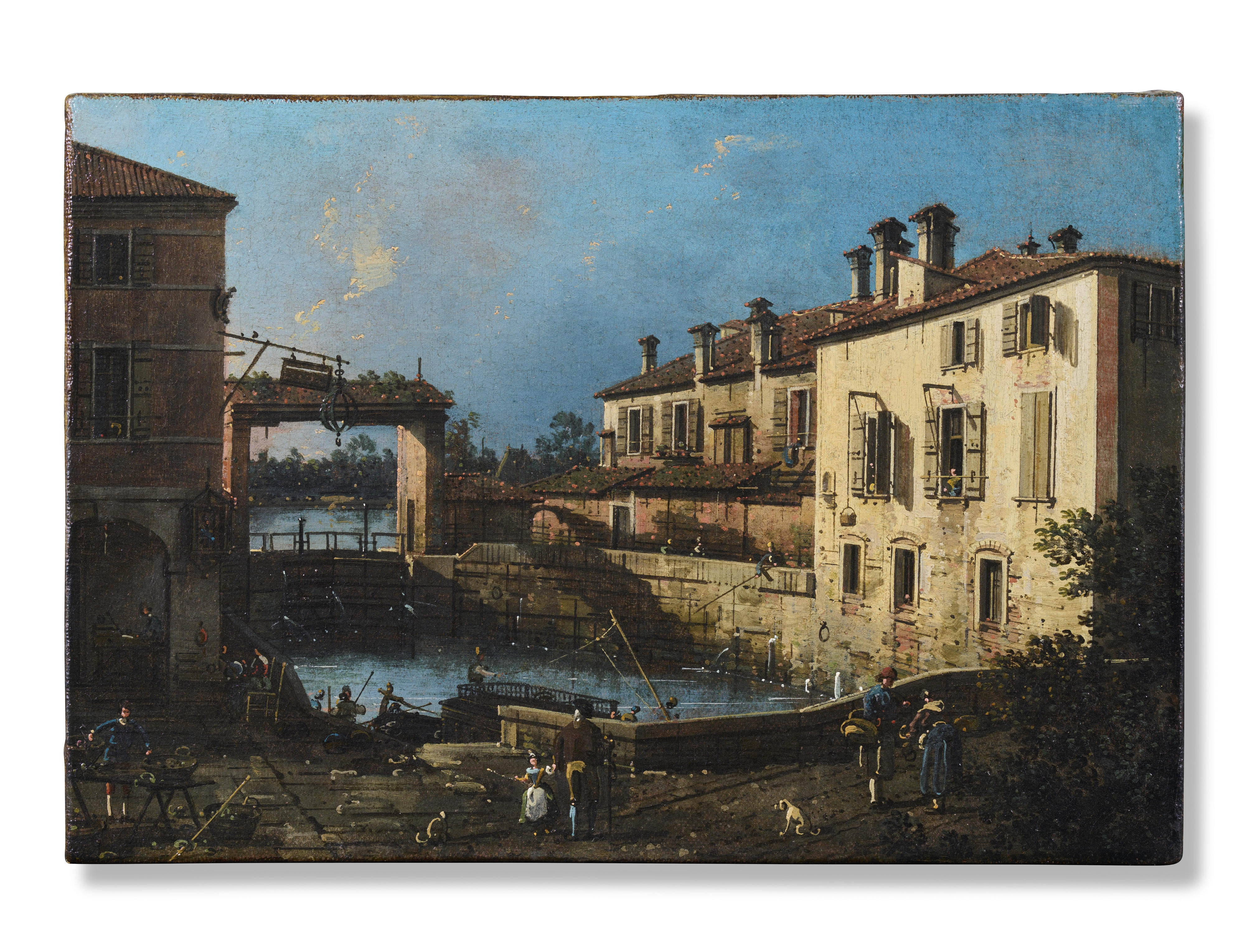
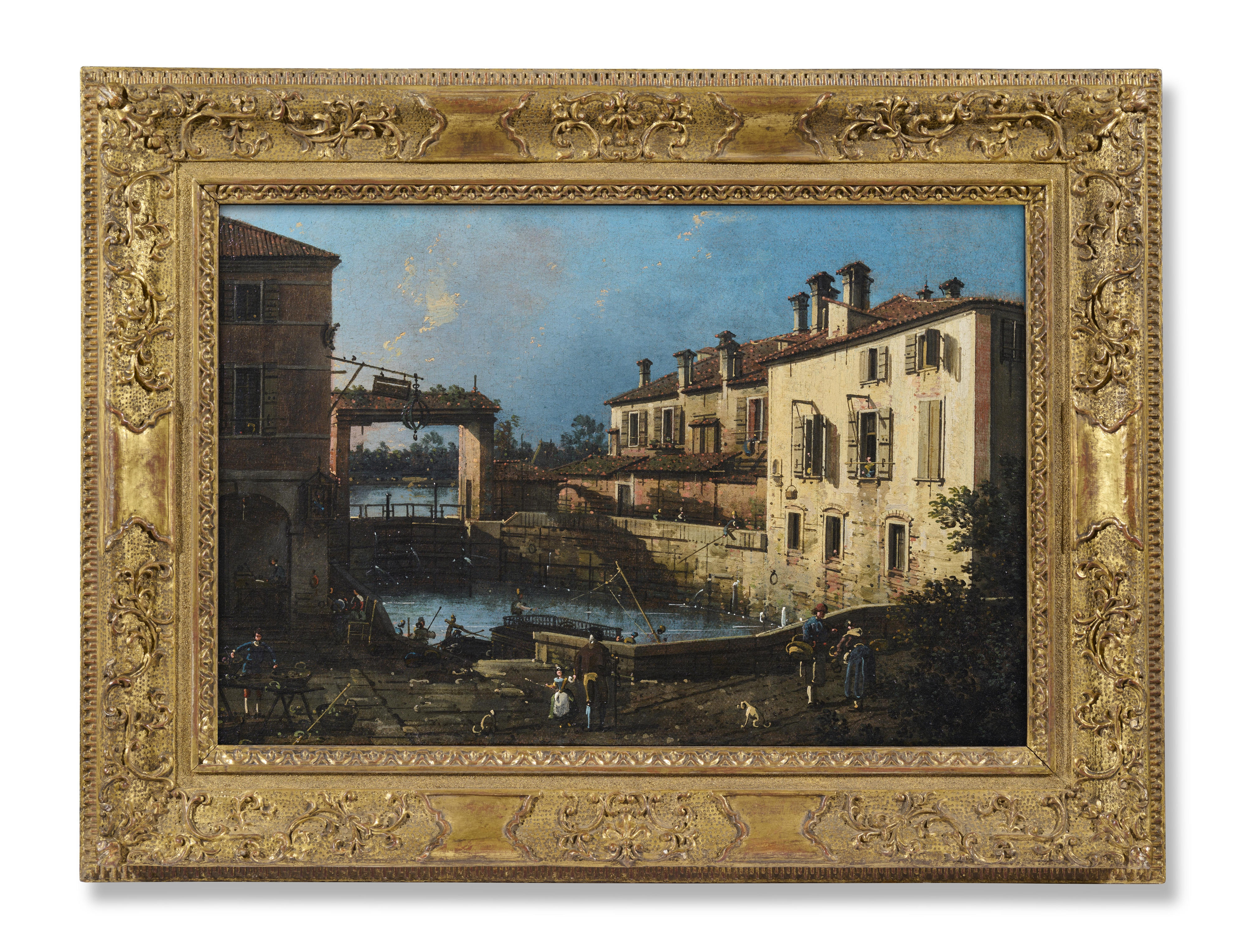
The Lock at Dolo
c. 1755
Oil on canvas
31 x 45 cm (12 1/4 x 17 3/4 in.)
With frame: 45 x 59 cm (17 3/4 x 23 1/4 in.)
Provenance
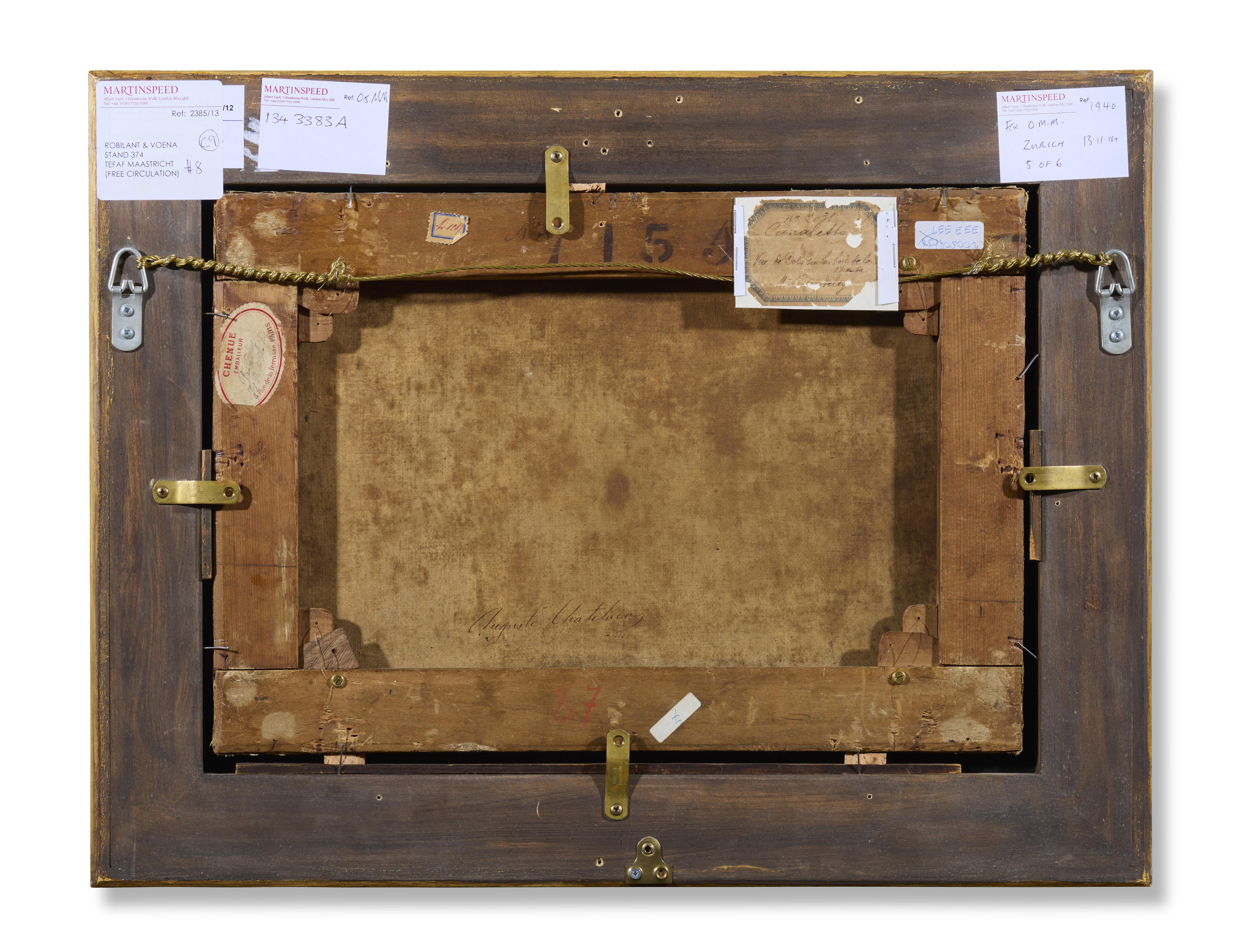
Auguste Chatelain (per an inscription on the relining canvas);
Alfred Beurdeley (1847–1919), Paris;
His sale, Galerie Georges Petit, Paris, 7 May 1920, lot 141;
Wilhelm von Bode (1845–1929), Berlin;
By inheritance to his son-in-law Professor Bruns, Berlin;
Private collection, Europe.
Literature
Hellmuth A. Fritzsche, Bernardo Bellotto genannt Canaletto, Burg b. Magdeburg, 1936, p. 107, under no. VG32.
W. G. Constable (later editions rev. J. G. Links), Canaletto, London, 1962, vol. 2, no. 373b (as 'imitator of Canaletto').
F. Simpson (ed.), Treasures of Venice: Paintings from the Museum of Fine Arts, Budapest, exh. cat., Minneapolis, 1995–96, p. 222, n. 1, in entry by Zsuzsanna Dobos (as 'attributed to Canaletto').
J. G. Links, A Supplement to W. G. Constable’s Canaletto, London, 1998, p. 35.
Boźena Anna Kowalczyk, ed., Canaletto e Bellotto: l’arte della veduta, exh. cat. Palazzo Bricherasio, Turin, 2008, p. 242, no. 99, illustrated p. 243 (as Canaletto).
M. Dimitrova, A. Poggi and M. Voena, Italian Paintings from the 17th to the 18th centuries, exh. cat., New York, 2011, pp. 54–55.
Annalisa Scarpa, ed., Canaletto à Venise, exh. cat. Musée Maillol, Paris, 2012–13, p. 146, in entry by Gerard-Julien Salvy.
Description
The present painting is a recent discovery and new addition to Canaletto’s catalogue. As indicated on the relining canvas it comes from the Auguste Chatelain collection; a label attached to the stretcher mentions that it was part of Alfred Beurdeley’s collection as a Canaletto,1 and was sold as such in 1920 at the Galerie Georges Petit, in Paris.
It was first cited by Fritzsche as an anonymous work based on the etching of The Lock at Dolo,2 when it was in the Berlin collection of Professor Bruns, Wilhelm von Bode’s son-in-law and heir. Constable, who wrote that he was unaware of autograph paintings of this scene, suggests that it is by an imitator of Canaletto, and Dobos maintains the same opinion. When the present painting appeared on the German antique market it was considered to be by Bellotto. Indeed, in stylistic terms it is close to works in the group “sometimes attributed to Bellotto” because of the dark tones, the swirls, and the strong chiaroscuro which are also typical of the latter part of Canaletto’s career following his return from London during the second half of 1755.
Some of these pieces, such as this painting, are composed similarly to the most beautiful etchings in the series Vedute Altre prese da i Luoghi altre ideate, published in Venice after Joseph Smith was appointed British Consul on 16 June 1744. The version acquired by the Budapest Museum of Fine Arts in 1978,3 that is very similar in terms of style and nearly identical in size, was known to Kozakiewicz when it was in a private Hungarian collection and is mentioned by the Polish scholar as one of the few examples of the collaboration between Canaletto and his nephew, Bellotto.4
A recent restoration has brought to light the artist’s signature on the verso of the original canvas—“Io Zuea Antonio Canal deto il Canaletto, feci”—which is similar to the inscription on two other paintings, along with the date 1763. A third version that formerly belonged to the Marchesa Feltrinelli is now in a private collection in Padua.5 When each of the painted versions are compared to the etching, and they are very close to the size of the plate, we see the same composition of houses and the lock, with the burchiello about to depart, but the figures are different. There are no known works by Bellotto with the same composition. The only painting that speaks to the nephew’s visit to the Dolo in 1742 is the Mills at the Dolo in a private collection.6
We would like to thank Bożena Anna Kowalczyk for her expertise and confirmation of the attribution to Canaletto based on the recent conservation detailed above. For her full explanation, please see the attached document.
1. Frits Lugt, Marques de collections, Amsterdam 1921, no. 421, pp. 72–75.
2. Ruth Bromberg, Canaletto’s Etchings, London and New York, 1974, pp. 66–71, no. 6.
3. J. G. Links, A Supplement to W. G. Constable’s Canaletto, London, 1998, pp. 35–36, no. 373.
4. Stephan Kozakiewicz, Bernardo Bellotto, London, 1972, vol. 1, p. 40, vol. 2, p. Z 294.
5. Links 1998, p. 35, no. 371.
6. Kozakiewicz, 1972, no. 29.