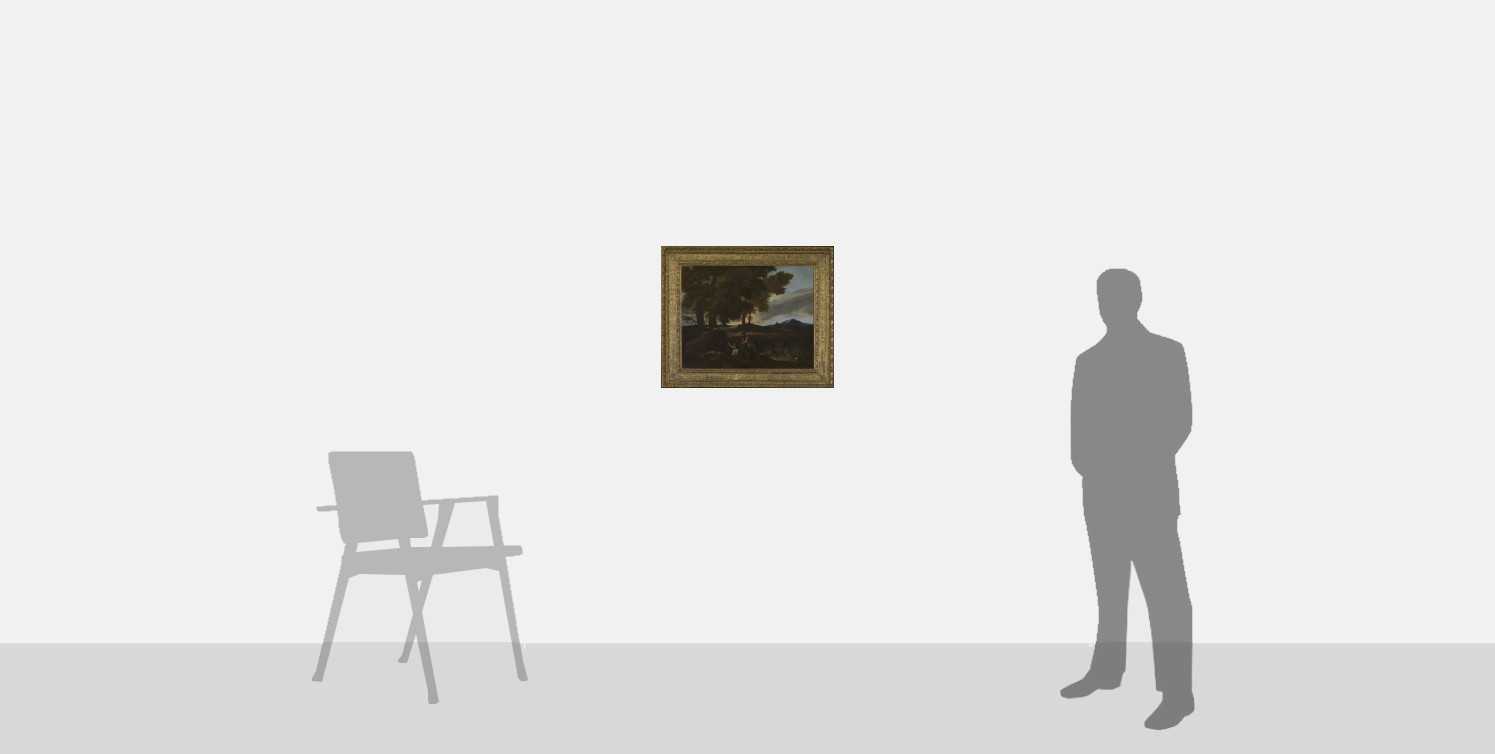

Nicolas Poussin
b. 1594, Les Andelys, Normandy
d. 1655, Rome
Apollo and Daphne
1625–26
Oil on canvas
63 x 77 cm (24 3/4 x 30 1/4 in.)
With frame: 84 x 100 x 6 cm (33 1/8 x 39 3/8 x 2 3/8 in.)
Provenance
By descent in the family to Maria Laura Dal Pozzo (d. 1771);
By descent to her son Giuseppe Boccapaduli, sold by him sometime between 1771 and 1809;
Private collection, Switzerland;
Eugene Thaw, New York;
Private collection, Switzerland.
Literature
D. Mahon, “Poussin in the Dal Pozzo Collection,” Burlington Magazine, CXXVII, 993, December 1985, p. 900.
T. J. Standring, “Some Pictures by Poussin in the Dal Pozzo Collection: Three New Inventories,” Burlington Magazine, CXXX, 1025, August 1988, pp. 624–25.
P. Rosenberg, “L’année Poussin”, in Nicolas Poussin 1594–1665, exhibition catalogue, Galeries Nationales du Grand Palais, Paris, 1994, p. 16.
P. Rosenberg and L. Prat, Nicolas Poussin: La Collection du Musée Conde à Chantilly, exhibition catalogue, Musée Condé, Château de Chantilly, 1994, p. 38.
M. Fagiolo dell’Arco, Jean Lemaire pittore “antiquario”, Rome, 1996, p. 147.
T. J. Standring, “Poussin’s Infancy of Bacchus Once Owned by Sir Joshua Reynolds: A New Addition to The Corpus Of The Early Roman Pictures,” Artibus et Historiae, 17, 1996, pp. 59–61.
K. Akira and K. Yukitaka, Claude Lorrain and the Ideal Landscape, exhibition catalogue, National Museum of Western Art, Tokyo 1998, pp. 50–51.
D. Mahon, “Gli esordi di Nicolas Poussin pittore: lavori dei suoi primi anni di Roma” in Nicolas Poussin. I primi anni romani, exhibition catalogue, Palazzo delle Esposizioni, Rome, 1998, p. 19.
D. Mahon, Works from his First Years in Rome, Jerusalem, 1999, p. 26.
T. J. Standring, “Sulle tracce di Poussin,” Quadri e Sculture, 8, 2000, pp. 4–21.
Z. Dimitrova, Poussin. The Death of Eurydice–Apollo and Daphne, London, 2002.
P. Rosenberg, Poussin and Nature. Arcadian Vision, exhibition catalogue, Museo de Bellas Artes, Bilbao, and Metropolitan Museum of Art, New York, 2008, pp. 130–33.
Z. Dimitrova in A History of Taste. Collecting French & Italian Old Master Paintings for America, exhibition catalogue, Robilant+Voena, London, 2010, pp. 40–45.
Description
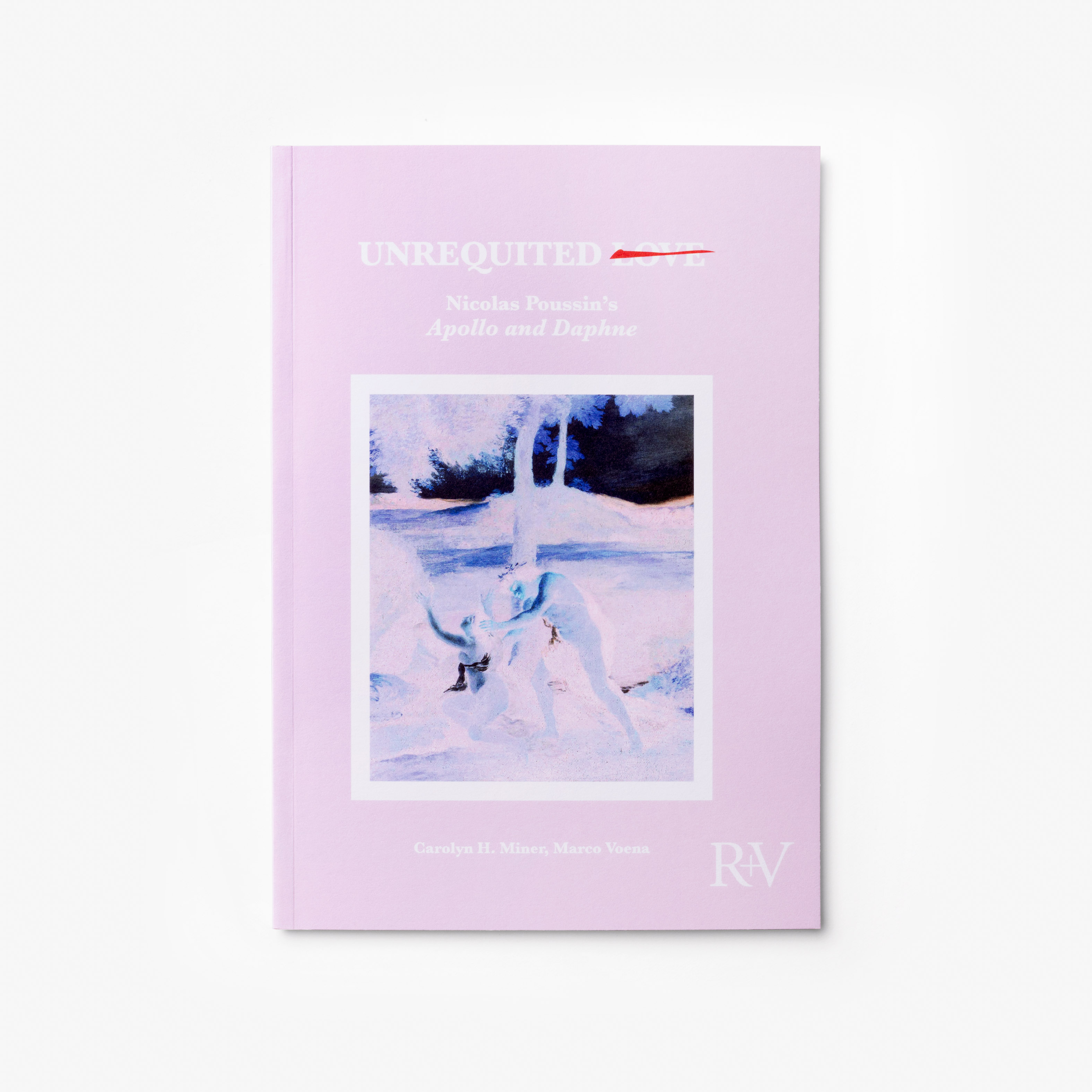
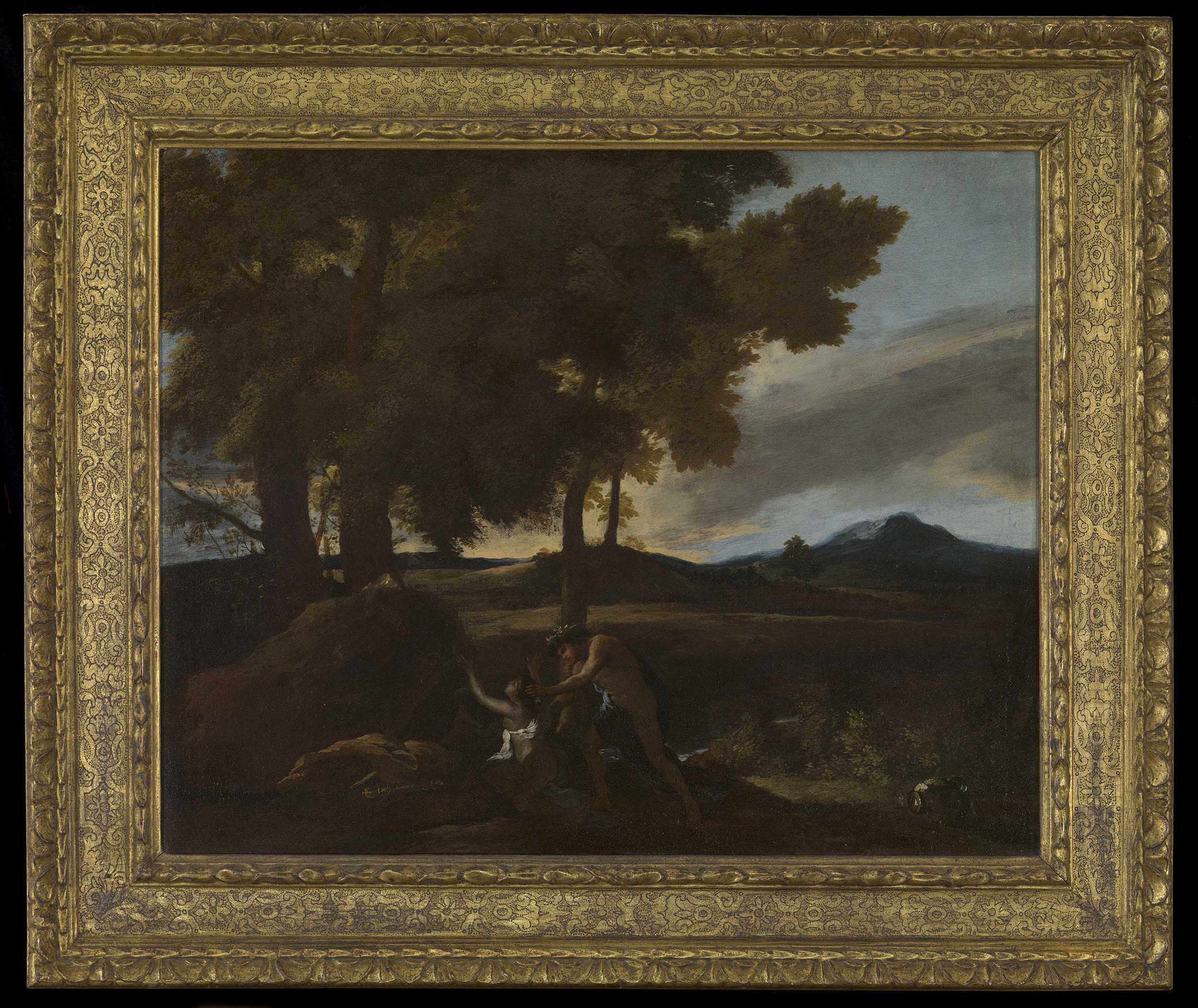
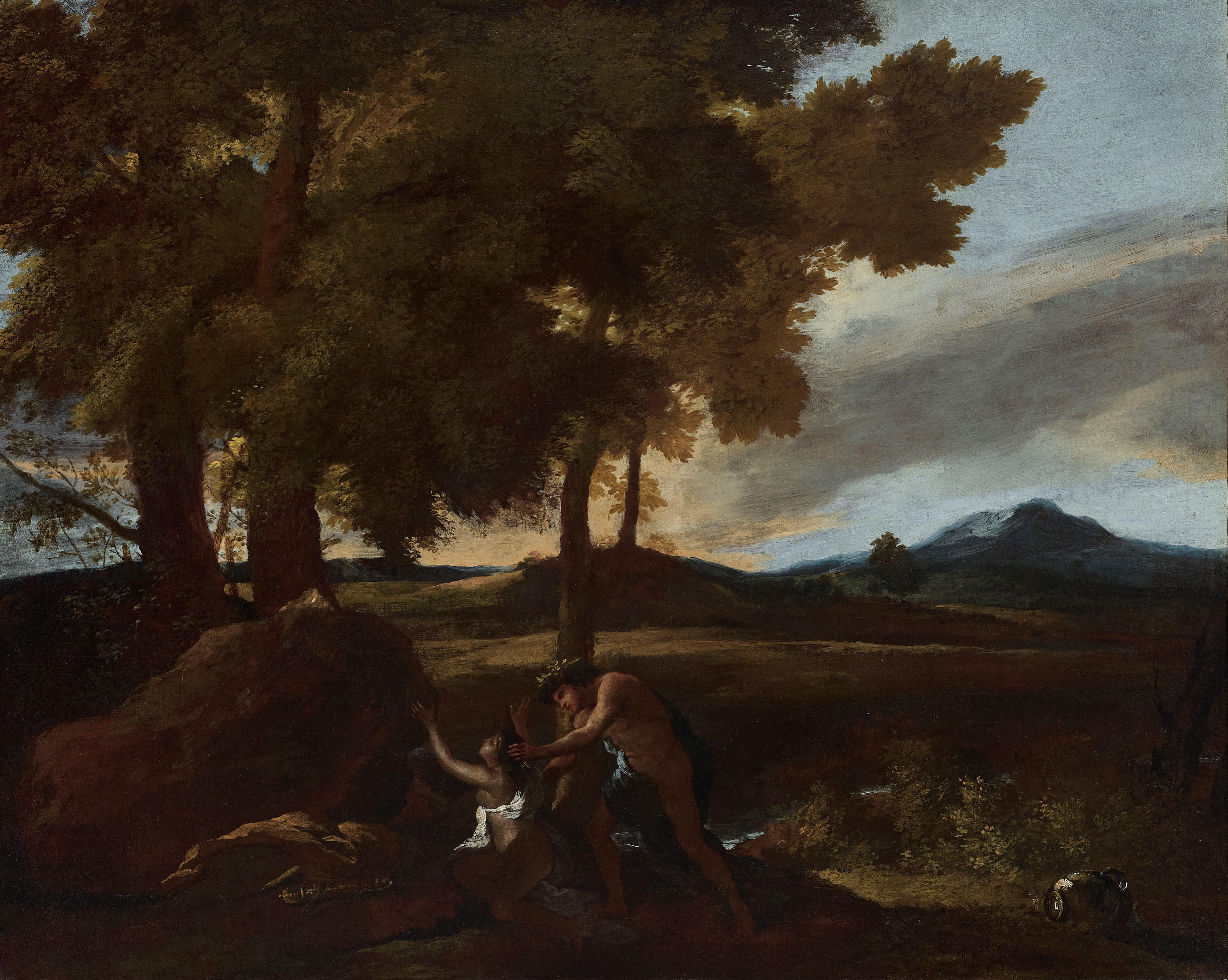
Framed by an idyllic pastoral landscape, Apollo and Daphne appear mid-chase, moments before her transformation into a laurel tree as she escapes the god’s outstretched hand. The painting’s soft colours and beautiful treatment of light owe much to the young Poussin’s careful study of Titian, whose landscapes he greatly admired.
Apollo and Daphne is one of a pair of paintings discovered by Pierre Rosenberg in the late 1980s in a Swiss private collection, which have since inspired a notable level of academic interest. Its companion piece, which was also with Robilant+Voena but has since been sold, depicts the death of Eurydice, another story taken from Ovid’s Metamorphoses. The paintings’ provenance from the collection of Cassiano Dal Pozzo and their significance as two of Poussin’s earliest landscape works, painted soon after his arrival in Rome, clearly mark them as an important discovery for our understanding of Poussin’s artistic beginnings.
The provenance of the two paintings is attested to by a series of inventories published by Timothy Standring. The 1740 inventory of the Dal Pozzo collection compiled by Antonio Maria Bozzolani, the most detailed and arguably the most objective of all the inventories of the collection (others were drawn up in 1689, 1695, 1715, 1729 and later 1771), describes the paintings as follows:
“39 Another painting on canvas made of three pieces which represents a landscape with two figures is the scene of The Death of Eurydice from Poussin, all retouched with its own gilded frame. This is written in the inventory of Gabriele at n. 95= 3 palms height (corresponding to 68.58 cm) canvas with Apollo and other Nymphs.
40 The other canvas is similar to the previous one, representing another landscape with Apollo half holding a nymph on her knees, painted by Poussin as before—this is described in the inventory at n. 103.” [1]
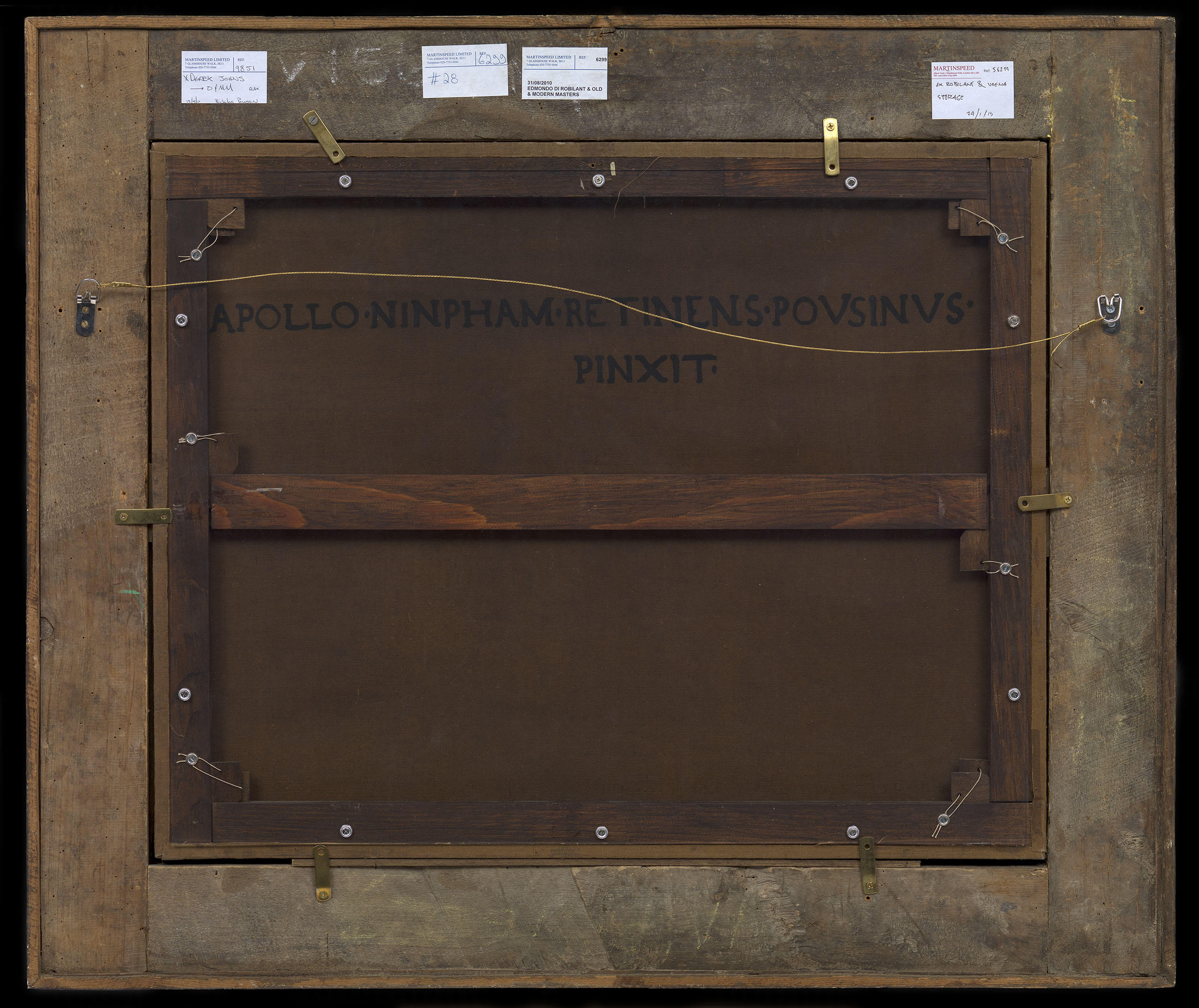
The inscriptions, presently copied on the frame but prior to the relining on the original canvas, further attest to the Dal Pozzo provenance. Typical of Dal Pozzo inscriptions, they closely resemble those found on many other pictures from his collection.
Both paintings remained together in the collection of Cassiano Dal Pozzo’s heirs until at least 1771, when they were last recorded in an inventory drawn up by the Sienese artist Giovanni Sorbi following the death of Maria Laura Dal Pozzo. The two paintings then passed into the collection of Maria Laura Dal Pozzo’s son Giuseppe Boccapaduli who, as pointed out by Timothy Standring (1988, p. 613, fig. 42), sold them for 50 scudi sometime between 1771 and his death in 1809, most likely around 1800.
The identification of the subjects of the two paintings has led scholars to varying interpretations. The present canvas has been published several times as Apollo and Daphne, but the lack of laurel branches sprouting from Daphne’s arms might suggest that Poussin has represented Apollo pursuing a nymph from another story, as suggested by the old inscription. The two paintings were clearly conceived as a pair with the Apollo to be displayed on the left and the Death of Eurydice on the right, with the tall, lush trees present in both canvases seeming to frame the two mythological episodes as if in a frieze composition.
The canvases, as confirmed by Pierre Rosenberg in the Bilbao–New York exhibition catalogue, undoubtedly date to the years 1625–26. This was a challenging period of great poverty for Poussin, when he painted prolifically, attempting to attract patrons and to make his name by undertaking literary subjects, which he translated into accessible narrative images. Poussin arrived in Rome in the spring of 1624, in April according to one of his earliest biographers, but his first years in Italy proved particularly difficult. His champion, the Italian poet Giambattista Marino died in 1625 and that same year Cassiano Dal Pozzo left for Spain and France, along with the all-powerful Barberinis. It was only in 1627, with the commission of the Death of Germanicus for Francesco Barberini, a nephew of Pope Urban VIII, and the following years with the commission of the Martyrdom of Saint Erasmus for Saint Peter’s—two paintings in which nature plays no role—that Poussin gained public acknowledgement.
In previous years, Poussin had mainly worked on small to medium-sized landscape paintings with subjects taken from mythology, showing bacchanals, nymphs and satyrs amid classical ruins and sweeping landscapes. The present painting of Apollo and Daphne and its pair depicting the Death of Eurydice bear a great resemblance to the Landscape with a Nymph and Sleeping Satyr belonging to the Musée Fabre in Montpellier and the Amor vincit omnia at the Cleveland Museum of Art. These works clearly show the influence of Venetian Renaissance painting, and of Bolognese landscape painting, from Annibale Carracci to Domenichino.
One can see that Poussin is still finding his own visual language, before he came to establish the ‘Landscape in a Noble and Heroic Style’ of the early 1630s, as defined by Pierre Rosenberg, seen in his most celebrated paintings, for example, A Bacchanalian Revel before a Term at the National Gallery, London or the Kingdom of Flora at the Gemäldegalerie in Dresden.
[1] The original Italian text reads “39 Altro quadro in tela de 3 p. per traverso Rapp. Un Paese Con dui figure cioe La morte di Euridice, dal Poussini, tutto ritoccato Con Sua Cornice fatta a Cassa Dorata – Questo e discritto nell’inventario d’Gabrielle [the 1695 inventory] al no. =95= Altro di 3 palmi con paese con dui figuri del Pusino” “40 Altro in tela Consimile parim. Per traverso Rappr. Un altro Paese con Apollo che ritiene una ninfa mezza genuflessa, perimenti del Pousini ritoccato, come sopra – Questo e nell’inventario descritto al no. 103 = Altro In tela di 3 palmi con Apollo et altre Ninfe”
[2] The original Latin text reads “Ila quidem, dum te fugeret, per flumina praeceps / Immanem ante pedes hydrum moritura puella / Servantem ripas alta non vidit in herba”
The artwork described above is subject to changes in availability and price without prior notice.