

Jan Janssens
b. 1590, Ghent
d. c. 1650, Ghent
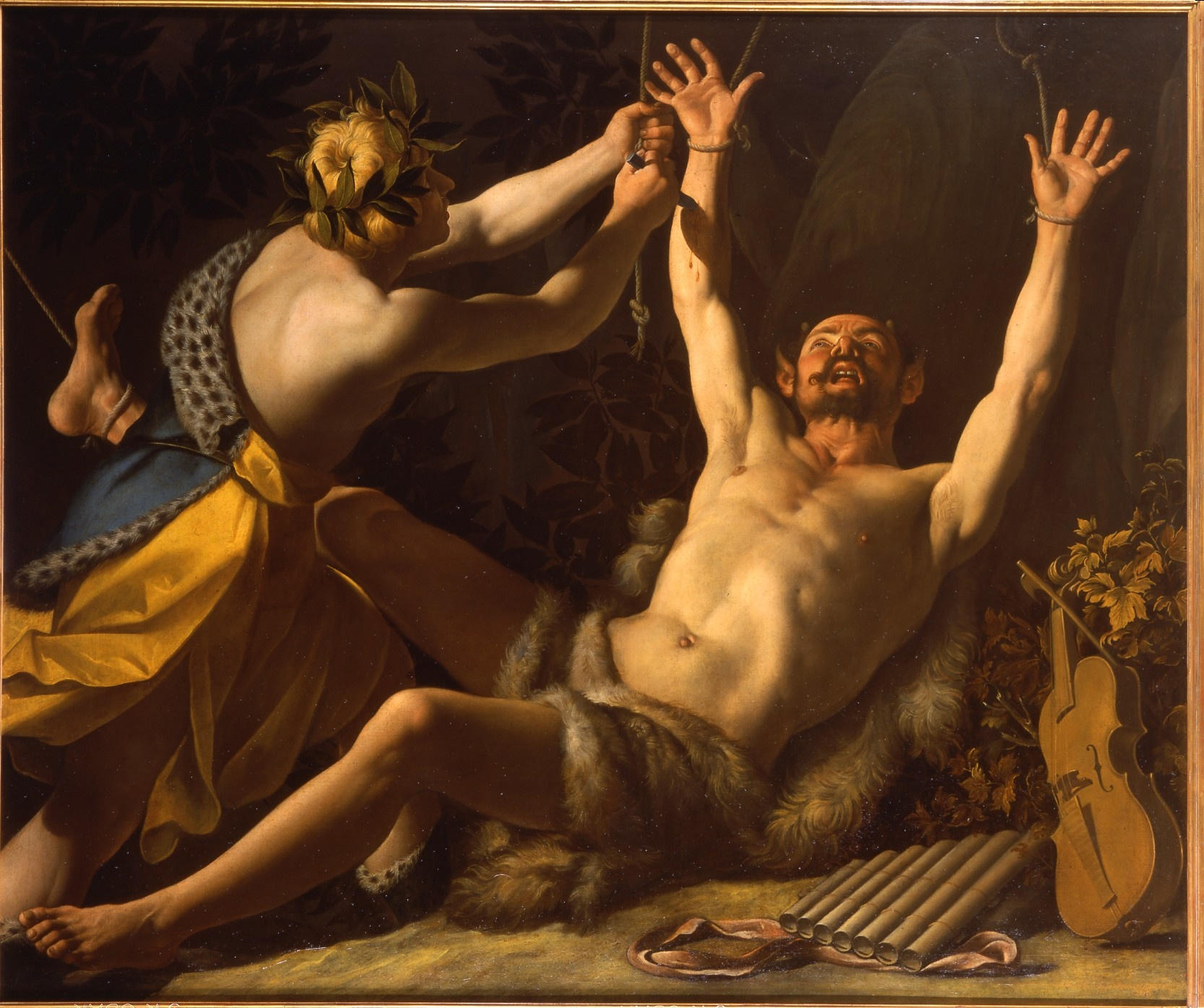
Apollo and Marsyas
c. 1630
Oil on canvas
169 x 198.5 cm (66 1/2 x 78 1/8 in.)
Provenance
Paul Delaroff (1852–1913), St. Petersburg
with Colnaghi, London, Autumn 1986
with Marco Voena, London, 2005
Acquired by Luigi Koelliker in 2005.
Literature
P. Semonov-Tian-Shansky, Études sur les peintres des écoles hollandaise, flamands et neerlandaise qu’on trouve dans la Collection Semenov et les autres collections publiques et privées de St-Petersbourg, Saint Petersburg, 1906, pl. XXXVIII, note 1, as 'Baburen'.
L. J. Slatkes, Dirck van Baburen (c. 1595–1624); A Dutch Painter in Utrecht and Rome, Utrecht, 1965, no. C7, as 'a lost work by Baburen'.
E. Schleier, 'A Lost Baburen Rediscovered, Burlington Magazine 114 (1972), p. 787,as 'by Baburen; as a variation of that artist’s painting at Schloß Bückeberg'.
L. J. Slatkes in Flemish Paintings and Sculpture, exhibition catalogue, Colnaghi, London, 1986, ill. col., 'Janssens'.
A. Brejon de Lavergnée, 'Le caravagisme en Europe: À propos de la réédition du Nicolson', Gazette des Beaux-Arts 122 (1993), p. 210, fig. 1087, as 'Janssens'.
Salzburg, Residenzgalerie, Die Melancholie Venziens: die Gemäldesammlung Safarik in des Sammlungen von Luigi Kolliker, 22 November 2003 – 1 Febury 2004, Salzburg, 2003, no. 20, as ‘Pietro Testa’.
G. Fusconi and A. Canevari, Piero Testa e la nemica fortuna: Un artista filosofo (1612–2015), Rome, 2014 p. 451, as ‘Opre già attribuite e Pietro Testa e non acetate in questa sede’.
Description
Jan Janssens was born in Ghent. Like many young artists in the early seventeenth-century Netherlands, Janssens was drawn to Rome, where he is documented in 1619 and 1620. Encountering the revolutionary style of Caravaggio, Janssens quickly became an adherent of the international Caravaggesque movement, taking inspiration in particular from the works of his fellow Northerners, the Utrecht Caravaggisti Gerrit van Honthorst and Dirck van Baburen. Returning to Ghent, where he became a master in the painters’ guild in 1621, Janssens continued to produce works in the Caravaggesque manner he had developed during his formative sojourn in Italy. Unflinching in their naturalism, Janssens’s dramatic compositions are distinguished by the highly expressive poses and gestures of their protagonists, and by their theatrical lighting, typically emanating from a single hidden source. The Catholic Counter-Reformation had given rise to a desire for emotionally stirring representations of religious themes, and thus Janssens’s altarpieces and other religious subject paintings became sought after by churches in and around Ghent. At the same time, Janssens catered to the taste for Caravaggesque works on the part of sophisticated patrons both in his native Netherlands and abroad—for example, his prominently-signed Caritas Romana (Academia di San Fernando, Madrid) had already become part of the famous collection of the Marqués de Léganès during the artist’s lifetime.
Ovid’s Metamorphoses records one of ancient mythology’s most stirring parables of hubris, in which the satyr Marsyas challenged Apollo to a musical contest. As punishment for his arrogance, Apollo bound Marsyas to a tree and flayed him alive. In the present painting, the God of Music is shown binding the satyr, who unleashes a scream of terror at his impending fate. Apollo’s viol and Marsyas’s flute lie discarded on the ground at right.
Apollo and Marsyas was for much of its modern history attributed to Baburen, and indeed, the present composition can be related to Baburen’s treatments of the same subject. Foremost among these is the painting of this subject first published by Erich Schleier in 1972, and now in the Museum of Fine Arts, Houston (fig. 1). At the time, Schleier postulated that the present work, long attributed to Baburen, was another version of the work now in Houston. Other now lost depictions of the subject by Baburen are thought to be reflected in two drawings on the recto and verso of a single sheet attributed to David de Haen, with whom Baburen often collaborated and once shared a house in Rome (figs. 2, 3).[1] The sketch on the verso of the sheet is correlates well if not exactly with the composition of the present painting. Indeed, though Janssens was clearly inspired by Baburen, Leonard Slatkes has noted that “Janssens’ works belong to the same artistic context as the original Van Baburen and thus partakes of aspects of the model in a way that no ordinary copy can.” Slatkes has dated the present work to around 1630, positing that it was painted in Ghent.
Fig. 1. Dirk van Baburen, Apollo and Marsyas, ca. 1623, oil on canvas, Sarah Campbell Blaffer Foundation, Museum of Fine Arts, Houston.
Figs. 2, 3. David de Haen. Apollo Flaying Marsyas (recto) and Apollo flaying Marsyas (verso), pen and ink on paper, Gabinetto Disegni e Stampi degli Uffizi, Florence.
[1] Leonard J. Slatkes, “David de Haen and Dirck van Baburen in Rome” Oud Holland 81, 3 (1966), figs. 2, 3.
This work is accompanied by an expertise by Wayne Franits.