

Apollonio di Giovanni
b. 1415/1417, Florence
d. 1465, Florence
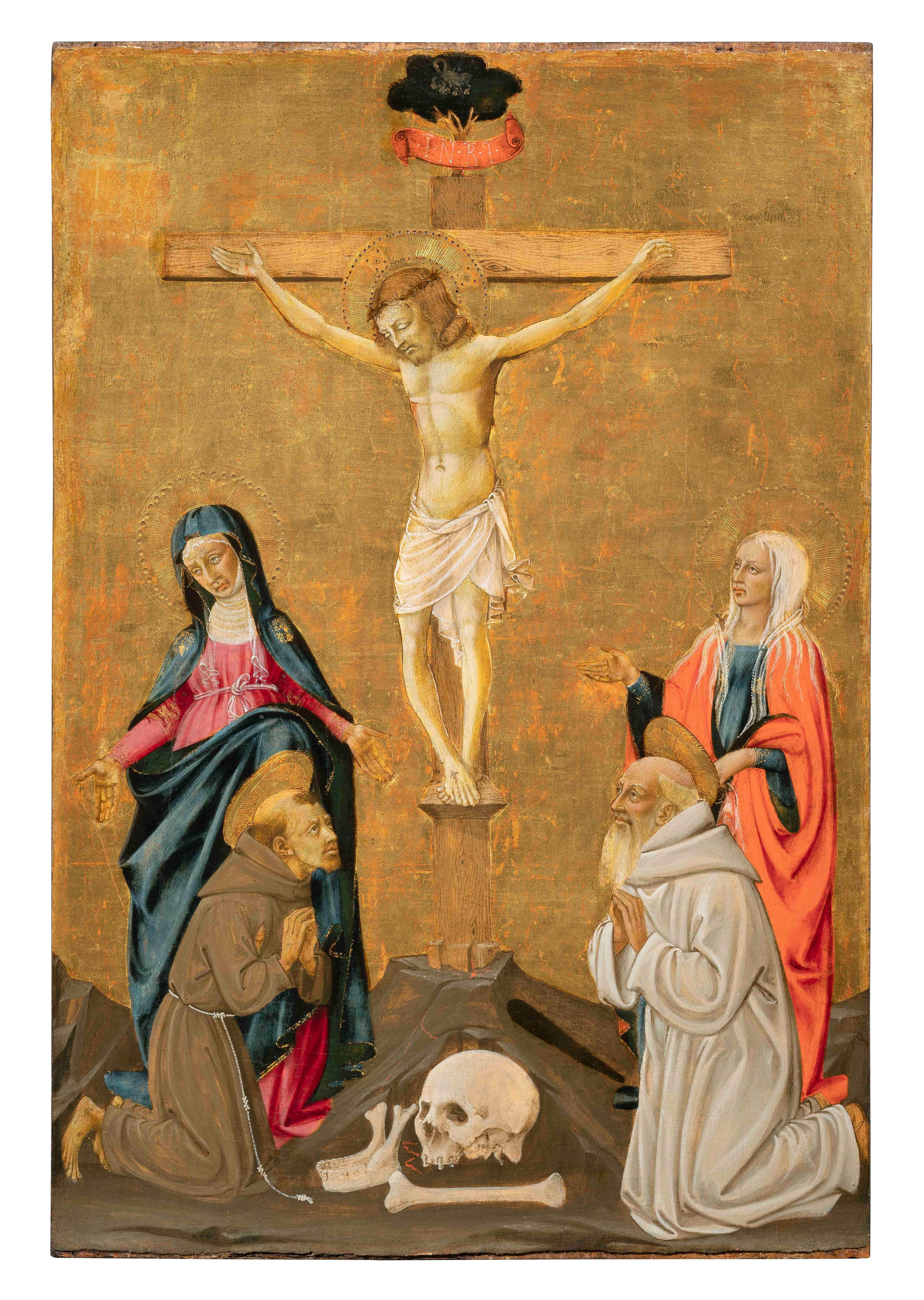
The Crucifixion with the Virgin Mary and Saints Mary Magdalene, Francis and Benedict
c. 1450
Tempera on panel
73 x 49 cm (28 3/4 x 19 1/4 in.)
Provenance
Description
Shown with blood dripping from the wounds in his side and hands, Christ is portrayed crucified on the Cross, with his head lowered, as if to emphasise his suffering. At left, the Virgin is clad in vivid pink and blue robes, spreading her hands in a gesture of despair. Saint Mary Magdalene is on the right, dressed in bright red cloak, while Saint Benedict, represented with a halo and dressed in a monastic white robe, raises his hands together in prayer. Before him on the ground is one of his standard attributes, the black rod of discipline. Saint Francis, wearing his standard friar’s habit, is present to the right of the Cross, kneeling upon the ground gazing up at Christ with his hands folded in veneration. The iconography of the Cross worshiped in penitence by hermit saints (Saint Francis and Saint Jerome, in particular), grew in popularity in Florence across the fifteenth century as monastic and mendicant orders strongly linked to spiritual eremitic movements likewise expanded in influence.
Born in Florence around 1416, Apollonio di Giovanni is documented as having worked in the city of his birth until his death in 1465. Known primarily for his cassoni, recent scholarship has allowed a more accurate assessment of Apollonio di Giovanni’s paintings of religious themes, an aspect of his activity previously overlooked in favour of his better-know secular works. Attributed to the artist by Andrea de Marchi, the present work can be compared with the Trinity and Saints in the Galleria dell’Accademia in Florence, which replicates in small the figure of Saint Francis and represents the style of the early maturity of Apollonio di Giovanni, distinguished by distinctive modelling in the faces and the folds of cloths. Indeed, the frankly expressive faces of the panel’s protagonists, and their agile, emotive gestures, were typical features of Apollonio di Giovanni, an expert narrator of stories depicted on nuptial chests. Similarly, the emphasis on narrative clarity is found in the emaciation of the figures and the oversized, accurately rendered skull and bones at the foot of the Cross, which underscore the work’s penitential theme.
This impeccably conserved panel no longer retains its original engaged frame, yet appears not to have been otherwise altered. Its scale and subject suggest that it was produced for use in private devotional practices. Benedict’s white robes perhaps suggest that the panel was commissioned by an adherent of the Camaldolese, an eremitical branch of the Order of Saint Benedict founded in the eleventh century by Saint Romuald.
The artwork described above is subject to changes in availability and price without prior notice.