
Filippo Falciatore
b. Active in Naples 1737
d. 1768
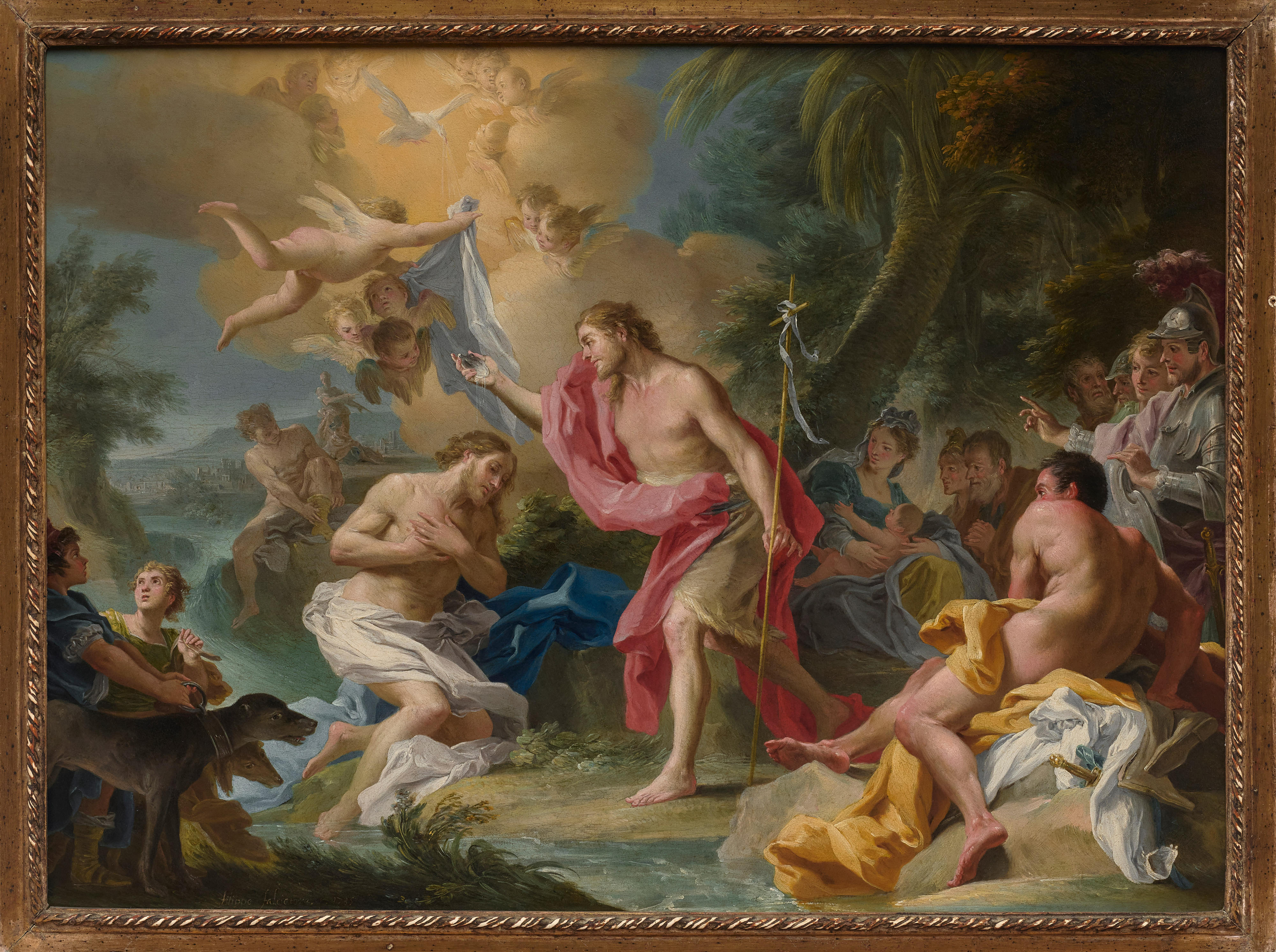
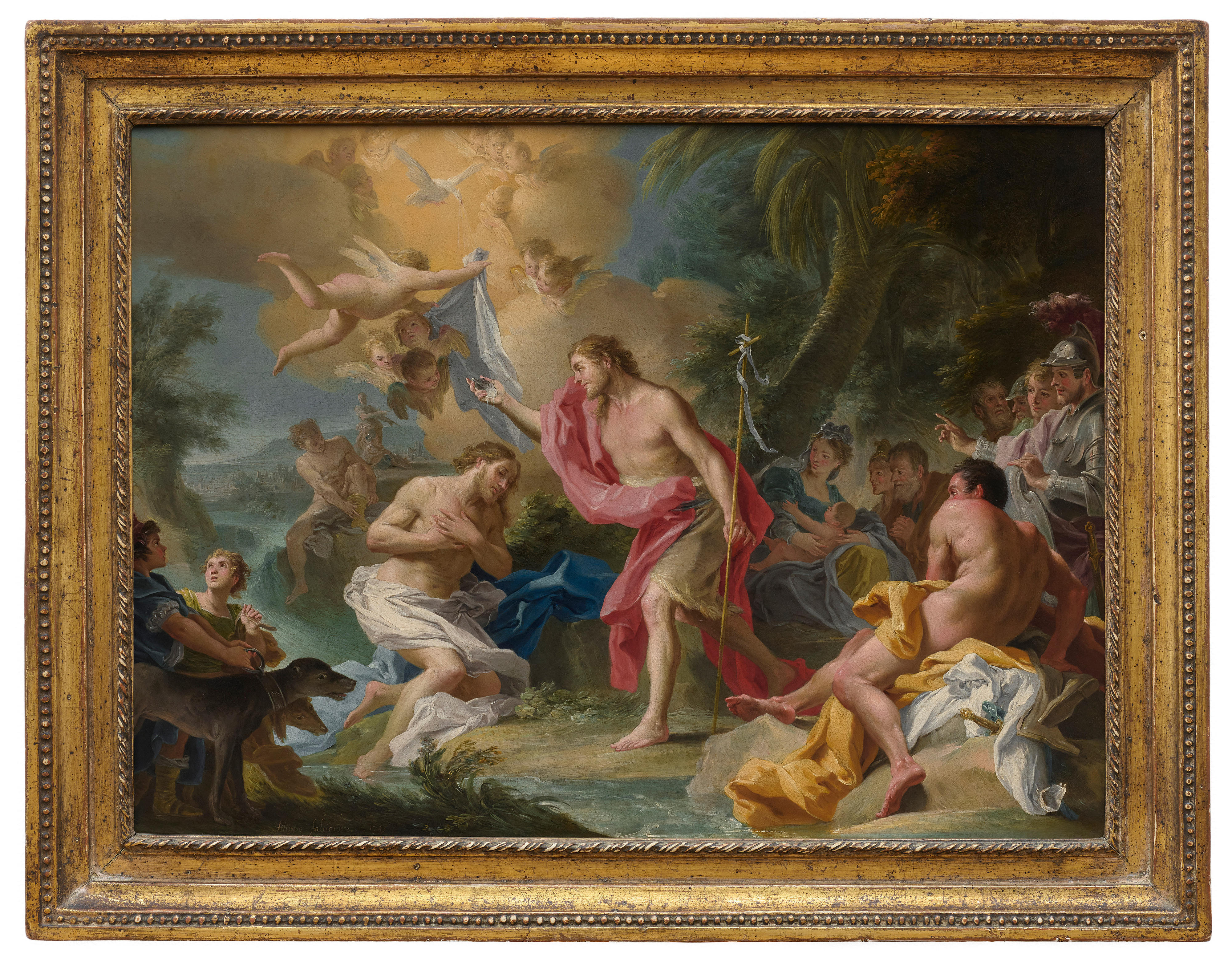
Baptism of Christ
1765
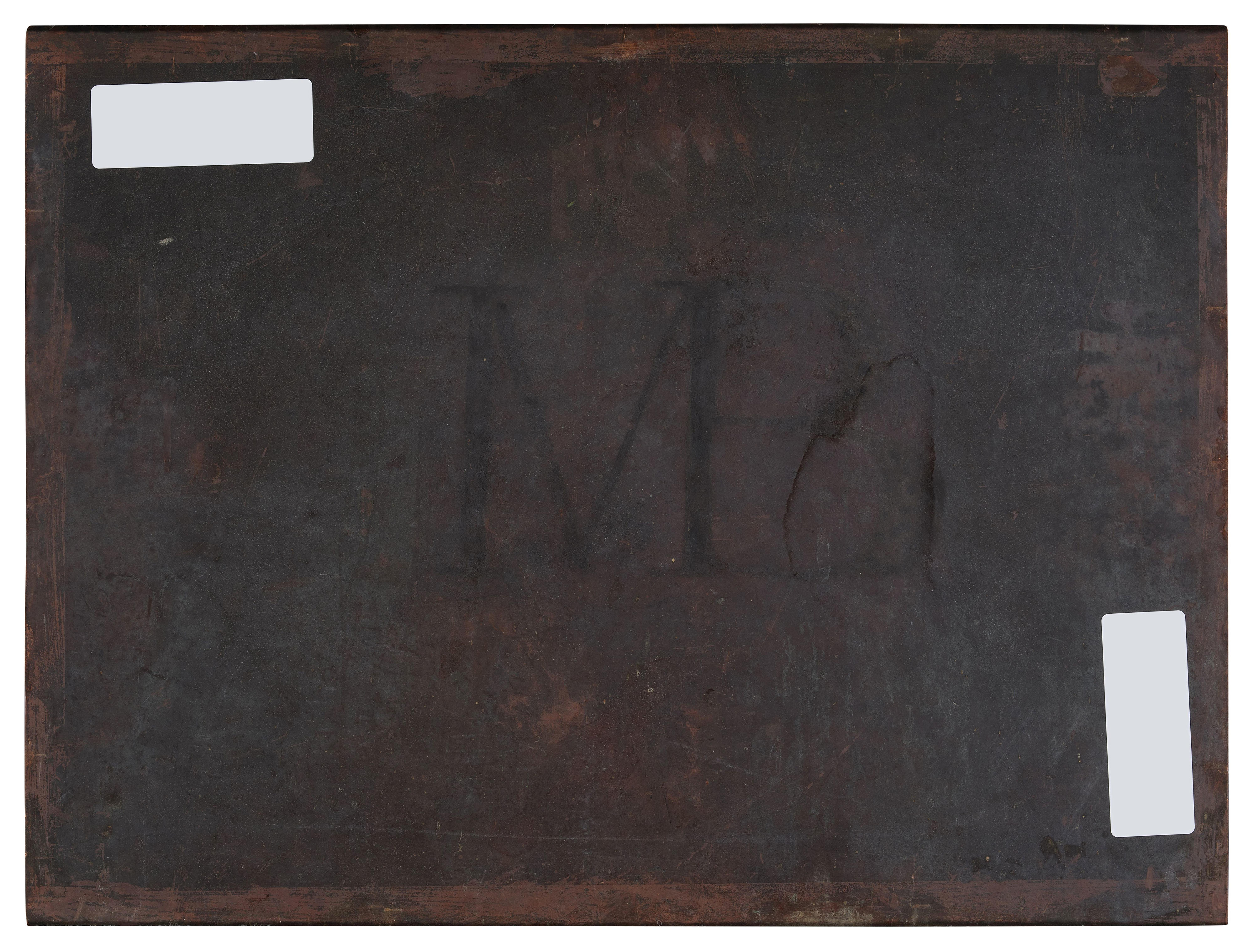
Oil on copper
40 x 54.9 cm (15 3/4 x 21 5/8 in.)
Framed: 50.8 x 64.8 cm (20 x 25 1/2 in.)
Provenance
Description
Although his exact date of birth is unknown, Filippo Falciatore was likely born in Naples towards the end of the 17th or beginning of the 18th century. He is documented, through his signed and dated works, as active between 1741 and 1768. A key proponent of the Neapolitan rococo style, Falciatore worked prolifically, active at the court of Charles VII of Naples, and undertaking both private and public commissions, including decorative schemes for notable churches and palazzi across Naples and the surrounding areas.
As a young man Falciatore was apprenticed to the painter Paolo De Matteis, before moving to the studio of Domenico Antonio Vaccaro, whose style was to greatly influence the young Falciatore. Indeed, his early output, which consisted predominantly of small- and medium-sized religious paintings, are very similar to Vaccaro’s manner, including the Madonna and Child with Saint Bruno in the Correale Museum, Sorrento, the Pietà in the Banco di Napoli collection, Capidomonte, and Judith and Holofernes in the Kunsthalle Bremen.
Although he likely produced works – namely two paintings noted by Nicola Spinosa in the Giannone collection in Naples,[1] Assalto ad una "cuccagna" al largo di Palazzo and Scene di vita popolare al largo del Castello – in the preceding years, the earliest series of Falciatore’s works that can be firmly dated are the frescoes in the sacristy of the Carmine Maggiore in Naples, which he painted in 1741, replacing previous decorations by Giovanni Balducci. Other early works from the artist’s career that have since been lost include the frescoes in the palace of Nicolò Pignatelli, Duke of Monteleone, and also in the palace of the Duke of Brunasso, alongside other decorative works in the churches of San Giacomo degli Spagnoli and the Santissima Trinità delle Monache.
In the 1750s, when the artist was at his most prolific, the artist continued to produce numerous works on sacred and profane subjects, including biblical scenes, subjects from classical mythology, and genre scenes, often depicting masquerades, concerts, or fêtes galantes, as has been pioneered and popularised by Watteau earlier in the century. Several of Falciatore’s paintings from this era are today in important public collections, including: a copper depicting Joseph and Potiphar’s Wife (Crocker Art Museum, Sacramento, CA), two canvases showing Raid of the Pirates and Raid of the Brigands (Staatsgalerie, Stuttgart), and Concert in a Garden and Tarantella at Mergellina (Detroit Institute of Arts, MI). These later genre scenes demonstrate the artist’s progression towards creating compositions with rich narratives and light-hearted atmospheres, that appear like a true ‘rococo capriccio’, as described by Spinosa.[2]
His later works include an Immaculate Conception dated 1763 for the Church of the Immaculate Conception in Cicciano, near Naples, and a painting Assault on a cart of Prisoners in the Foro Carolino from 1764 (which appeared on the New York art market). His last known work, to which the present copper painting is related, is a Baptism of Christ, signed and dated 1768, in the church of San Giovanni in Trani (fig. 1).
This recently cleaned oil painting on copper bears many of the artist’s finest characteristic of his mature style. These include the vivid colours of the fabrics and soft lighting that pervades the scene, bringing the various groups of figures into a harmonious composition. The attention to the apparent motion of each figure, from the male figure putting on or removing his boot to the left of Christ’s torso, to the infant who grasps the folds of his mother’s dress in the group to the right, demonstrates the artist’s adeptness at animating such scenes. The metallic support imparts across the whole scene a luminosity, accentuating the tones and crisp details of the figures, their clothing, and their surroundings.
With regards to the altarpiece of the same subject in Trani, the two works share the same central figures, although in our painting, Christ and Saint John appear more animated and more elegant in their poses. The present painting, furthermore, also offers an extended rendering of the Trani composition, the latter being restricted to the two central figures and a few putti. In this version on copper, by contrast, Falciatore was able to include other figures in two main groups at either side, whose expressions and poses enhance the overall flow of the painting, guiding the viewer’s attention on the baptism at the centre. These additional figures, as well as the verdant setting, demonstrate the artist’s skill for creating narrative scenes brimming with details. Whether this was a preparatory work for the Trani altarpiece, or created afterwards, is uncertain; regardless, it is a fine example of the artist’s production in his final years, exhibiting his key characteristics that made him a petit-maître of Neapolitan rococo.
Professor Nicola Spinosa has recently confirmed this as an autograph work by Falciatore, and assisted with the cataloguing this work, connecting it to the Trani altarpiece.
[1] N. Spinosa, in Civiltà del '700 a Napoli, exhibition catalogue, Florence, 1980, I, p. 238, figs. 118a and b.
[2] N. Spinosa, Pittura napoletana del Settecento, dal barocco al rococò, Naples, 1986, p. 64.
Fig. 1 - Filippo Falciatore, The Baptism of Christ, 1768. Chiesa di San Giovanni Battista, Trani.