
Giandomenico Tiepolo
b. 1727, Venice
d. 1804, Venice
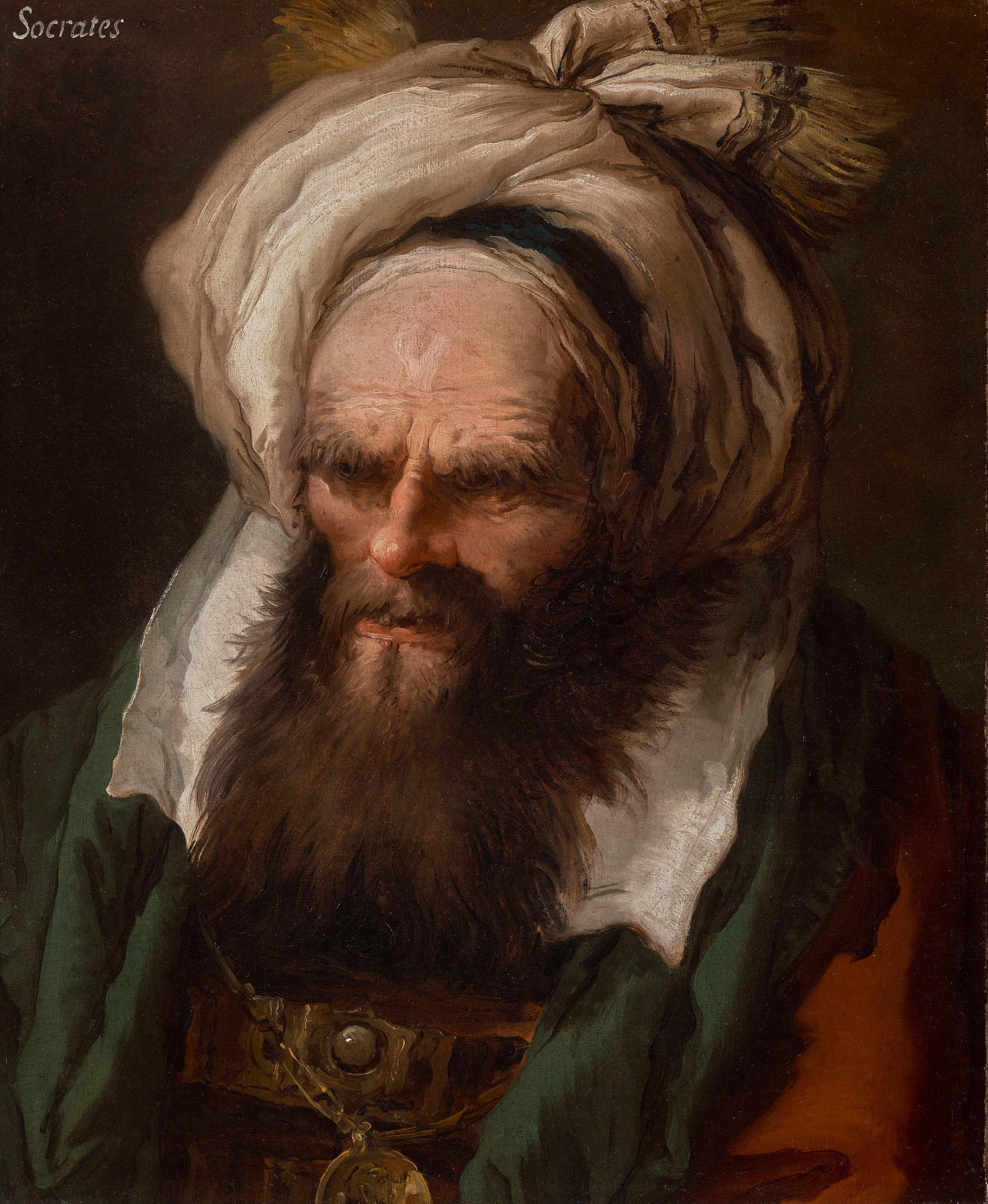
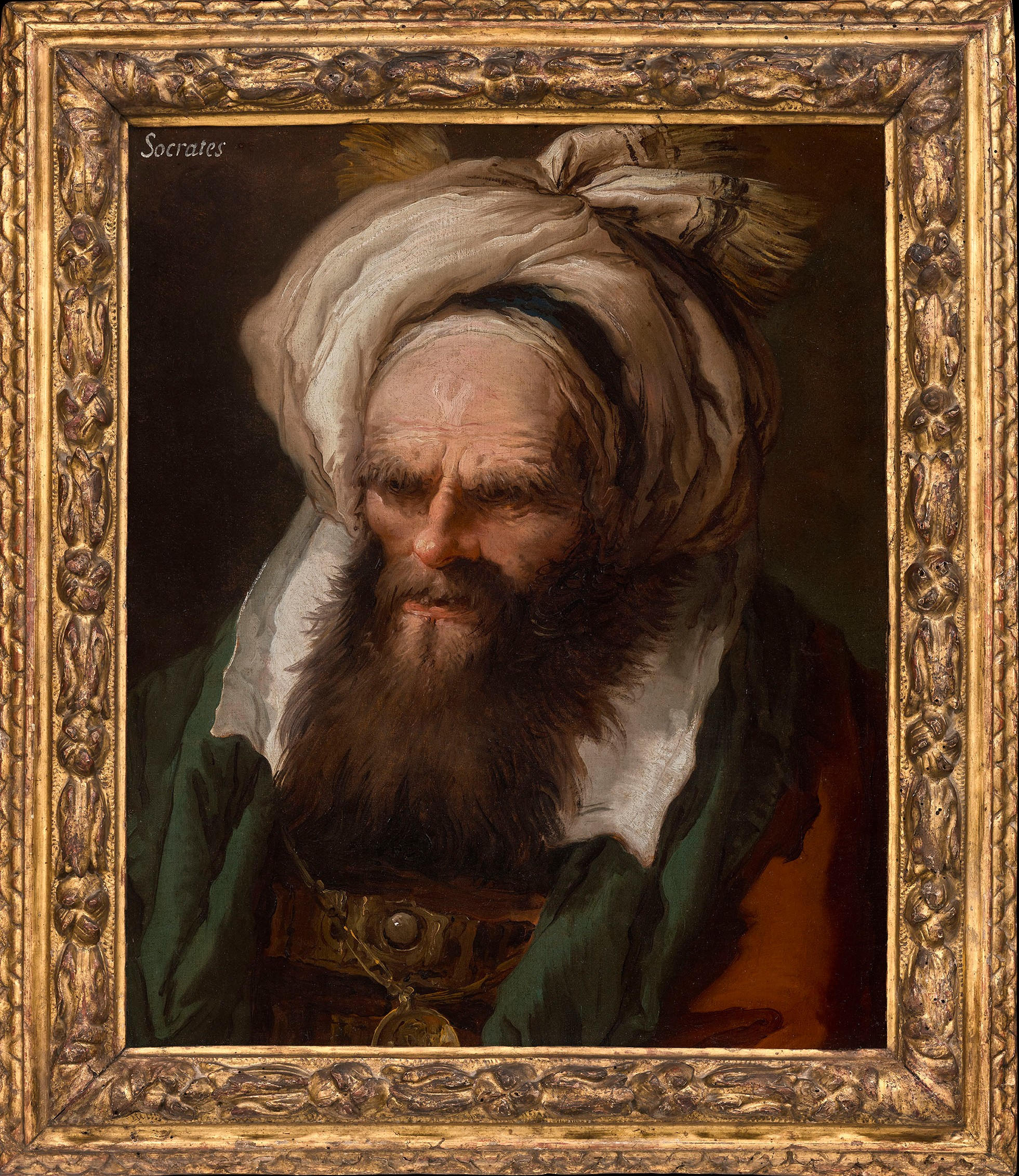
Bust of a Man in a green and red robe, 'Socrates'
c. 1770s
Oil on canvas, laid on board
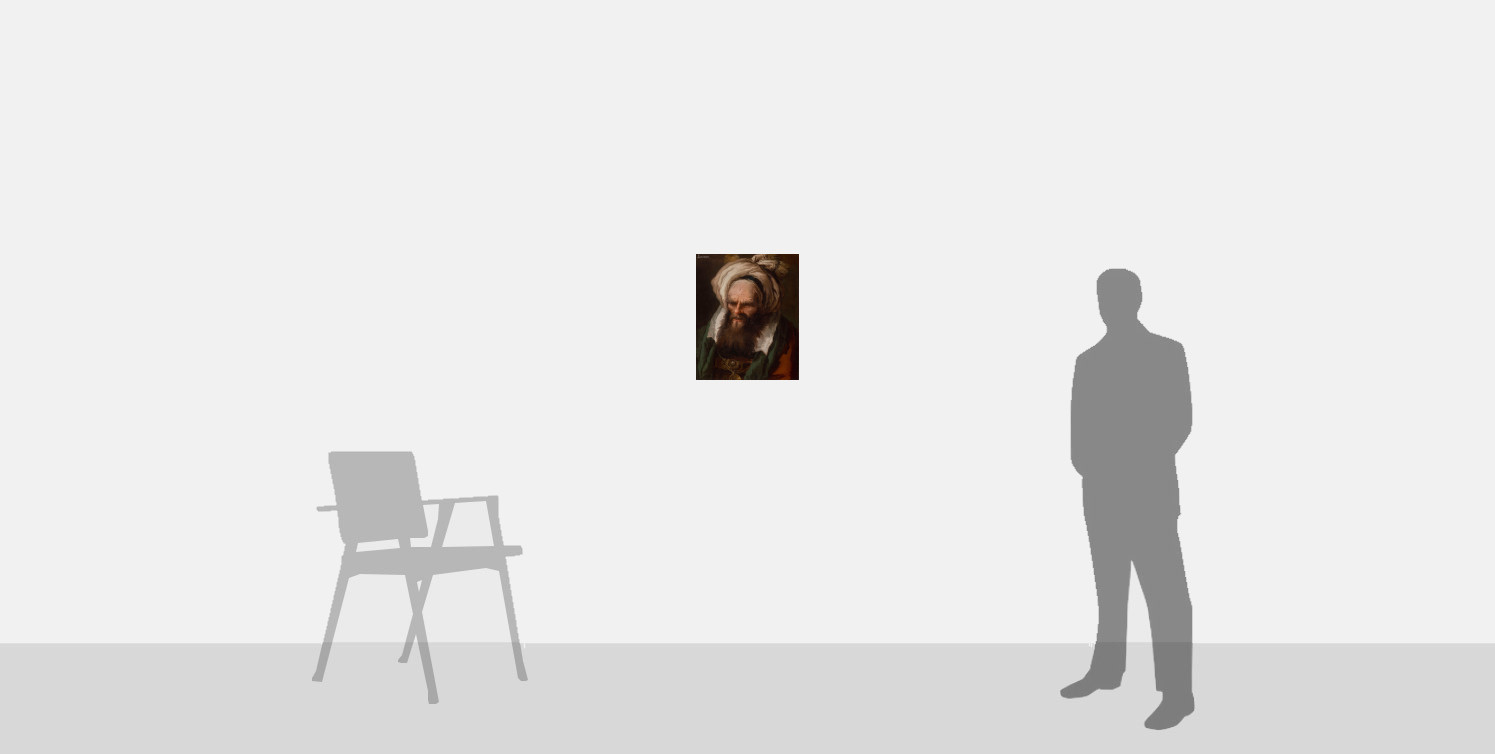
55.9 x 45.7 cm (22 x 18 in.)
With frame: 67.9 x 57.5 cm (26 3/4 x 22 5/8 in.)
Provenance
Thence by descent in the family.
Description
Come l’Antonio di Shakespeare, Tiepolo avrebbe potuto dire “I’ the East my pleasure lies”, “A Oriente è il mio piacere”. Non c’è scena, casuale o solenne, che non abbia fatto presidiare dai suoi Orientali, come se soltanto loro potessero garantire il piacere della pittura’[1].
With these words Roberto Calasso, in one of the most brilliant art history essays published some years ago (Rosa Tiepolo, Milan, 2006), reminds us of the frequent presence of these figures in Tiepolo’s oeuvre, with their large cloaks, thick beards and luxurious turbans. They inhabit Tiepolo’s canvases and his frescoes, across his many subjects and genres, including ancient history, religious scenes, mythology or literature. These men from an exotic Eastern world, beyond merely being the interested attendees at Cleopatra’s feast or the eyewitnesses of the miraculous rescue of Iphigenia, are also the main characters of an extraordinary cycle of character heads.
After his return to Venice from Würzburg and certainly before 1757, Giambattista Tiepolo painted a set of twenty heads of Philosophers for an unknown collector which would be intriguing to identify with his friend Francesco Algarotti (on this set and its derivations cfr. G.Knox, ‘”Philosopher Portraits” by Giambattista, Giandomenico and Lorenzo Tiepolo’, in The Burlington Magazine, 1975, pp. 147-153 and more recently The Artist at Court. Giandomenico Tiepolo and his Fantasy Portraits, catalogue of the exhibition ed. by A. Úbeda de los Cobos, Madrid 2014, pp. 74 -87).
The twenty paintings were engraved by Giandomenico Tiepolo for a book entitled Raccolta di Teste which was published in the autumn of 1757; Giandomenico added other ten engravings which reflect other models by his father. A second volume with other engravings followed in 1774.
Giambattista’s paintings and Giandomenico’s engravings were widely admired and copied; for a long part of their career both Giandomenico and his brother Lorenzo painted heads of philosophers or men from the East. An important addition to these works is a a set of three paintings by Giandomenico Tiepolo that were discovered in a Californian private collection, each one inscribed with the name of a Greek philosopher. The present painting is identified as Socrates, while the others are inscribed with the names of Demosthenes and Aristotle (figs. 1 and 2). A comparable head of a similar size was recently sold at Christie's New York (31 January 2024) for $945,000 (fig. 3).
The three paintings of philosophers are of comparable formats and dimensions, and were likely intended for the viewer's entertainment, prompting reflection on these great men of ancient times, even if it is possible that the inscriptions with names of the Greek philosophers might be a slightly later addition. It is also interesting to point out that neither of the three paintings reflects the traditional iconography of the philosophers.
The Socrates in this picture is an impressive yet mysterious figure, his eyes almost lost in shadow below his furrowed brow, and his pursed lips perhaps indicating the intensity of his thought. Costumed in a dazzling green and red robe with a golden clasp, and wearing a striking white turban, his presence is magnificent, yet shrouded in intrigue. With his gaze cast downwards, the philosopher appears somewhat detached from the viewer, adding to his enigmatic persona.
The date and precise circumstances of the creation of this set present work is unclear, but even if on a stylistic ground a datation to the Spanish period of Giandomenico seems reasonable, it is interesting to point out that the present painting closely relates to one of the engravings of the Raccolta di Teste, the Testa I.5 (an example is in the collection of the British Museum, fig. 4).
Note 1: “As Shakespeare’s Antonius, also Tiepolo could have said ‘I’ the East my pleasure lies.’ There is no event, a common or a solemn scene, that Tiepolo has chosen to depict without his Oriental Men, as if only these magnificent figures may provide the pleasure of painting”-
Fig. 1: Giandomenico Tiepolo, Head of a bearded man in a blue and yellow collared robe (Private Collection).
Fig. 2: Giandomenico Tiepolo, Head of a bearded man in a yellow robe and a blue cap, wearing a gold chain (Private Collection).
Fig. 3: Giandomenico Tiepolo, A bearded man wearing a turban, 60.6 x 50.4 cm (23 7⁄8 x 19 7⁄8 in.) (Christie's New York, 31 January 2024, sold for $945,000).
Fig. 4: Giandomenico Tiepolo, after Giambattista Tiepolo, Head of an old bearded man wearing a turban-like headdress and a medallion, 1771-1800, etching. British Library, Department of Prints and Drawings inv. no. 1907,0515.84.106.