
Giovanni Battista Crespi, called il Cerano
b. 1573, Cerano, Italy
d. 1632, Milan
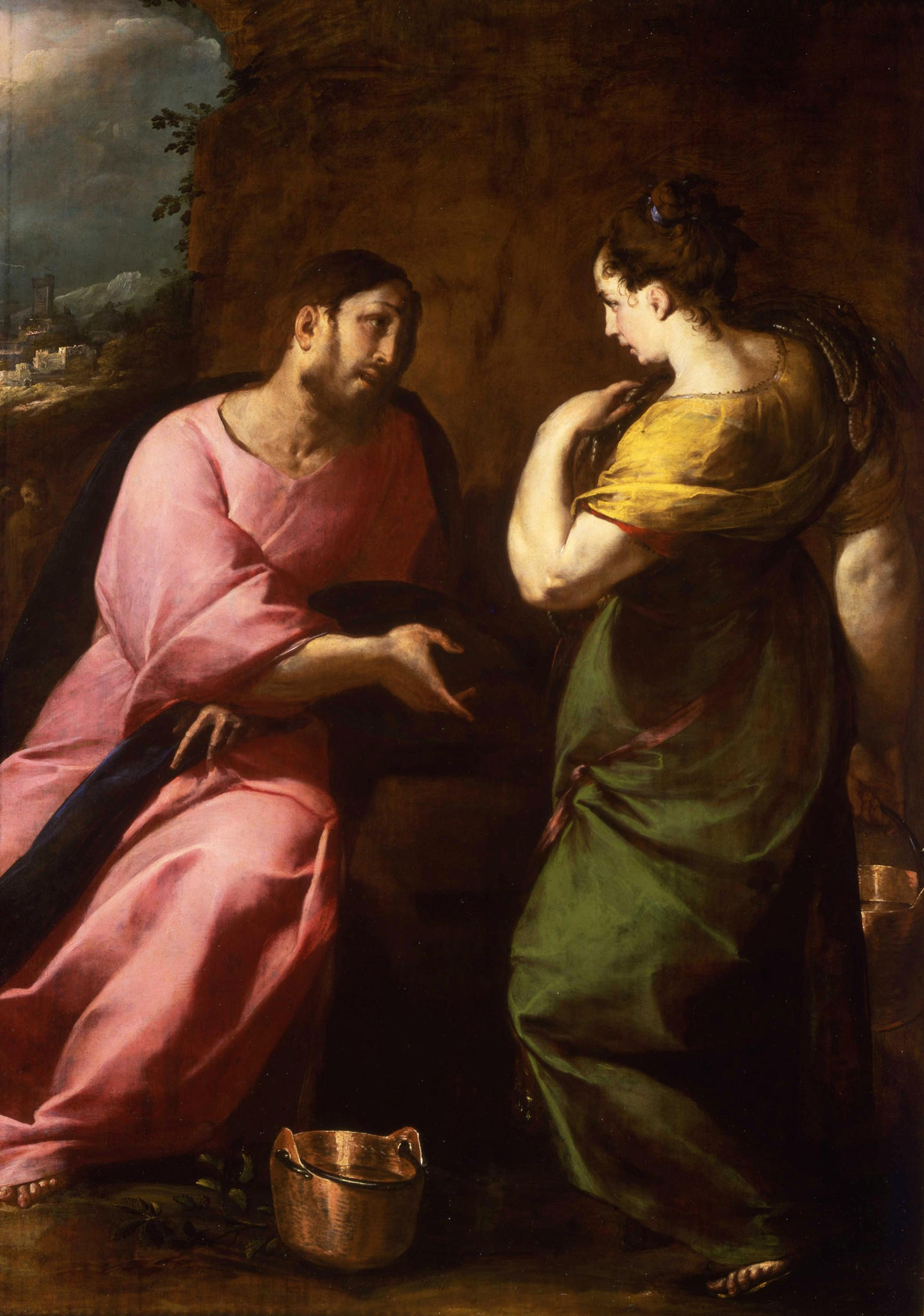
Christ and the Samaritan Woman at the Well
c. 1605
Oil on panel
100 x 72 cm (39 3/8 x 28 3/8 in.)
Provenance
Possibly Lichtenstein collection, Vienna
Purchased by Sir Thomas Barlow for the District Bank, Manchester
National Westminster Bank, Heythrop Park, Banbury, 1969
With Colnaghi, London, 1994
Koelliker collection, Milan
Literature
Peter Cannon-Brookes, Lombard Paintings, c.1595–c.1630: the Age of Federico Borromeo, City Museums and Art Gallery, Birmingham, 1974, exh. cat., pp. 112–13.
Marco Rosci, “Crespi, Giovan Battista,” in Dizionario Biografico degli italiani, Rome, 1984, vol. 30, p. 708.
Master Paintings, Colnaghi, New York, 1994, exh. cat., entry by Donald Garstang, no. 6, pp. 38–41, reproduced.
Alessandro Morandotti, Pittura italiana antica: artisti e opere del Seicento e del Settecento, Milan, 1995, p. 129.
Marco Rosci, Il Cerano, Milan, 1999, no. 137, pp. 214–17, reproduced.
Alessandro Morandotti and Francesco Frangi, eds., Dipinti Lombardi del Seicento. Collezione Koelliker, Turin, 2004, entry by Federico Cavalieri, pp. 30–33, reproduced.
Marco Rosci, ed., Il Cerano. Protagonista del Seicento Lombardo, Palazzo Reale, Milan, 2005, exh. cat., entry by Flavio Caroli, no. 42, pp. 186–87, reproduced.
Alessandro Morandotti and Frencesco Frangi, eds., Maestri del ‘600 e del ‘700 Lombardo nella Collezione Koelliker, Palazzo Reale, Milan, 2006, exh. cat., entry by Federico Cavalieri, pp. 34–37, reproduced.
Italian Paintings from the 17th to the 18th Centuries, Robilant + Voena, New York, 2011, exh. cat., entry by Federico Cavalieri, pp. 16–19, reproduced.
Mauro Leonardi, Mezz’ora di Orazione, Milan, 2015, reproduced.
Faithful to Nature: Eleven Lombard Paintings 1530–1760, Nicholas Hall, New York, 2019, exh. cat., entry by Virginia Brilliant, pp. 70–71, 96 –98, illustrated.
Description
Cerano painted two further identical versions of this subject. One is on panel (100 x 70 cm) and is located in the Cathedral of Toledo, Spain, and the other is on canvas (100 x 71 cm) and can be found in the Narodwe Museum in Warsaw; at least two smaller versions, probably workshop productions, are also known, and one of these is in the Palazzo Corsini in Rome. The present work is generally accepted to the best of the three. As early as 1964, James Byam Shaw noted on his copy of the catalogue of the Cerano exhibition held in that year in Novara, held in the archives at Colnaghi, of which he had then been director, that there was a “much better version” of the Warsaw canvas in the District Bank in Manchester. And in the catalogue of his seminal exhibition on the primo seicento Lombardo in 1974, in which the present version was published for the first time, Peter Cannon-Brookes noted that all three paintings are: “similar in handling except in their treatments of the draperies of the Samaritan Woman. The liquid handling of the Heythrop Park [i.e. the present] version with its transparent qualities presents a sharp contrast to the large number of clearly separated brush strokes which build up the same forms in the Toledo version and the much more dense handling of the Warsaw version.” This attention to painterly detail is also evident in the tendrils of hair articulated with elegantly drawn, winding brushstrokes over the forehead and neck of the Samaritan Woman in the present version, compared with the more summary execution of the hair in the other related works.
In the catalogue of the Novara exhibition Marco Rosci dated the Warsaw canvas to the 1620s, but in 1970 Alfonso Perez Sanchez placed the Toledo panel around 1605, noting the similarities between the Samaritan Woman and the figure of the serving girl in Cerano’s Visitation of that year, which was part of his Mysteries of the Rosary series in the Milanese church of Santa Maria del Vigentino. Cannon-Brookes followed Perez Sanchez in the catalogue of his 1974 exhibition. Rosci, however, continues to prefer a later date of around 1615 to 1620, placing the work squarely within the artist’s maturity. This hypothesis seems viable, especially in the light of the present painting’s similarities to the Beheading of San Dionigi in Vigevano, which was certainly painted after 1616). The two paintings share the spectacular depth of the landscape illuminated by a cold gleam and enlivened by distant figures, the bravura rendering of the metals and, above all, the similar use of chiaroscuro in the figures of Christ and Saint
Rusticus.
The spirit of engaged intimacy animating the expressions and gestures of Christ and the Samaritan are clearly inspired by Barocci, as is the visage of Christ, whose delicately modelled features, wispy beard, and speaking attitude were all elements of a type made popular images of Christ and various male saints by that artist. Archival documents demonstrate that Cerano was working for the Borromeo family in Milan by 1591, and it seems likely that the young artist was sent in the last decade of the sixteenth century to the Roman household of Cardinal Federico Borromeo in Piazza Navona. There would have had the chance to study first hand the work of Michelangelo and the paintings by Barocci for the Oratorians in the Chiesa Nuova. Federico took up residence as archbishop of Milan in 1601, and Cerano was given a leading role in every major artistic project initiated by the Cardinal for the next thirty years, including several canvases for the first cycle of scenes of the life of Carlo Borromeo to be hung in the Cathedral as part of the canonization process begun in 1601, and frescoes and altarpieces for the church of Sant Maria presso San Celso where Cerano was assisted by Giulio Cesare Procaccini.
Rome did not provide all of Cerano inspiration, however. The depiction of scenes from the Old and New Testaments as commonplace or everyday events was a hallmark of the new taste for devotional realism in northern Italy, beginning in the Bolognese milieu of the Caracci and later spreading throughout Lombardy and to Genoa. The paring back of the subject to its narrative essentials, and the attention to details of still life, namely the copper water pots in the foreground and held in the hand of the Samaritan, are characteristic of the Lombard approach to this new mode of handling devotional themes. Cerano’s knowledge of Bassano might also be noted in the compositional rhythm, in the light effects, and in the woman’s astonished, almost incredulous expression.
The painting’s provenance merits note. Sir Thomas Barlow (1883–1964) purchased this picture for the head office of the District Bank in Manchester, of which he was chairman from 1947 until 1960. He claimed that it came from the Liechtenstein collection in Vienna, and an inscription on the back of the work suggests that it passed through or resided in Naples at some undetermined time. Following the merger of the National Provincial Banks with the National Westminster Bank in 1969, the picture was transferred, along with the other Old Master paintings in the same collection to Heythrop Park, Banbury, which had recently been purchased by National Westminster from the Jesuits and was then used as a training center. The present painting was installed in the chapel.
The artwork described above is subject to changes in availability and price without prior notice.