
Dirck Jaspersz Van Baburen
b. c. 1592/93, Utrecht
d. 1624, Utrecht
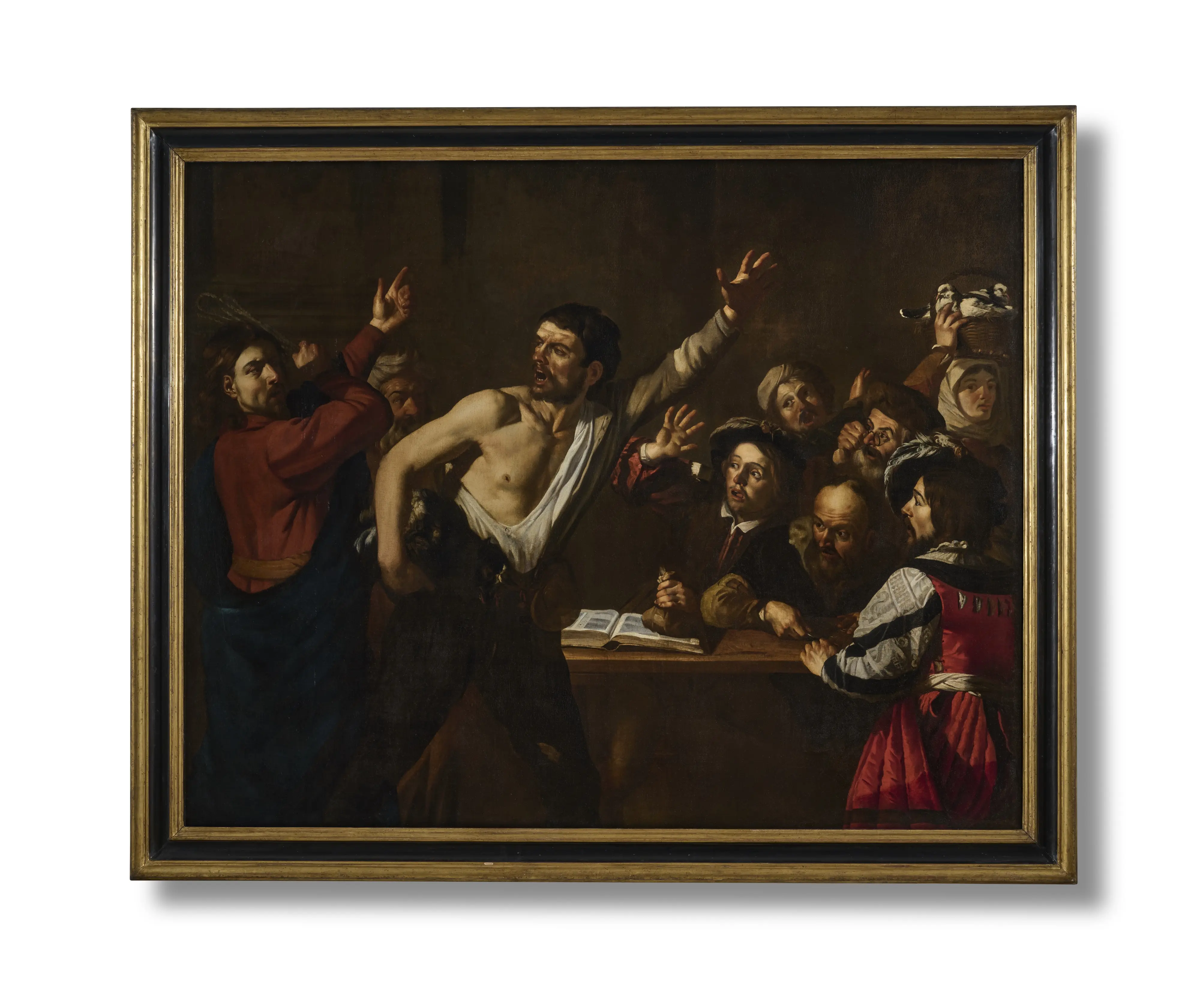
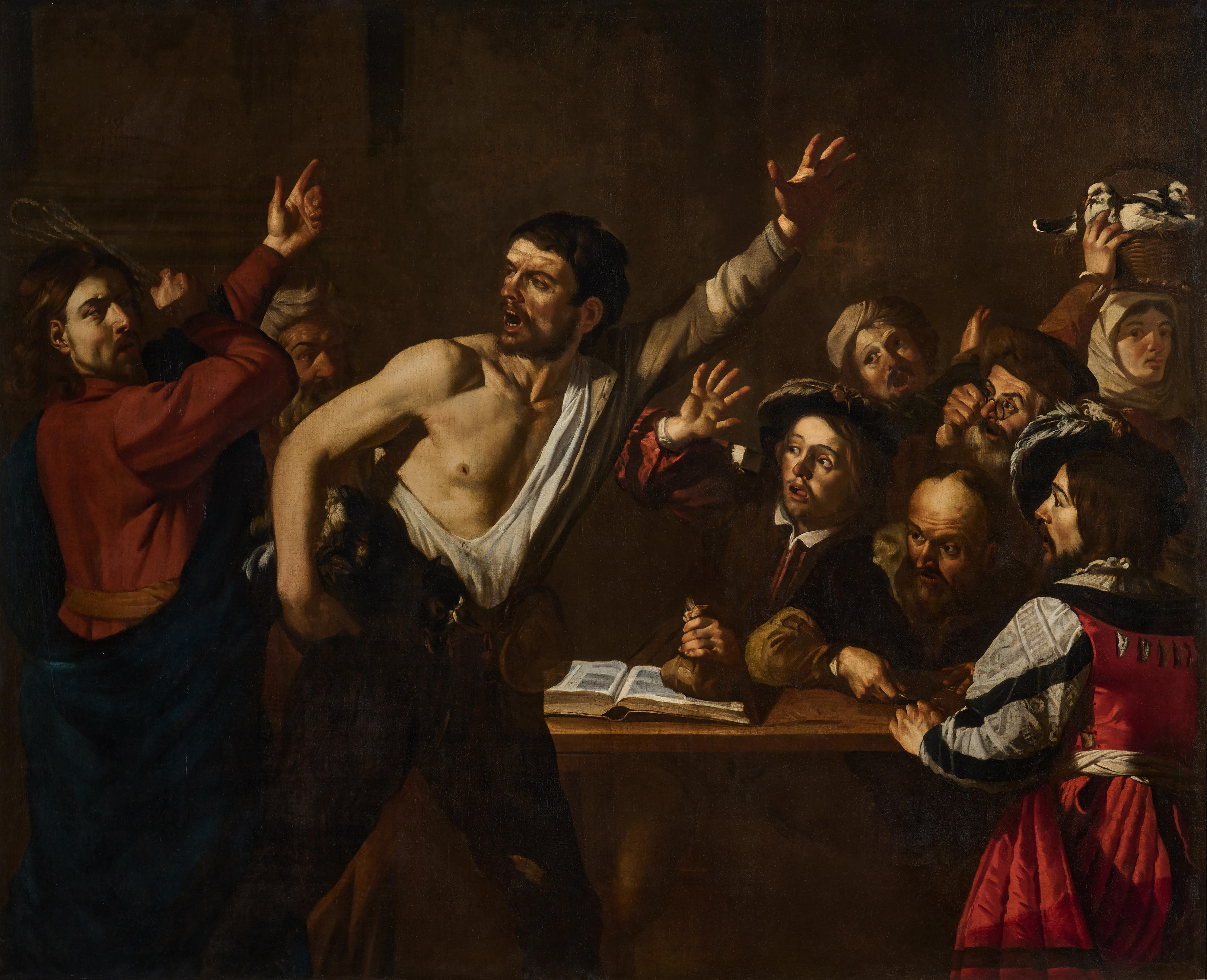
Christ Driving the Money Lenders from the Temple
c. 1618
Oil on canvas
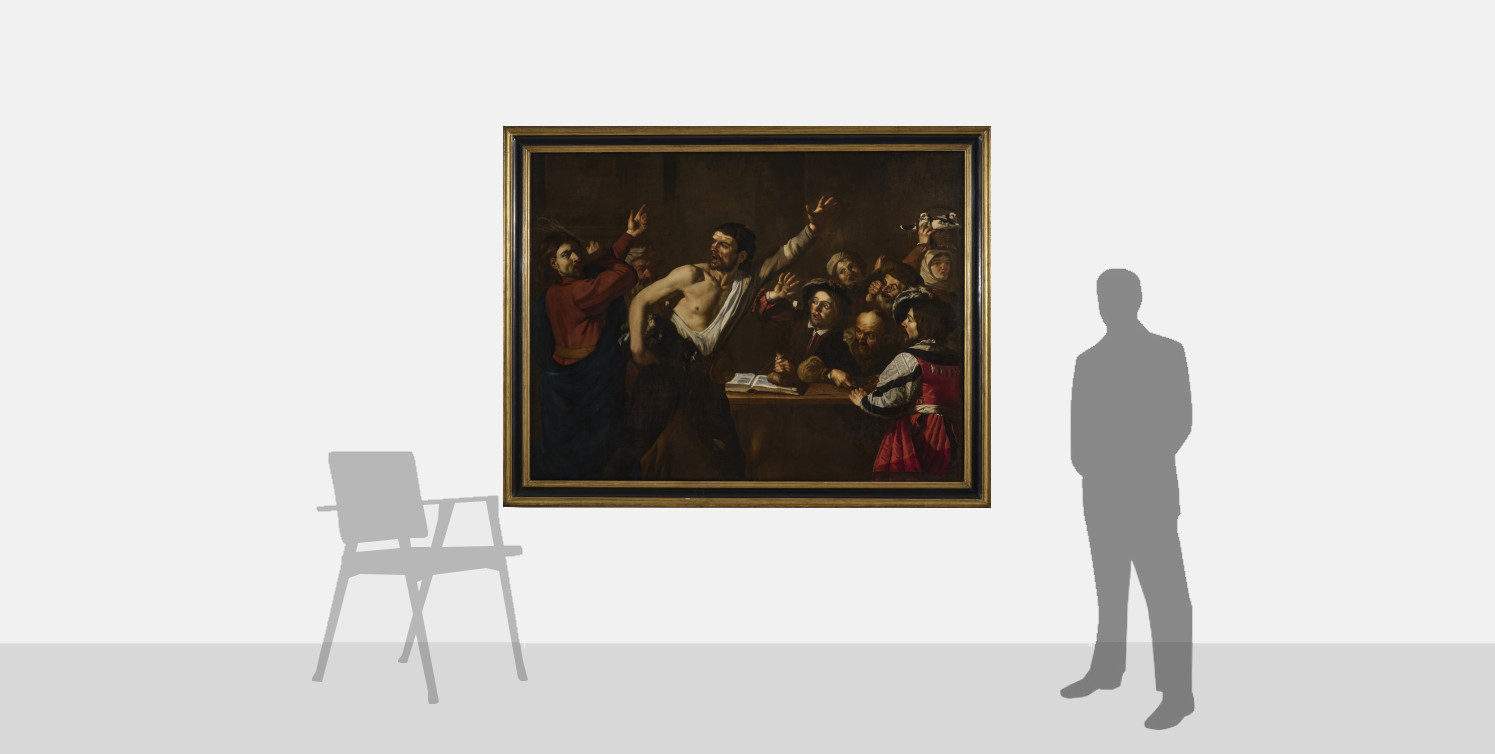
170 x 217 cm (66 7/8 x 85 3/8 in.)
Provenance
Possibly Manzitti Collection, Genoa.
(Christie's, Rome, 7 April 1987, lot 130, as by Nicolas Tournier),
Art market, Spoleto, 1987,
Private Collection, Turin.
Literature
B. Nicolson, Caravaggism in Europe, revised ed., 3 vols., ed. L. Vertova, Turin 1989., vol. 1, p. 93; vol. 3, fig. 1029, as by an unknown South Netherlandish Caravaggist (between Theodoor Rombouts and Baburen).
Old Master Paintings: An Exhibition of European Paintings from the 16th to the 19th Century, exh. cat., New York and London, 1991, n. p., illustrated, as dating c. 1617–18.
L. J. Slatkes, “Bringing Ter Brugghen and Baburen Up-To-Date”, Bulletin du Musée National de Varsovie, 37 (1996), pp. 204 no. 29, 204–5.
N. Hartje, Bartolomeo Manfredi (1582–1622); Ein Nachfolger Caravaggios und seine europäische Wirkung. Monographie und Werkverzeichnis, Weimar, 2004, p. 153 no. 582.
L. J. Slatkes and Wayne Franits, The Paintings of Hendrick ter Brugghen 1588–1629, Amsterdam and Philadelphia, 2007, p. 165.
W. Franits, The Paintings of Dirck van Baburen ca. 1592/93–1624: Catalogue Raisonné, Amsterdam and Philadelphia 2013, pp. 28–31; 95–96, no. A5, pl. 5; 97; 105, no. 7; 111.
G. Capitelli, “Dutch Caravaggists in Rome”, in Gert Jan Van der Sman, ed., Caravaggio and the Painters of the North, exh. cat., Madrid, 2016, p. 37, as possibly a “mélange” drawn from the oeuvre of Baburen and Ribera.
L. M. Helmus et al., Utrecht Caravaggio and Europe, exh. cat., Utrecht, 2018–19, p. 184.
Description
Dirck van Baburen was a leading member of the Utrecht Caravaggisti, a group of Dutch artists who moved from Utrecht to Rome in the early seventeenth century, and upon their return, introduced the dramatic chiaroscuro and intense realism of Caravaggio to the northern Netherlands. Fewer than forty autograph works are known by Baburen, whose untimely death at the age of thirty brought an abrupt end to his career. In 1612/13, the nineteen-year-old Baburen left the studio of Paulus Moreelse for Italy and spent most of his time there in Rome. Following the death of Caravaggio in 1610, the decade of Baburen’s arrival in the Eternal City witnessed the pinnacle of the Caravaggesque movement in Rome, owing to the popularity of his novel style, both among patrons and the influx of talented artists who practiced it. With few exceptions, most of the dozen or so works dated from Baburen’s prized Roman period consist of religious subjects.
Christ Driving the Money Changers from the Temple ranks among the artist’s most impressive creations. This imposing canvas depicts an episode from Christ’s life that is told in all four gospel books (Matthew 21:12–17; Mark 11:15–19; Luke 19:45–48; and John 2:13–16). In these accounts, we learn that Christ had traveled to Jerusalem during Passover and upon entering the Jewish Temple, he became enraged at the presence of money changers and merchants selling cattle, sheep and doves. Accusing them of turning the Temple into a “den of robbers” because of their iniquitous activities, Christ proceeded to drive these men and their animals out the sacred space with a whip of cords, overturning their money-changing tables in the process.
Baburen deftly focuses on the climax of the biblical tale: an energetic, furious Christ points upward, presumably to heaven, with one hand, while wielding a whip in the other. He is about to strike a screaming, fleeing man, who has secured one of the animals for sale under his arm. Below, to this man’s right, another recoils in terror, grasping his money bag but sensibly raising his other arm to protect himself in anticipation of receiving the next blows. His fellow merchants react as well, with one adjusting his pince-nez to get a better look at the violence unfolding before him. Any seventeenth-century viewer would have recognized the motif of the pince-nez as a cogent symbol of his (and his mercantile comrades’) moral blindness. Only one figure in Baburen’s scene stands passively aloof: a woman at the right edge of the painting with a basket of doves on her head, who gazes directly at the viewer.
Christ Driving the Money Changers from the Temple was painted around 1618, during one of the busiest periods of Baburen’s approximately eight-year sojourn in Rome. For centuries its whereabouts had been unknown, until it suddenly surfaced on the art market in 1987. This striking picture has recently reemerged for only the second time in thirty-three years.
In addition to representing a major achievement within the master’s Italian-period oeuvre, perhaps more than any other of his pictures from this period, it has rich ties to the complex artistic milieu of early seventeenth-century Rome, specifically revealing the Dutch artist’s familiarity with an earlier version of the same subject by Manfredi, painted around 1616–17 (Musée des Beaux-Arts et Archéologie, Libourne). In the late seventeenth-century, the Italian antiquarian and art critic, Giovan Pietro Bellori, described Manfredi’s Christ Driving the Money Changers from the Temple as a picture he had seen hanging in the palace of the “Signori Verospi” (Giovan Pietro Bellori, Le vite de’ pittori scultori e architetti moderni (1672), 2 vols., 2nd ed., ed. by E. Borea, Turin, 2009, vol. 1, p. 234). Baburen’s most important Roman patron, the Spanish collector, Pietro Cussida, lived in the same street in Rome as the Verospi, a wealthy family of merchants originally from Spain who were also sophisticated art collectors. It is highly likely that Cussida and the Verospi were acquainted, and it was through this connection that Baburen had the opportunity to view the Verospi collection and thus the Manfredi Money Changers.
Baburen must have studied the composition of the Italian master’s painting rather closely, and recognised its derivation from Caravaggio’s famous Calling of Saint Matthew in the church of San Luigi dei Francesi in Rome, which he also most assuredly knew. In essence Baburen’s picture constitutes a variation upon Manfredi’s. Although the agitated figures seated at the table are similar, Baburen has turned Christ in space and placed his arm in a poised position, poised that is, to release his whip on the greedy merchants. Even more significant, in terms of his having imbued his rendition of the subject with more drama than Manfredi had conveyed, is his replacement of the latter’s seated and hunched over figure in the foreground with one standing, who screams and recoils in terror. Baburen has also adapted Manfredi’s lighting effects to enhance the overall air of alarm and dread.
The noted French Caravaggist, Valentin de Boulogne (1591–1632), was also captivated by Manfredi’s art during his period in the Eternal City. In its architectural setting, general compositional structure, and such specific motifs as the table grouping and the seated recoiling figure immediately across from Christ, Valentin’s Christ Driving the Money Changers from the Temple (Galleria Nazionale d’Arte Antica, Rome) evinces his knowledge of Manfredi’s picture. And like Baburen, the Frenchman has altered what he saw in the painting by Manfredi: an additional panicked figure appears at the lower left of the canvas and, quite wonderfully, he includes a pair of legs jutting out from beneath the table, along with an arm and shoulder, to intimate the presence of a merchant desperately seeking shelter from the raging Christ’s forceful blows.
Baburen returned to the subject of Christ driving the money changers shortly after he resettled in Utrecht, in a canvas signed and dated 1621 (Schorr Collection, United Kingdom). Its derivation from the present version is most obvious in the pose and position of the energetic Christ wielding the lash and that of the fleeing merchant immediately in front of him, with his left arm outstretched in terror. Manfredi’s depiction of this subject continued to inform Baburen’s own representation, as did, to a lesser extent, Caravaggio’s Calling of Saint Matthew, both canvases had clearly made an indelible impression upon him. This second, Utrecht-period version likewise includes the monumental fluted columns of the Jewish temple, thus echoing Manfredi’s setting for the story, while the men at the table, particularly the armed bravo at the far right, are quite Caravaggesque A similar ruffian appears in our earlier version of this subject.
Thus, Christ Driving the Money Changers from the Temple is one of Baburen’s most significant pictures because of its demonstrable links to the art of Manfredi and prominent collectors in early seventeenth-century Rome as well as its importance for the Dutchman’s second version of this subject.
This work is accompanied by an expertise by Professor Wayne Franits.