
Lucio Fontana
b. 1899, Rosario de Santa Fé, Argentina
d. 1968, Comabbio, Italy
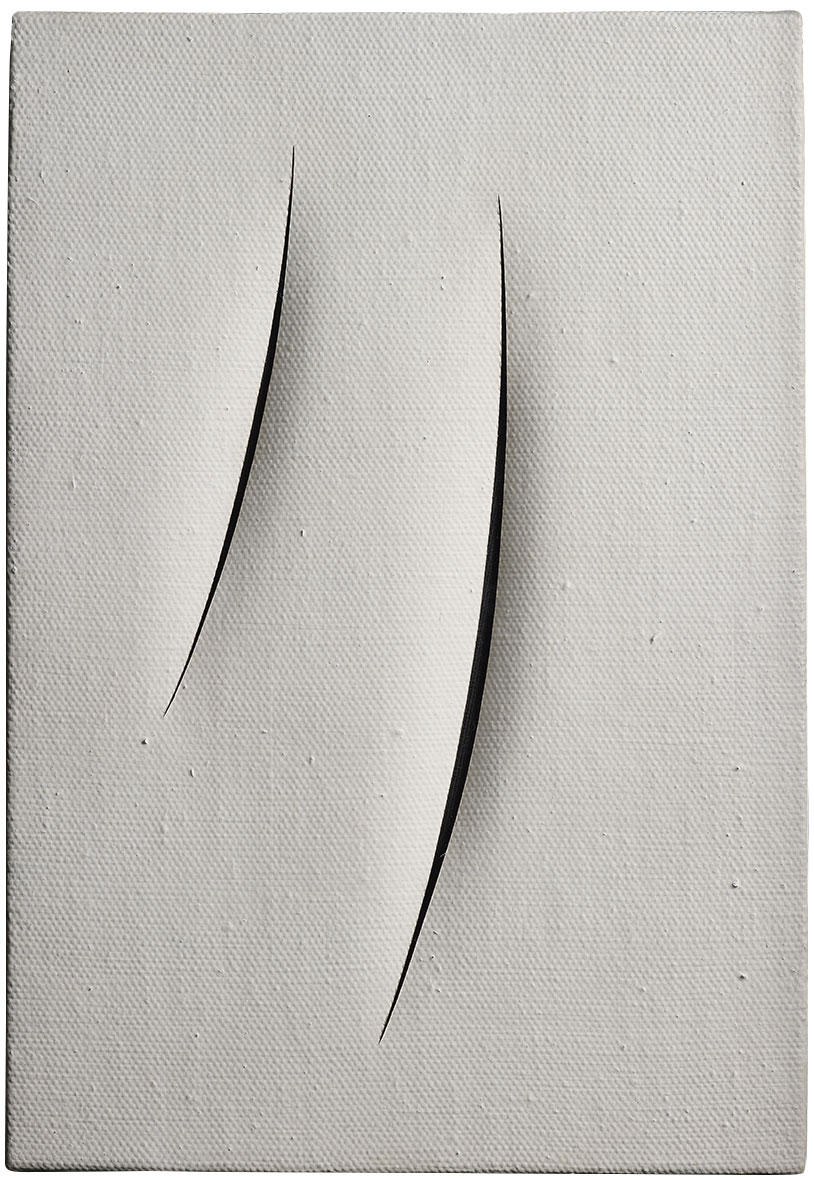
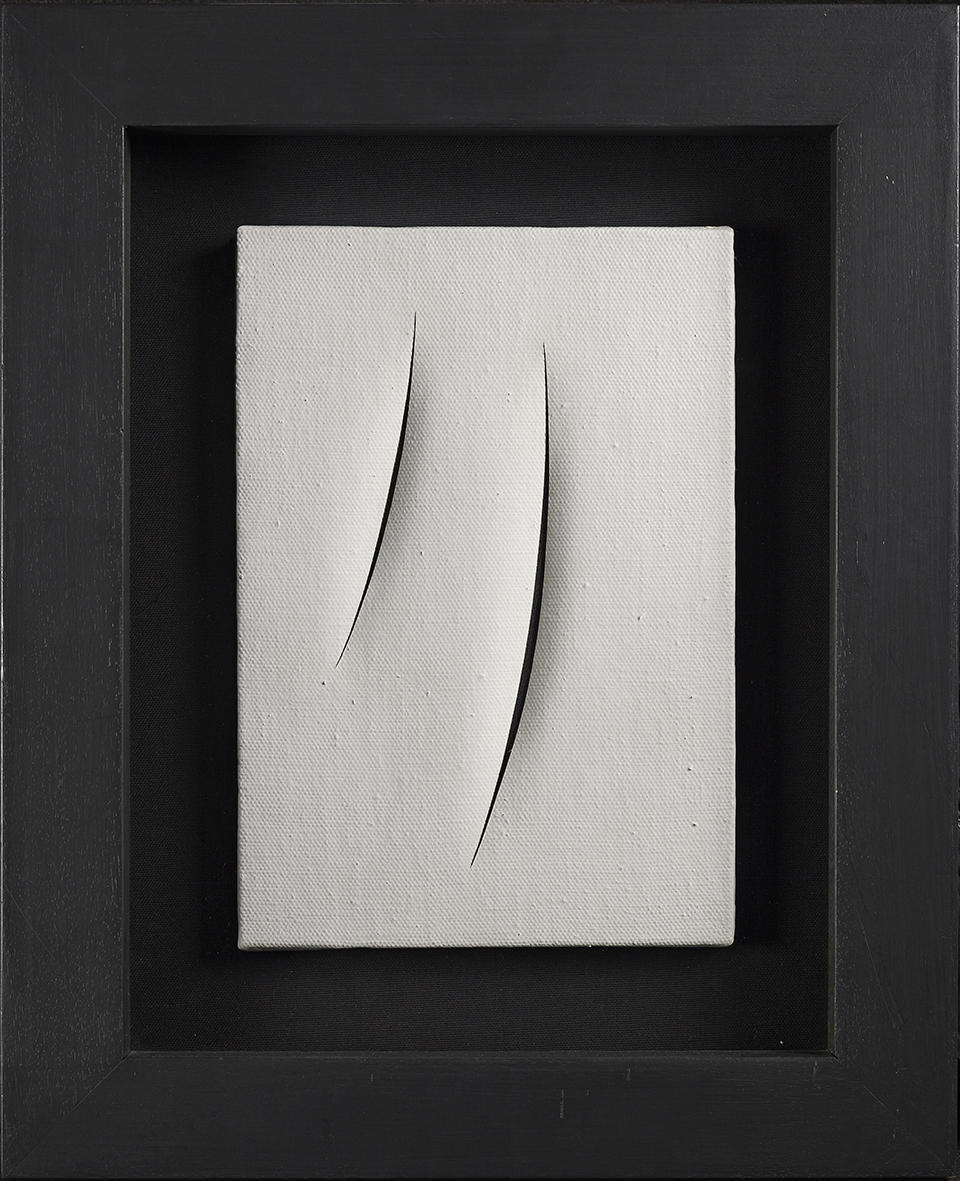
Concetto Spaziale, Attese (Spatial Concept, Waiting)
1961
Water-based paint on canvas
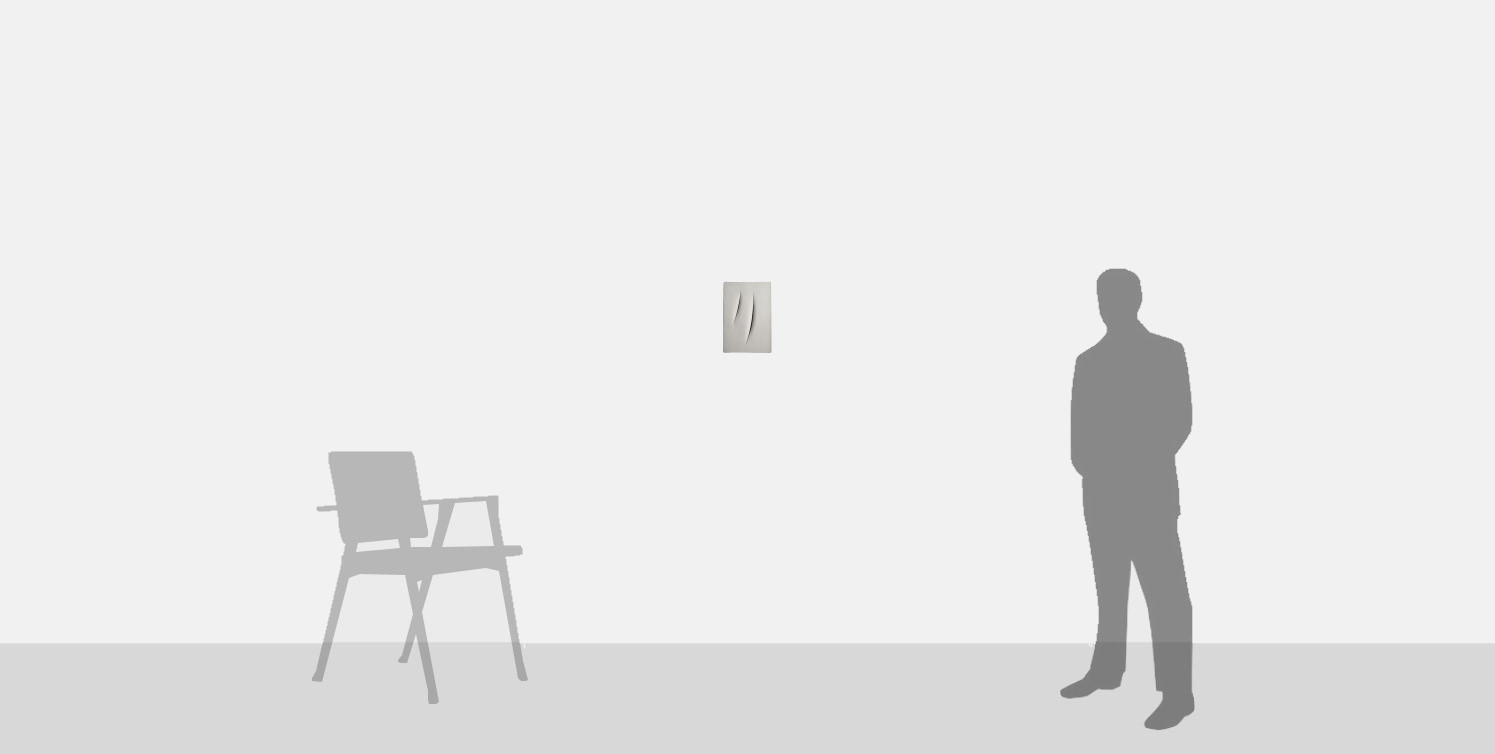
32 x 22 cm (12 5/8 x 8 5/8 in.)
Provenance
Literature
E. Crispolti, Lucio Fontana. Catalogo ragionato di sculture, dipinti, ambientazioni, Milan, 2006, II, p. 624, no. 61T85.
Description
“With the taglio I have invented a formula that I think I cannot perfect…I succeeded in giving those looking at my work a sense of spatial calm, of cosmic rigour, or serenity with regard to the infinite. Further than this I could not go.”—Lucio Fontana (quoted in Pia Gottschaller, Lucio Fontana: The Artist’s Materials, Los Angeles, 2012, p. 58)
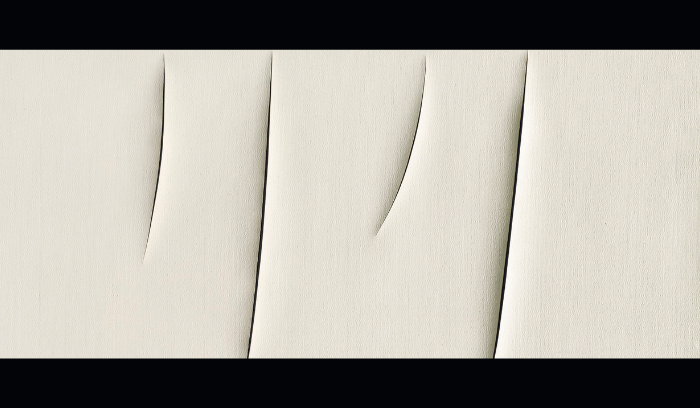
This beautiful Concetto Spaziale is one of a series of works Fontana made in Milan between 1958 and 1968. These works, which all consist of a surface that has been sliced once or multiple times, are collectively known as the tagli (cuts). Considered together, they are Fontana’s most extensive and varied group of works and they have come to be seen as emblematic of his gestural aesthetic.
Fontana first began puncturing the surface of paper or canvas in the late 1940s, blurring the distinction between two- and three-dimensionality. Recognising the importance of this innovation, he continued, through the 1950s and 1960s, to seek different ways of developing the hole as his signature gesture. The first tagli were made in the late summer and early autumn of 1958. They comprised small, often diagonal incisions, composed in groups over unprimed canvases. During 1959 these tentative slits evolved into single, more decisive slashes, and soon thereafter into multiple slices, each cut was made with a single gesture using a sharp blade.
Fontana experimented with both the size and shape of the tagli and painted many of the canvases in bright monochrome colours. In the instances in which Fontana slashed an unpainted canvas, there is a particular affinity between the rawness of the surface and the primordial character of the gesture itself. Destruction and creation were bound together in these works—the same gesture that negated the canvas as a purely pictorial vehicle also opened up its sculptural possibilities.
Although Fontana experimented with a variety of colours for his monochrome tagli, he concluded that white was the ultimate hue to attain the sense of limitless, infinite space and radiant luminosity that he wanted to convey with these works. White, the artist said, is the “purest colour, the least complicated, the easiest to understand”, that which most immediately and most successfully conveyed the “pure simplicity” and the “pure philosophy” which preoccupied him in the later years of his career.
Potent in their simplicity, the pristine white contrasts with the abyss of blackness beneath the two slashes, which became a 'ground zero' of previously unimagined freedoms, ideas, and potentials in the post-war era. Works like the present one, with their slashed surfaces defying the limitations of matter and opening up a fourth dimension, were to Fontana’s way of thinking united in spirit with the astronauts of the era making bold new steps into space; both offer an optimistic vision of man’s role in the unfolding infinity of the universe. “When I sit down to contemplate one of my cuts, I sense all at once an enlargement of the spirit,” Fontana said. “I feel like a man freed from the shackles of matter, a man at one with the immensity of the present and of the future" (quoted in Luca Massimo Barbero, Lucio Fontana: Venice/New York, exh. cat. Guggenheim Museum, New York, 2006, p. 23).
The artwork described above is subject to changes in availability and price without prior notice. Where applicable Artist Resale Rights will be added.