
Joseph Wright of Derby
b. 1734, Derby
d. 1797, Derby
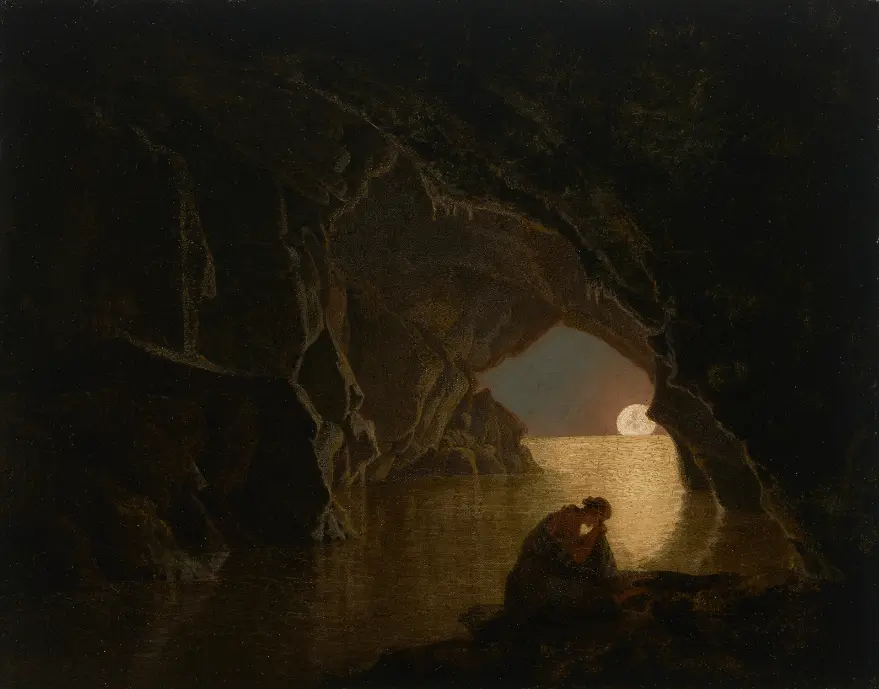
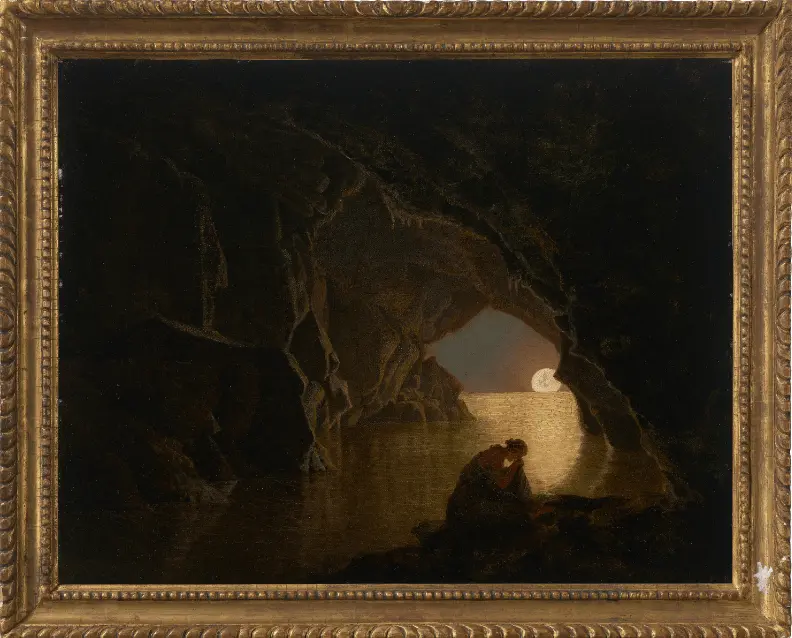
A Grotto in the Gulf of Salerno, with the Figure of Julia
c. 1770s
Oil on canvas
40.3 x 51.1 cm (15 7/8 x 20 1/8 in.)
Provenance
Richard Arkwright (1755–1843), by descent to his third son,
Peter Arkwright (1784–1866), by descent to his son,
Frederick Arkwright (1806–1874), by descent to his son,
Frederick Charles Arkwright (1853–1923), (probably) by descent to his son,
Richard Alleyne Arkwright (1884–1965), Willersley Castle, until 1927.
Cyril Plant (1910–1986), by whose heirs sold,
Christie's, London, 14 July 1989, lot 56;
Private collection.
Literature
J. Egerton, Joseph Wright of Derby (1734–1797), exhibition catalogue, London, Paris and New York, 1990, p. 102, under no. 59.
Description
Wright of Derby’s surpassing play of light and shadow, exemplary of his distinctive Romantic aesthetic, is displayed in A Grotto in the Gulf of Salerno, with the Figure of Julia. Created following his return from his European Grand Tour, the painting embodies the fashionable concept of the Sublime, with the tragic figure dwarfed by the craggy folds of the cave.
Wright set sail for Italy in November 1773 with his pregnant wife, Hannah, as well as his pupil, Richard Hurleston and the artist John Downman. The group arrived in Nice in December and then visited Genoa and Leghorn before travelling to Rome in February 1774. Wright’s visit to Naples from Rome, between October and November 1774 arguably the greatest impact on the artist during his Italian sojourn. He left Rome in June 1775, passing through Florence, Bologna, Venice, Parma and Turin before finally arriving back in Derby in September of that year. In fact, Wright painted very few of his Italian subjects in Italy, but were instead created when he returned to England, taking as their starting point the drawings and gouache sketches he had made on the Continent, as well as drawing upon a variety of other visual and literary sources available to him in England.
The drawing upon which the present painting was based was executed on the Gulf of Salerno in 1774 during Wright’s Neapolitan sojourn. It is one of two carefully observed plein air sketches of caves along the coast (the other related sketch belongs to the National Trust for Scotland, The Georgian House). These meticulously described cavern scenes were clearly consummate expressions of Wright’s Romantic sensibilities, for the artist used them as the basis for a number of paintings. The first of these he executed in Italy and are simple oil reworkings of the drawings (these are now held in the Yale Center for British Art, New Haven, and the Smith College Museum of Art, Northampton, Massachusetts). Yet upon Wright's return to England, the drawings became the basis for a number of large oil paintings into which he incorporated dramatic narrative elements. Ambitious among the ones that take Julia as its subject was exhibited in Covent Garden in 1797. Though lamentably this work is now lost, Wright’s description of it as ‘a dark cavern, faintly illuminated with a large glowing coloured moon…the figure of Julia sits on a rock in the foreground her head down to her knees’, denotes the direct relationship of that painting with the present work.
A second pair of works in which Wright employed his Salerno drawings were exhibited in 1778 and 1780. The first of these was A Grotto by the Sea-Side in the Kingdom of Naples, with Banditti: a Sunset (Museum of Fine Arts, Boston); the second, A Grotto in the Gulf of Salerno, with the Figure of Julia is now in a private collection. In this latter version, Julia is bathed in silvery morning light, rather than in that of the golden hues of the moon and she raises her hands in a gesture of anguish.
Antiquity offers a number of different Julias who could be the subject of Wright’s painting, yet academic consensus is that she is Julia, the only legitimate child of the Emperor Augustus, who spent much of her life as a pawn in her father's dynastic ambitions. She was first married to her cousin, Marcellus, the son of her father's sister, Octavia. Following her first husband’s early death, Augustus orchestrated a union with his general, Agrippa, some twenty-five years her senior. Histories at this stage begin to mention her adulteries, first with a nobleman named Sempronius Gracchus, and then to Augustus' stepson, and her stepbrother, Tiberius. When Agrippa died, Augustus married his daughter to Tiberius and stepson, thus rendering Julia mother and legally the sister of two of his heirs, Lucius and Gaius, and wife of another by 11 BC. In spite of her ostensibly secure position, Julia was arrested in 2 BC for adultery and treason; her father sent her a letter in Tiberius’ name declaring their marriage void, and he also accused her publicly of plotting to take his life. Several of Julia's supposed lovers were exiled, and Iullus Antonius, son of Mark Antony, committed suicide as a result. Disinclined to execute his own daughter, Augustus sent Julia into exile on the island of Pandataria, modern-day Ventotene, off the coast of Lazio. It is this heartrending episode in her already tragic life, exiled and alone, that Wright depicts.
Remarkably, the painting for generations belonged to the Arkwright family at Willersley Castle, members of whom were part of Wright’s close circle of acquaintances in Derbyshire society, the commercial and intellectual elite of the Midlands who were the driving force behind the Industrial Revolution. In 1790, Wright was commissioned to paint two full-length portraits of Charles Hurt of Wirksworth (1758–1834) and of his wife, Susannah Arkwright (private collection). Charles Hurt, who came from an old and distinguished family of Derbyshire landowners and industrialists, owned a lead-smelting business at Wirksworth, in the Derbyshire Dales, and was a successful mining engineer. His wife, Susannah, was the daughter of Sir Richard Arkwright, the inventor of the cotton spinning water-frame and the so-called “father of the modern industrial factory system”, which was a catalyst for the Industrial Revolution itself. Susanna’s marriage to Charles Hurt thus joined together two of the most influential families in southern Derbyshire. Her father and brother, Richard Arkwright Jr., were two of Wright’s most important patrons.
That the present painting belonged for generations to the Arkwrights should be no surprise given these close ties between the artist and these significant patrons, members of whose family are depicted in many portraits by Wright. Susannah’s brother, who was one of the artist’s most important patrons, is documented as having owned a number of works by Wright aside from family portraits; including his View of Ullswater Lake, one of the most famous of the artist’s late landscapes, which he acquired at Wright’s studio sale in 1801 (untraced); two of his Northern Tenebrist inspired exercises in exploring strong effects of chiaroscuro – a Boy blowing up a bladder and a Girl looking through a bladder (both in private collections), as well as the present painting.