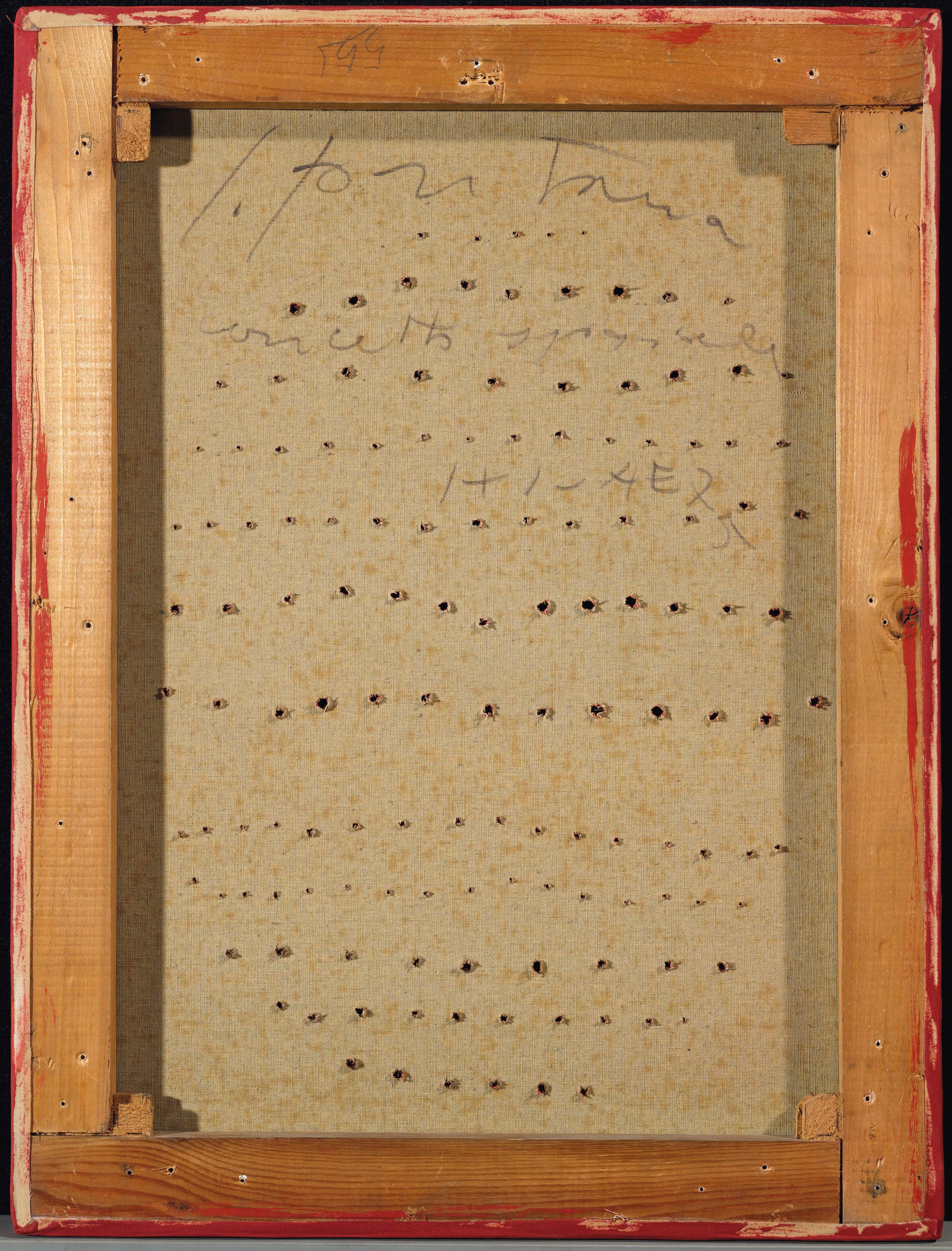


Lucio Fontana
b. 1899, Rosario de Santa Fé, Argentina
d. 1968, Comabbio, Italy
Concetto Spaziale (Spatial Concept)
1960
Water-based paint on canvas
61 x 46 cm (24 1/8 x 18 1/8 in.)
Provenance
Private collection, Milan;
Galleria Tega, Milan;
Private collection;
Christie’s, London, 30 June 2015, lot 56;
Private collection.
Literature
Enrico Crispolti, Lucio Fontana. Catalogo generale, Milan, 1986, vol. 1, p. 246, no. 60 B 41.
Enrico Crispolti, Lucio Fontana. Catalogo ragionato di sculture, dipinti, ambientazioni, Milan, 2006, vol. 1, p. 405, no. 60 B 41.
Description
“The discovery of the cosmos is a new dimension, it is infinity, so I make a hole in this canvas, which was at the basis of all the arts and I have created an infinite dimension…the idea is precisely that, it is a new dimension corresponding to the cosmos…The hole is, precisely, creating this void behind there…Einstein’s discovery of the cosmos is the infinite dimension, without end. And so here we have: foreground, middle ground and background…to go farther what do I have to do?…I make holes, infinity passes through them, light passes through them, there is no need to paint.”—Lucio Fontana (quoted in Carla Lonzi, Autoritratto, Bari, 1969, pp. 169–71)
“I do not want to make a painting—I want to open up a space.”—Lucio Fontana (quoted in Enrico Crispolti, Lucio Fontana. Catalogue Raisonné, Brussels, 1974, vol. 1, p. 7)
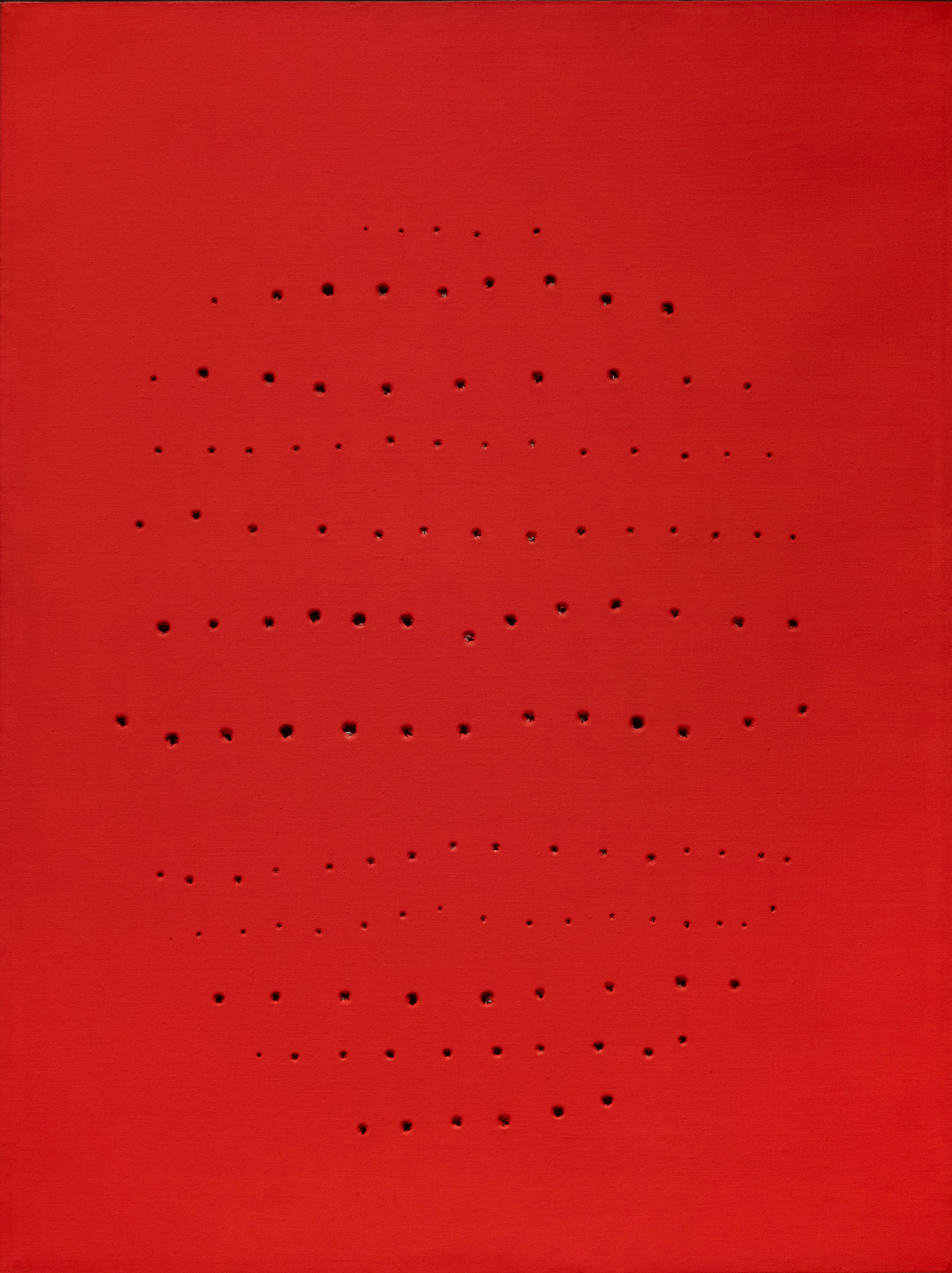
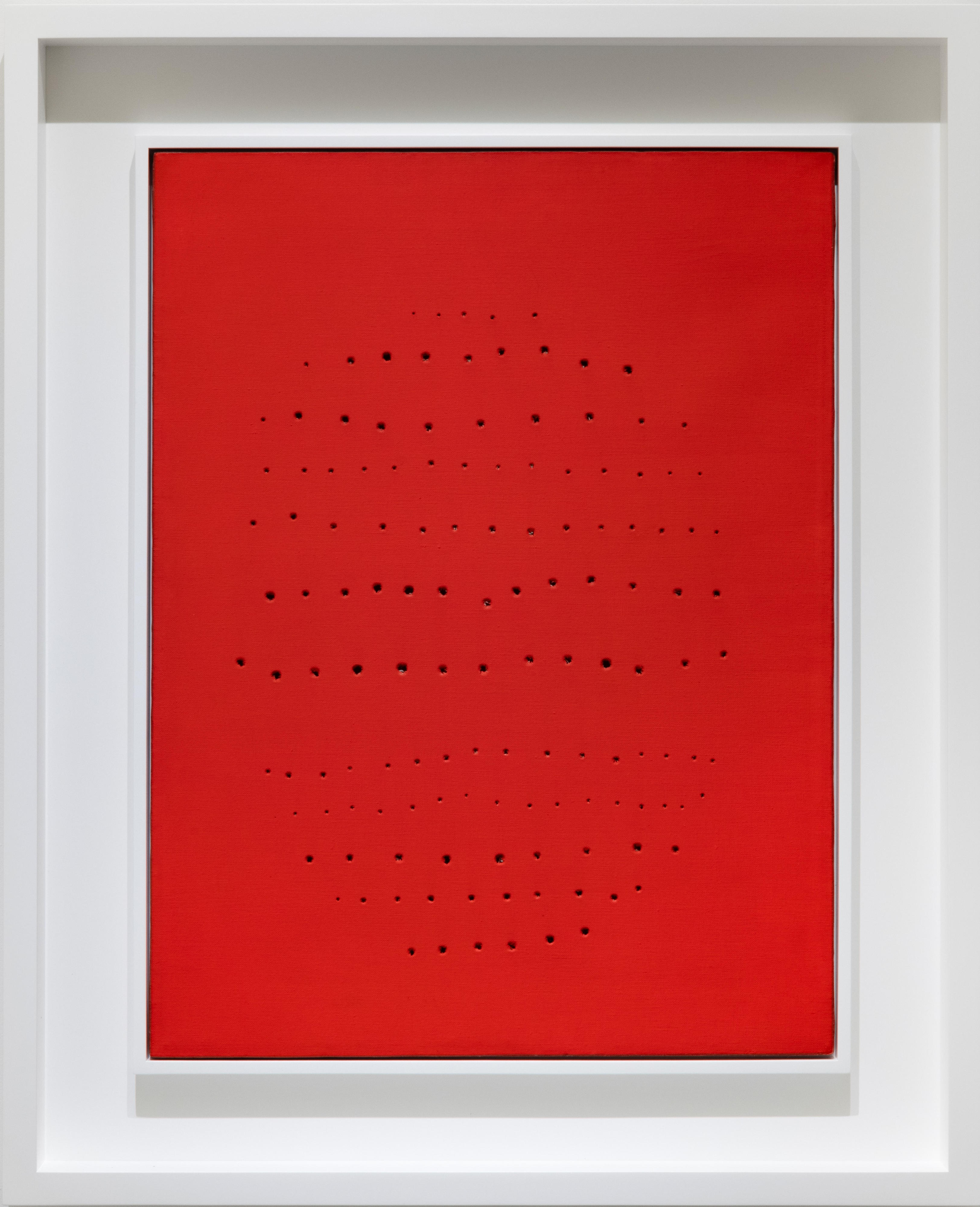
Created in 1960, Lucio Fontana’s Concetto Spaziale belongs to his ground-breaking series of buchi (holes). With its flaming red monochrome surface and its constellation of punctures arranged in an oval, the work relates to—and perhaps even anticipates—one of Fontana’s greatest series, La Fine di Dio (The End of God) begun in 1963. It was through his buchi that Fontana first began his explorations into the infinite dimensions beyond the canvas. By confronting and piercing the canvas, the artist physically and conceptually destroyed the two-dimensional pictorial plane as a locus of representation and form. In doing so, Fontana gave birth to a Spatialist art that goes beyond the limits of the traditional flat painted surface. Indeed, with this gesture, Fontana believed he had opened art to new and limitless creative possibilities.
Fontana originated the term Concetto Spaziale (Spatial Concept) in 1946, shortly after the publication of the Manifiesto Blanco, a treatise outlining the artistic precepts of a group of artists under Fontana’s leadership. The concepts articulated in the manifesto would be augmented further in the Manifesto dello Spazialismo, published in 1947. Together, these manifestos called for new forms of art that drew inspiration from the technological innovations now available to mankind. Fontana thus invited other artists of his time to release art from the burden of representation and overcome the constraints associated with traditional painting. Initiated in 1949, the buchi represented Fontana’s first elucidation of these new concepts.
Fontana’s enduring fascination with the cosmos and the exploration of space manifests in the present work through the instinctual and gestural, yet carefully calibrated, piercings coalescing into a veritable constellation on the surface of the canvas. The holes belie the artist’s movements, representing physical expressions of Fontana’s transcendence of the picture plane. Fontana’s lifelong preoccupation with space and light are also evident in the work’s vibrant red surface, glowing energetically as if from within. As the viewer passes in front of the canvas, light seems to pass through the holes, creating a fantastic shimmering effect that invites the eye to enter into the immaterial voids created by the buchi. The flat monochrome surface is at first glance deceptively serene, perhaps even devoid of artistic touch, yet this effect is dramatically interrupted by Fontana’s punctures, enacted with violence and precision to reveal the space that lies behind the seemingly but no longer sacred conventional picture plane.
The egg shape into which the holes are arranged might be understood as emblematic of the birth of a new conception of art. This concept was ultimately immortalised in the renowned Fine di Dio series, which features the same oval composition as the present work. The title Fine di Dio is a metaphor for the end of all religions, philosophies, and all other now obsolete earthbound thinking, while the ovoid form symbolises the genesis of a new era. By punctuating the canvas to form an egg-like shape, Fontana performed an act of destruction which is also, at the very same time, one of creation, giving vital form to the idea of the birth of a Spatial Art.
“I do not want to make a painting—I want to open up a space.”—Lucio Fontana (quoted in Enrico Crispolti, Lucio Fontana. Catalogue Raisonné, Brussels, 1974, vol. 1, p. 7)
Created in 1960, Lucio Fontana’s Concetto Spaziale belongs to his ground-breaking series of buchi (holes). With its flaming red monochrome surface and its constellation of punctures arranged in an oval, the work relates to—and perhaps even anticipates—one of Fontana’s greatest series, La Fine di Dio (The End of God) begun in 1963. It was through his buchi that Fontana first began his explorations into the infinite dimensions beyond the canvas. By confronting and piercing the canvas, the artist physically and conceptually destroyed the two-dimensional pictorial plane as a locus of representation and form. In doing so, Fontana gave birth to a Spatialist art that goes beyond the limits of the traditional flat painted surface. Indeed, with this gesture, Fontana believed he had opened art to new and limitless creative possibilities.
Fontana originated the term Concetto Spaziale (Spatial Concept) in 1946, shortly after the publication of the Manifiesto Blanco, a treatise outlining the artistic precepts of a group of artists under Fontana’s leadership. The concepts articulated in the manifesto would be augmented further in the Manifesto dello Spazialismo, published in 1947. Together, these manifestos called for new forms of art that drew inspiration from the technological innovations now available to mankind. Fontana thus invited other artists of his time to release art from the burden of representation and overcome the constraints associated with traditional painting. Initiated in 1949, the buchi represented Fontana’s first elucidation of these new concepts.
Fontana’s enduring fascination with the cosmos and the exploration of space manifests in the present work through the instinctual and gestural, yet carefully calibrated, piercings coalescing into a veritable constellation on the surface of the canvas. The holes belie the artist’s movements, representing physical expressions of Fontana’s transcendence of the picture plane. Fontana’s lifelong preoccupation with space and light are also evident in the work’s vibrant red surface, glowing energetically as if from within. As the viewer passes in front of the canvas, light seems to pass through the holes, creating a fantastic shimmering effect that invites the eye to enter into the immaterial voids created by the buchi. The flat monochrome surface is at first glance deceptively serene, perhaps even devoid of artistic touch, yet this effect is dramatically interrupted by Fontana’s punctures, enacted with violence and precision to reveal the space that lies behind the seemingly but no longer sacred conventional picture plane.
The egg shape into which the holes are arranged might be understood as emblematic of the birth of a new conception of art. This concept was ultimately immortalised in the renowned Fine di Dio series, which features the same oval composition as the present work. The title Fine di Dio is a metaphor for the end of all religions, philosophies, and all other now obsolete earthbound thinking, while the ovoid form symbolises the genesis of a new era. By punctuating the canvas to form an egg-like shape, Fontana performed an act of destruction which is also, at the very same time, one of creation, giving vital form to the idea of the birth of a Spatial Art.