
Lucio Fontana
b. 1899, Rosario de Santa Fé, Argentina
d. 1968, Comabbio, Italy
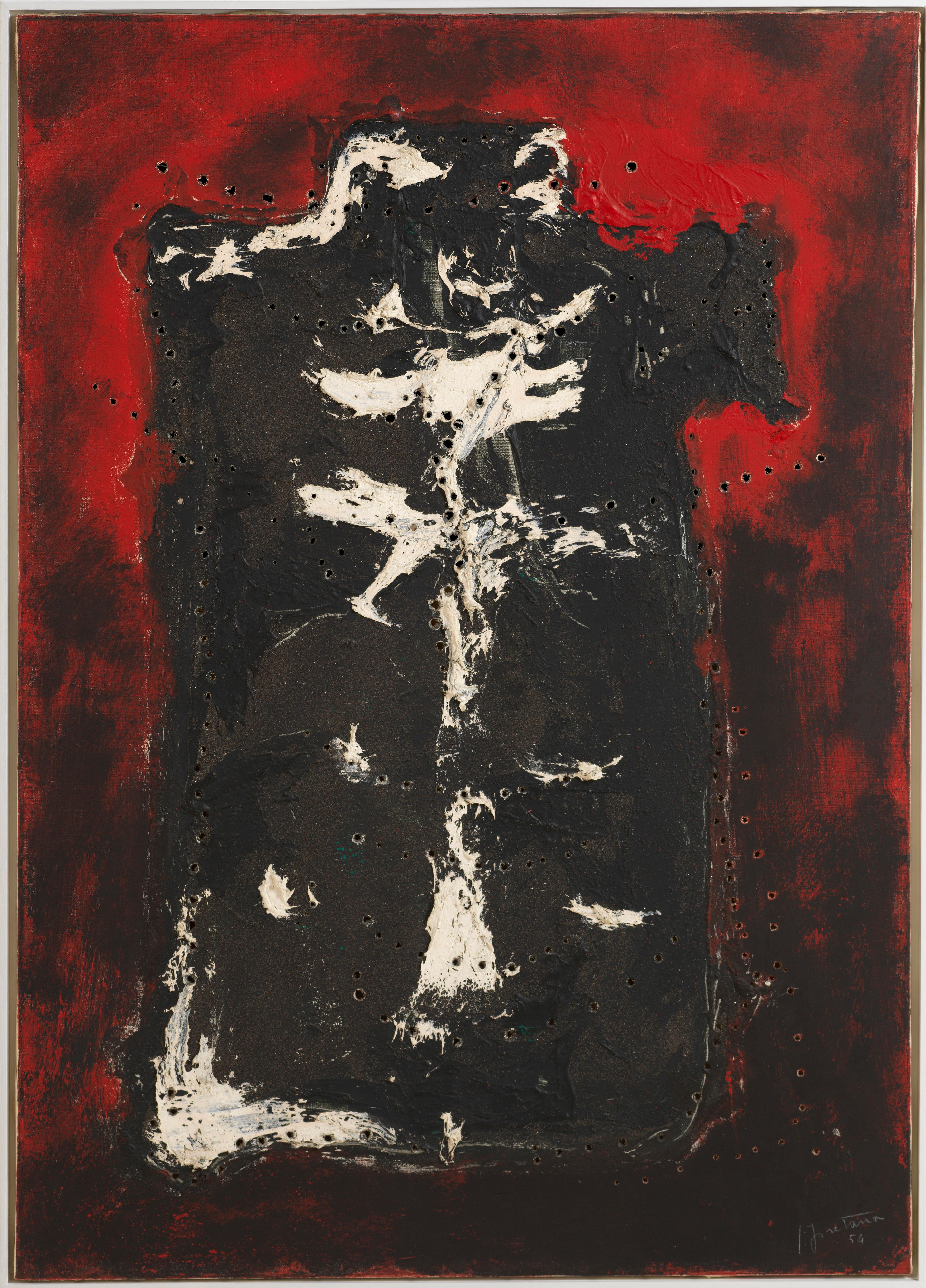
Concetto Spaziale (Spatial Concept)
1954
Oil, mixed media and sequins on canvas
100.5 x 70.5 cm (39 5/8 x 27 3/4 in.)
Provenance
Private Collection, Tortona,
Private collection, Switzerland.
Literature
R. Pasini, L'informale italiano, Parma, 1997, p. 73 (illustrated in colour).
E. Crispolti, Fontana. Catalogo generale di sculture, dipinti, ambientazioni, Geneva-Milan, 2006, I, p. 318 (illustrated).
Description
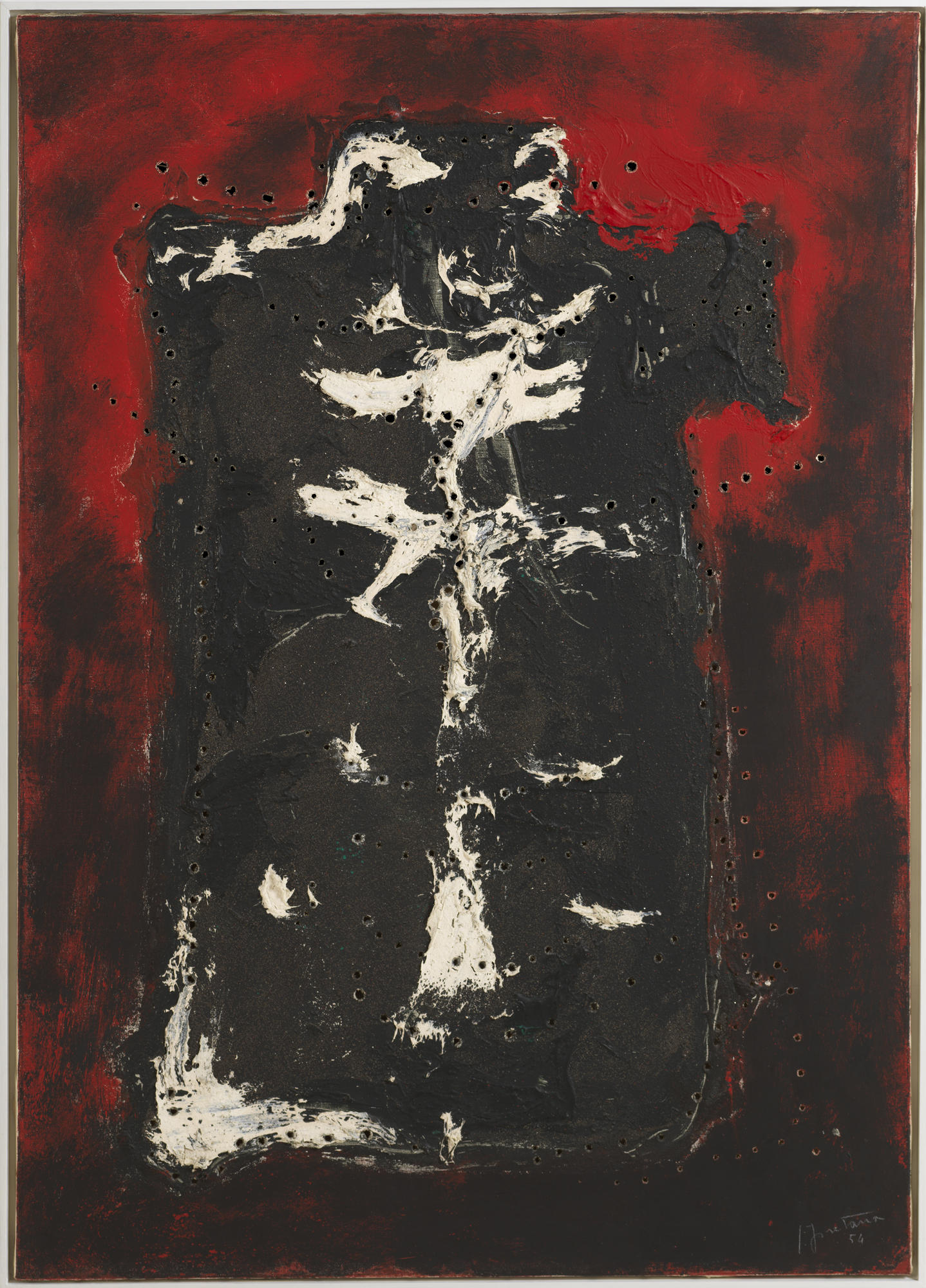
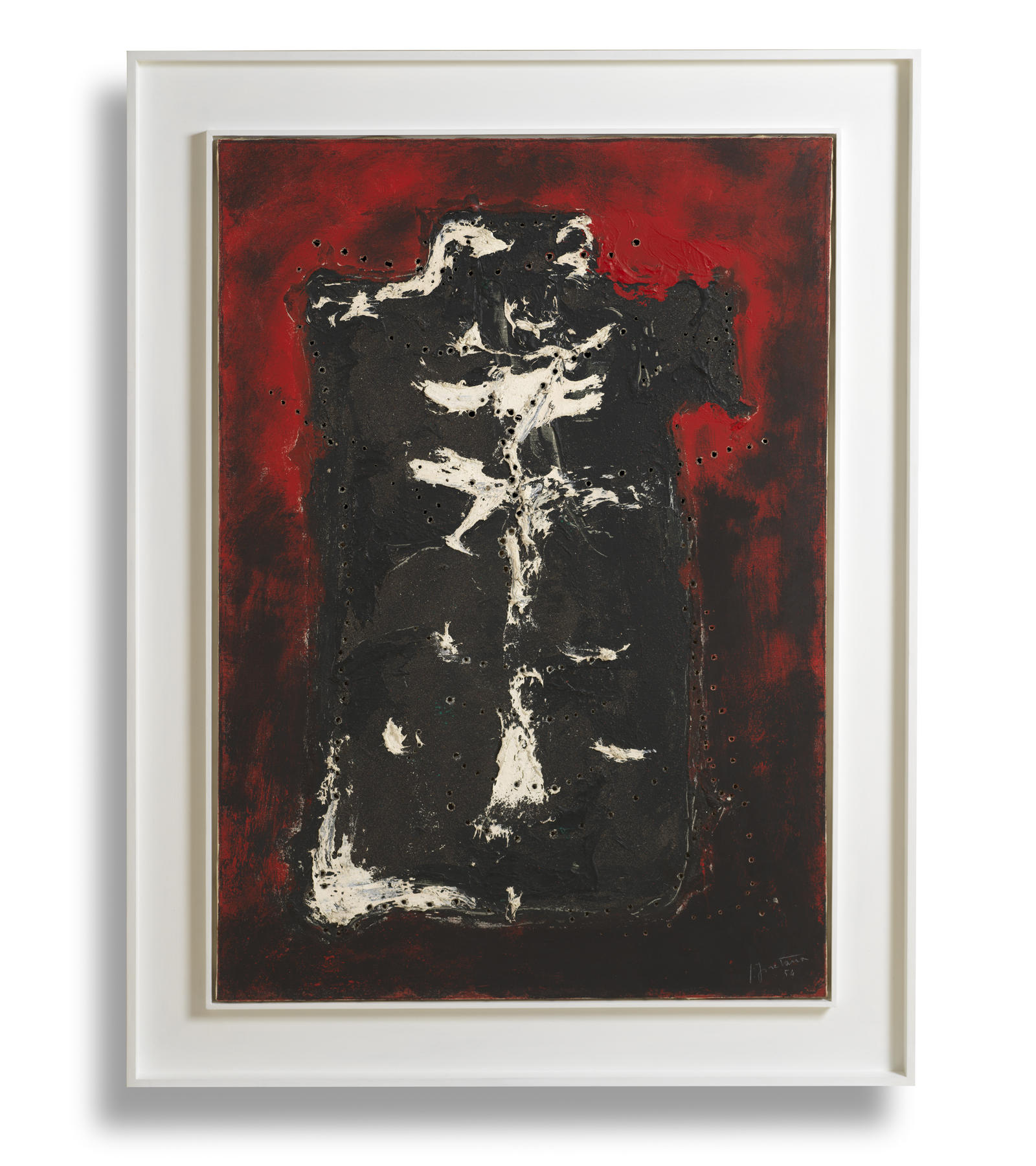
The present work represents one of Fontana’s early barocchi (baroque), a cycle of artworks initiated in 1954, introducing the artist’s most unapologetically emotive and gestural work. With visual aesthetics characterised by pictorial building blocks of holes, paint and glass fragments, barocchi artworks are defined by Fontana’s use of heavily impastoed paint for the depiction of signs. Placed against monochromatic backgrounds, he used fine and coarse sand in the impastoed areas, applying the mixture with a spatula. In addition, the signs sometimes vaguely allude to figures and the various pictorial elements are characterised by the dynamic ‘baroque’ accent that gives the cycle its name. The strong presence of an Informel vocabulary in these works reflects Fontana’s interest in the immediacy of the sign as expressed through the materiality of paint. With the Informel artists’ belief that that they could literally trace and inscribe the inner mental impulses through physical movement into thickly textured paint, Fontana’s barocchi embody the visual representation of such a concept. Concerning their artistic production, in samples taken from highly impastoed areas of two barocchi from 1956 the presence of PVA was confirmed. The PVA that is usually present in Fontana’s works tend to come from the use of house paints or Vinavil, an Italian adhesive, used as means of increased viscosity or as a binder.
In the group of almost fifty barocchi, the genesis of which has been documented photographically, it is likely that he used an already pigmented house paint for the first paint layer, on top of a thin white commercial primer. Fontana often added some sand to the first paint layer, rendering it light by revealing the white ground in little scratches caused by the grains being dragged through the wet paint. The formation of severe drying cracks in the impastoed paint films was prevented through the presence of bulking agents such as sand and often anthracite-coloured lustrini, small glittery particles that allowed the creation of a smooth, nonreflective surface. Lastly, the baroque style as interpreted by Fontana, is characterised by an artificial dynamism which results in explosive, gestural, curved shapes, occasionally altered shapes of the stretchers themselves, and heavily impastoed paint surfaces that are associated with the 'Informel' painters.
The artwork described above is subject to changes in availability and price without prior notice.
Where applicable ARR will be added.
In the group of almost fifty barocchi, the genesis of which has been documented photographically, it is likely that he used an already pigmented house paint for the first paint layer, on top of a thin white commercial primer. Fontana often added some sand to the first paint layer, rendering it light by revealing the white ground in little scratches caused by the grains being dragged through the wet paint. The formation of severe drying cracks in the impastoed paint films was prevented through the presence of bulking agents such as sand and often anthracite-coloured lustrini, small glittery particles that allowed the creation of a smooth, nonreflective surface. Lastly, the baroque style as interpreted by Fontana, is characterised by an artificial dynamism which results in explosive, gestural, curved shapes, occasionally altered shapes of the stretchers themselves, and heavily impastoed paint surfaces that are associated with the 'Informel' painters.
The artwork described above is subject to changes in availability and price without prior notice.
Where applicable ARR will be added.