
Lucio Fontana & Egidio Costantini
Concetto Spaziale (Spatial Concept)
1964/65
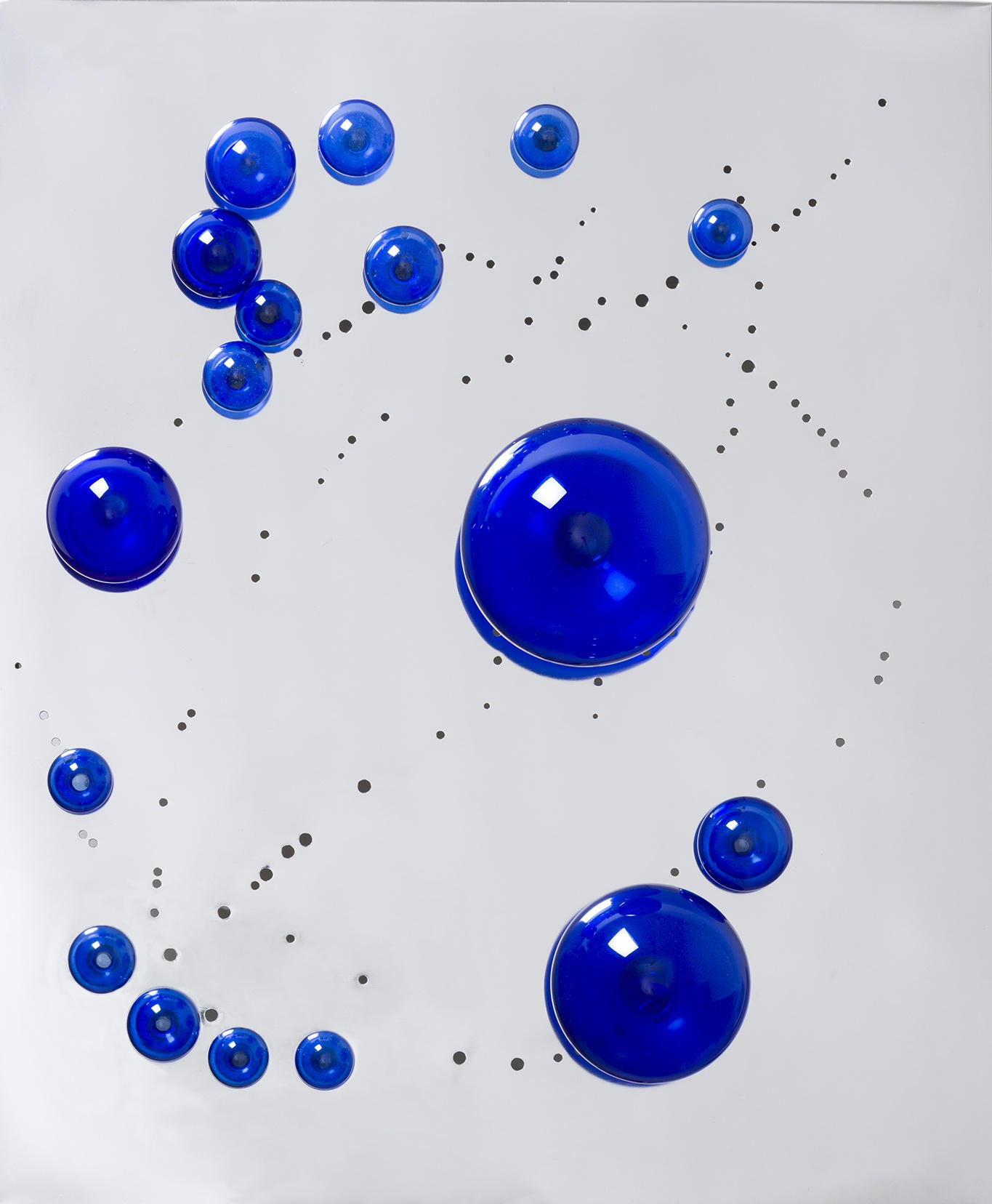
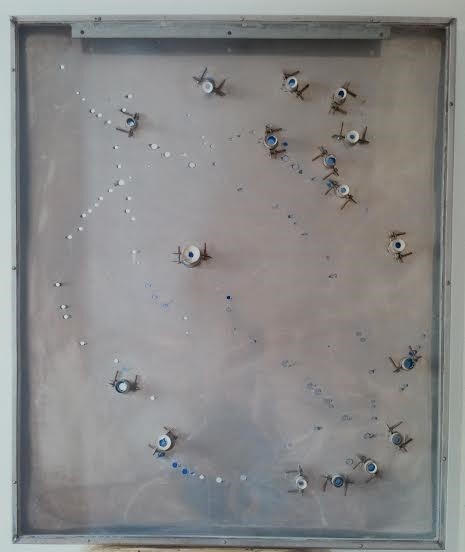
Metal sheet with perforations and seventeen glass balls
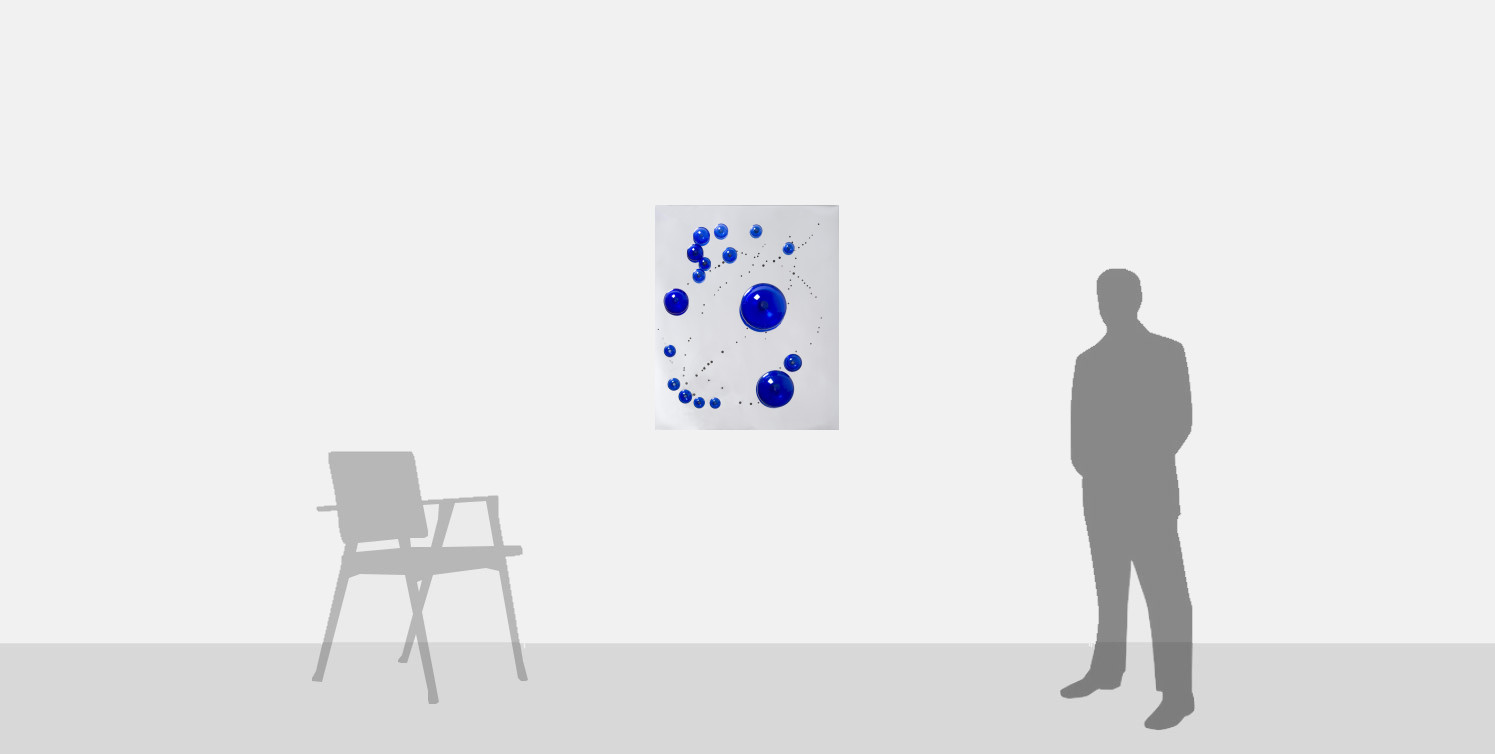
100 x 82 x 9.5 cm (39 3/8 x 32 1/4 x 3 3/4 in.)
Provenance
Galleria del Naviglio, Milan;
Private collection, Milan.
Description
Lucio Fontana was a founder of the Spatialist movement, a unique expression of the European Informel and an Italian answer to the American Abstract Expressionism. He wrote the manifesto of the movement in Argentina in 1946, and a year later he produced another one in Milan together with fellow artists who shared his new vision for an art which would unite space, time, colour, sound, and movement. Using new technology and industrial materials like neon lighting, TV, radio waves, and aluminium, Fontana explored gestural artmaking in unprecedented ways. At the climax of his artistic activity, he slashed a monochrome painted canvas, opening its two-dimensional plane onto a palpable and real third dimension, allowing the painting’s surface to become a portal to a quasi-mystical outer space.
In 1961, Paolo Marinotti, owner of the exhibition space at Palazzo Grassi in Venice, invited Fontana, along with Jean Dubuffet, Mark Rothko, Sam Francis, and others, to participate in an exhibition entitled “Arte e Contemplazione.” Fontana set to work on a number of canvases, applying thick paint to their surfaces to evoke the sensual richness of Venice. In the Venezia series, by manipulating paint with his fingers and various instruments, Fontana created furrows and stirred vortices that alluded to the Venetian sky, to the Baroque spirals of the city’s churches, and to the patterns formed by when moonlight touched water. Scattered fragments of Murano glass embedded in the canvases cast coloured shadows, evoking the delicacy of Veneto-Byzantine mosaics.
Another exhibition, this time in 1964 at the Galleria del Naviglio in Milan, prompted Fontana to work with Venetian glass once again. That year, the brothers Carlo and Renato Cardazzo, who owned the gallery, invited Egidio Costantini to organize an exhibition of glass sculpture. Born in Brindisi in 1912, Costantini moved to Venice with his family in 1918. Before embarking on his own glassmaking career, Costantini worked as an agent for several Murano glass factories, which allowed him to train with master glassblowers and learn the workings of the trade. With the aim of elevating the craft of glassblowing to the same level as that of sculpture or painting, he mediated collaborations between glassblowers and artists to create works in glass based on the designs of contemporary artists. He began to work with a group of Venetian artists and from this stemmed the founding in 1950 of the Centro Studio Pittori nell’Arte del Vetro di Murano. Four years later, he went to Paris to promote his project with the most famous artists of the day, and this led to collaborations with Alexander Calder, Gino Severini, Pablo Picasso, Jean Arp, Max Ernst, and others. In 1955, he opened a gallery in Venice devoted to the exhibition of these works, called the Fucina degli Angeli (the Forge of Angels).
Cardazzo suggested that for the exhibition at the Galleria del Naviglio, Costantini collaborate with Lucio Fontana. Costantini recalled, “Therefore I went and I met with him. The Master was uncertain at first, given the limited time available. However, his uncertainty quickly disappeared once he realised my enthusiasm, that enthusiasm and passion for glass that encouraged, in the past, some of the most notorious contemporary artists to join my art movement. Lucio Fontana was seduced by my love for glass and my thirst for glassmaking renovation. Together we chose some drawings to be realised. After the days in Milan I came back with spheres and discs of various colours he suggested or designed in the basement of his studio in Corso Monforte 23. The Master, together with me, composed several artworks on panels he prepared. It was wonderful to work alongside the Master.”
The exhibition opened on the evening of 19 December 1964, and the collaborative works by Fontana and Costantini—of which the present piece is a significant and beautiful example—proved a great success. In this work, the mixture of holes (bucchi) perforating the surface and the glass situated upon it recall the Baroque splendours of the Venezia series, while the composition, the glass elements and holes suggestive of islands on a topographical map, seem to allude to the lagoon city. Indeed, the spatial play between the luminescent materials and the voids, set against the shimmering silver surface, conjures a strong sense of surface and of floating, and of the scale of the vast open spaces that surround the city of Venice and which at dawn make it glitter like a jewel on the horizon line between the sea and the sky.
The present work was acquired directly from Galleria il Naviglio by its most recent owner and has been in the same collection for almost half a century. Among the works executed by Fontana and Costantini, this one is one of the largest and more complex, an impressive composition which testifies once again the experimental genius of Lucio Fontana.
The artwork described above is subject to changes in availability and price without prior notice. Where applicable ARR will be added.
In 1961, Paolo Marinotti, owner of the exhibition space at Palazzo Grassi in Venice, invited Fontana, along with Jean Dubuffet, Mark Rothko, Sam Francis, and others, to participate in an exhibition entitled “Arte e Contemplazione.” Fontana set to work on a number of canvases, applying thick paint to their surfaces to evoke the sensual richness of Venice. In the Venezia series, by manipulating paint with his fingers and various instruments, Fontana created furrows and stirred vortices that alluded to the Venetian sky, to the Baroque spirals of the city’s churches, and to the patterns formed by when moonlight touched water. Scattered fragments of Murano glass embedded in the canvases cast coloured shadows, evoking the delicacy of Veneto-Byzantine mosaics.
Another exhibition, this time in 1964 at the Galleria del Naviglio in Milan, prompted Fontana to work with Venetian glass once again. That year, the brothers Carlo and Renato Cardazzo, who owned the gallery, invited Egidio Costantini to organize an exhibition of glass sculpture. Born in Brindisi in 1912, Costantini moved to Venice with his family in 1918. Before embarking on his own glassmaking career, Costantini worked as an agent for several Murano glass factories, which allowed him to train with master glassblowers and learn the workings of the trade. With the aim of elevating the craft of glassblowing to the same level as that of sculpture or painting, he mediated collaborations between glassblowers and artists to create works in glass based on the designs of contemporary artists. He began to work with a group of Venetian artists and from this stemmed the founding in 1950 of the Centro Studio Pittori nell’Arte del Vetro di Murano. Four years later, he went to Paris to promote his project with the most famous artists of the day, and this led to collaborations with Alexander Calder, Gino Severini, Pablo Picasso, Jean Arp, Max Ernst, and others. In 1955, he opened a gallery in Venice devoted to the exhibition of these works, called the Fucina degli Angeli (the Forge of Angels).
Cardazzo suggested that for the exhibition at the Galleria del Naviglio, Costantini collaborate with Lucio Fontana. Costantini recalled, “Therefore I went and I met with him. The Master was uncertain at first, given the limited time available. However, his uncertainty quickly disappeared once he realised my enthusiasm, that enthusiasm and passion for glass that encouraged, in the past, some of the most notorious contemporary artists to join my art movement. Lucio Fontana was seduced by my love for glass and my thirst for glassmaking renovation. Together we chose some drawings to be realised. After the days in Milan I came back with spheres and discs of various colours he suggested or designed in the basement of his studio in Corso Monforte 23. The Master, together with me, composed several artworks on panels he prepared. It was wonderful to work alongside the Master.”
The exhibition opened on the evening of 19 December 1964, and the collaborative works by Fontana and Costantini—of which the present piece is a significant and beautiful example—proved a great success. In this work, the mixture of holes (bucchi) perforating the surface and the glass situated upon it recall the Baroque splendours of the Venezia series, while the composition, the glass elements and holes suggestive of islands on a topographical map, seem to allude to the lagoon city. Indeed, the spatial play between the luminescent materials and the voids, set against the shimmering silver surface, conjures a strong sense of surface and of floating, and of the scale of the vast open spaces that surround the city of Venice and which at dawn make it glitter like a jewel on the horizon line between the sea and the sky.
The present work was acquired directly from Galleria il Naviglio by its most recent owner and has been in the same collection for almost half a century. Among the works executed by Fontana and Costantini, this one is one of the largest and more complex, an impressive composition which testifies once again the experimental genius of Lucio Fontana.
The artwork described above is subject to changes in availability and price without prior notice. Where applicable ARR will be added.