
Lucio Fontana
b. 1899, Rosario de Santa Fé, Argentina
d. 1968, Comabbio, Italy
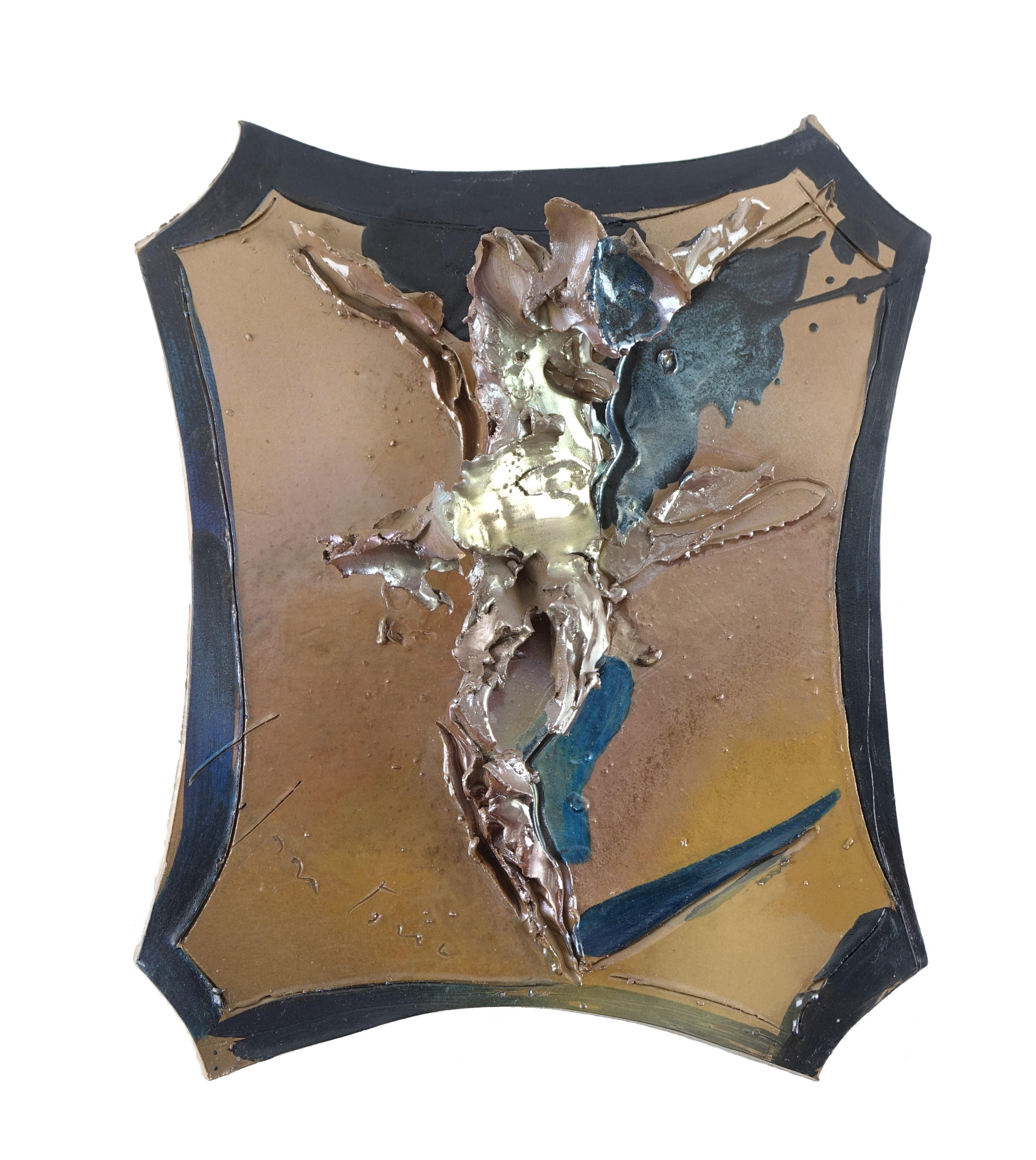
Crocifissione (Crucifixion)
1957–58
Engobed, painted and glazed terracotta
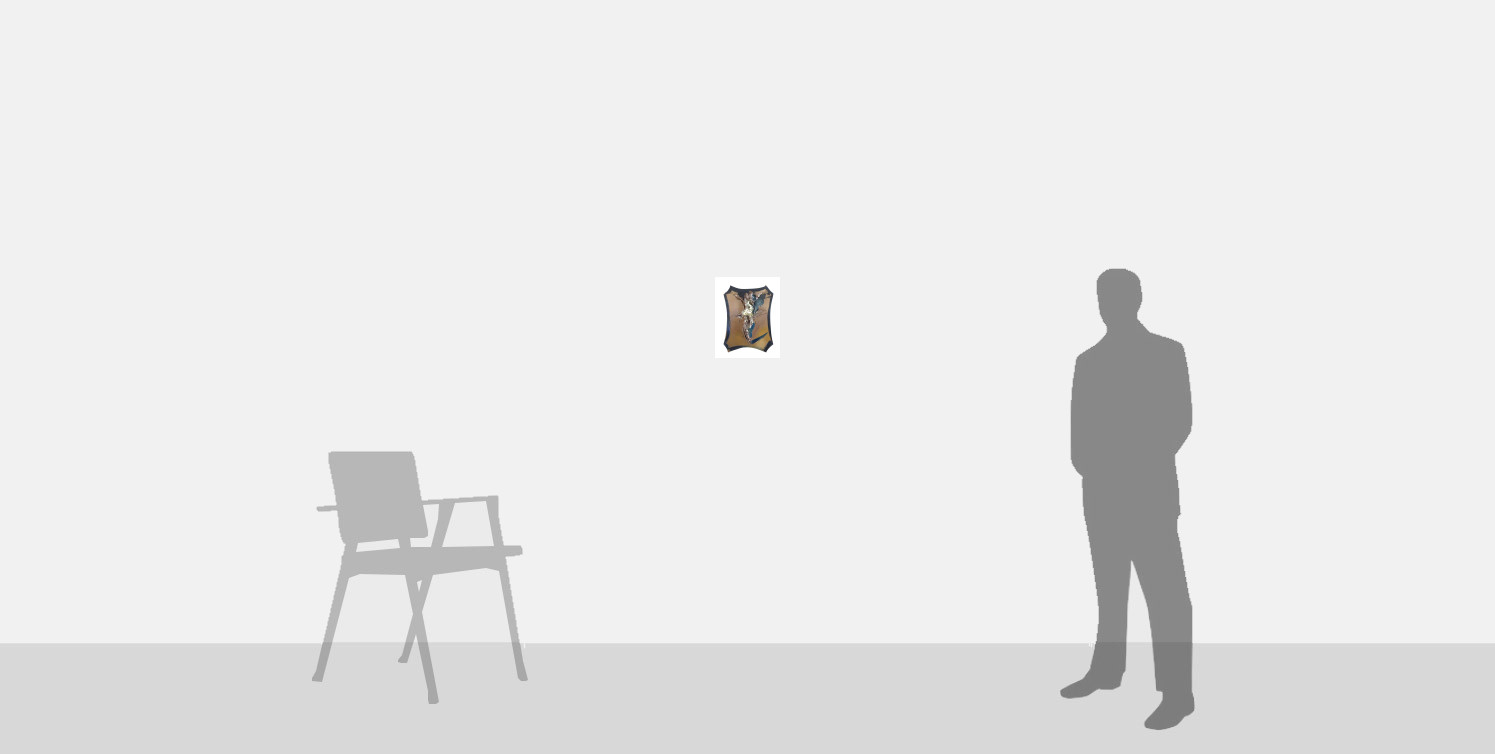
36 x 29 x 9.5 cm (14 1/8 x 11 3/8 x 3 3/4 in.)
Provenance
Private collection, Milan,
Private collection, Castiglione d'Adda.
Literature
Description
‘[the] Baroque was a leap ahead…it represented space with a magnificence that is still unsurpassed and added the notion of time to the plastic arts. The figures seemed to abandon the flat surface and continue the represented movements in space…’—Lucio Fontana
With its rich materiality and dynamic and expressive movement, Lucio Fontana’s Crocifissione is one of a series of ceramic sculptures that combines elements of figuration with the dominant ideas of Spatialism, the revolutionary movement founded by the artist. Fontana radically reimagined one of art history’s most iconic subjects, the Crucifixion of Christ, offering a near-abstract, gestural vision of this religious subject. The painterly application of brown and black paint complement the incisions into and modelling of the clay, the abstracted body of Christ, arms outstretched on the cross, appearing to emerge directly from the ceramic surface behind.
Executed between 1957 and 1958, this Crocifissione dates from one of the most experimental and innovative periods of Fontana’s long and prolific career. Regarding himself primarily as a sculptor, Fontana had, since his earliest days as an artist, been interested in the medium of sculpture – indeed, he undertook his apprenticeship under his father who was a sculptor of funerary monuments.
Having worked in a variety of different sculptural modes, both figurative and abstract, Fontana returned to Milan from Argentina (where he had spent the War years) in 1947 with a radically new artistic outlook. Believing in the wake of the Second World War that traditional modes of painting and sculpture were outdated, and unable to reflect the modern epoch, Fontana called for a reformation of the visual arts. He envisaged art coming out of its frames and off its plinths to embody dynamic concepts of movement, colour, time and space, freed from the conventional artistic categories of painting, sculpture and architecture. These ideas coalesced into what Fontana called Spatialism. “Man is tired of the forms of painting and sculpture”, he declared in the Manifiesto Blanco, a tract penned by Fontana in 1946. “The oppressive repetitions show that these arts have stagnated in values that are extraneous to our civilization, and have no possibility of development in the future…we abandon the practice of all the forms of known art, we commence the development of an art based on the unity of time and space…” (Manifiesto Blanco, 1946, quoted in E. Crispolti and R. Siligato, eds., Lucio Fontana, exh. cat., Rome, 1998, p. 116).
Alongside this belief in the need for a new conception of art for the modern era, Fontana also looked to past artistic models for reference and inspiration. The Baroque was a particularly important period in Fontana’s eyes, the gesture and evocation of movement into space aligning with his ambitions for his own art. In the present work, Fontana’s admiration for the Baroque is evident in both subject and form. The subject of the Crucifixion transcends time, echoing the long tradition of such representations in European art; furthermore, the execution of the sculpture, with its passionately and energetic forms, and allusion to chiaroscuro in both the paint and the physical shadows cast by the peaks and troughs, demonstrate the artist’s pioneering reinterpretation of Baroque principals into a revolutionary new language of art.
This ceramic work echoes Fontana’s paintings produced in the same moment; between 1953 and 1957, he created a series of Barocchi (Baroques), paintings which united ideas and techniques of seventeenth-century art with a futuristic exploration of space.
In its pioneering abstraction and defiance of the traditional categories of art, Fontana's Crocifissione simultaneously acknowledges the great precedent of religious sculpture while overturning convention and reflecting the central tenets of the artist’s pioneering experiments that would characterised his practice in the 1950s and 1960s.