
Daniele Crespi
b. 1597/98, Busto Arsizio, Lombardy
d. 1630, Milan
David and Saul
c. 1625–28
Oil on canvas
183 x 138.5 cm (72 1/8 x 54 1/2 in.)
Provenance
Milan, Ceroni collection
Milan, Koelliker collection
Milan, Koelliker collection
Literature
U. Ruggeri, Per Daniele Crespi I, in “La Critica d’Arte” 1967, pp. 45 – 56;
E. Milani, Daniele Crespi: registri, bibliografia e mostre. Testimonianza critiche, antologia pittorica, in “Almanacco della Famiglia Bustocca” 1970, pp. 35 -135;
M. Valsecchi in Il Seicento lombardo, catalogue of the exhibition Milano 1973, pp. 52 -54;
G. Bora, s.v. Crespi Daniele, in Dizionario Biografico degli Italiani, vol. XXX, Roma 1984, pp. 698 -703;
M. Bona Castellotti, La pittura lombarda del ‘600, Milano 1985, tav. 190;
F. Frangi in Daniele Crespi nelle raccolte private, catalogue of the exhibition ed. by F. Frangi – G. Testori, Milano 1989, pp. 36 -39;
N. W. Neilson, Daniele Crespi, Soncino 1996, pp. 64 – 65, n. 77;
F, Frangi in Dipinti lombardi del Seicento. Collezione Koelliker, ed. by F. Frangi – A. Morandotti, Torino 2004, pp. 88 – 91;
F. Frangi in Maestri del ‘600 e ‘del 700 Lombardo nella Collezione Koelliker, catalogue of the exhibition ed. by F. Frangi – A . Morandotti, Milano 2006, pp. 84 – 87;
A. Spiriti, Daniele Crespi: la conquista del classicismo, in Daniele Crespi. Un grande pittore del Seicento lombardo, catalogue of the exhibition ed. by A. Spiriti, Cinisello Balsamo 2006, pp. 29 - 57
E. Milani, Daniele Crespi: registri, bibliografia e mostre. Testimonianza critiche, antologia pittorica, in “Almanacco della Famiglia Bustocca” 1970, pp. 35 -135;
M. Valsecchi in Il Seicento lombardo, catalogue of the exhibition Milano 1973, pp. 52 -54;
G. Bora, s.v. Crespi Daniele, in Dizionario Biografico degli Italiani, vol. XXX, Roma 1984, pp. 698 -703;
M. Bona Castellotti, La pittura lombarda del ‘600, Milano 1985, tav. 190;
F. Frangi in Daniele Crespi nelle raccolte private, catalogue of the exhibition ed. by F. Frangi – G. Testori, Milano 1989, pp. 36 -39;
N. W. Neilson, Daniele Crespi, Soncino 1996, pp. 64 – 65, n. 77;
F, Frangi in Dipinti lombardi del Seicento. Collezione Koelliker, ed. by F. Frangi – A. Morandotti, Torino 2004, pp. 88 – 91;
F. Frangi in Maestri del ‘600 e ‘del 700 Lombardo nella Collezione Koelliker, catalogue of the exhibition ed. by F. Frangi – A . Morandotti, Milano 2006, pp. 84 – 87;
A. Spiriti, Daniele Crespi: la conquista del classicismo, in Daniele Crespi. Un grande pittore del Seicento lombardo, catalogue of the exhibition ed. by A. Spiriti, Cinisello Balsamo 2006, pp. 29 - 57
Description
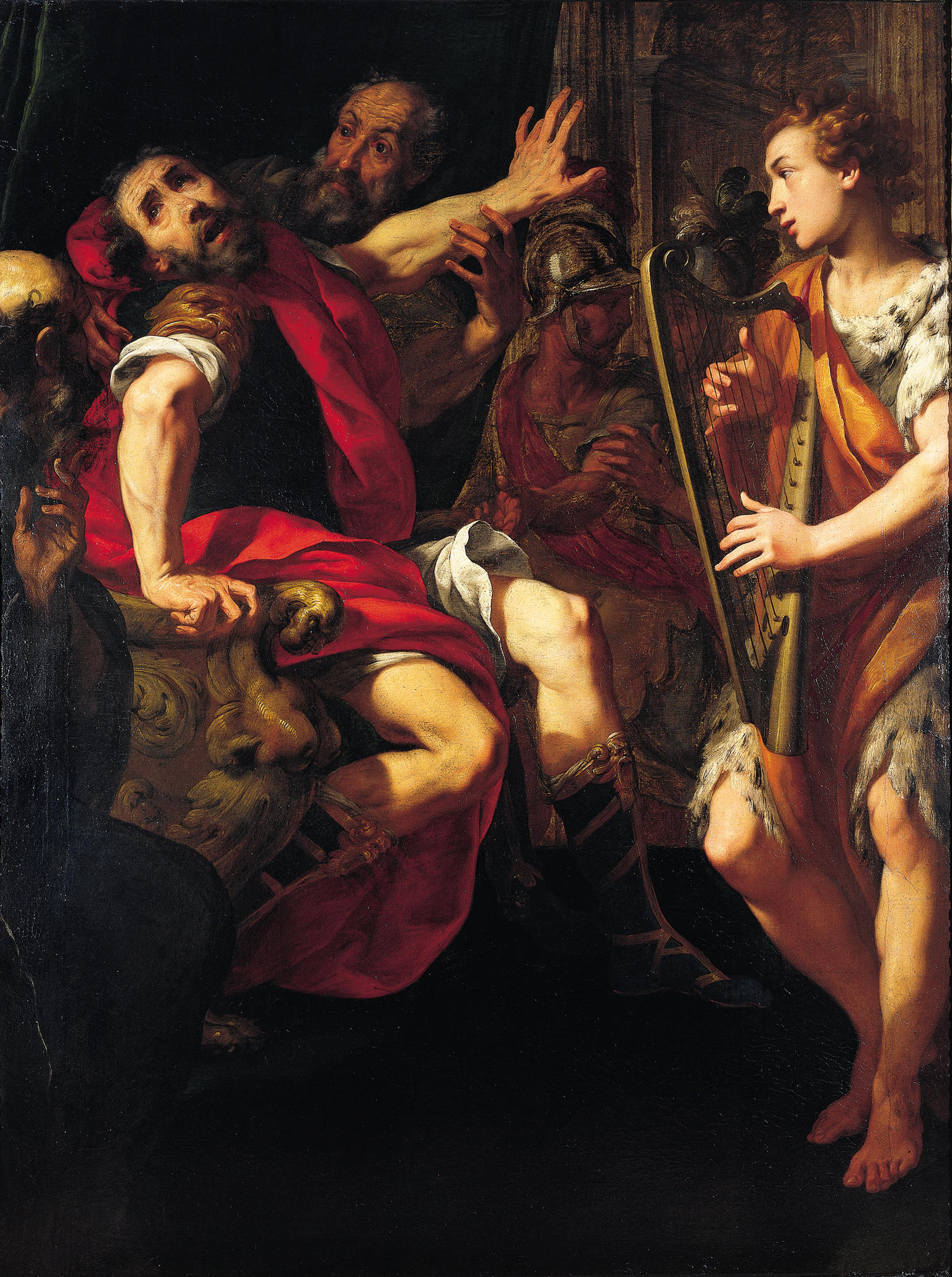
According to the Book of Samuel in the Old Testament, an “evil spirit from the Lord” plagued King Saul, making him agitated and fearful of persecution. Because music was thought to have a therapeutic effect, the king summoned the hero and warrior David, who was renowned for his skill with the harp. In this scene of intense psychological drama, David tries to soothe the troubled king. David’s pleasing performances would eventually lead to him succeeding Saul as the king of Israel. Daniele Crespi reveals Saul’s fragile mental state by portraying him in a state of anguish, one hand balled into a fist tightly clenching his elaborate throne, his legs and other arm flailing. Two elderly courtiers attempt to placate him, one grasping his arm, the other speaking to him gently, as two soldiers converse nervously in the background. The young David, at right, gazes sympathetically at the wretched king, and skillfully plucks his instrument.
It is abundantly clear from works like this extraordinary canvas that had Crespi enjoyed a longer career, and were his works not largely confined to Lombardy, he would be widely known as a master of the first order. He was without doubt the finest painter of the second generation of Baroque painting in Milan. In his paintings the willful deformation and neurotic intensity of the first generation of Lombard painters are subjected to a more disciplined design and a more rhetorical expression, which he gathered from contemporary Florentine painters as well as from the emerging school of Bologna. The resulting style is highly original in its staging, admirable in its action, and convincing in its feeling. This picture demonstrates Crespi’s rapid development toward a style of absolute coherence and exceptional theatricality. The dramatic chiaroscuro of the work generally reflects Crespi’s intensifying naturalism, while the design, with bold rhythms and strong drawing, is conditioned by Florentine interpretations of early Baroque style. And both the palette and striking differentiation of paint handling—compare the rendering of Saul’s tremulous flesh with that of his and David’s splendid silk and fur garments—are freshly informed by Rubens’s example. But by now these elements have been thoroughly synthesized and reconciled with a persistently Milanese subjectivity. This, Crespi’s mature style, is at once rich in narration, declamatory in form, and charged in expression.
The composition also, it might be noted, demonstrates Crespi’s keen awareness of antique sculpture, for the figure of Saul clearly references one of the most studied, revered, and copied works of ancient art, the marble Laocoön excavated in the early sixteenth century in Rome and placed immediately on view in the Vatican. Though Crespi’s career worked mainly in Lombardy, it has been suggested that he did visit Rome in the early 1620s, as many of his works seem to bear witness to the study of works of art only available there. At the same time, Crespi seems to look to his fellow contemporary Lombard artists—the figure of David with his blond ringlets might be plucked from one of Tanzio da Varallo’s images of the young hero with the head of Goliath.
Please note that the price and availability of the above work are subject to change without prior notice.
It is abundantly clear from works like this extraordinary canvas that had Crespi enjoyed a longer career, and were his works not largely confined to Lombardy, he would be widely known as a master of the first order. He was without doubt the finest painter of the second generation of Baroque painting in Milan. In his paintings the willful deformation and neurotic intensity of the first generation of Lombard painters are subjected to a more disciplined design and a more rhetorical expression, which he gathered from contemporary Florentine painters as well as from the emerging school of Bologna. The resulting style is highly original in its staging, admirable in its action, and convincing in its feeling. This picture demonstrates Crespi’s rapid development toward a style of absolute coherence and exceptional theatricality. The dramatic chiaroscuro of the work generally reflects Crespi’s intensifying naturalism, while the design, with bold rhythms and strong drawing, is conditioned by Florentine interpretations of early Baroque style. And both the palette and striking differentiation of paint handling—compare the rendering of Saul’s tremulous flesh with that of his and David’s splendid silk and fur garments—are freshly informed by Rubens’s example. But by now these elements have been thoroughly synthesized and reconciled with a persistently Milanese subjectivity. This, Crespi’s mature style, is at once rich in narration, declamatory in form, and charged in expression.
The composition also, it might be noted, demonstrates Crespi’s keen awareness of antique sculpture, for the figure of Saul clearly references one of the most studied, revered, and copied works of ancient art, the marble Laocoön excavated in the early sixteenth century in Rome and placed immediately on view in the Vatican. Though Crespi’s career worked mainly in Lombardy, it has been suggested that he did visit Rome in the early 1620s, as many of his works seem to bear witness to the study of works of art only available there. At the same time, Crespi seems to look to his fellow contemporary Lombard artists—the figure of David with his blond ringlets might be plucked from one of Tanzio da Varallo’s images of the young hero with the head of Goliath.
Please note that the price and availability of the above work are subject to change without prior notice.