

Fausto Melotti
b. 1901, Rovereto
d. 1986, Milan
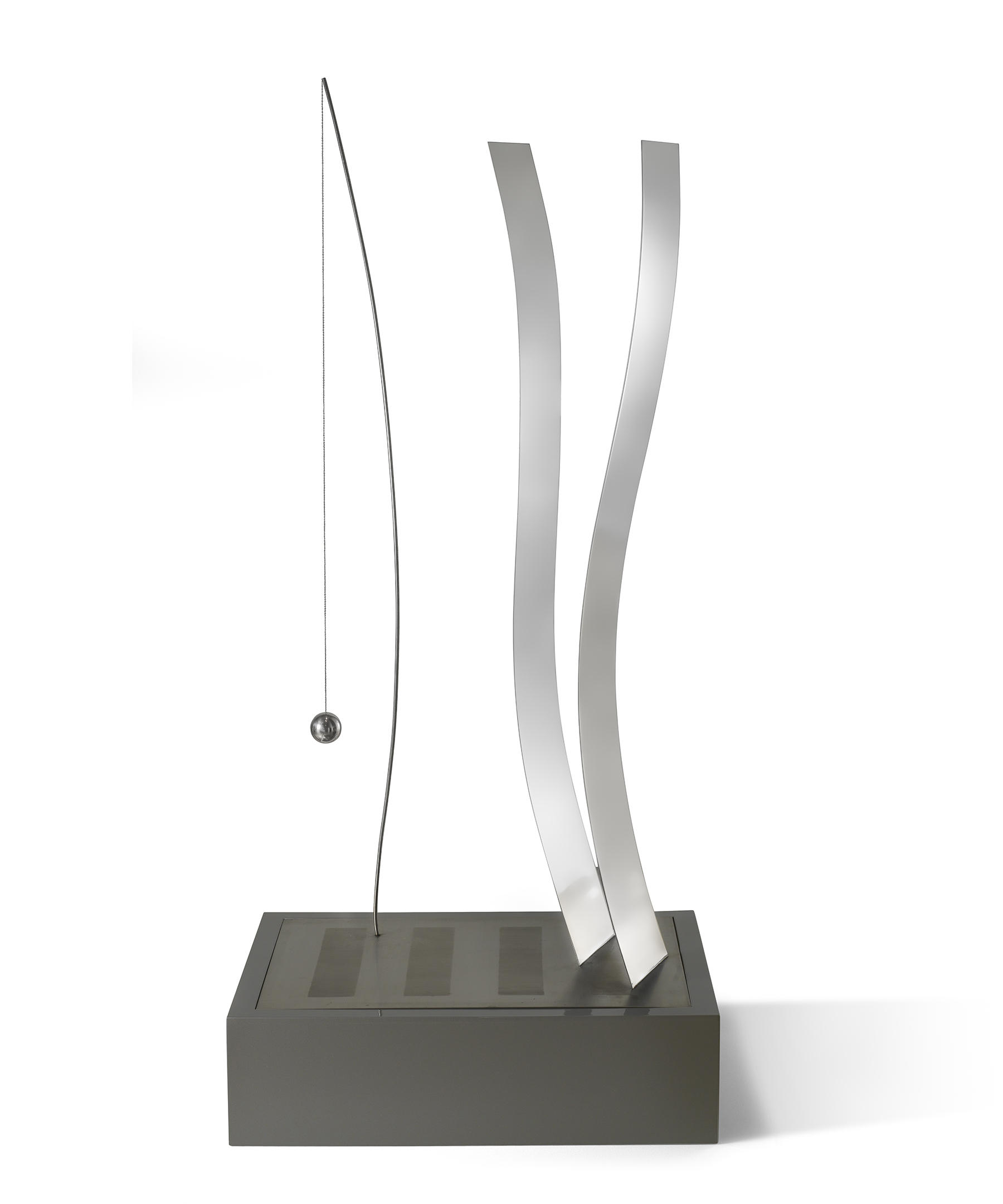
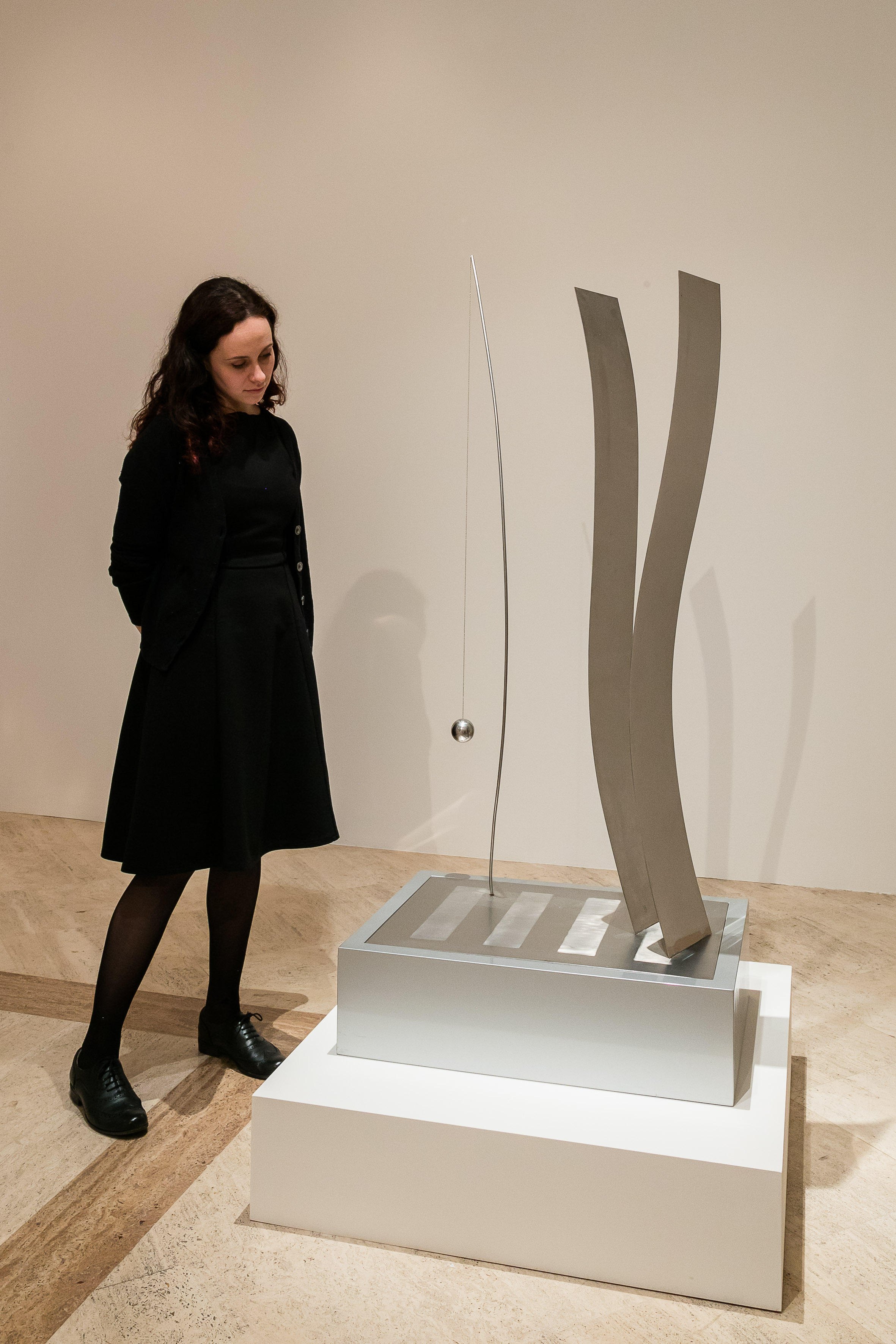
Due Curve
1973-74
Stainless steel
132 x 66 x 63 cm/64.1 x 25.9 x 24.8 in
Edition of 3
Provenance
Private collection, Italy
Literature
V. Conti, Un gioco che quando riesce è poesia in
"Corriere Mercantile", Genova, 16 maggio 1975, illustrated
G. Celant, Melotti, Catalogo generale Sculture 1973-1989 e Bassorilievi, Milan 1996, vol. II, p. 377, n. 1973 77, illustrated
G. Celant, Melotti, Catalogo generale Sculture 1973-1989 e Bassorilievi, Milan 1996, vol. II, p. 377, n. 1973 77, illustrated
Description
Fausto Melotti was born in Rovereto (Trento) on the 8th of June 1901. In 1918 he enrolled in the Faculty of Physics and Mathematics at the University of Pisa, a course of studies that he continued at the Politecnico in Milan, where he graduated in Electrotechnical Engineering in 1924. During this period, he studied the piano and took up studies of sculpture in Turin under the sculptor Pietro Canonica. In 1928 he enrolled at the Accademia di Brera in Milan, where he was the pupil of Adolfo Wildt with Lucio Fontana, with whom he formed a enduring friendship. In 1932 he agreed to give a course in modern plastic arts at the Scuola artigianale in Cantù.
In 1935 Fausto Melotti’s cousin Carlo Belli published Kn, a text described by Kandinsky as being “the Gospel of abstract art”. It was the theoretical development of the experimentation undertaken by the abstract artists. That same year Melotti joined the Parisian movement Abstraction-Création. Also in 1935, Melotti was among the Milanese artists who exhibited at the first group show of abstract art in the studio of Casorati and Paolucci in Turin, and held a solo show in the Galleria del Milione in Milan of sculpture of rigorously contrapuntal inspiration. Melotti encapsulated a sort of “musical abstraction” in the field of the figurative arts: “Slowly music has ensnared me, disciplining me with its laws, distractions and digressions in a balanced discourse.
Coming of age in pre-war Milan and living through the horrors of the Second World War, Melotti metabolized wartime devastation in his work by returning to Renaissance principles of harmony, order, geometry, and musical structure, which he integrated into a highly personal yet universally accessible artistic language that expresses the full range of emotional experiences in modern human existence. Encapsulating Melotti’s lyrical approach to sculpture, the curved and spiralling note-like forms here appear to move through the air, with their lines and shapes suggesting a complex orchestra of melodies and registers. Melotti’s late work of the 1970s and 1980s is characterized by rhythmic geometric forms with an underlying humanist narrative that bridge the threshold between the figurative and the abstract with their curator Douglas Fogle describes as “quivering just on the threshold between the solidity of figuration and the immateriality of abstraction”.
The eye of the observer, resting on Fausto Melotti's work, inevitably takes on a trip back in time and history in search of an intimate and pure memory - a return to the origins and essence, capable of revealing not only a new vision of the present but also an elusive intuition of the future.
In Due Curve, the lines and surfaces placed in sequences and at intervals appear as a visual score. It follows an implicit rhythm, constituted by mild fluctuations and micro vibrations, that seems longing for liberating the entire structure from its static nature.
In a note he wrote in the book Linee, Melotti reflects: “In a fine drawing the line, like a soul, throbs of indecisions, certainties, desired deceptions.” One could say that this thought sums up his vision of an art that is constantly moving and resonant of life, capable of opening a gate to another imaginary, where one can capture the beauty of what casualty leaves behind.
Placed on the ground in a precarious balance, the long vertical structures of an abstract form suggest a relative lack of weight and hint to the malleability of the material. A dynamic dialogue opens up between the frail and the concrete, in which one can glimpse the incredible poetic gesture of the sculptor Melotti.
Well beyond form and language, Due Curve affirms its existence in a perpetual dimension, without beginning or end. And through the upward extension of the work itself, Melotti seems to be indicating us the extension of our inner space in an invitation to spiritual elevation towards lightness and freedom of being.
The artwork described above is subject to changes in availability and price without prior notice.
Where applicable ARR will be added.
In 1935 Fausto Melotti’s cousin Carlo Belli published Kn, a text described by Kandinsky as being “the Gospel of abstract art”. It was the theoretical development of the experimentation undertaken by the abstract artists. That same year Melotti joined the Parisian movement Abstraction-Création. Also in 1935, Melotti was among the Milanese artists who exhibited at the first group show of abstract art in the studio of Casorati and Paolucci in Turin, and held a solo show in the Galleria del Milione in Milan of sculpture of rigorously contrapuntal inspiration. Melotti encapsulated a sort of “musical abstraction” in the field of the figurative arts: “Slowly music has ensnared me, disciplining me with its laws, distractions and digressions in a balanced discourse.
Coming of age in pre-war Milan and living through the horrors of the Second World War, Melotti metabolized wartime devastation in his work by returning to Renaissance principles of harmony, order, geometry, and musical structure, which he integrated into a highly personal yet universally accessible artistic language that expresses the full range of emotional experiences in modern human existence. Encapsulating Melotti’s lyrical approach to sculpture, the curved and spiralling note-like forms here appear to move through the air, with their lines and shapes suggesting a complex orchestra of melodies and registers. Melotti’s late work of the 1970s and 1980s is characterized by rhythmic geometric forms with an underlying humanist narrative that bridge the threshold between the figurative and the abstract with their curator Douglas Fogle describes as “quivering just on the threshold between the solidity of figuration and the immateriality of abstraction”.
The eye of the observer, resting on Fausto Melotti's work, inevitably takes on a trip back in time and history in search of an intimate and pure memory - a return to the origins and essence, capable of revealing not only a new vision of the present but also an elusive intuition of the future.
In Due Curve, the lines and surfaces placed in sequences and at intervals appear as a visual score. It follows an implicit rhythm, constituted by mild fluctuations and micro vibrations, that seems longing for liberating the entire structure from its static nature.
In a note he wrote in the book Linee, Melotti reflects: “In a fine drawing the line, like a soul, throbs of indecisions, certainties, desired deceptions.” One could say that this thought sums up his vision of an art that is constantly moving and resonant of life, capable of opening a gate to another imaginary, where one can capture the beauty of what casualty leaves behind.
Placed on the ground in a precarious balance, the long vertical structures of an abstract form suggest a relative lack of weight and hint to the malleability of the material. A dynamic dialogue opens up between the frail and the concrete, in which one can glimpse the incredible poetic gesture of the sculptor Melotti.
Well beyond form and language, Due Curve affirms its existence in a perpetual dimension, without beginning or end. And through the upward extension of the work itself, Melotti seems to be indicating us the extension of our inner space in an invitation to spiritual elevation towards lightness and freedom of being.
The artwork described above is subject to changes in availability and price without prior notice.
Where applicable ARR will be added.