
Attributed to Gustave Léonard de Jonghe (Belgian School)
b. 1829, Courtai
d. 1893, Antwerp
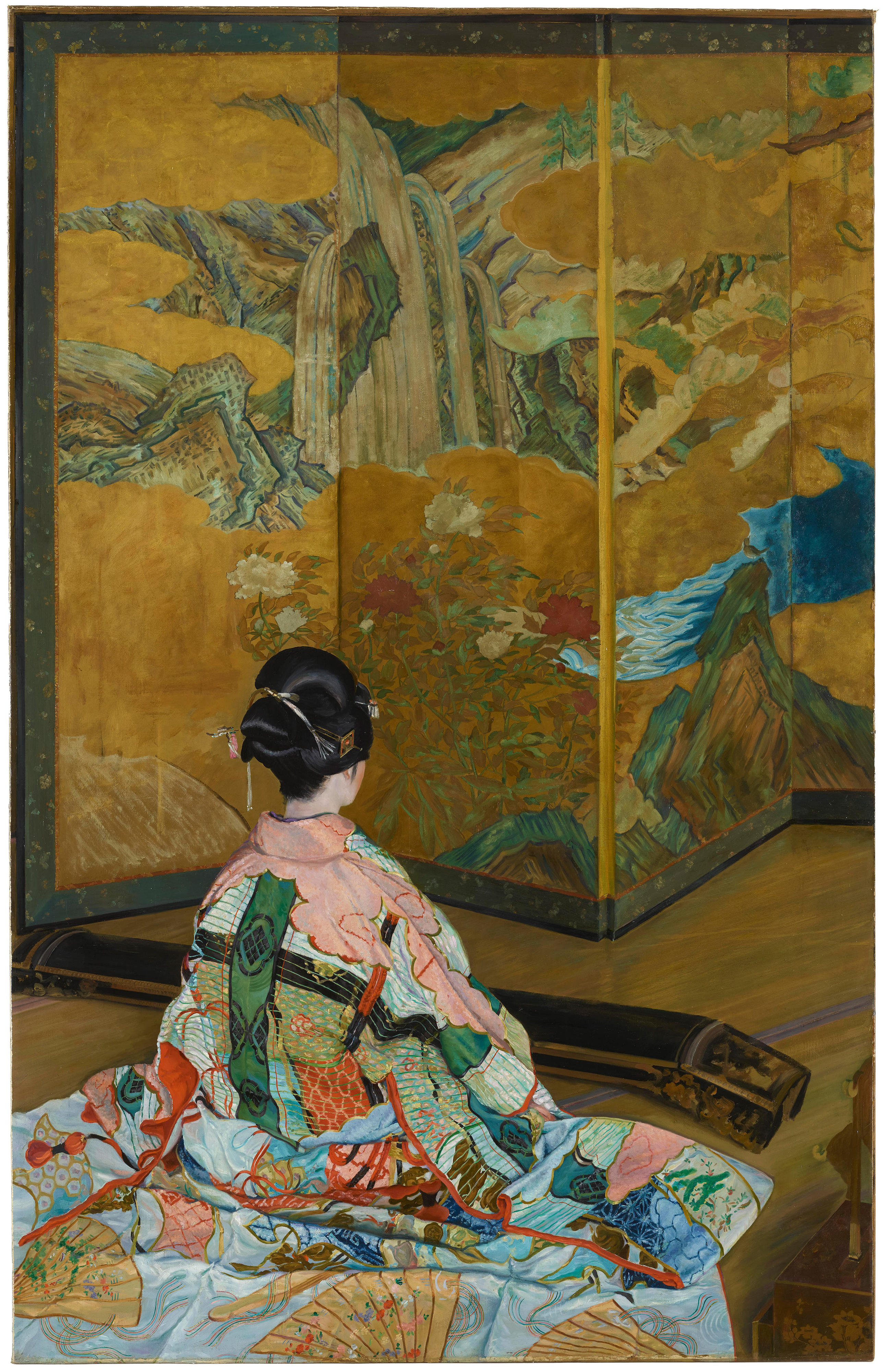
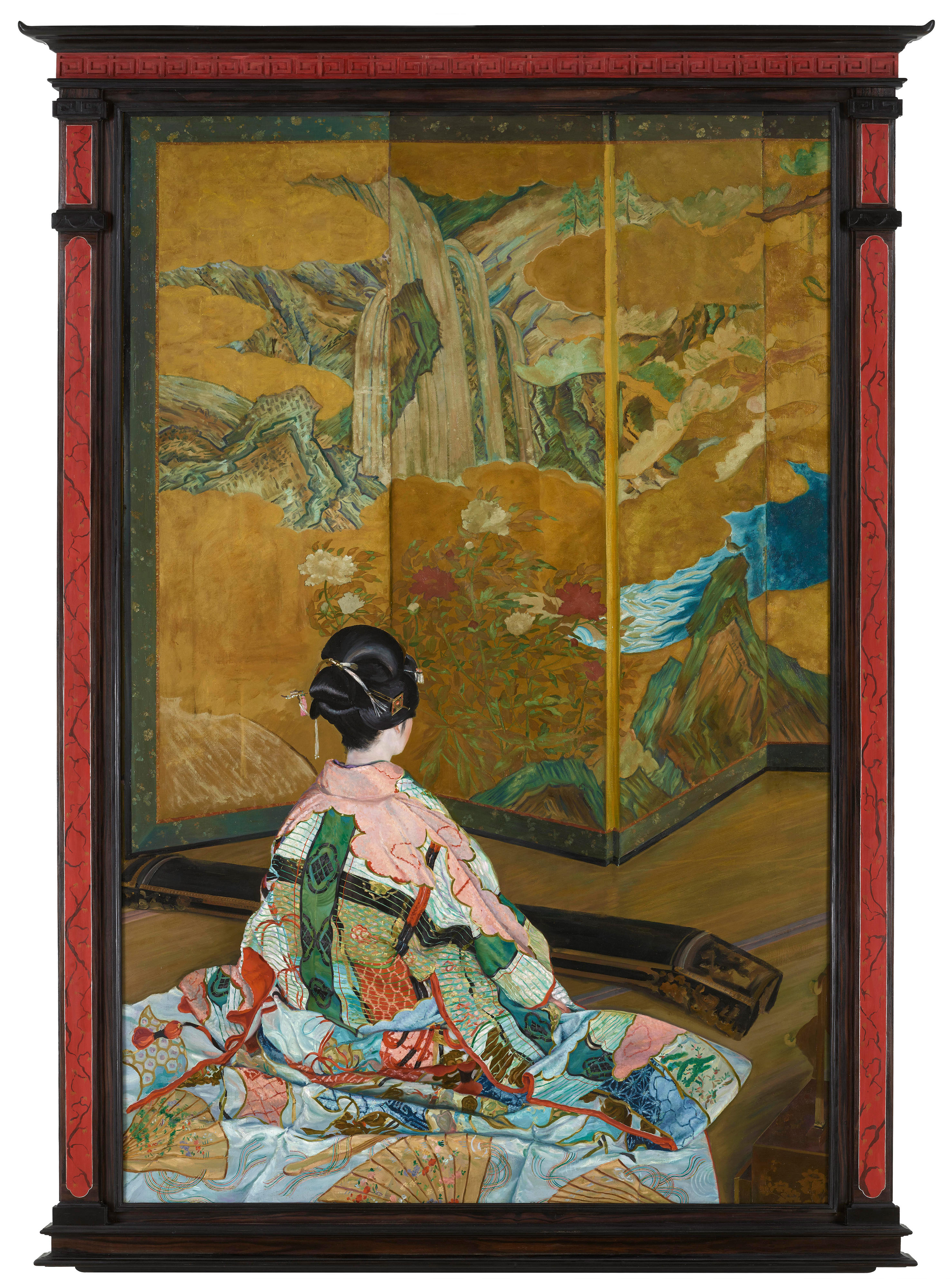
Femme japonaise jouant du koto (A Japanese woman playing the koto)
c. 1870s
Oil on canvas
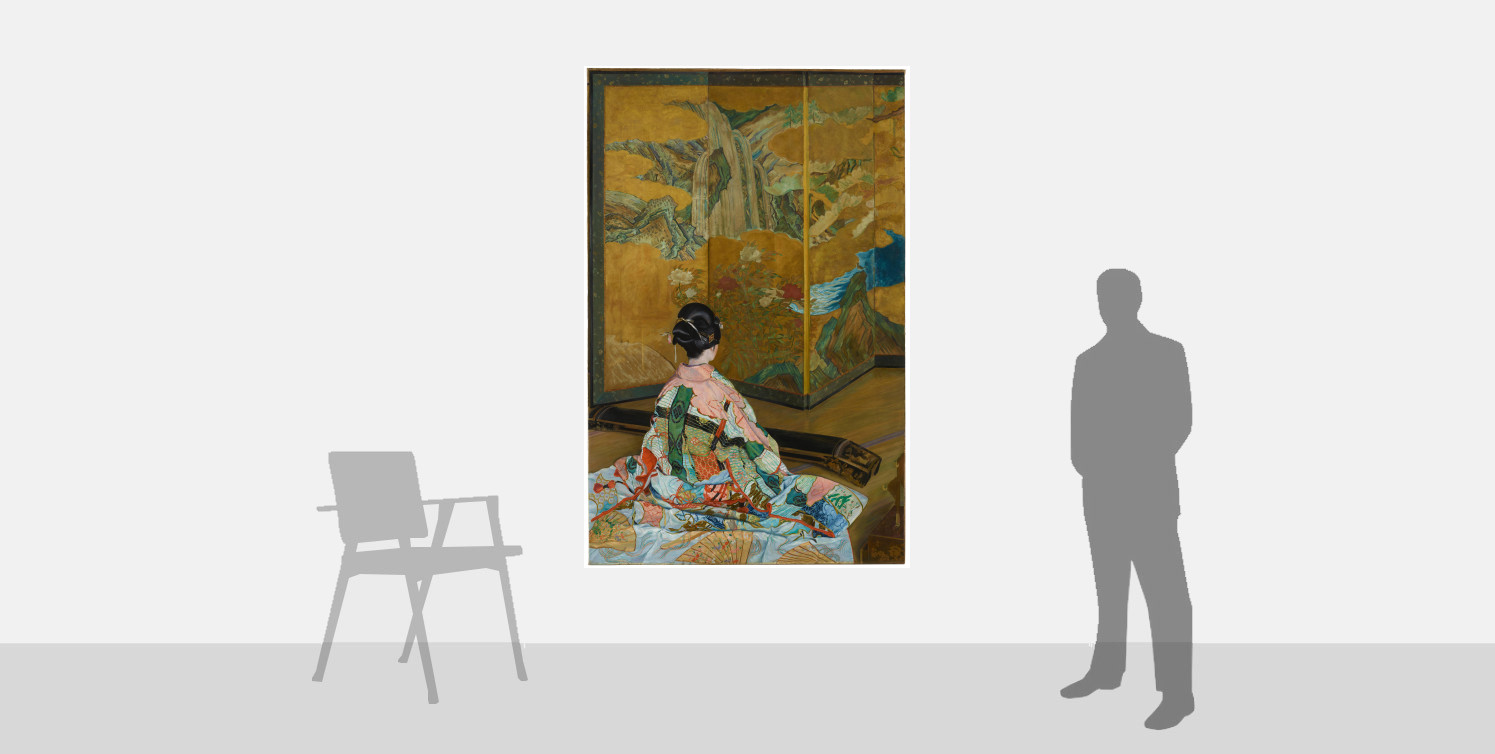
223.5 x 145 cm (88 x 57 1/8 in.)
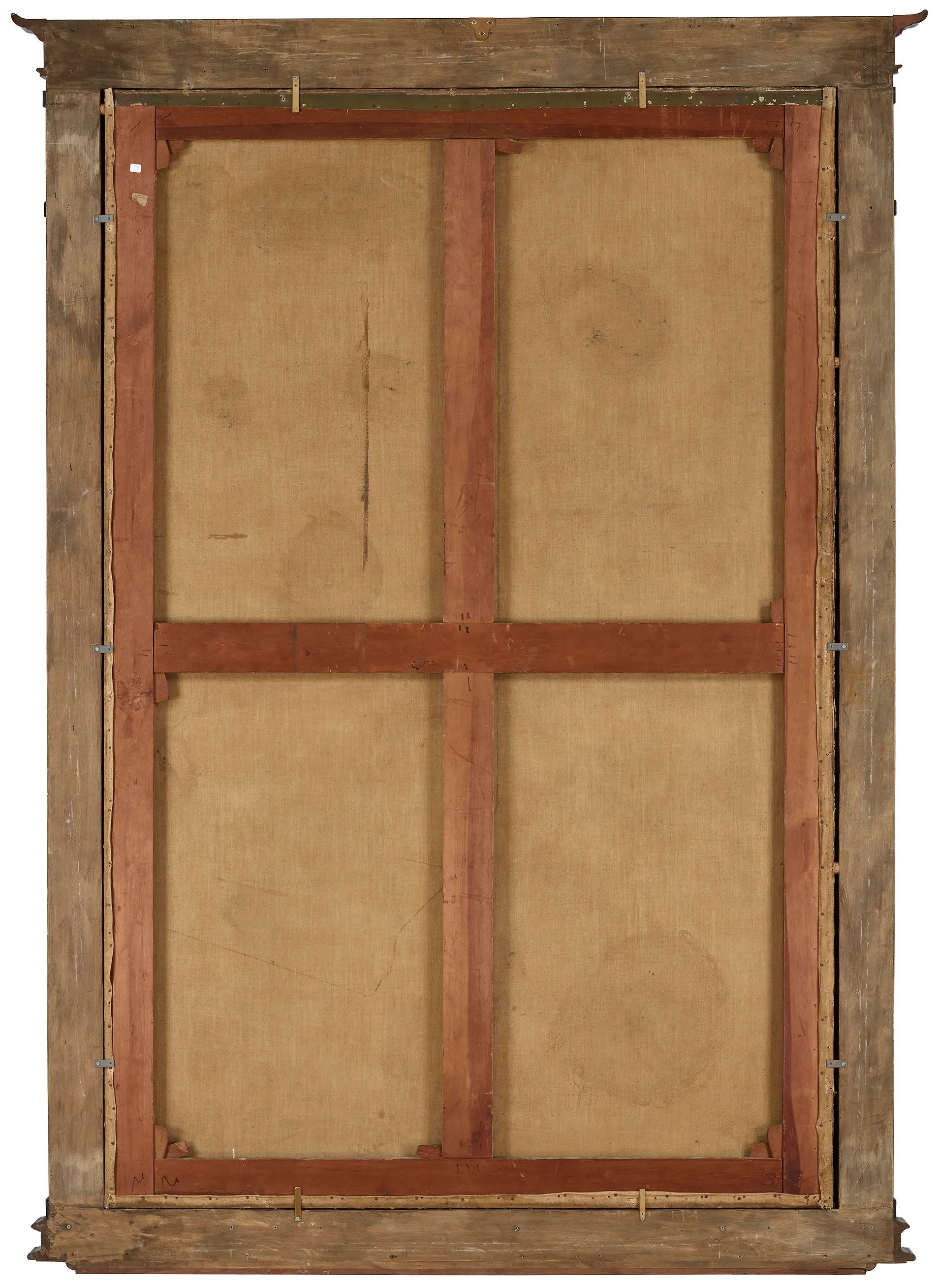
Framed: 251 x 182.5 x 10.3 cm (98 7/8 x 71 7/8 x 4 in.)
Provenance
Description
This commanding painting depicts a Japanese woman dressed in an elaborate kimono sitting or kneeling on the floor, viewed from behind. Next to her is a koto, a traditional multi-stringed instrument made of wood, considered the national instrument of Japan. The upper two thirds of the painting are dominated by a bold byobu (folding screen), with a style that suggests a 16th- or 17th-century Kano school painter. Cut off by the right edge of the canvas is a typical kyodai kesho bako, a make-up box and mirror stand. The floor is covered by tatami matting, indicating that the painting represents a Japanese interior, rather than a European room decorated with Japanese objects.
The phenomenon of Japonisme is well-known as a feature of Western culture in the second half of the 19th century, influencing artists from movements across Impressionism, Post-Impressionism, the Nabis and Art Nouveau. Following the ending of Japanese national isolation, that begun gradually in the late 1840s and 1850s, then rapidly following the Meiji Restoration in 1868, the demand for all things Japanese exploded across art and culture in Europe, especially in the urban centres of Paris and London. Japanese art and objects began to appear in Europe; in Paris, pioneering individuals such as the Japanese art dealer Hayashi Tadamasa (1853–1906) and German-French dealer Siegfried Bing (1838–1905) established influential businesses supplying Japanese prints and works of art to the hungry market, advancing access and the taste for Japanese art. Japonisme arguably reached its peak following the 1878 Exposition Universelle in Paris, where a wide public could visit the Japanese Pavilion and encounter prints, ceramics, lacquerware, textiles, fans and other crafts. A significant exhibition of Japanese craft at the Ecole des Beaux-Arts in 1890 – featuring over 1100 prints, scrolls and books and partly organised by Siegfried Bing – was a further monumental event in the dissemination of Japanese culture in Europe.Among the spheres of European culture in which Japonisme took hold most notably were the visual arts. Many European and American artists working in Paris at the time were profoundly influenced by Japanese art and design, themselves avid collectors of prints. This manifested itself in both style – including flattening of space, unconventional cropping and bold outlines – and subject-matter: paintings of interiors commonly included Japanese objects, or European models dressed in Japanese dress, reflecting the tastes of patrons and emphasising their connoisseurial traits. Artists who famously worked in a Japoniste manner included Vincent van Gogh, who referenced Ukiyo-e prints in his paintings, and painted Courtesan after Japanese artist Keisai Eisen, 1887 (Van Gogh Museum, Amsterdam, fig. 1); Claude Monet, whose La Japonaise, 1876, depicts the artist’s wife dressed in a richly decorated red kimono and holding a fan, with an array of further fans decorating the wall (MFA Boston, fig. 2); James McNeill Whistler, in works such as Caprice in Purple and Gold: The Golden Screen, 1864 (fig. 3) and La Princesse du pays de la porcelaine, 1863–65 (both Smithsonian National Museum of Asian Art, Washington DC); Alfred Stevens, whose La Parisienne japonaise, 1872, shows a women in a blue kimono holding a fan and regarding her reflection in a mirror (La Boverie, Liège, fig. 4); James Tissot’s Young Ladies Looking at Japanese Objects, 1869 (Cincinnati Art Museum, fig. 5); and Mary Cassatt, who notably created a series of colour prints inspired by Japanese woodcuts after seeing the 1890 Ecole des Beaux-Arts exhibition.
Most artists – including those mentioned above – did not travel to Japan, but instead were influenced by the influx of Japanese prints and decorative objects in Europe. There were those, however, who did visit Japan and became well-known back home for their representations of traditional customs and everyday scenes of these ‘exotic’ lands. In the 1890s, American artists Theodore Wores and Robert Frederick Blum, and Scottish artists Edward Atkinson Hornel and George Henry spent time in Japan, being among the first Western artists to do so. Paintings such as Wores’ Returning from the cherry groves, Tokyo (fig. 6) and Robert Frederick Blum’s The Ameya (Metropolitan Museum of Art), reflect these artists' fascination with the people and way of life in Japan, seen through Western eyes. It is also worth considering the American artist Lilla Cabot Perry, who lived in Japan between 1893 and 1901, where she had moved with her husband who worked at Tokyo University. She was the only female American artist known to have spent time in Japan in the 19th century, and was instrumental in introducing Impressionism to Japan, as well as furthering knowledge of Japan in her native United States. She made over 80 paintings while in Japan, representing scenes of everyday life and domestic subjects. The influence of Japan continued to inform Perry’s work after her return to the US, often incorporating motifs in her society portraits and genre scenes (fig. 7).
Turning to the present painting, the interior setting and brightly-coloured and richly patterned kimono bring to mind especially paintings by Belgian artists Gustave Leonard de Jonghe and Frans Verhas, and Dutch painter George Hendrik Breitner, all of whom spent periods of time in Paris and were influenced by the Japoniste fashions of the time. While de Jonghe and Verhas were mainly celebrated for their realist portraits of well-dressed women in fashionable interiors, some of their most famous paintings are on Japanese themes or include Japanese elements such as de Jonghe’s L’admiratrice du Japon, c. 1865 (Cummer Museum and Gardens, Florida, fig. 8) and Verhas’ various paintings of women in brightly-coloured kimonos (figs. 9-10). Breitner’s series of painting depicting Dutch model Geesje Kwak dressed in a kimono are among the artist’s most notable works.
As noted above, the authentic matting and array of articles implies the work depicts a Japanese – as opposed to European – interior, either encountered first-hand by the artist or more likely based on a print or photograph, combined with first-hand observation of imported Japanese objects. The format and style of our painting are most closely aligned with the work of de Jonghe, as suggested by the late Gabriel P. Weisberg, the renowned scholar of 19th-century Japonisme (email correspondence). Several specific elements are comparable to the Cummer Museum’s L’admiratrice du Japon, notably: the great attention given to the ornately-patterned kimono; the dominance of the folding screen within the composition; the bold forms and realism with occasional painterly brushwork, especially in the kimono and screen; and the veracity of the Japanese objects and furniture. The considerable similarities between the two paintings have been remarked upon by curatorial staff at the Cummer Museum.
We are grateful to Gabriel P. Weisberg for his invaluable help with cataloguing this work.Fig. 1 – Vincent Van Gogh, Courtesan (after Eisen), 1887. Van Gogh Museum, Amsterdam, s0116V1962.
Fig. 2 – Claude Monet, La Japonaise, 1876. MFA Boston, 56.147.
Fig. 3 – James McNeill Whistler, Caprice in Purple and Gold, 1864. Smithsonian National Museum of Asian Art, Washington DC, F1904.75a.
Fig. 4 – Alfred Stevens, La Parisienne japonaise, 1872. La Boverie, Liège, BA.AMC.05b.1907.21748.
Fig. 5 – James Tissot, Young Ladies looking at Japanese objects, 1869. Cincinnati Art Museum, 1984.217.
Fig. 6 – Theodore Wores, Returning from the cherry groves, Tokyo, 1887. Formerly with Bailly Gallery.
Fig. 7 – Lilla Cabot Perry, Easter Morning, 1915. Formerly private collection, California.
Fig. 8 – Gustave Leonard de Jonghe, L’admiratrice du Japon, c. 1865. Cummer Museum of Art and Garden, Florida, AG.1988.3.1.
Fig. 9 – Frans Verhas, La collectionneuse au kimono vert, 1881. Formerly private collection, California.
Fig. 10 – Frans Verhas, The Kimono. Private collection.