
Francis Bacon
b. 1909, Dublin
d. 1992, Madrid
Man in Blue VII
1954
Oil on canvas
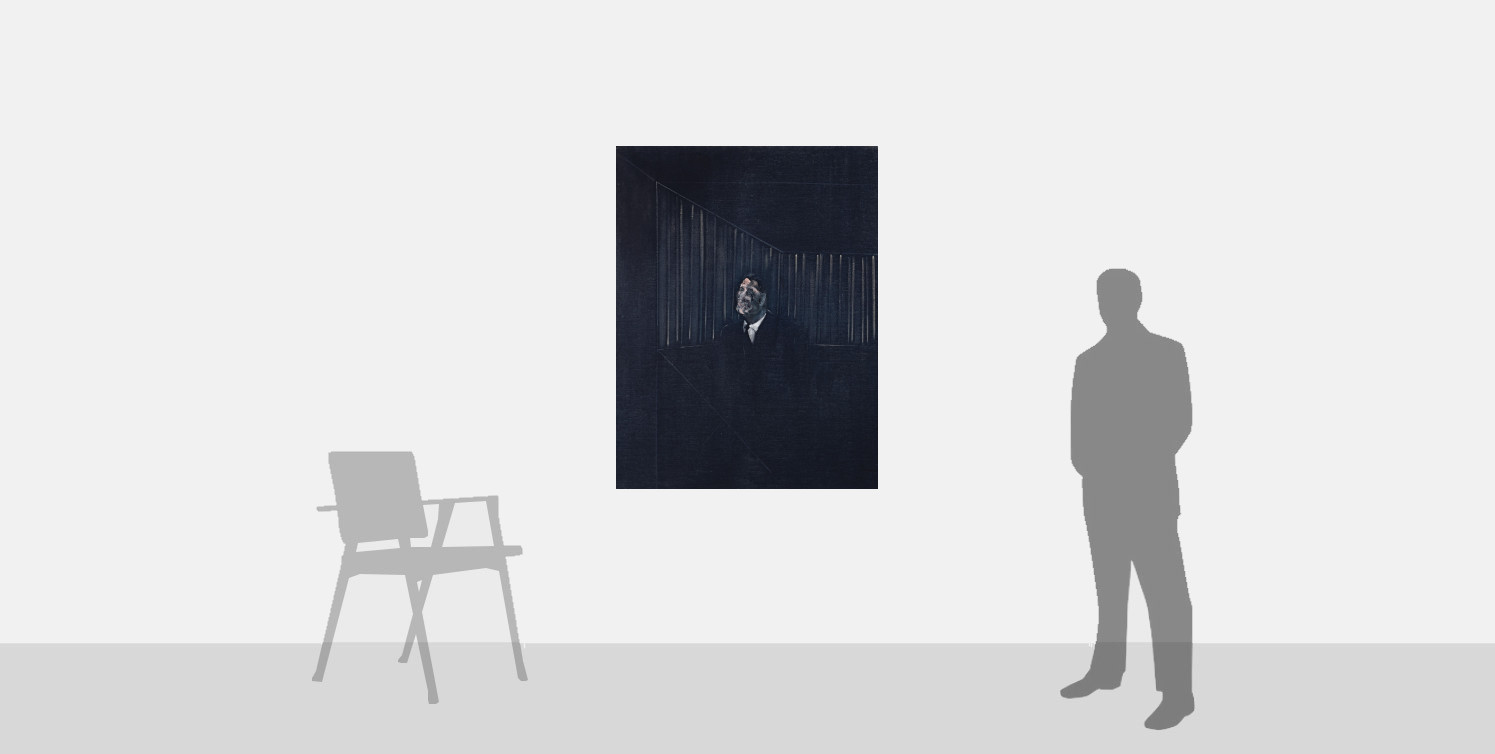
152.7 x 116.5 cm (60 1/8 x 45 7/8 in.)
With frame: 171.5 x 136.5 x 6 cm (67 1/2 x 53 3/4 x 2 3/8 in.)
Provenance
Hanover Gallery, London;
Charles Williams, London;
Redfern Gallery, London;
Marlborough Fine Art Ltd., London;
The Marchioness of Hartington;
Waddington Galleries, London;
Ivor Braka Ltd, London;
Private collection, Europe;
Christie’s, London, 6 February 2002, lot 13;
Private collection;
Christie’s, Paris, 8 June 2016, lot 16;
Private collection.
Literature
The British Pavilion: Exhibition of Works by Nicholson, Bacon, Freud, exh. cat. Biennale di Venezia XXVII, Venice, 1954, no. 58a.
Summer Exhibition, exh. cat. Redfern Gallery, London, 1961, no. 9.
Arte Britânica no século XX, exh. cat. Fundação Calouste Gulbenkian, Lisbon, 1962, no. 52.
John Rothenstein and Ronald Alley, Francis Bacon, London, 1964, p. 88, no. 87, illustrated p. 193.
Francis Bacon: Portraits and Heads, exh. cat. Scottish National Gallery of Modern Art, Edinburgh, 2005, no. 14, illustrated p. 44.
Description
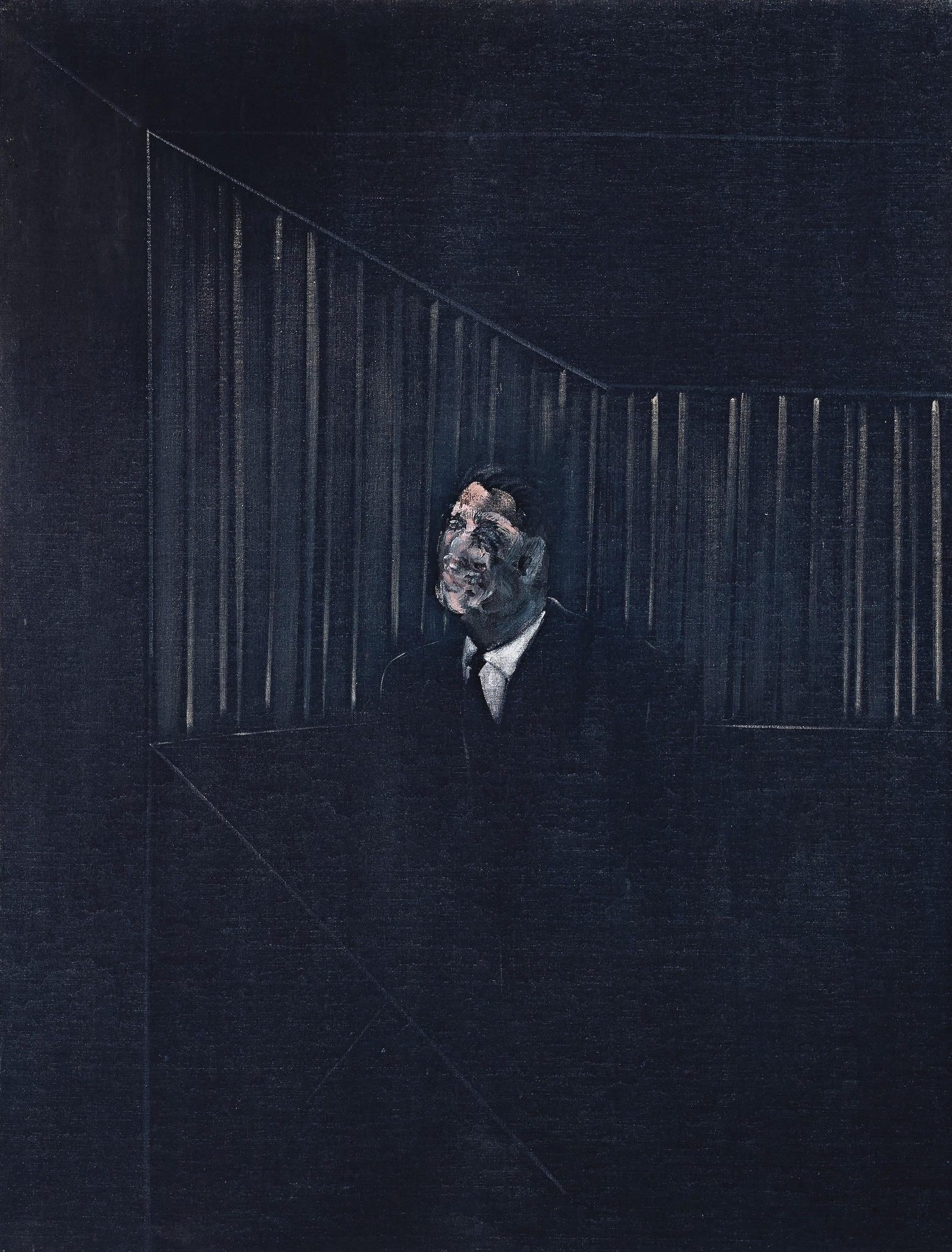
The final work in the series of seven Man in Blue paintings, which Bacon painted in 1954, Man in Blue VII is an existentialist portrait of postwar Europe. Immersed in a deep sea of midnight blue, the slender figure of a man is cast into the shadows, isolated, trapped in the dark. The twilight tones of the painting are relieved only by the striking pink and alabaster white of the man’s grimacing face above his starched white collar. Bacon’s genius lies precisely in the expressiveness of this face, whose features have been meticulously distorted with the impulsive sweep of the artist’s brush. In this final incarnation of Man in Blue, Bacon achieved what mattered most for him—creating a pictorial sensation that “acts directly on the nervous system.”
Bacon produced this series between March and June 1954, when he was staying at the Imperial Hotel in Henley-on-Thames. During the 1950s, the artist often stayed in this town not far from London to be close to his lover Peter Lacy, who owned a house there. At times their tumultuous relationship was so violent that Bacon had to take refuge at the Imperial Hotel. There, he met various anonymous businessmen passing through, with some of whom he had illicit relations; these disaffected, shadowy figures inspired the Man in Blue series. As the artist wrote in a letter to David Sylvester: “I am excited by the new series I am doing—it is about dreams and life in hotel bedrooms” (quoted in “On the Margins of the Impossible” in Matthew Gale and Chris Stephens, eds., Francis Bacon, exh. cat., Tate Britain, London, 2008).
Showing Bacon at the very peak of his expressive powers, conveying all of life’s pain and fragility in his painting, the Man in Blue series was a turning point in the British painter’s work. Three works from this series are now in museum collections: Man in Blue I in the Museum Boijmans Van Beuningen in Rotterdam; Man in Blue IV in the Museum Moderner Kunst Stiftung Ludwig in Vienna, and Man in Blue V in the Kunstsammlung Nordrhein Westfalen in Dusseldorf.
Executed in the lead up to Bacon’s solo exhibition at the Hanover Gallery in London in June and July of 1954, six paintings from the series were shown there in public for the first time. Meanwhile, the present painting, Man in Blue VII, is the only one of the series to have featured in Bacon's celebrated exhibition at the British Pavilion during the 1954 Venice Biennale. This crucial exhibition for the artist was essentially a miniature retrospective of his work of the previous ten years and included many of the paintings that would come to define Bacon as an artist. The recognition of the Venice Biennale was decisive for Bacon—who at the time had not yet had an exhibition in a museum—and played a vital role in establishing his international reputation. As David Sylvester wrote regarding the critical reception of this exhibition: “Bacon’s work, a horrifying vision of mankind today, is probably the only genuine revelation of this entire Biennial” (David Sylvester, The British Pavilion: Exhibition of Works by Nicholson, Bacon, Freud, exh. cat. Biennale di Venezia XXVII, Venice, 1954).
The Man in Blue paintings continue to explore the themes of the artist’s iconic series of Popes (Study for a Portrait I-VIII), completed the previous year. In the early 1950s, Bacon began to abandon the expressionist manner and half-dreamlike, half-horrifying zoomorphic images of the previous decade. The human form became instead his chief subject. His palette became darker, and his work was dominated by deep blue and black backgrounds. In this sense, the reinterpretations of Velázquez’s famous Portrait of Pope Innocent X marked a turning point in the work of Bacon, who turned his attention to exploring tormented humanity within a more intimate context. Just as he had presented Church leaders emblematic of spiritual and temporal leadership as isolated figures in cages, cast into outer darkness, in the Man in Blue paintings Bacon he subjects the businessman, a symbol of booming post-war capitalism, to a similar treatment. The golden robes are replaced by starched white shirts, but in both series the clothes cannot obscure the expression of the suffering face that yearns to be free.
In the Man in Blue paintings, the glass cube in the Popes series becomes an architectural framework of carefully aligned vertical lines, which could allude to a hotel bar. The outline and configuration of the enclosed spaces are identical in each of the seven paintings, in which the central figure seems to be trapped, contained behind a counter and enclosed within bars that prevent his escape. Just as the eight popes oscillate between arrogance, malevolence, and anguish, the mood of the blue-suited man changes throughout this series, moving from confidence, calm, indifference, and dreaminess to desperation and despair, also echoing the Three Studies for the Human Head (1953), the first triptych ever produced by Bacon.
Although the pose of the figure in Man in Blue VII is similar to the one in Man in Blue II, his body seems to be absorbed into the background, while his face seems to stand out even more, and his features seem more distorted than in the other paintings in the series. Here, the tense smile already seen in Man in Blue VI turns into a silent scream, accentuating the whiteness of the teeth in this open mouth with its fleshy lips. Bacon himself described his obsession with the mouth, a recurring motif in these works: “I’ve always been very moved by the movements of the mouth and the shape of the mouth and the teeth…I like, you may say, the glitter and colour that comes from the mouth, and I’ve always hoped in a sense to be able to paint the mouth like Monet painted a sunset” (David Sylvester in “Un Parcours” in Francis Bacon, exh. cat., Centre Pompidou, Paris, 1996). In his representation of the mouth, Bacon was chiefly inspired by two images of screaming women: that of the nurse in Eisenstein’s Battleship Potemkin and that of the mother in the foreground of the Massacre of the Innocents by Nicolas Poussin, whose head is reminiscent of that of Man in Blue VII. For Bacon, this painting by Poussin showed “probably the best human cry in painting.”
In Man in Blue VII, the pictorial material itself invokes tragedy, suggesting a man’s brokenness through its nuances. Around 1950, Bacon changed his way of painting. Up until that point he had used the unprimed reverse side of canvases; he now devised a new technique for creating backgrounds by applying layers of oil and turpentine. The substance of the paint thus became more transparent and fluid, and Bacon’s brushstrokes stand out in a more vigorous, dramatic, almost phosphorescent way. According to David Sylvester, the Man in Blue series reveals a further stage in the development of this style: “In 1954 the blue became darker, more velvety, more nocturnal; the handling coarser and less vibrant; the model's energy, more projected, less internal"(David Sylvester, Looking Back at Francis Bacon, London, 2000).
Bacon tended to use photographs of people in his close circle as subjects for his paintings, preferring to work from pictures rather than a model. As he said, “What I want to do is to distort the thing beyond the appearance, but in the distortion to bring it back to a recording of appearance.” The Man in Blue series was one of the very few Bacon painted from life. The artist described how, apart from the presence of a model, painting a stranger went against his desire to capture all the sensations arising from intimate knowledge of the person he was painting. From this point of view, the men of the Imperial Hotel were extremely problematic, so the features of his lover Peter Lacy seem to emerge behind the archetypical figure of the businessman in a white collar.
Man in Blue VII is an embodiment of contemporary angst behind a mask of domination and respectability, evoking the spirit of a time when existentialism was at its height. In 1946, Jean-Paul Sartre’s L’Existentialisme est un Humanisme was a resounding success in Europe. In it, Sartre describes the state of anguish and despair that fills a man when he accepts the responsibility of his own destiny. This is the dizzying truth expressed in Man in Blue VII—the face of capitalism confronted by its own fate, incapable of the slightest redemption.