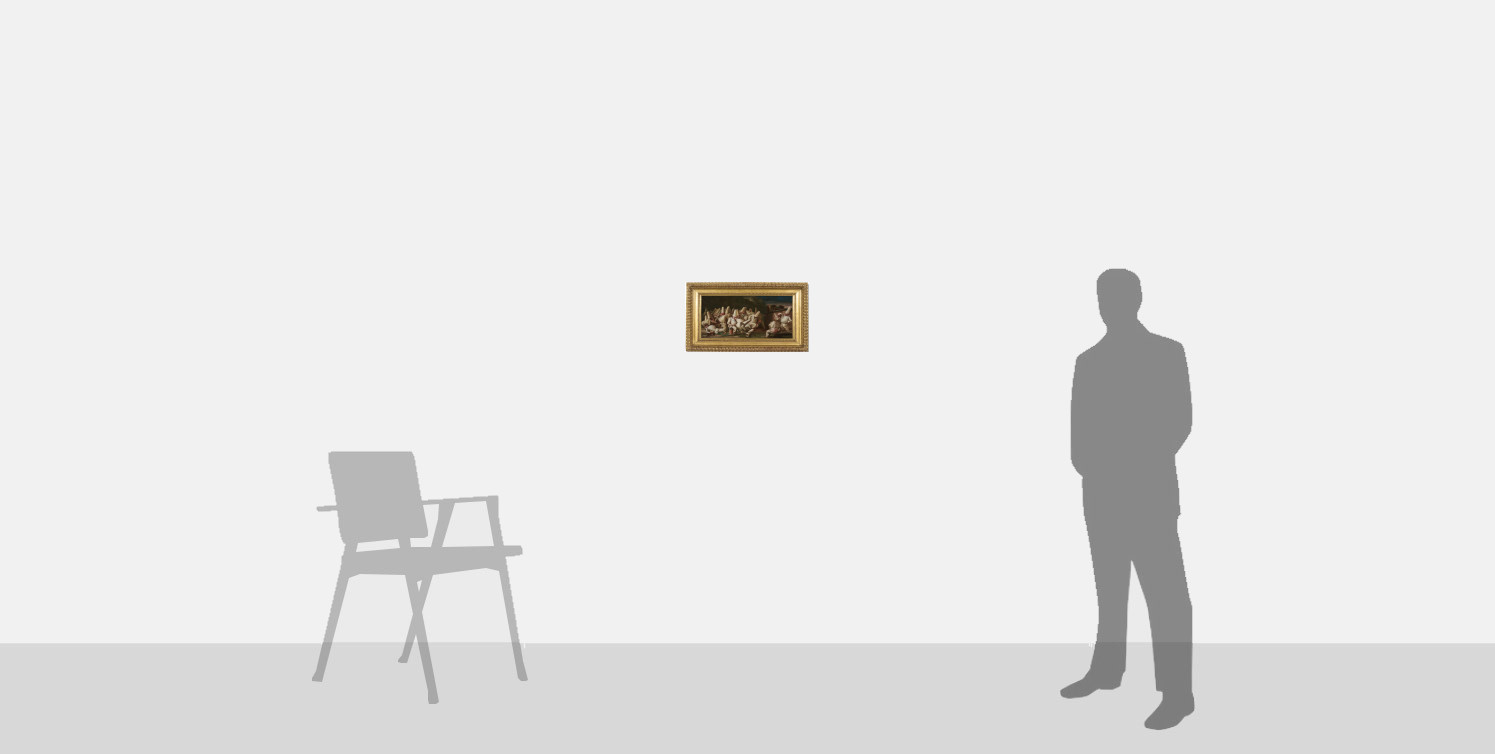

Giovanni Battista Tiepolo
b. 1696, Venice
d. 1770, Madrid
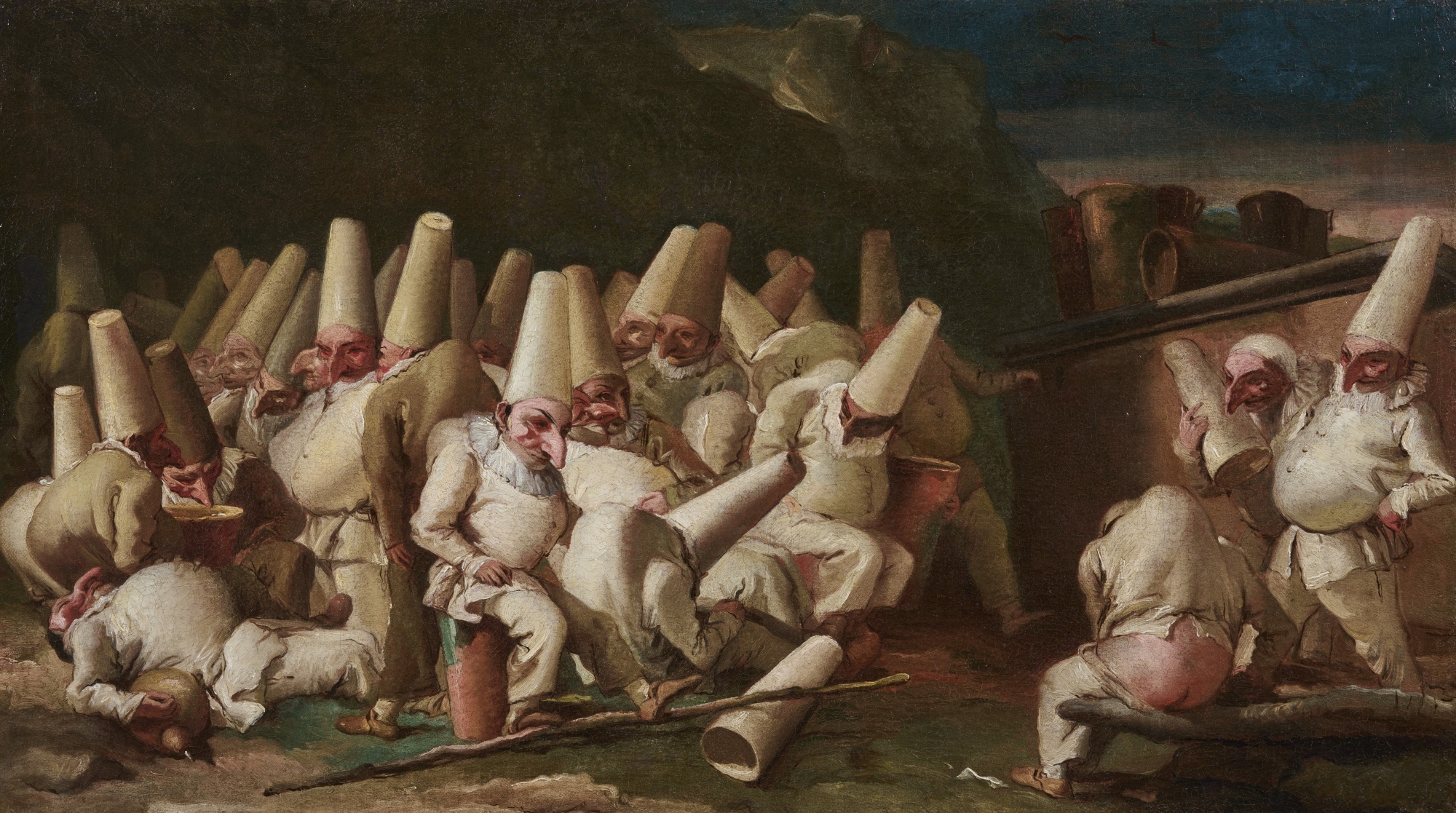
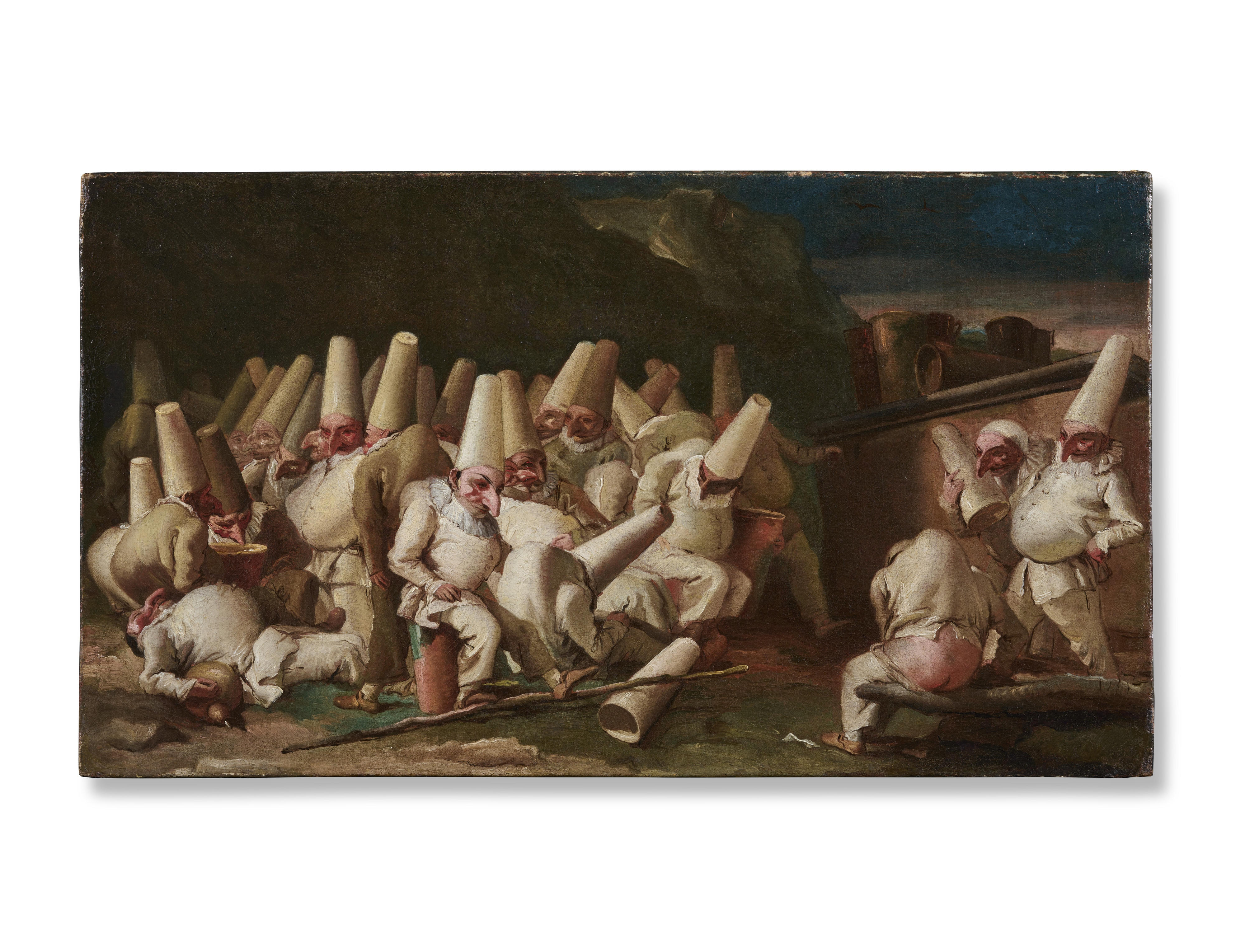
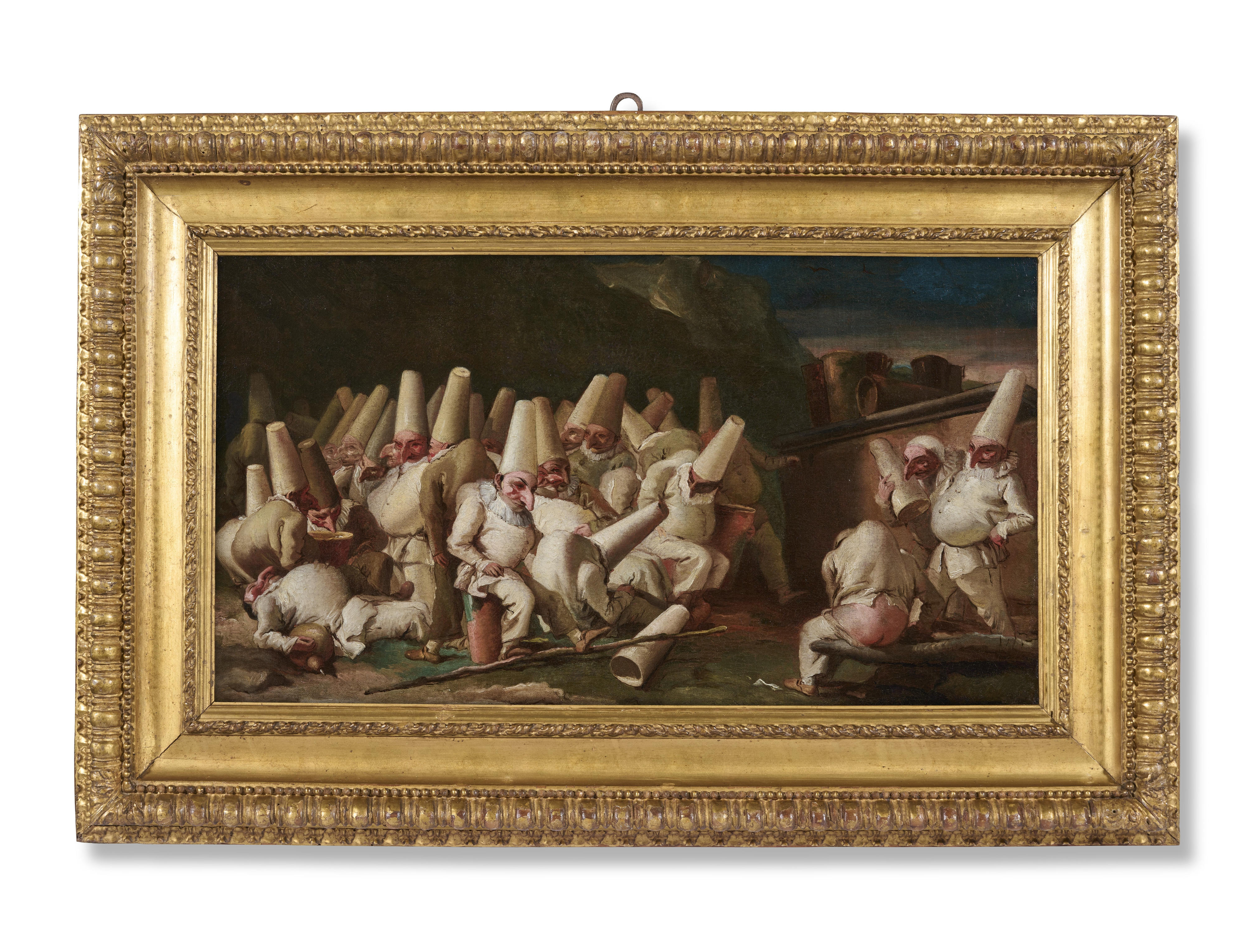
Group of Punchinelli
c. 1730s
Oil on canvas
31 x 55 cm (12 1/4 x 21 5/8 in.)
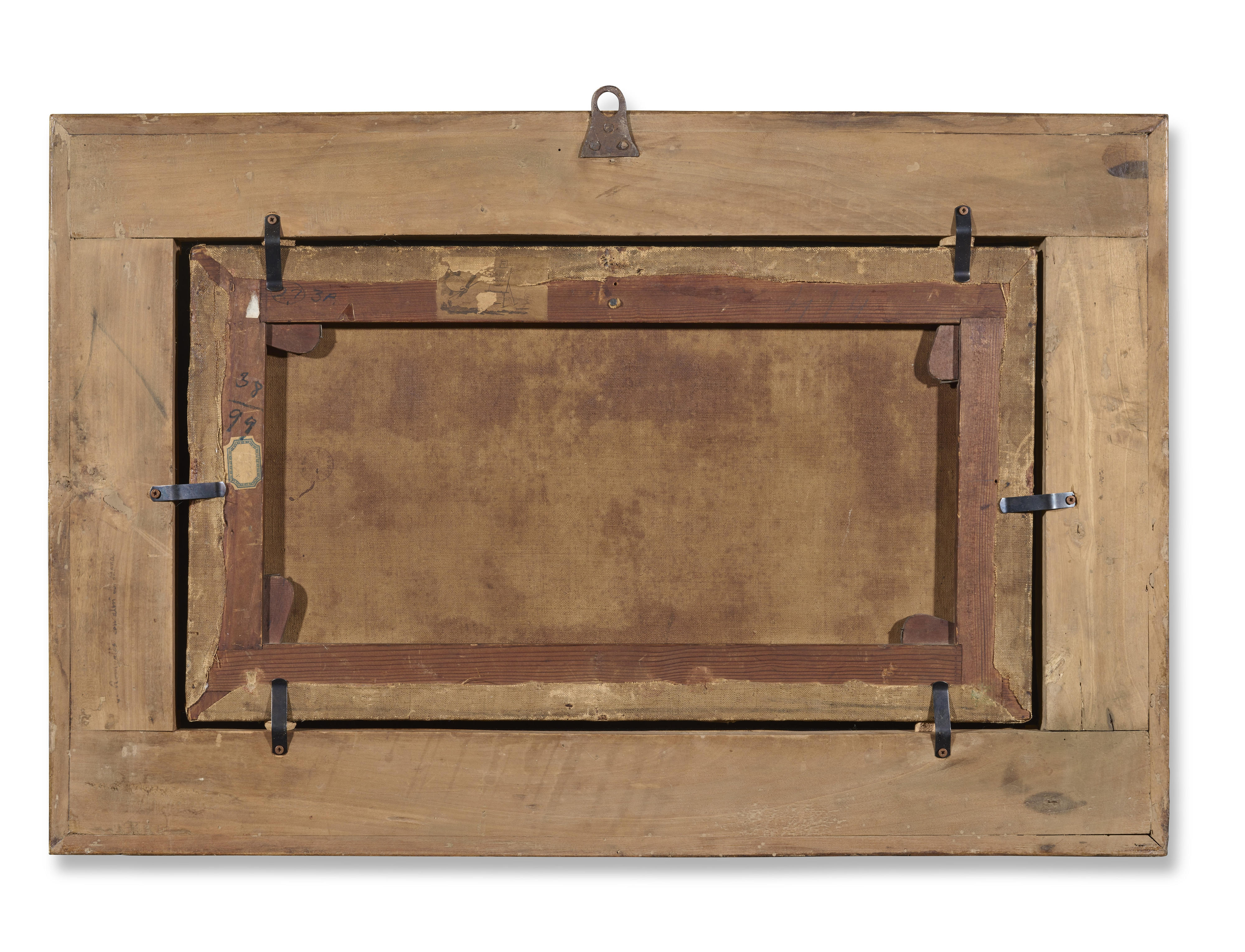
With frame: 48.5 x 73.6 x 5.1 cm (19 1/8 x 29 x 2 in.)
Provenance
his sale, Hotel Drouot, Paris 8 December 1947, lot. 71;
Broglio collection, Paris
Palais Galliera, 20 March 1974, lot. 44, where acquired by a European private collection.
Literature
Antonio Morassi, A Complete Catalogue of the Paintings of G.B. Tiepolo, London, 1962, p. 40 (as Giandomenico Tiepolo).
Adriano Mariuz, Giandomenico Tiepolo, Venice, 1971. p. 132, illustrated no. 202 (as Giandomenico Tiepolo).
Isabella Valente, "Pulcinella da uno a centomila: la Maschera e la coscienza critica del reale in Giandomenico Tiepolo" in F. Carmelo Greco (ed.) Quante Storie per Pulcinella, Combien d'histories pour Polichinelle, conference proceedings, Naples, 1990, p. 289, nos. 6–10, p. 292 (as Giandomenico Tiepolo).
Giuseppe Pavanello, Canova collezionista di Tiepolo , Mariano del Friuli, 1996, pp. 18, 20–21 (as Giandomenico Tiepolo).
Filippo Pedrocco, Satiri, centauri e pulcinelli : gli affreschi restaurati di Giandomenico Tiepolo conservati a Ca'Rezzonico, exhibition catalogue, Museo Correr, Venice, 2000, p. 53 (as Giandomenico Tiepolo).
George Knox, "Pulcinella in Arcadia," in Adriano Mariuz and Giuseppe Pavanello, Tiepolo. Ironia e comico, exhibition catalogue, Fondazione Giorgio Cini, Venice, 3 September–5 December 2004, pp. 97, 109, 112 (as Giambattista Tiepolo).
Adriano Mariuz, "I disegni di Pulcinella di Giandomenico Tiepolo," Arte Veneta, XL, 1986, p. 270 (as Giandomenico Tiepolo).
Victoria Sears Goldman, "The Most Beautiful Punchinelli in the World: a Comprehensive Study of the Punchinello Drawings of Giovanni Battista Tiepolo," PhD dissertation, Princeton University, Princeton, New Jersey, 2021, p. 527 (as Giandomenico Tiepolo).
Description
Among the most popular and appealing works of Giovanni Battista Tiepolo are his painted and, more commonly, drawn images of Punchinelli. Over the course of around thirty years, from the late 1720s until the early 1760s, Tiepolo, the preeminent Venetian fresco painter of his day, created at least thirty-six drawings of Punchinello, a character from the Commedia dell’Arte. The majority of the drawings are connected to venerdì gnoccolare, a bacchanalian celebration on the final Friday of Carnevale in Verona. Accordingly, Tiepolo’s Punchinelli cook and eat gnocchi, guzzle wine, expire from intoxication and suffer the digestive consequences of their excessive consumption.
The present canvas clearly illustrates a venerdì gnoccolare scene. A dense jumble of thirty-two Punchinelli with their conical hats point and turn in all directions, hunched and bunched and pot-bellied. Two figures at the left of the canvas may still be engaged in the cooking of gnocchi, sniffing from the pot, but most of the Punchinelli have already succumbed to the gnoccolonità that vexes hapless participants in the ritual after the feast: several are visibly drunk or ill and one, at the right of the canvas, appears to be relieving himself in front of two jeering companions. A toppled gnocchi pot, a discarded Punchinello hat, a wine flask and a walking stick are jumbled about the foreground.
Scholarly opinions about the authorship of this and other painted as well as drawn depictions of Punchinelli have been divided between Giovanni Battista Tiepolo and his son Giovanni Domenico. While long thought to be by the son, this work, with its notably squat and pot-bellied Punchinelli, is undoubtedly the work of the father Giovanni Battista, given the artist’s propensity for depicting Punchinelli with these physical traits. Giovanni Domenico, by contrast, when portraying the Punchinello character, preferred a taller, less caricatured version (for comparison, see fig. 1, Giovanni Domenico Tiepolo, Carnival Scene: Punchinello’s Triumph, 1760–70).
The present work was in fact originally attributed to Giovanni Battista, exhibited at the Chicago Art Institute in 1938. However, after Antonio Morassi published the painting as the work of Giovanni Domenico in 1962, scholars accepted this attribution and it remained unchallenged until 2004 when George Knox questioned Morassi’s stylistic analysis. Knox instead dated the work to about 1730, furthermore linking the painting to a drawing attributed to Giovanni Battista, formerly in the Oppenheimer collection in London, then in the Sitwell collection, Northamptonshire, that bears several compositional similarities to the present painting (fig. 2, sold at Dreweatts, Berkshire in November 2021, lot 309). Key areas of comparison between the drawing and the painting under discussion include individual figures in the crowd of Punchinelli, the recumbent Punchinello on the left side of the canvas with his arm draped over a gnocchi pot, and the seated Punchinello to the right. The array of discarded items in the foreground also appear related in the two works. Indeed, the drawing formerly in the Sitwell collection, dating in from the 1620s or early 1630s, may have been used as a preparatory work for the painting, which would give weight to Knox’s dating of the painting to the early 1730s.
Two other Punchinelli drawings by Giovanni Battista—the Drunken Punchinella (fig. 3, Musée de la Picardie, Amiens) and the Two Punchinelli (fig. 4, Fondazione Giorgio Cini, Venice) depict masked figures so similar to protagonists in the present painting—namely the horizontal figure on the left of the canvas, and the seated Punchinello with his buttocks exposed at the right side—that they too would seem to serve as preparatory, or at least related, studies.
Moreover, the strong chiaroscuro of the present painting with the dark shadows on the right side is clearly more coherent with the early works of Giovanni Battista, around 1730, when the style of Giambattista Piazzetta was still evident in his paintings.
We are grateful to Adelheid M. Gealt, Professor Emerita, Art History, Indiana University, for her kind assistance in the preparation of this sheet. The painting was examined by a committee of experts at TEFAF Maastricht 2023, who unanimously supported the re-attribution to Giovanni Battista Tiepolo. We would also like to thank Keith Christiansen, Chairman Emeritus of the Department of European Paintings at the Metropolitan Museum of Art and curator of the major Tiepolo exhibition at the institution in 2000, for his expertise and verbalised support of the attribution to Giovanni Battista, and likewise Peter Kerber, Director of the Gemäldegalerie at the Kunsthistorisches Museum, Vienna, for his affirmation of this attribution.
Fig. 1. Giovanni Domenico Tiepolo, Carnival Scene: Punchinello’s Triumph, 1760–70, oil on canvas, Statens Museum for Kunst, Copenhagen.
Fig. 2, Giovanni Battista Tiepolo, A Large Group of Punchinelli, 1720s–30s, pen, ink and wash, 24 x 37.2 cm, inscribed in pen and ink, lower left on mount: “Juan Bapta Tiepolo f,” location unknown (sold Sitwell sale, Dreweatts Berkshire, 17 November 2021, lot 309).
Fig. 3. Giovanni Battista Tiepolo, Drunken Punchinella, 1720s, pen and brown ink, brown wash over traces of black chalk, 11.5 x 20.8 cm, Musée de Picardie, Amiens, M.P. 975-6.
Fig. 5. Giovanni Battista Tiepolo, Seated Punchinello Leaning against a Bust, pen and brown ink and wash, over black chalk, on paper, 21.6 x 19.8 cm, The Morgan Library and Museum, New York, 1983.55.