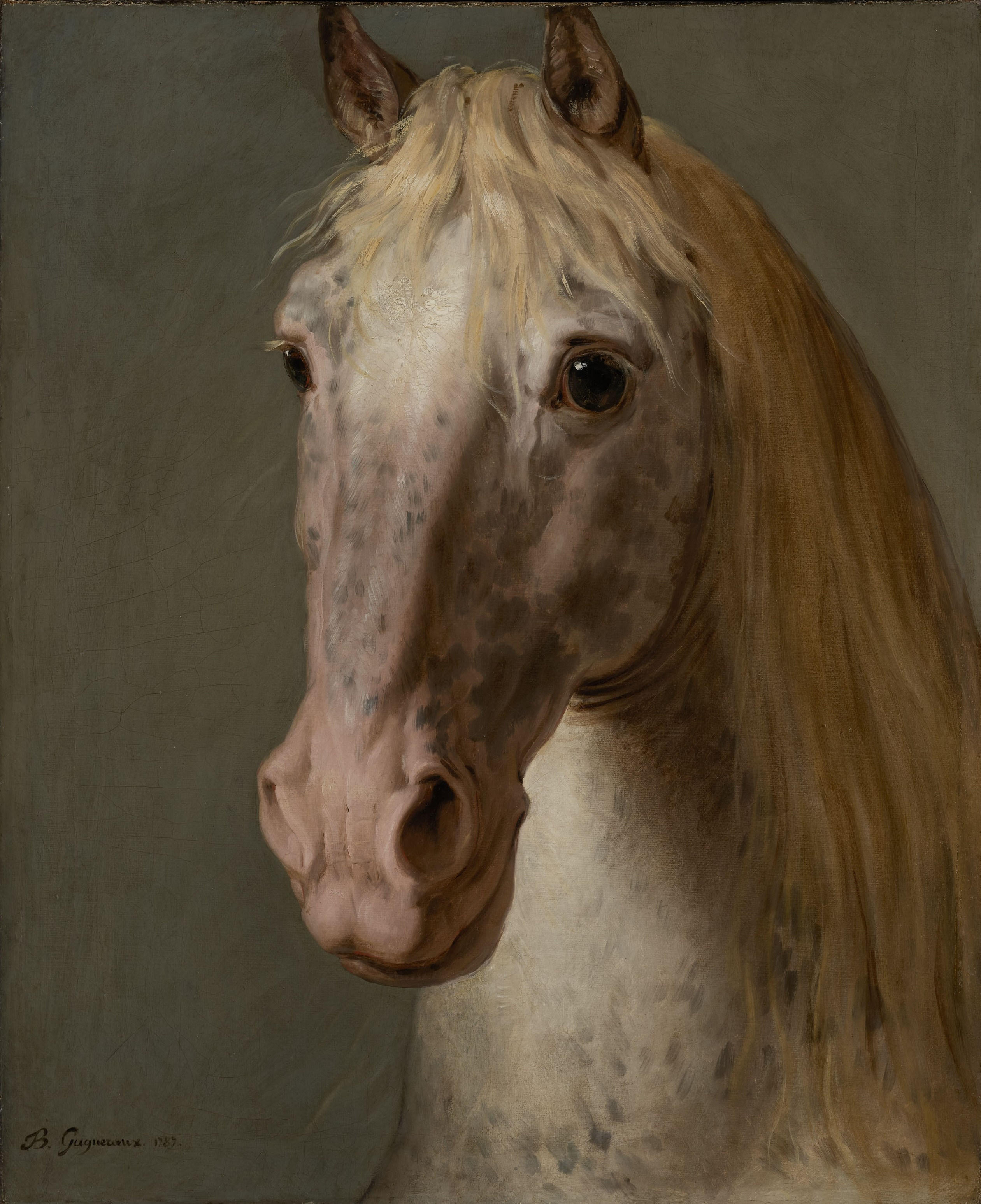


Bénigne Gagneraux
b. 1756, Dijon
d. 1795, Florence
Head of a white horse
1787
Oil on canvas
74.5 x 60.2 cm (29 3/8 x 23 3/4 in.)
With frame: 99.5 x 85.5 cm (39 1/8 x 33 5/8 in.)
Provenance
Recorded in the inventory made after the artist's death in Florence, drawn up 2 september 1795, n° 10 : « Deux tableaux peints sur toile où sont deux têtes de cheval, bordures dorées, larges 1 brasse et hauts 1 br. et 1/3 »,
Probably in the collection of the grandson of the artist, the architect Bénigne Claude Alfred Chevrot, called Alfred Chevrot (1820-1895), son of Agathe Gagneraux, daughter of the artist, in 1846, and thence by descent,
Private collection, Ile-de-France.
Literature
Probably Henri Baudot, 'Eloge historique de Bénigne Gagnereaux', Mémoires de l'Académie des sciences, arts et belles lettres de l'Académie de Dijon, années 1845-1846, pp. 216-217.
Birgitta Sandström, Bénigne Gagneraux, Edsbruk, 1981, p. 256.
Birgitta Sandström, Bénigne Gagneraux 1756-1795 : éducation, inspiration, œuvre, doctoral thesis at the University of Stockholm, 1981, pp. 136-137, n° 10b, reproduced fig. 37.
Pierre Georgel, Catherine Gras, Monique Geiger, Marguerite Guillaume, Bénigne Gagneraux (1756-1795) un peintre bourguignon dans la Rome néo-classique, exh. cat.. Dijon, Musée des Beaux-Arts de Dijon, 1983, p. 17.
Sylvain Laveissière et al., Bénigne Gagneraux (1756-1795), un pittore francese nella Roma di Pio VI, exh. cat.. Rome, Galleria Borghese, 1983, p. 111-112, reproduced. fig. 17 (note by Sylvain Laveissière).
Description
Bénigne Gagneraux attended the Ecole de dessin in his hometown of Dijon, where he studied under Francois Devosge (1732–1811), and was the first recipient of the Prix de Rome awarded by the États de Bourgogne in 1776. This award allowed the young Gagneraux to spend four years in Rome, during which time he made copies of masterpieces to decorate the palaces of the États de Bourgogne. At the end of his scholarship, Gagneraux remained in the city instead of returning to France, working for various clients including making drawings after the antique for Giovanni Battista Piranesi.
In 1784, the French artist met Gustav III of Sweden, who became a key patron, and in the years that followed, Gagneraux established a successful career, spending much of his time on commissions for the Swedish king, as well as for Pope Pius VI and the États de Bourgogne, becoming one of the most fashionable French painters in Rome. With the anti-French riots in 1793, he was forced to leave Rome, taking refuge in Florence where he was appointed drawing professor at the Accademia by Ferdinando III. His untimely death came in 1795 at the age of just 38, when he fell from a window – either by accident, or as suicide.
The present painting demonstrates Gagneraux’s mastery as a painter of horses, and is one of a handful of equine ‘portraits’ known by the artist– its attentiveness to the details and veracity of the features shows it was made from life, rather than based on drawings or the artist’s imagination. The horse is a true white (as the skin under its coat it clearly pink, as opposed to black which is the case for grey horses) with some dapple marks around its face, perhaps of the historic Boulonnais breed, a popular type named after Boulogne-sur-Mer in the north west of France, and becoming popular across Europe from the seventeenth century on account of its strength and endurance. It was used widely for agricultural and military purposes. This signed and dated study is likely related to the artist’s commission from the États de Bourgogne in 1786; he was asked to produce two large canvases, La Bataille de Seneffe (1788) and Le Passage du Rhin à Tholhuis (1790, both Musée des Beaux-Arts de Dijon), the first two in a planned series of history paintings depicting the victories of the Grand Condé to decorate the Palais de Dijon. Successive paintings in the series remained unrealised, likely due to the disruption caused by the French Revolution.In preparation for these paintings, Gagneraux undertook several horse studies; in addition to the present work, these include Horse frightened by a snake (1787, Dijon, Musée Magnin, fig. 1), Saddled horse in a landscape (1787, private collection), Saddled horse seen in profile (1787, galerie Jean-Luc Baroni et Emmanuel Marty de Cambiaire) and Head of a black horse (private collection). Since the artist signed many of these preparatory works, including ours, it is clear that he envisioned selling them as finished pieces in their own right. Gagneraux evidently took the commissions seriously, explaining the reason for the delay in delivering to the États de Bourgogne in 1792 to his former master and director of the Musée des Beaux-Arts de Dijon, Francois Devosge, ‘ce sont les études particulières du cheval qui m'ont retardé ... j'en ai fait de très sérieuses’ (It is the individual horse studies that have delayed me, I have made some very serious ones).
In this canvas, the faithful depiction of the horse’s physiognomy and delicate representation of the textures of its coat, mane and soft skin round the nose demonstrate Gagneraux’s impressive skill in capturing the likeness of these animals. Unlike some of the horses in the larger battle paintings, which are somewhat idealised and humanised, this white steed has a naturalistic appearance, capturing the animal’s alertness and the connection that can exist between animal and man.
Fig. 1. Examples of modern Boulonnais horses.
Fig. 2. Bénigne Gagneraux, Horse frightened by a snake (Cheval effrayé par un serpent), 1787, Dijon, Musée Magnin.