
Athénaïs Paulinier
b. 1798, Paris
d. 1889, Paris
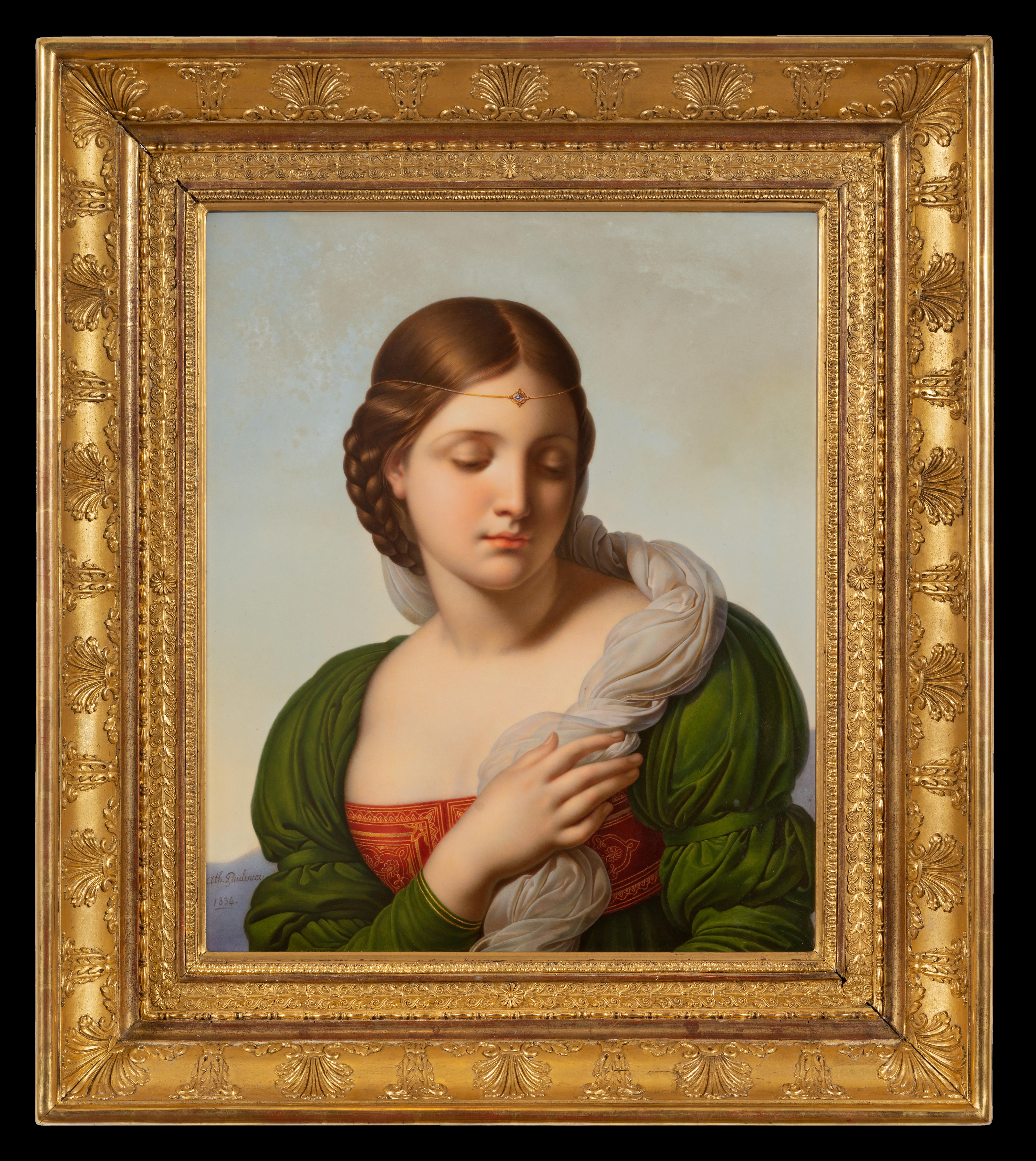
Head of the Virgin after Girodet
1834
Hard-paste porcelain and enamels
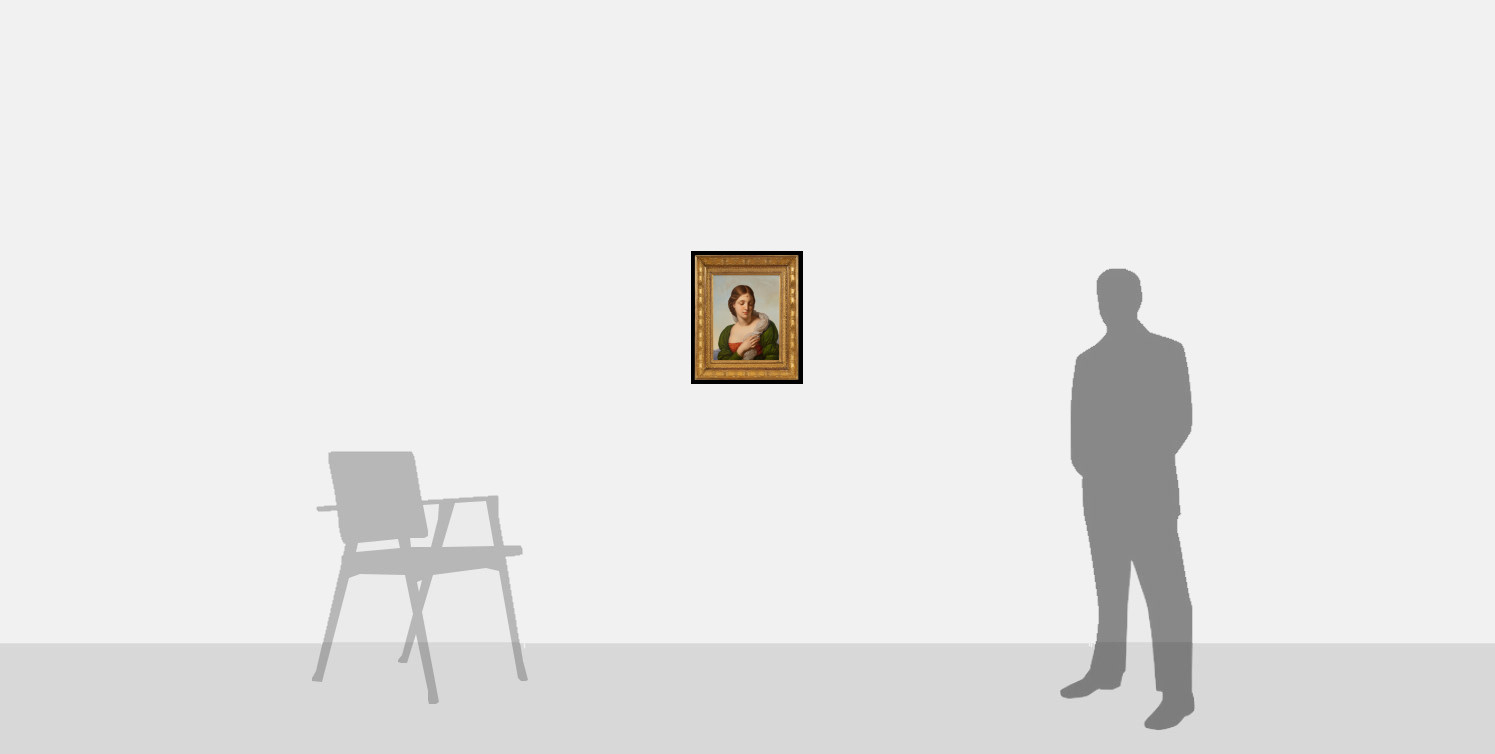
59 x 50 cm (23 1/4 x 19 3/4 in.)
Provenance
(her sale, Hôtel Drouot, Paris, 5 June 1889, lot 37).
with Charles Janoray, New York;
Acquired in 2009 by the Twinight Collection, New York;
Private collection, France.
Description
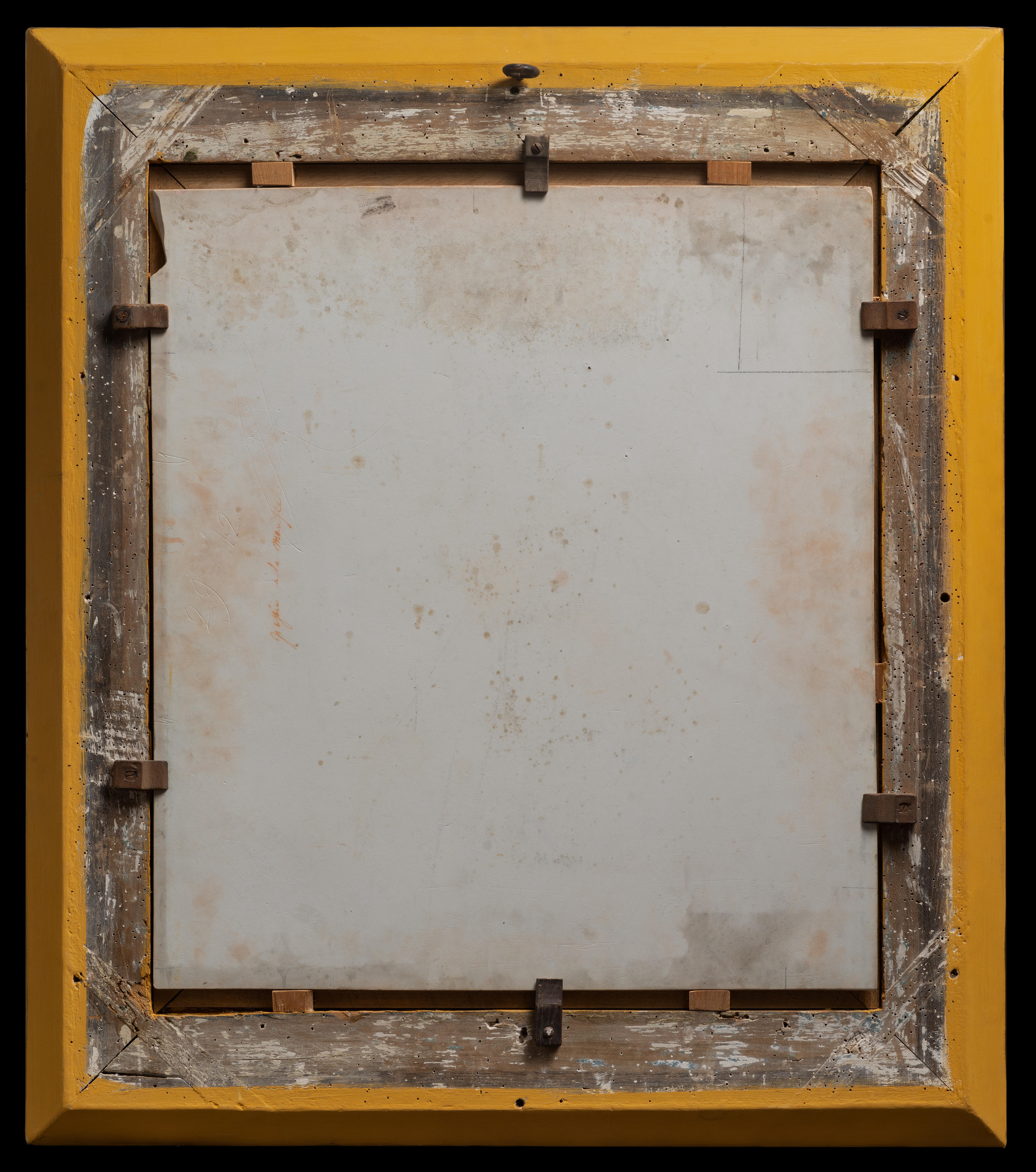
This large porcelain plaque framed set in a gilded wood frame was painted in 1834 by Athénaïs Paulinier after L’Étude de Vierge or Le Visage de la Vierge, painted by Anne-Louis Girodet-Trioson (1767–1824), in 1812 and exhibited at the Salon de peinture et de sculpture at the Louvre in the same year. The Virgin is presented in a three-quarter profile view, gently gazing down towards her left hand, which caresses the long white veil that tumbles over her right shoulder. Her plaited light brown hair is adorned with a ferronnière, a headband encircling the forehead and, as is typical, adorned with a jewel at its centre. She wears a green grown with a red bodice embellished with fine gold detailing. In the background is a landscape of clear, slightly milky blue skies over hints of a pale blue mountain range.
As noted above, Girodet’s painting canvas was exhibited at the Salon of 1812 as L’Étude de Vierge (no. 1314). It no longer survives, or has yet to be identified, but an engraved illustration from its presentation at the Salon can be found in the Recueil de pièces choisies par les ouvrages de peinture et de sculpture exposés au Louvre le premier novembre 1812 (Fig. 1). Three works on porcelain record Girodet’s composition. One is a small circular miniature measuring painted by Marie-Victoire Jaquotot (1772–1855), is currently in a private collection (sold Tajan, Paris, 5 April 2001, lot 207). According to the art historian Pierre-Alexandre Coupin, a second plaque after Girodet’s painting was also produced by Jaquotot during Girodet’s lifetime (see Pierre-Alexandre Coupin, Œuvres posthumes de Girodet Trioson, Paris, 1829, vol. 1, p. 66). Nevertheless, a letter from Athénaïs Paulinier to Alexandre Brongniart (1770–1847), director of the Sèvres porcelain manufactory, notes that “this head being of great beauty and having the advantage of never having been copied and of being copied only by me” (A.M.N.S., Ob9.; original letter reproduced in accompanying documentation); either Paulinier was unaware that Jaquotot, her own teacher, had previously copied this painting, or Coupin’s statements are incorrect, or Jaquotot reproduced Girodet’s original only after her pupil had done so.
Girodet’s painting was welcomed at the time as a major work by the artist, who was gravely ill and exhibited only once, with this canvas, at the Salon between 1810 and 1819. The work was acquired by Count Alphonse Perregaux (1785–1841) and is listed in the catalogue raisonné of his gallery of paintings in 1841. At the sale of this collection on 8 December 1841, the work was bought by a M. Paillet for 3,155 francs.
Critics at the time, such as the artist Charles-Paul Landon, noted similarities between Girodet’s Virgin and the great masters of the Italian Renaissance, including Leonardo and Raphael. In 1812, Girodet in fact had access to the works in the Musée Napoléon, now the Musée du Louvre, and drew inspiration from these great masters of the past in his works of the period. A number of details, such as the Virgin’s downcast gaze and the tender sweetness of the work’s atmosphere, evoke Raphael’s images of the Virgin, notably La Belle Jardinière (fig. 2, c. 1507–8, Musée du Louvre, Paris), which was also reproduced on porcelain by Jaquotot. Additionally, the headband worn by Girodet’s Virgin and her Renaissance-style costume can be connected to Leonardo’s famous La Belle Ferronière (fig. 3, c. 1495–97, Musée du Louvre, Paris).
With no trace of Girodet’s painting since 1841, it is impossible to determine whether Paulinier copied the original painting exactly, or whether they differ slightly. However, Landon’s engraving suggests that the general composition of the work remained faithful to Girodet’s painting (see Charles-Paul Landon, Salon 1812–Recueil de pièces choisies parmi les ouvrages de peinture et de sculpture exposés au Louvre le premier novembre 1812, Paris, 1812, vol. 2, p. 6). Furthermore, the dimensions of Paulinier’s plaque match those of Girodet’s canvas, as is mentioned in her correspondence with Brongniart: “Mr Robert, who has just come to see this beautiful original, strongly urges me to copy it in the size of the model, that is, on a plate 22 ½ inches long by 18 ½ inches wide” (A.M.N.S., Ob9.; original letter reproduced in accompanying documentation).
At the beginning of the nineteenth century, owing to poor conservation or restoration work, concern arose about the deterioration of Old Master paintings, even those in the most exalted of collections. As the application of paint to porcelain considerably increased its durability, many porcelain copies of the Louvre’s masterpieces were made at Sèvres, on the initiative of Alexandre Brongniart. These were initially based on Raphael's paintings, then extended to paintings by Italian and Flemish masters, and finally to French painters of the seventeenth and eighteenth centuries. This trend was soon followed by a taste for copies of paintings by contemporary artists. As a result, the number of copies made on porcelain plaques after living artists rose sharply in the first half of the nineteenth century. Marie-Victoire Jaquotot, mentioned above, was even allowed to borrow paintings from the Louvre, often keeping them in her studio for some time. In an 1822 letter to the Minister of the King’s Household, she noted: "…after having devoted myself to reproducing some of the most beautiful paintings of the École ancienne and principally of Raphaël, I wish to devote myself in a few years to the most remarkable paintings of the École Françoise, which shines so brightly…" (A.M.N.S., Ob9.; original letter reproduced in accompanying documentation).
Thus, when Paulinier began copying Girodet’s painting, she was following in her own teacher’s well-established footsteps.
Born Marie Élisabeth Apollinie Athénaïs Le Barbier de Tinan, Athénaïs Paulinier was an accomplished figurative painter on porcelain. She took the Paulinier name following her marriage to Alphonse Paulinier, Conseiller du Cher and bodyguard to King Louis XVIII. She trained as a porcelain painter with Jaquotot, whom she refers to as her instructor in her correspondence with Brongniart (A.M.N.S., Ob9.; original letter reproduced in accompanying documentation). Her work at Sèvres lasted only a short time, from 1830 to 1834.
Paulinier’s career was distinguished by her copies of Old Master paintings on porcelain, which she regularly exhibited at the Salon. Her production also included miniatures, which were likewise regularly exhibited. She presented three porcelain plaques at the Salon in 1833: a Virgin and Child after Bartolomé Esteban Murillo (1617–1682), an Infanta Margarita after Diego Velàzquez (1599–1660), and a Head of a Roman Peasant Woman after Louis Court (1670–1733). In the same year, Paulinier also presented works in oil on canvas depicting contemporary sitters. These works earned her a 3rd class medal at the 1833 Salon, followed by a 2nd class medal in 1835 for the present plaque (see https://gallica.bnf.fr/ark:/12148/bpt6k49754t/f509.item.r=Porcelaine).
Following her period at Sèvres and the presentation of the present plaque at the Salon of 1835, Paulinier presented no further works until 1864. At this Salon, she presented only two miniatures, and then one the following year, which was also her last appearance at the Salon. Paulinier's paintings are not well known today, and the present plaque seems to be her only work to have emerged on the market in the modern era.
The correspondence between Paulinier and Brongniart relates the various stages in the decoration of the present plaque. It mentions the fact that Paulinier had the painting in her possession on 6 July 1833. She found the painting to be so exceptional that she asked the director of Sèvres for a new plaque in order to preserve the original painting’s dimensions: "I have at the moment at home, Monsieur, the beautiful head of the Virgin that Girodet exhibited in 1812; I intended to copy it on a plate that you kindly had delivered to me (the 30-franc one); this would make a great reduction in size; Mr Robert, who has just come to see this beautiful original, strongly urges me to copy it in the size of the model, that is, on a plate 22 ½ inches long by 18 ½ inches wide; I am very afraid of a work of this size especially after the misfortune that has befallen me; I would risk it, however, if it would make me a good study, this head being of great beauty and having the advantage of never having been copied and of being copied only by me. If it were possible for me to obtain from the factory a plate of the size I desire, and not too expensive, I would be greatly obliged to you, Monsieur...” (A.M.N.S., Ob9.; original letter reproduced in accompanying documentation).
Paulinier’s caution when it came to creating such a piece was not without cause, as this plate is remarkable for large size, a technical feat. Copying paintings onto porcelain plates is a particularly complex process: the artist must at once be a talented painter, but also have technical mastery of porcelain. A large, flat surface is extremely difficult to achieve, as is accuracy in terms of achieving vibrant colouring on that surface. A note from Brongniart indicates his acceptance of Paulinier's request, with the price rising to 300 francs, and a blank plaque was promptly delivered to Paulinier in July 1833 (A.M.N.S., Vbb 8 : Présents et ventes à crédit, juillet 1833, F. 187, recto).
On 15 October 15 of the following year, Paulinier reported on the progress of his work to Brongniart: "Please allow me, Sir, to thank you for all the interest you have shown in the success of my work. Thank God, the fire I was so dreading went off without a hitch, and its effect was even better than I had dared to hope; now I have to finish off this painting, which has cost me more work than I had ever put into anything; to do this, I have already begun the tests necessary to remedy the inconveniences you have kindly pointed out, Sir…" (A.M.N.S., Ob9.; original letter reproduced in accompanying documentation).
It was only a year later that the plaque was presented at the Salon of 1835. In a letter to Brongniart, Paulinier offered to sell his masterpiece to Sèvres for 4,000 or 5,000 francs: “I thought at the time, Monsieur, that it was not raising my pretensions too high, to ask you for four to five thousand francs for my head of the Virgin” (A.M.N.S., Ob9.). Brongniart, however, did not agree to Paulinier’s request. The plaque was finally sold at auction after Paulinier’s death for 1,000 francs (see Provenance, above). The only other work painted by the artist which she kept until her death, is a reproduction of Judith with the Head of Holofernes after Bartolomeo Manfredi (1582–1622) on porcelain, whose whereabouts remain unknown today.
Fig. 1. Charles-Paul Landon, after Girodet, L’Étude de Vierge, engraving, Recueil de pièces choisies parmi les ouvrages de peinture et de sculpture exposés au Louvre le premier novembre 1812.
Fig. 2. Raphael, La Belle Jardinière, c. 1507–8, oil on panel, Musée du Louvre, Paris.
Fig. 3. Leonardo da Vinci, La Belle Ferronière, c. 1495–97, Musée du Louvre, Paris.