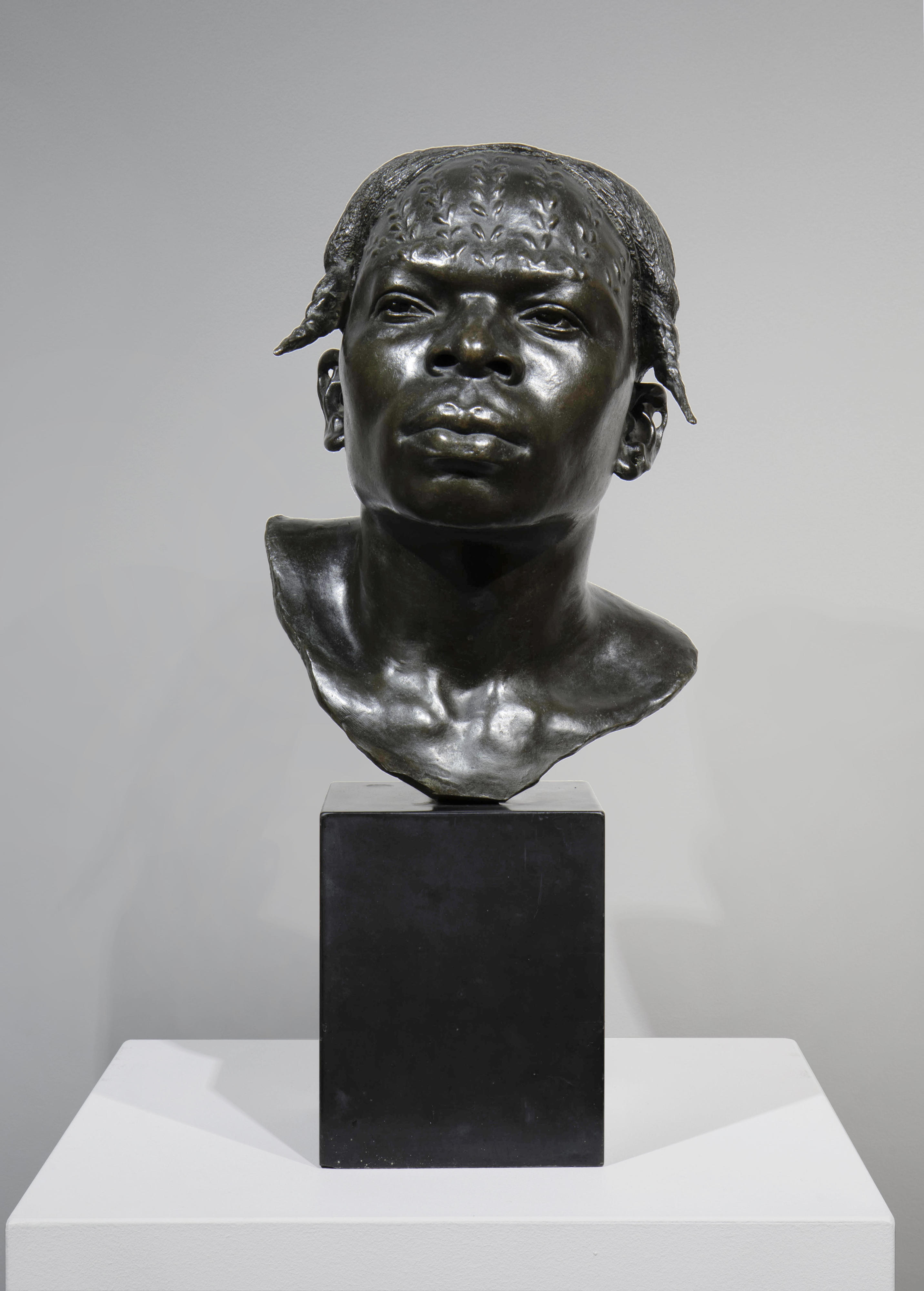
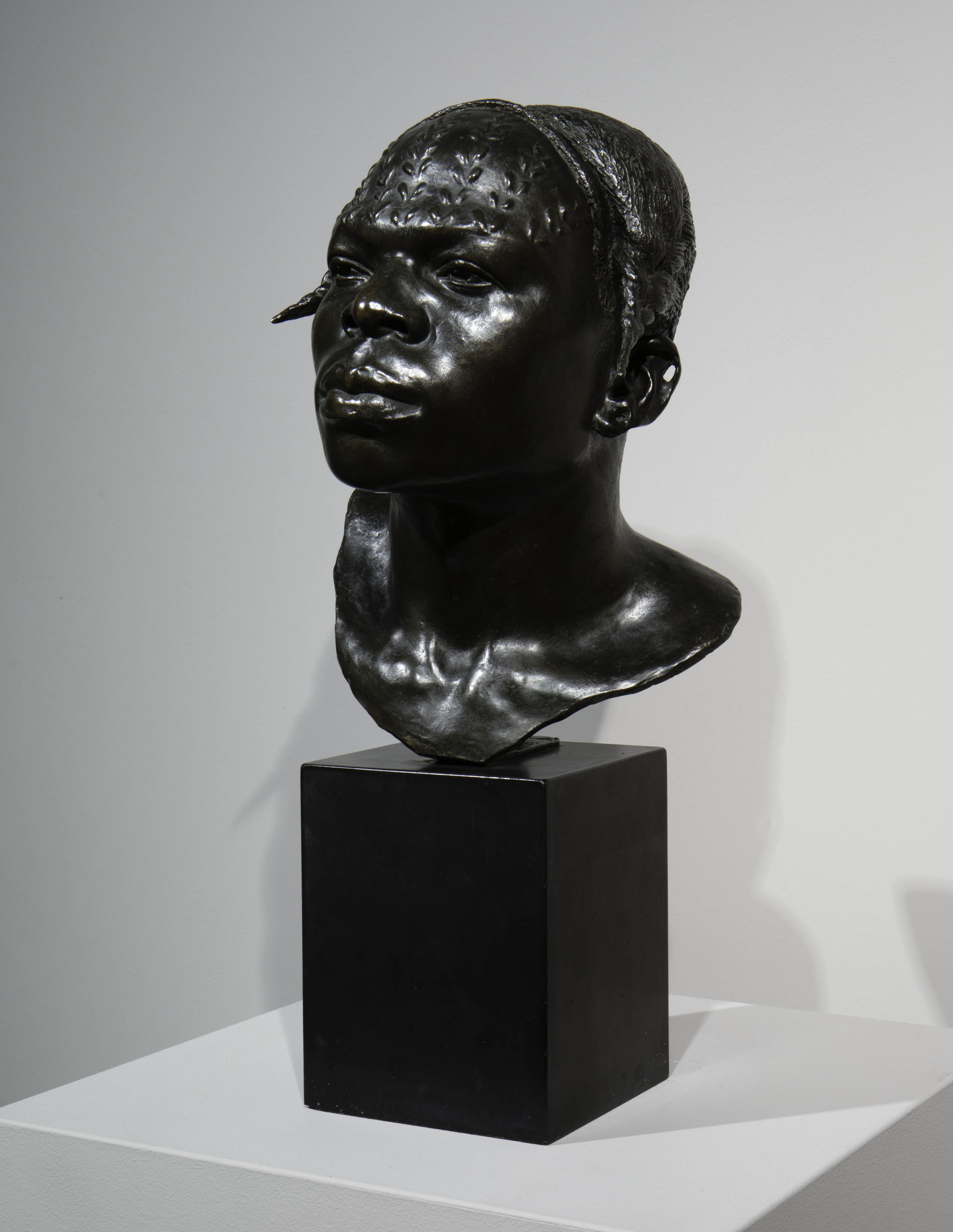
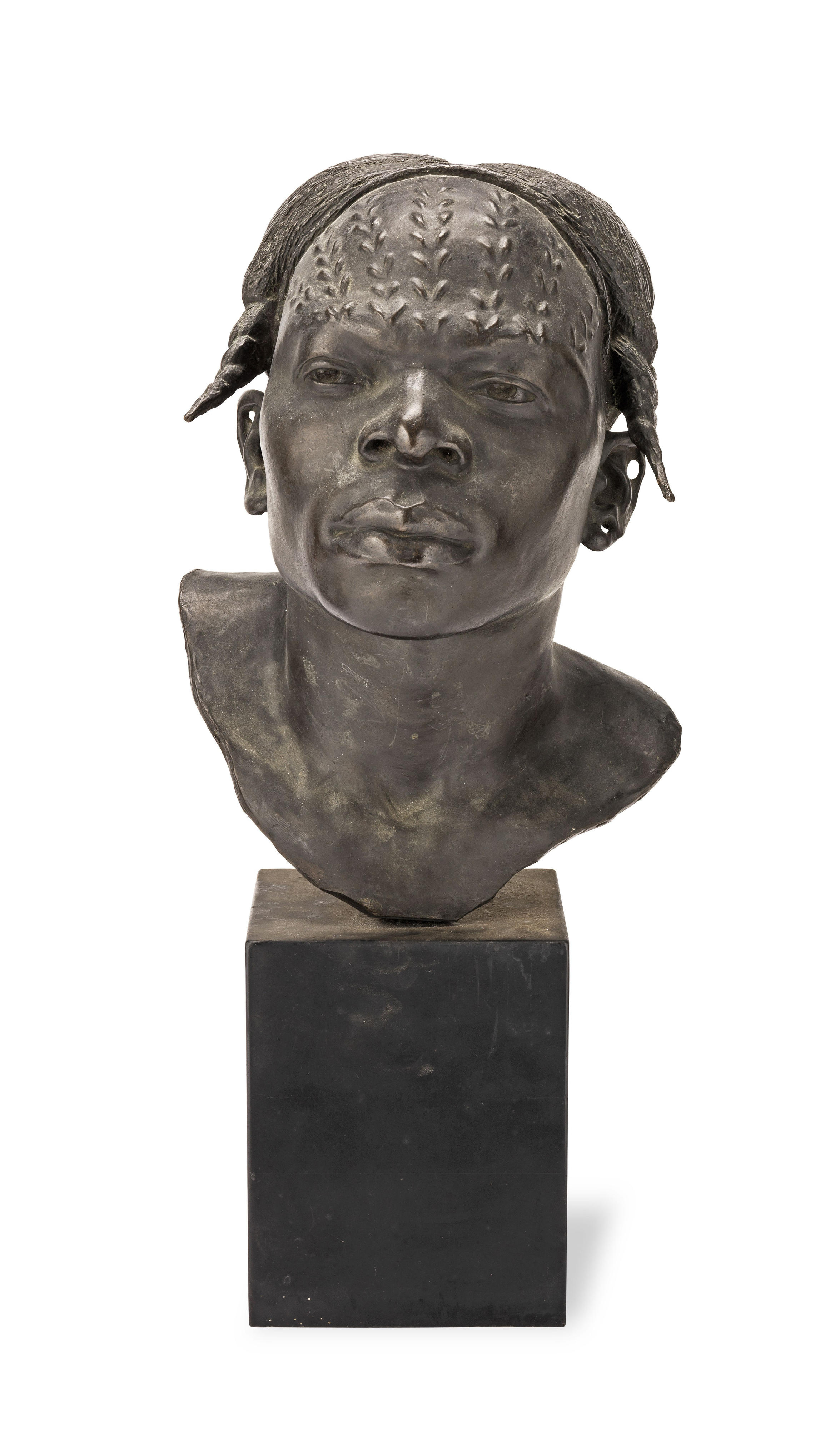

Bust of a Man
c. 1900
Bronze
H: 54 cm (21 1/4 in.)
Provenance
Gift of the artist to Dick Morton, Hills House, Denham; by inheritance to his wife, and then by descent to his grandniece.
Literature
Pierre Kjellberg, Bronzes of the 19th Century: Dictionary of Sculptors, Atglen, Pennsylvania, 1994, p. 648.
Sarita Ward, A Valiant Gentleman, London, 1927, p. 155.
Description
Herbert Ward (11 January 1863, London–5 August 1919, Neuilly-sur-Seine) was a British sculptor, writer, and anthropologist. From a young age, Ward was driven by a sense of adventure that took him to New Zealand, Australia, Borneo, and the Congo. His works' naturalism has meant he is often classified as an artist of the British New Sculpture Movement. However, considering his years in France, one can see evidence of the influence of artists such as Charles Cordier, who also travelled to Northern Africa. Ward was among the first artists to work within the Orientalist genre of ethnographic sculpture. His representations of African subjects are inextricable from contemporary ideas about racial hierarchies and the conception of the racial 'other'.
His extensive travels inspired his writing and later his artistic practice, which grew from travel drawings and watercolours into life-size bronzes. Ward cultivated his artistic skills as a student at the Royal Academy, London, and after 1902 maintained a studio in Paris. France was considered the leading nation in bronze casting and allowed easier access to African models. Ward's singular focus on Congolese subjects found a ready audience in France, as a number of his French contemporaries likewise depicted African and Asian subjects in their work.
Ward described his sculpture as "honest observation" of the way of life he had encountered in Africa. The seeming verisimilitude in the articulation of the details of his subjects' hairstyles, facial and body scarification, ornament, and clothing do suggest a certain degree of ethnographic intention. Ward was adamant that they were not created as scientific illustrations but as art, seeking to capture "the spirit of Africa in the broad sense." Rather than individual portraits, Ward's sculptures are consciously produced syntheses, idealizing Black bodies and presenting a contrast between his own, naturalistic depictions and the stylization seen in African material culture.
In both his writings and his art, Ward demonstrated that he was not devoid of prejudices and misconceptions. Some of his sculptures, particularly his bronze Sleeping Africa (1902), evoke the theory that the development of African cultures was behind that of Western society—a theory perpetuated as a rationale for Imperialism and the European colonization of the African continent. Ward likely modelled his allegorical figure sleeping on a map of the Africa to imply that colonialism would bring about the "awakening" of the continent to Eurocentric ideals. By the 1910s, however, Ward began to doubt the morality of the colonial experiment in the Congo. His final sculpture, Distress or The Tragedy of the Congo, depicts a Black male figure with his head down and his arms wrapped around himself in an expression of deep mourning. These two works, made a decade apart, illustrate Ward's evolving attitude toward European Colonialism in Africa.
Ward's sculptures have been exhibited in contradictory ways, as a demonstration of the talent of the artist at the Paris Salon, as a justification for Imperialism in Brussels, and later as an ethnographic display at the Smithsonian in Washington. Around 1900, during one of his lecture tours, Ward and his wife Sarita Sanford, daughter of American financier Charles Henry Sanford, visited the Smithsonian, and were so impressed by their research, exhibitions, and education departments that Ward decided to leave his collection to the museum. While Ward intended to oversee the installation of the collection himself, in 1919 he fell ill and died before the project was realized. Through the determination of his wife, the collection opened to the public in 1921 with an installation that took inspiration from Ward's studio in Paris and remained on view until 1961. In addition to his private collection, 18 original bronze works were also donated, including a casting of the present bronze.
The Bust of a Man was one of Ward's first sculptural works. It was exhibited at the Royal Academy in London in 1901, and a plaster version was shown at the Salon des Artistes Français the same year. Ward received the highest possible award for a non-French native, a mention honourable, which precipitated a purchase of a bronze by the French Government.
Three other versions of the bronze head are known and are currently at the Museé d'Orsay in Paris, the Smithsonian National Museum of Natural History in Washington, and the National Museum of Wales in Cardiff. Many of Ward's contemporaries cast large series of their works through foundries, but instead, Ward preferred to produce only a few versions of each of his life-size compositions, including busts such as the present cast. Tabletop reductions of the large-scale works were produced by some of France's foremost foundries, including Rudier.
The present cast was gifted by the artist to his close friend 'Dick' Morton, and upon his death, the piece passed to his wife—the great aunt of the previous owner.
Please note that the price and availability of the above work are subject to change without prior notice.