
Baldassare Franceschini, called Il Volterrano
b. 1611, Volterra
d. 1690, Volterra
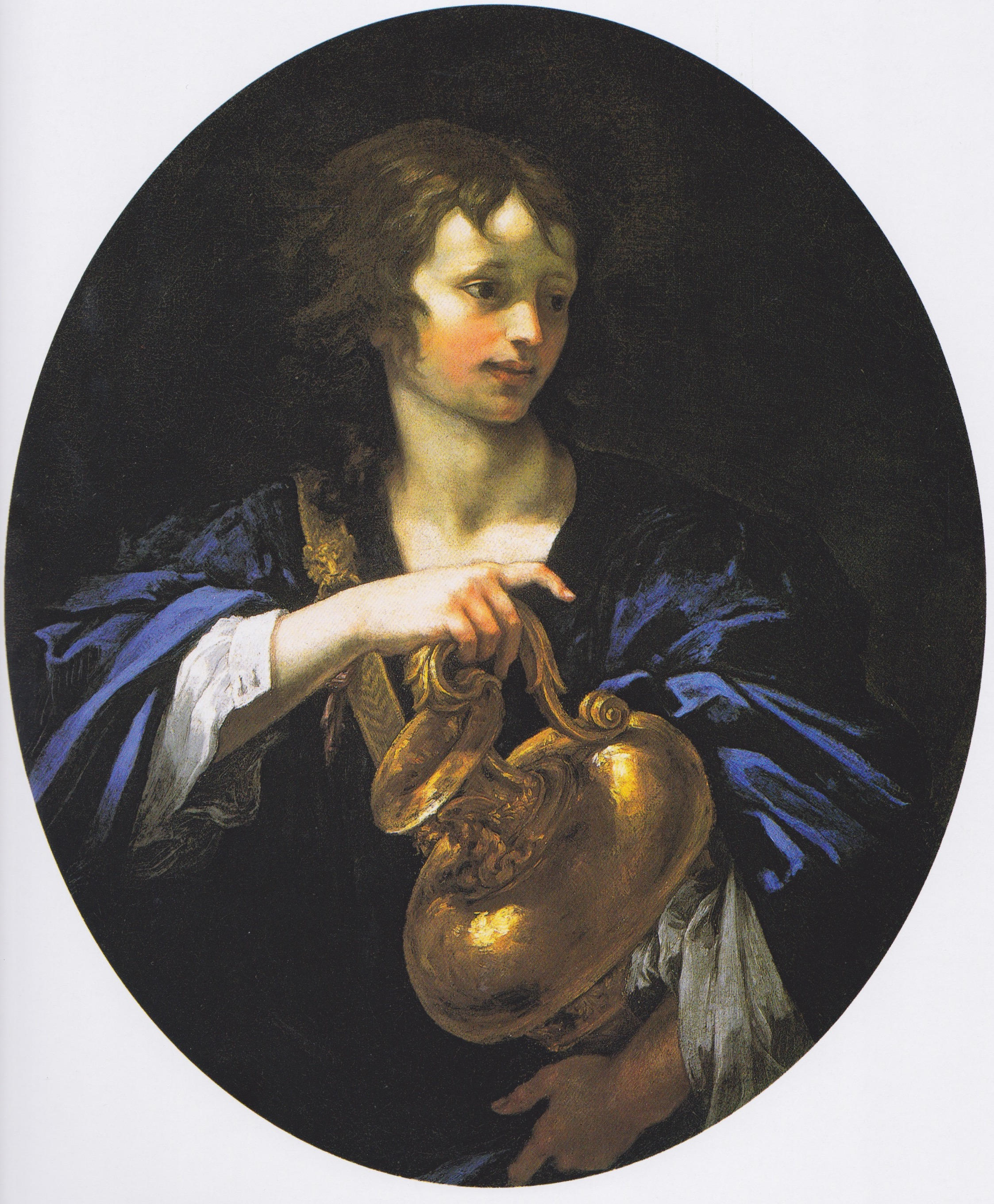
Hylas with a Vase
c. 1650
Oli on canvas
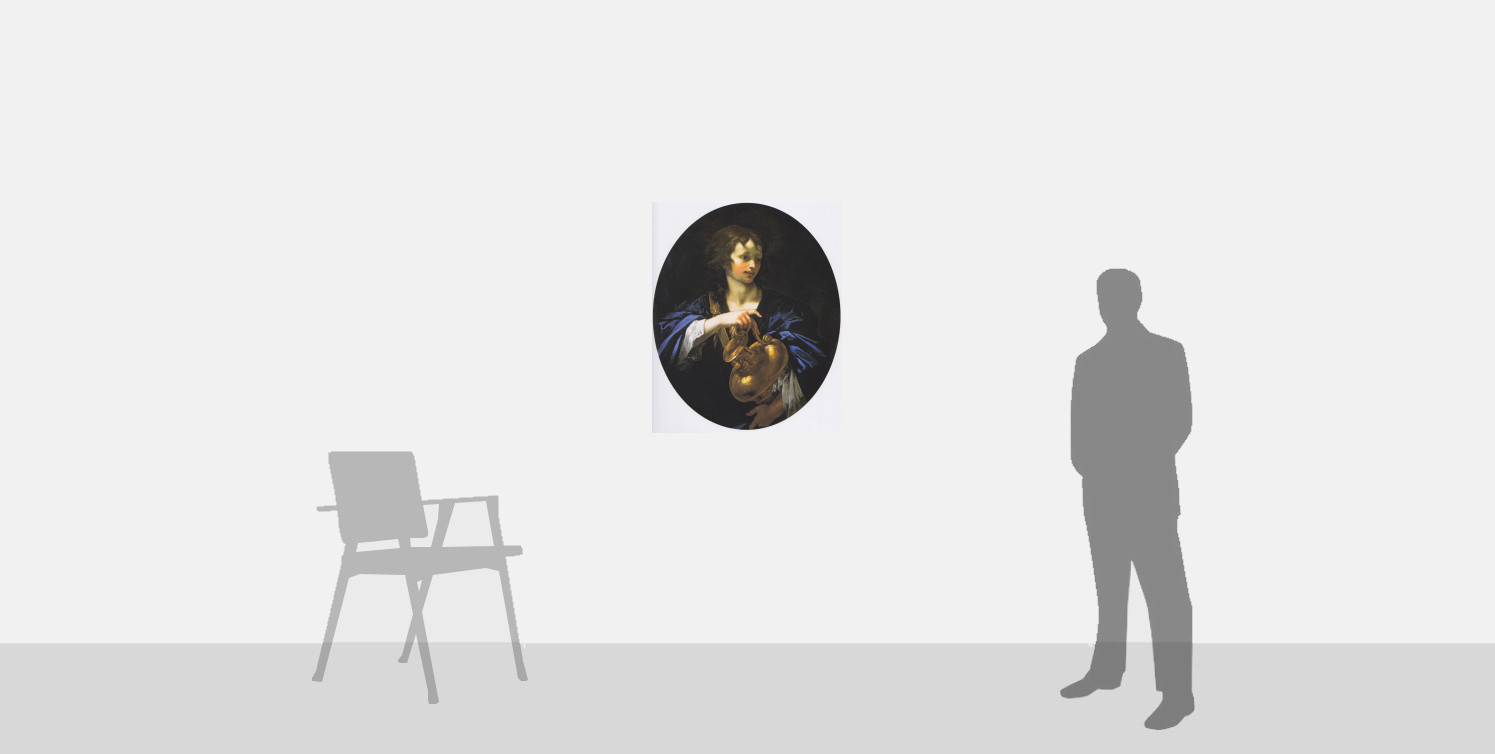
102.9 x 84.5 cm (40 1/2 x 33 1/4 in.)
Provenance
Comissioned by Cosimo di Antonio Citerni, Florence,
On his death
in 1653, by inheritance to his brother Benedetto Citerni, Florence, and then by
descent,
with Marco Voena, London and Milan, 2001-2002,
Carlo Orsi, Milan,
Private collection, New York.Literature
M.C. Fabbri, in M. Gregori (ed.), Pittura nella Firenze di Ferdinando II de Medici, Turin, 2002, pp. 16-17, 37-38.
F. Baldassari, La pittura del Seicento a Firenze. Indice degli artisti e delle loro opere, Turin, 2009, p. 394.
S. Bellesi, Catalogo dei pittori fiorentini del ‘600 e ‘700, Florence, 2009, I , p. 150; II, p. 297, fig. 651.
A. Grassi, Il Volterrano. Le ragioni di una forma tra alcune voci della Firenze seicentesca, Florence, 2012, p. 2104 (or p. 110) ?.
M.C. Fabbri et al., Volterrano, Florence, 2013, pp. 15-22, 29-30, 152-153, cat. 31.
Description
In his Notizie dei Professori, Filippo Baldinucci (F. Baldinucci, Notizie dei professori del disegno da Cimabue in qua, Florence, 1681–1728, V, p. 161) left open the question of Baldssare Franceschini's training, noting that he possessed only scant information. In all likelihood, as modern studies have speculated, Volterrano's early artistic instruction took place within the limited local context of his native Volterra, where he worked with the only noteworthy painter, the Florentine Cosimo Daddi. A fundamental moment in Volterrano's training took place between late 1629 and early 1630, when the sixteen-year-old painter moved to Florence and joined the workshop of Matteo Rosselli. There he began to develop his own style, and within a year, he had advanced sufficiently to undertake frescoes in Volterra using skilled foreshortening.
Franceschini's dazzling ascent, as described by Baldinucci, accelerated in 1636, the year in which the biographer indicates the first contact between the artist and Don Lorenzo de Medici, who entrusted the painter with the realisation of a series of iconographically complex frescoes in the Villa della Petraia, which Volterrano would complete in 1648. Thus Franceschini’s works in Petraia allow observation of the painter’s evolution over a period of years, from the earliest figures still strongly linked to Rosselli's models to the bold choices in colour and composition that denote the artist’s maturity—his confidence in rendering of the physicality, movement and three-dimensionality of his figures and his talent for creating illusionistic spaces in which to insert groups of such figures grew exponentially.
In 1650 a trip to Rome led Franceschini to confront the protagonists of the Roman Baroque, from Pietro da Cortona to Bernini to Baciccio. To that period dates the present canvas, in which the young Hylas, the companion of Hercules, is depicted on his way to the stream where he will meet his tragic fate, being abducted by water nymphs. The painting was executed for Cosimo Citerni, the fifth and last son of Antonio di Bartolomeo Citerni, a wealthy grain merchant. Cosimo followed in his father's footsteps and does not seem to have had any particular relationship with the Medici court, where, however, his brother Luca, 'by profession a priest and a friend of the Muses', served as a chaplain and close friend of Don Lorenzo de Medici.
The present painting replicates a composition, executed in fresco set under and oval glass pane, which Franceschini made for Cardinal Giovan Carlo de' Medici for the villa at Castello (fig. 1). The work was presented together with a pendant, also executed with the same unusual technique, which depicts Venus embracing Cupid. Both works are now in the Museo Stefano Bardini in Florence. The two frescoes and the present canvas should be dated, according to Maria Cecilia Fabbri, around the middle of the seventeenth century, given their obvious similarities with the Sleeping Cupid executed, again in fresco, around this time for Grand Prince Ferdinando de' Medici (Galleria Palatina, Palazzo Pitti, Florence).
This group of paintings includes some of the most famous and representative images of Franceschini’s activity, a gallery of sensual and elegant young ephebes, virtually emblematic of Ferdinando de' Medici's Florence, rendered with exquisite colouring, as in the present painting where the light striking the bronze vase illuminates with reflections the rosy complexion of Hylas and his blue cloak.
Fig. 1. Baldassare Franceschini, Hylas with a Vase, Museo Stefano Bardini, Florence
Fig. 2. Baldassare Franceschini, Sleeping Cupid, Galleria Palatina, Palazzo Pitti, Florence