
Filippo Napoletano
b. c. 1587, Rome
d. c. 1629, Rome
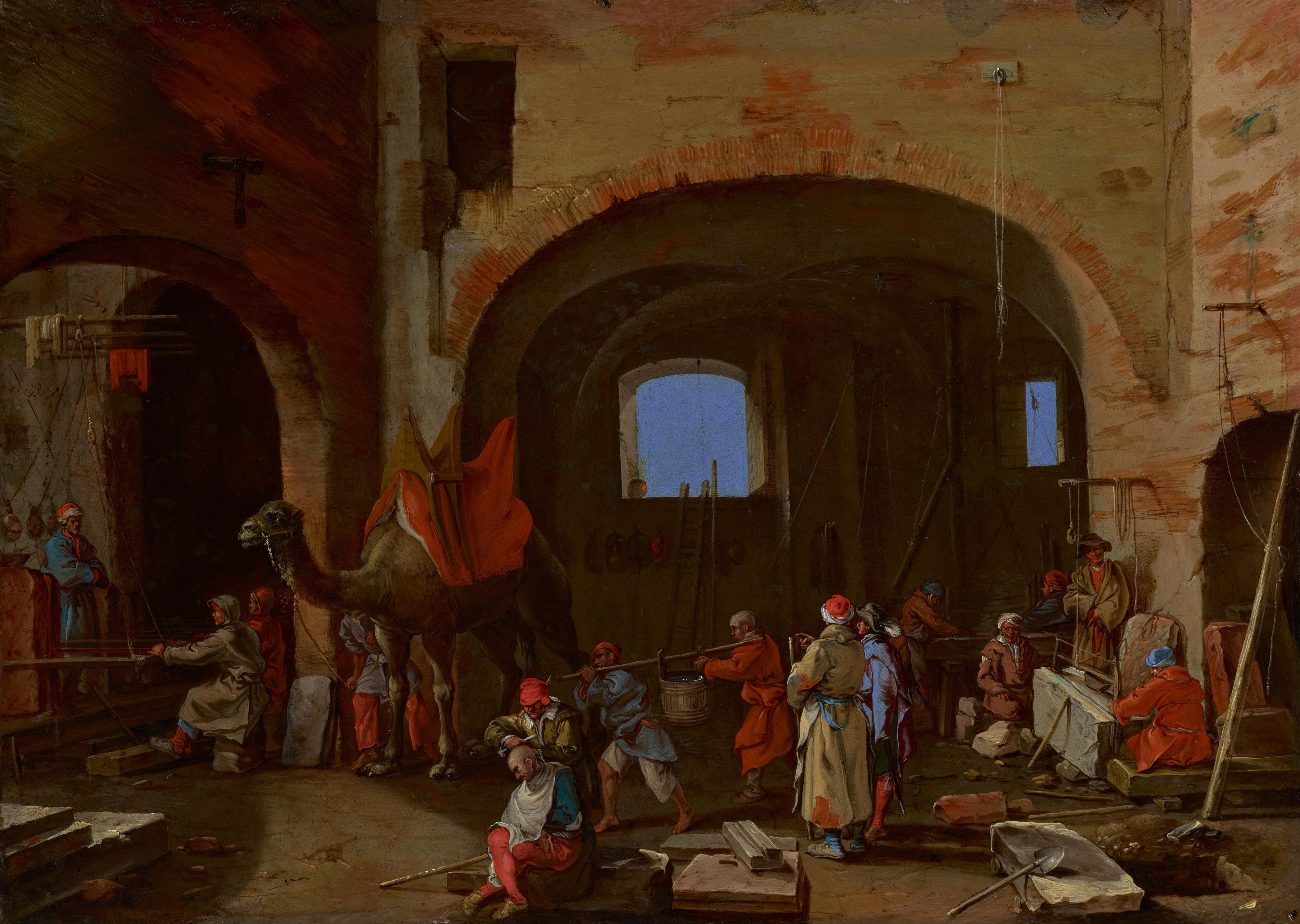
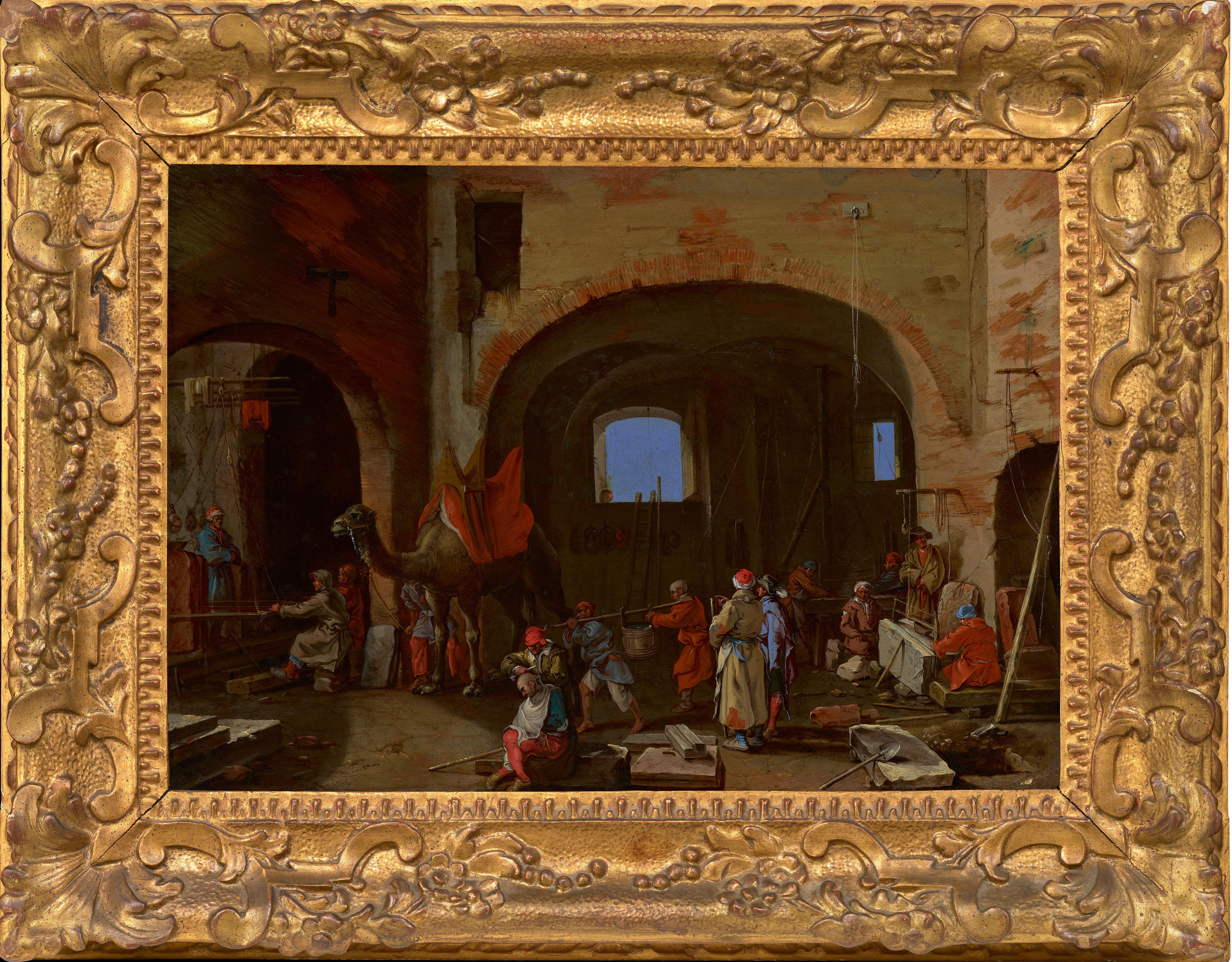
Interior with Working Figures (Stone-cutters at the Arsenals of Pisa)
c. 1620–25
Oil on copper
24.3 x 34 cm (9 5/8 x 13 3/8 in.)
Framed: 36 x 46.3 x 4.5 cm (14 1/8 x 18 1/4 x 1 3/4 in.)
Provenance
Private collection, Italy.
Description
The subject of this small painting on a copper support is undoubtedly one of the most original in the known works of Filippo Napoletano, so much so that it is not easy to identify right away. The scene is set in a building with red brick arches and cracked plastered walls, similar to those in a number of the artist’s paintings and drawings and reminiscent of his studies of ancient Roman monuments.[1] Fixed to the walls and ceilings are ropes and pulleys used for moving the blocks of stone lying around on the ground. Two windows of different sizes in the rear wall admit light into the building and give glimpses of the blue sky beyond, a solution previously adopted by the artist for The Alchemist’s Workshop, a canvas acquired for the Medici Guardaroba in 1619 when the painter was a resident at the court of Grand Duke Cosimo II (fig. VI).[2]
On the right, under the gaze of a man who, perhaps to guard against the cold, is drawing a kind of overcoat around himself, two workmen are seated facing each other. They are working on a slab of stone (fig. 1): the one with his back to us is pushing the saw used for cutting the slab, which is attached to a rope hanging from a pulley above. Behind them, two men are sawing another slab resting on two trestles. On the far side of the composition, on the left, again under the gaze of an overseer, a pair of workmen are performing a similar task (fig. 2): they are sitting side by side, their feet planted on a beam to give them better purchase.
Other figures fill the centre ground: a man with his back to us in oriental garb, with yellow robes, a turban, blue-striped stockings and a blue waistband, perhaps holding an apron in place, is addressing a nobleman in a light-blue coat and a hat adorned with a white feather, who is pointing to something (fig. 3). Two figures are passing in front of them, carrying between them a pole bearing a tub of water for use in the cutting operations. In the foreground, a man appears to be shaving the head of a person seated cross-legged on a slab of stone. Behind this group stands a camel, its bridle held by a stable lad whose face is hidden by the bulk of the animal (fig. 4).
In my opinion, this small painting on copper, which owes something to the artist’s imagination, is a depiction of activities in the Arsenals in Pisa, a city where Napoletano had spent time (just as he did in Livorno), as confirmed by his well-known depictions of ships and a number of vedute.[3] Other images from this period show that large arches were a feature of the Pisan Arsenals.[4] We also know from documentary evidence that, when the traditional activities of the Arsenals were in decline in the early seventeenth century, the building became a centre for storing and processing pietre dure (semi-precious stones). Employed there were slaves and workmen whose task was to cut up the raw materials for items manufactured by the Galleria dei Lavori (a court-based workshop founded in 1588 by Grand Duke Ferdinand I de’ Medici, later known as the Opificio delle Pietre Dure, literally meaning “workshop of semi-precious stones”) and for decorating the walls of the Cappella dei Principi attached to the Basilica of San Lorenzo.[5] The man dressed in red carrying a bucket on a pole (fig. 3) and the man seated cross-legged in the foreground (fig. 4) can undoubtedly be identified as slaves on account of their shaven heads.[6] The presence of the camel is also a significant indicator: from later seventeenth-century documents we know that these animals, kept in and around Pisa in some numbers because of the mild climate, were normally looked after by slaves.[7] The presence of dromedary camels (camelus dromedarius) at the Medici court is attested in 1580 by no less an authority than Michel de Montaigne, and there is plenty of evidence that these animals were exhibited in public spectacles at the time of Cosimo II (1590-1621).[8] Filippo Napoletano had already depicted camels in one of his two canvases of Persian Huntsmen, painted for the Grand Duke in 1620, in which one of the animals is depicted with the same saddle as in our painting (fig. I).[9] The fact that the artist’s corpus of drawings includes a depiction of a Camel’s Head in Profile (fig. II),[10] as well as the Carcass of a Camel,[11] confirms that he had been able to observe these creatures in real life.
Some of the male figures in the painting were also most likely drawn from Filippo’s observations in life. The pair of workers on the left engaged in cutting a stone slab (fig. 2) is reproduced exactly in two drawings conserved at the Accademia di Belle Arti in Perugia, previously published with an attribution to a “follower of Jacques Callot”:[12] in the first, the two figures are depicted separately (fig. III), while in the second, the saw, the stone slab and the figure of the overseer are also included (fig. IV).[13] The overseer is depicted with the same precision in a drawing kept by the Département des Arts Graphiques at the Louvre (fig. V) showing two superimposed rows of six men in different poses and bearing the attribution “Callot” in the bottom margin. This drawing was correctly re-attributed to Filippo Napoletano by Marco Chiarini.[14] The Italian expert agreed that there was indeed an affinity with Callot, but at the same time pointed out hallmarks of its true author, in particular “the depiction of individual facial features”, as confirmed in our painting here.
The originality of the subject matter depicted in this painting is matched in Napoletano’s work only by the Alchemist’s Workshop, referred to earlier (fig. VI). This represents, again with a certain freedom, a workshop in the Casino di San Marco in Florence, then owned by Don Antonio de’ Medici (1576–1621), where experiments of various kinds were performed. Both paintings bear witness to the artist’s careful observation of people at work in real-life situations.
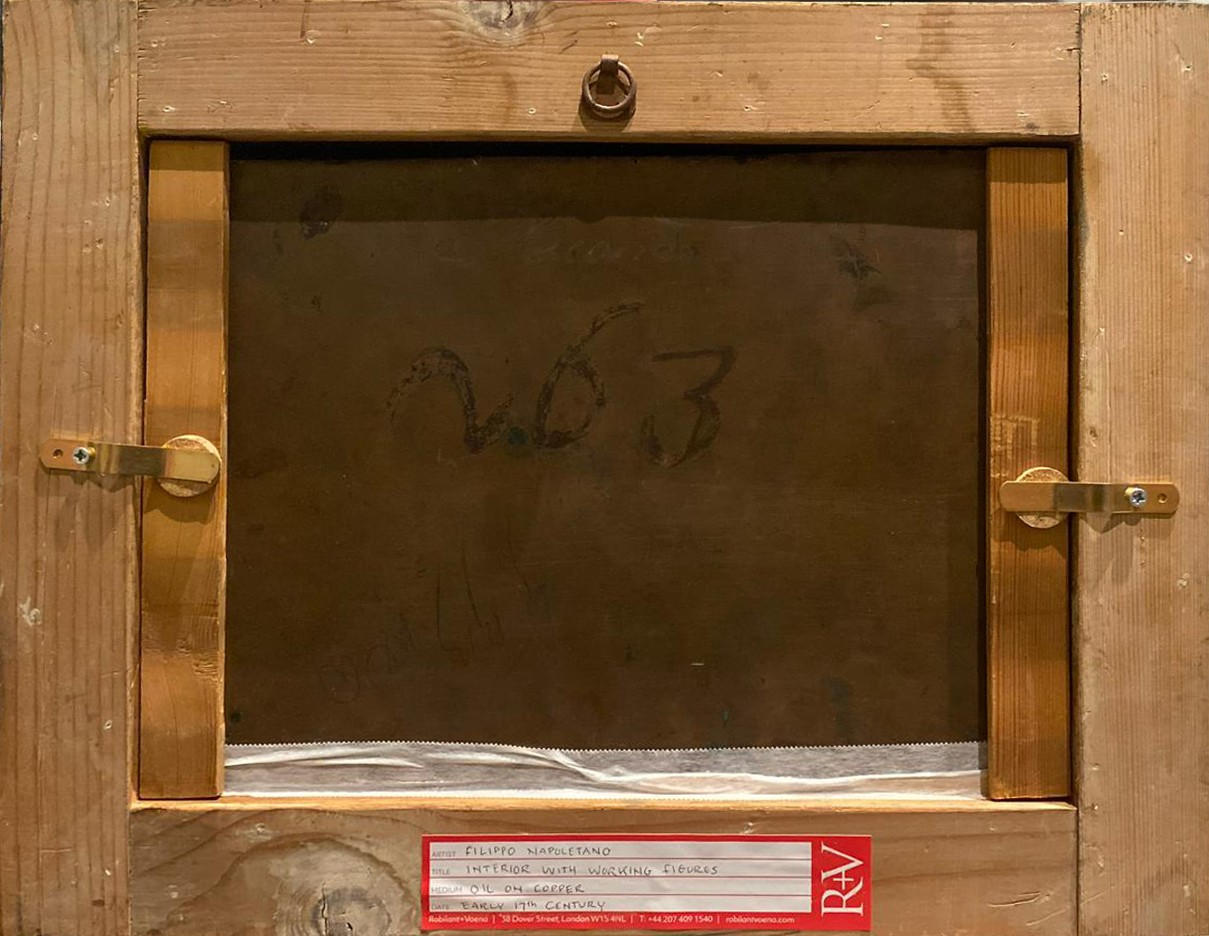
Although there is no denying that our small painting on copper belongs in both subject matter and style to the years Filippo Napoletano spent at the Court of Tuscany (1617–21), it is not described among the works documented as belonging to Grand Duke Cosimo II, now conserved in the Uffizi Galleries. Nor does it feature in the inventory drawn up on the death of Cardinal Carlo de’ Medici (1596–1666), who was also a major collector of Napoletano’s works, nor in those of other family members. On the back of the copper panel, the number “263” is marked in old handwriting, confirming that it comes from a historic collection (fig. VII). It is possible that the recipient was an official of the Arsenals or a Pisan collector, or even a knight of the Order of Saint Stephen, which was founded by Cosimo I in 1562 “to defend the faith and guard the Mediterranean” and based right there in Pisa.
Elena Fumagalli, January 2025
[1] For possible examples of paintings, see Il mulino (Florence, Gallerie degli Uffizi, Galleria Palatina, inv. 1890 n. 1214) and l’Accampamento di zingari (Bordeaux, Musée des Beaux-Arts, inv. M. 5695); for drawings see Ruderi in fiamme e figure (Florence, Gallerie degli Uffizi, Gabinetto dei disegni e delle stampe, inv. 10683S) and Rovine di Ostia antica (New York, The Metropolitan Museum of Art, inv. 57.658.283): M. Chiarini, Teodoro Filippo di Liagno detto Filippo Napoletano 1589-1629. Vita e opere, Florence, 2007, pp. 262, n. 32; 333, n. 113; 381, n. 185; 420, n. 296.
[2] Florence, Gallerie degli Uffizi, Galleria Palatina, inv. Poggio Imperiale 1860 n. 1237: M. Chiarini, op. cit., 2007, p. 274, n. 44.
[3] For the vedute, see S. Rinaldi, ‘I lungarni pisani all’inizio del Seicento. Nuove vedute di Filippo Napoletano, Remigio Cantagallina e Stefano Della Bella’, in A. Tosi and M. Rossi (ed.), Nel giardino delle arti e delle scienze. Studi in onore di Lucia Tongiorgi Tomasi, Pisa, 2022, pp. 229-230.
[4] See Livorno e Pisa. Due città e un territorio nella politica dei Medici, Pisa, 1980, pp. 189-196.
[5] See G. Targioni Tozzetti, Atti e memorie inedite dell’Accademia del Cimento e notizie aneddote dei progressi delle scienze in Toscana, III, Florence, 1780, p. 14: “In Pisa all’Arsenale si facevano sbozzare e segare i Massi grandissimi di Pietre Dure, fatte venire di Sicilia, di Corsica, e d’altre parti, per scegliere poi, e mandarsi a Firenze, per la Galleria, e per la Cappella di S. Lorenzo” (referring to the early 17th century). See also the documents 1621–22 published in A. M. Giusti, P. Mazzoni, A. Pampaloni Martelli (ed.), Il Museo dell’Opificio delle pietre dure a Firenze, Florence, 1978, pp. 322-323 and D. Stiaffini, ‘Gli Arsenali repubblicani e l’area della Tersana fra XII e XX secolo’, in S. Bruni (ed.), Gli Arsenali della Repubblica di Pisa. Storia, restauro, valorizzazione, Pisa, 2017, pp. 30-3.
[6] C. Santus, Il “turco” a Livorno. Incontri con l’Islam nella Toscana del Seicento, Rome, 2019, p. 43.
[7] See L. Lombardini, Ricerche sui cammelli, Pisa, 1879, p. 379, doc. 1.
[8] A. Groom, Exotic Animals in the Art and Culture of the Medici Court in Florence, Leiden-Boston, 2018, pp. 154-155 and note 69.
[9] M. Chiarini, op. cit., 2007, p. 297, n. 77a.
[10] See B. Brejon de Lavergnée, Catalogue des dessins italiens. Collections du Palais des Beaux-Arts de Lille, Paris-Lille, 1997, p. 129, n. 350; M. Chiarini, op. cit., 2007, p. 403, n. 245.
[11] Florence, Biblioteca Marucelliana, inv. n. B142: M. Chiarini, Disegni del Seicento e Settecento della Biblioteca Marucelliana, Firenze, 2017, pp. 193, 236.
[12] M.V. Cresti, F.F. Mancini, G. Sapori (ed.), Cento disegni dell’Accademia di Belle Arti di Perugia XVII-XIX secolo, exhibition catalogue, Rome, 1977, pp. 33-34, cat. nn. 23-24 (by G. Sapori), 36.
[13] In the entry on this drawing (Cento disegni, cit., n. 23, pp. 33-34), Giovanna Sapori identifies the figure who oversees the two men at work as a statue.
[14] M. Chiarini, op. cit., 2007, p. 438, n. 331. The figure in question is on the left of the bottom row.
Fig. 1 Detail of Filippo Napoletano, Stone-cutters at the Arsenal of Pisa.
Fig. 2 Detail of Filippo Napoletano, Stonecutters at the Arsenal of Pisa.
Fig. 3 Detail of Filippo Napoletano, Stonecutters at the Arsenal of Pisa.Fig. 4 Detail of Filippo Napoletano, Stonecutters at the Arsenal of Pisa.
Fig. I Filippo Napoletano, Persian Huntsmen, Gallerie degli Uffizi, Florence, inv. 1890, no. 5035.
Fig. II Filippo Napoletano, Camel’s Head in Profile, Palais des Beaux-Arts, Lille, inv. 2319.
Fig. III Filippo Napoletano, Two stone-cutters, Accademia di Belle Arti di Perugia, inv. 12.
Fig. IV Filippo Napoletano,Two stone-cutters and their overseer, Accademia di Belle Arti di Perugia, inv. 17.
Fig. V Filippo Napoletano, Six Figures, Département des Arts graphiques, Musée du Louvre, Paris, inv. 25131.
Fig. VI Filippo Napoletano, The Alchemist’s Workshop, Florence. Gallerie degli Uffizi, Galleria Palatina, inv. Poggio Imperiale 1860, no. 1237.
Fig. VII Reverse of copper panel, showing number “263”.