

Paolo Scheggi
b. 1940, Settignano, Italy
d. 1971, Rome, Italy
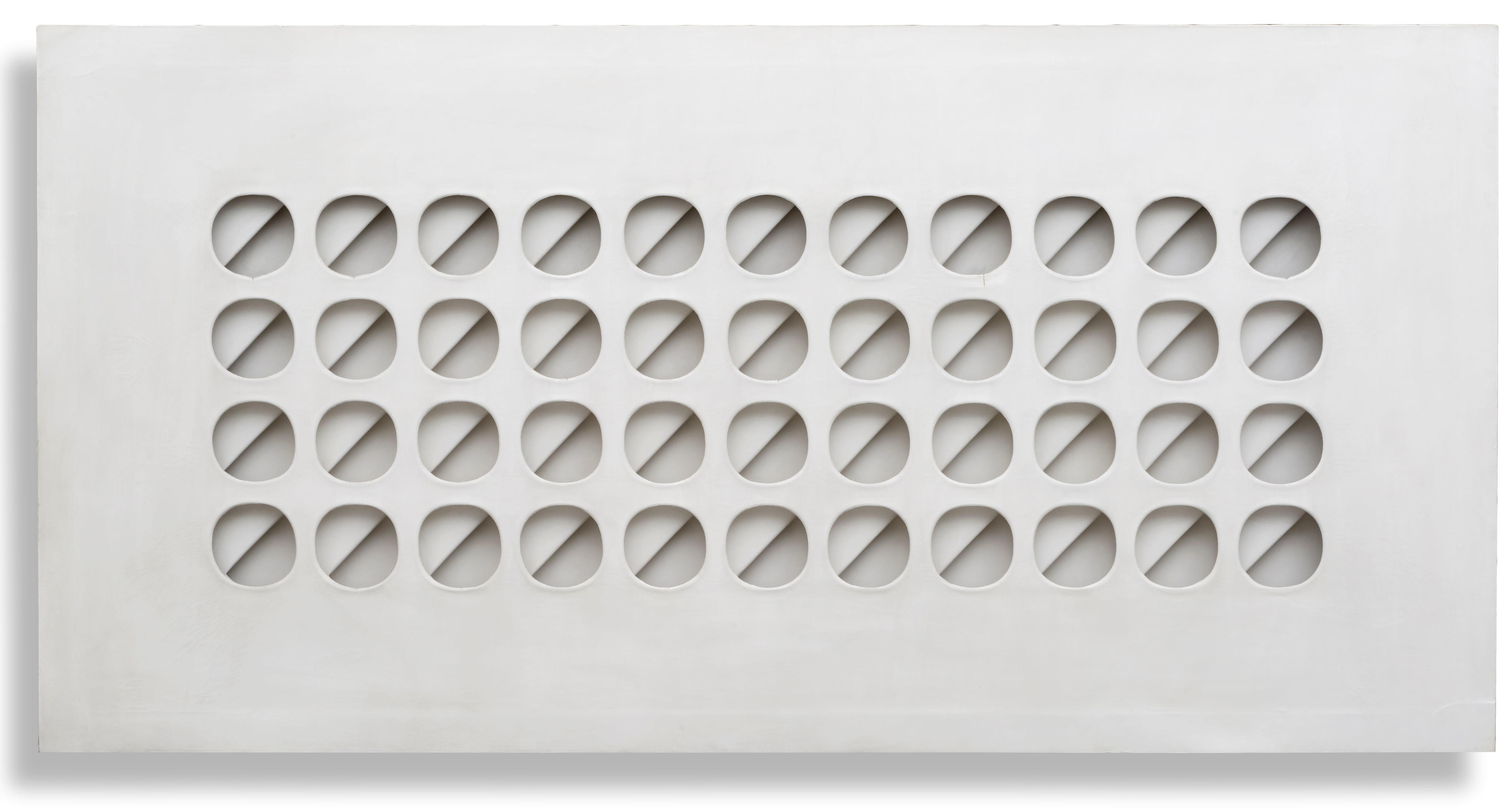
Intersuperficie Curva Bianca (White Curved Intersurface)
1966
Acrylic on three superimposed canvases
100 x 200 x 7 cm (39 3/8 x 78 3/4 x 2 3/4 in.)
Provenance
Gift of the Artist, 1969,
Private Collection, Italy.
Literature
L. M. Barbero and G. Dorfles, Scheggi. La breve e intensa stagione di Paolo Scheggi, exhibition catalogue, Parma, 2002–3, p. 179, no. PS082.
L. M. Barbero, Paolo Scheggi Catalogue raisonné, Milan, 2016, illustrated pp. 33, 272, no. 66 T 67.
Description
“The intersurface concept situates Scheggi’s work in a particular morphological condition between the relief, the pierced plane and the europlastic object. Scheggi chooses curved forms, or ones deriving from rotations of logarithmic spirals, and he cuts out, on canvas surfaces, the edges of the zones corresponding to their spatial determination. Scheggi superimposes three or more planes, and fixes them into a single object consisting of the counterpoint of visual juxtaposition of the cut-out forms in the different surfaces painted in just one colour.”
Carlo Belloli, in 7 intersuperfici curva-bianche + 1 intersuperficie curva-dal rosso + 2 progetti di compositori spaziali, exhibition booklet, Genoa, Galleria del Deposito inauguration May 26 1964.
This is an iconic work by Paolo Scheggi, executed in 1966 – the year of his participation in the Venice Biennale. To considerable public and critical acclaim, Scheggi’s room at the Biennale (joint with Agostino Bonalumi), consisted of four Intersuperficie each measuring 133x133cm with forty nine modular openings, of white, blue, yellow and red colour (Fig. 1). The impressive installation elicited significant attention and won both artists important transatlantic exposure. As a result of his visit to the Biennale, Alan Solomon (Director of the Jewish Museum in New York) recommended the work of both artists to art dealer Alfredo Bonino, who then organized the seminal Italy-New Tendencies show at his Galeria Bonino in New York later that autumn, featuring Scheggi, Bonalumi and Castellani as representatives of the thriving Milanese school.
Our work is clearly closely related to the Venice Biennale paintings, featuring forty four apertures, rhythmically arranged within an above average sized surface of two meters. The regular curves of the circular openings and the sharply defined diagonal pattern of the second layer of canvas, emphasise the sculptural space Scheggi sought to create within his paintings and is similar to the modularity of the red and blue works from the Biennale cycle. What sets it apart from them however, is the wide border framing the aperture composition, acting as a visual pause to the energy of the spatial dynamic within it and lending the work a notable parity between the dynamic and the meditative. Executed in white, which for Scheggi contained ‘a luminosity that is the inner energy itself of the space of the work’, as Francesca Pola has argued, the piece is a masterpiece of balance, tension and materiality in Scheggi’s rare oeuvre.
Scheggi had started working in this way in 1964, with his earlier pieces exploring organic, oval, variously-sized apertures on the canvas rather than the staunchly modular composition evident here. This evolution of his practice represented a maturation of his language since his earliest work with overlaid canvases from 1962, and a clarification of his intent. He described his own process thus, highlighting the inseparable link between his work and a total vision of perception understood as an instrument of knowledge:
“Theoretical process: The objects are square and derived from operations on the square. The space is divided by means of rotations of logarithmic spirals, logarithmic parabolas, modular and continual relations. The inscribed forms have elementary structures.”
Paolo Scheggi, “Proposte sul cerchio. Dieci intersuperfici curve bianche”, in Intersurfaces courbes – compositeurs spatiaux – un projets d’intégration plastiques, Galerie Smith, Brussels, November 4–21, 1964
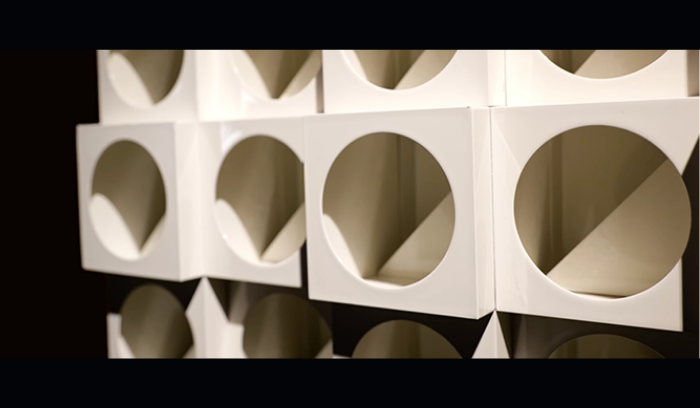
The present work anticipates Scheggi’s seminal environment Intercamera Plastica of 1967, which consisted of multiple compositions of circular openings on a wood support defining a space which enveloped the viewer (Fig.2). This work was first exhibited at the Galleria Naviglio, Milan in January 1967, and then included in the important group exhibition of environments Lo Spazio dell’immagine at Palazzo Trinci, Foligno, in the summer of 1967. Scheggi acknowledged its key relationship to his Intersuperfici, and saw it as an apex for his practice.
‘The experiment of the intercamera plastica (plastic interchamber) is something that links back in time to some of my research into volumetric interferences concomitant with the first intersuperfici curve (curved intersurfaces). At the time it involved, on the one hand, possible solutions of pure plasticity within the limits of an a-functional architecture, and on the other, dialectic reflected zones articulated in invented spaces. Later, when the curved intersurfaces became modelli spaziali (spatial models), the two lines of inquiry gradually acquired a common method until they integrated totally, thereby opening up a different inquiry.’
Paolo Scheggi on Intercamera Plastica, 1967, quoted in F. Pola, Paolo Scheggi. The Humanistic Measurement of Space, exhibition catalogue, Robilant+Voena, 2014, p. 127.
This masterful work of an impressively large size sits at the key junction between these developments in Scheggi’s praxis as a sublime example of his mature idiom, from arguably the most important year in his short-lived career.
Fig.1 Paolo Scheggi in his room at the Venice Biennale, 1966, photo by Ugo Mulas (Photo Ugo Mulas. Copyright © Ugo Mulas Heirs. All rights reserved).
Fig. 2 Intercamera Plastica, 1967, Installation at Robilant+Voena during Paolo Scheggi. The Humanistic Measurement of Space, 1 October – 4 November 2014.
Fig 3. Scheggi’s personal instructions for the installation of the work, given to the previous owners as a gift. Dated 29 May 1969.