
John Chamberlain
b. 1927, Rochester, IN, USA
d. 2011, Manhattan, NY, USA
Untitled
1963
Painted and chromium-plated steel
54.6 x 48.3 x 58.4 cm (21 1/2 x 19 1/8 x 23 in.)
Provenance
Private collection, acquired directly from the artist
Private collection, Islip, New York
Christie’s, New York, 3 November 1978, lot 30
Gilbert and Lila Silverman collection
Christie’s, New York, 11 November 2009, lot 135
Private collection, New York
Literature
Description
“Chance and casual freedom seem to exceed the order within the work. Reality seems more capricious than any order it holds. This disparity between reality and its order is the most radical and important aspect of Chamberlain’s sculpture.”—Donald Judd, 1964
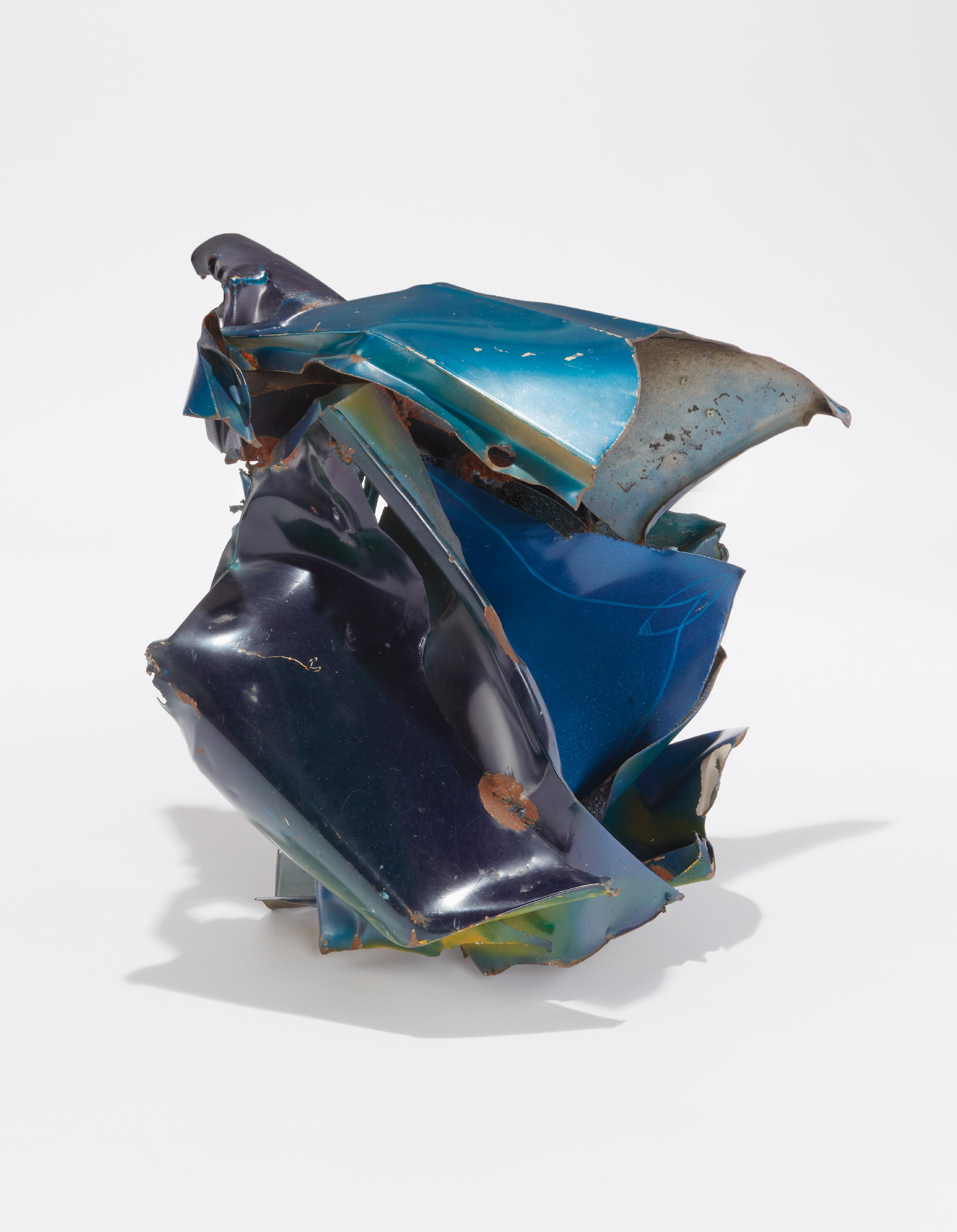
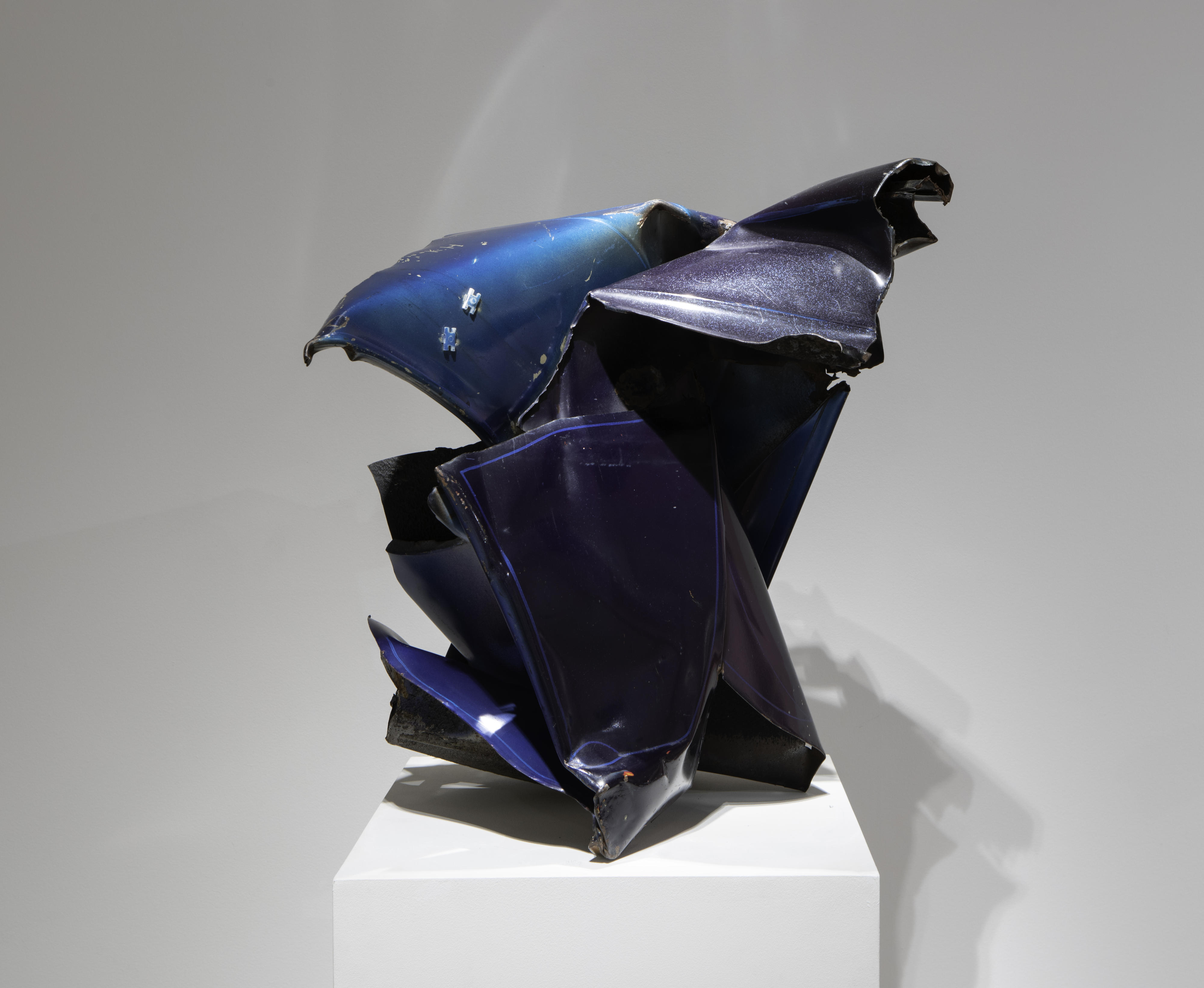
Rendered in shades of hi-fi blue, Untitled from 1963 is a striking example of John Chamberlain’s signature process of crunching and torqueing discarded automobile parts into elegant and harmoniously balanced sculptures. The contortion of the sheet metal highlights its painted surface, just as the accordioned form accentuates the contrast between the finished, outer colour and the underbelly’s unadulterated, silvery metal.
The artist’s decision to use colored steel—primarily from the bodies of automobiles—as the basis of his twisted and torqued abstract metal sculptures was in fact the result of happenstance and characteristic improvisation. As the artist explained in an interview, “In the early sculptures I used anything made of steel that had color on it. There were metal benches, metal signs, sand pails, lunch boxes, stuff like that…I used a variety of parts. Body shops would cut parts away, and I would choose what I wanted from whatever was in their scrap pile” (Chamberlain, quoted in “Auto/Bio: Conversations with John Chamberlain,” in Julie Sylvester, John Chamberlain: A Catalogue Raisonné of the Sculpture, 1954–1985, New York, 1986, p. 15). His conversion to the nearly exclusive use of automobile parts took place when he was living at Larry Rivers’s farm in the Hamptons in 1957. He recalled how “all of a sudden, it occurred to me one day that all this material was just lying all over the place. I saw the material as other people’s idea of waste…Only years later did it occur to me that I had taken material from an antique car of his—it was material from a 1929 Ford. So it was an antique, it wasn’t throw-away junk. It was years later that I figured out that what I had done was a little presumptuous: to use material of his that very likely had some value to him. Nevertheless I took a fender. I didn’t want to use it as a fender, so I drove over it a few times to rearrange its shape, which was the beginning of what I now know as process” (Chamberlain quoted in Sylvester 1986, p. 15). And thus began the artist’s signature use of car parts as the basis of his sculptural works of all sizes.
The crumpled, scraped, and rusted steel of salvaged auto parts often came ready made in the most bold and vibrant colours. Indeed, Chamberlain’s friend, the sculptor Donald Judd, likewise sought out the luminosity found in metallic car parts when he used Harley Davidson hi-fi blue to paint some of his earliest progression sculptures. The present work documents the blue variations available in 1960s American cars, accented with pre-cut holes from the original assembly as well as with patches of textured rust. Judd praised Chamberlain in the 1960s for his use and selection of colour, saying "Chamberlain is the only sculptor really using colour, the full range, not just metallic shades; his colour is as particular, complex and structural as any good painters" (Donald Judd, “In the Gallery” Arts Magazine (March 1962)). Yet Chamberlain’s use of colour was never intended to allude to or reference the automobile materials that comprised his sculpture; his interest instead resided in the active transformation of everyday materials and the diverse ways in which he could force the materials into twisted and contorted arrangements essentially divorced from their stylish automotive origins. Chamberlain recalled watching someone squeeze a sponge in their hand while washing dishes, and one end of the sponge popping out of one side of the fist holding it, and looking like a sculpture to the artist. “It’s daily life,” he explained, “That’s where I get the idea that everybody makes sculpture every day, whether in the way they throw the towel over the rack or the way they wad up the toilet paper. That’s all very personal and very exact, and in some sense very skilful on their part…those little things, like blowing up a paper bag and hitting it so it pops—take it one little step further and do it in slow motion and explore what the resistance of the air in the bag is, and you make something. To me that is very interesting, if there is a body of work demonstrating all these things that come together, that’s useful in art history, as a record of accumulation and development of knowledge in this occupation” (Chamberlain quoted in Sylvester 1986, p. 12).
As noted above, Chamberlain, the source and type of his materials—discarded automobiles, salvaged for parts—was inconsequential to its formal, aesthetic properties. “I wasn’t interested in the car parts per se. I was interested in either the color or the shape or the amount. I didn’t want engine parts, I didn’t want wheels, upholstery, glass, oil, tires, rubber, lining, what somebody’d left in the car when they dumped it, dashboards, steering wheels, shafts, rear ends, muffler systems, transmissions, fly wheels, none of that. Just the sheet metal. It already had a coat of paint on it, and some of it was formed. You choose the material at a time when that’s the material you want to use, and then you develop your processes so that when you put things together it gives you a sense of satisfaction” (Chamberlain quoted in Sylvester 1986, p. 15). However, according to Diane Waldman, curator of the artist’s 1971 solo exhibition at the Guggenheim, the automobile had taken on an iconic status in American culture and could not so easily be eclipsed by color, shape, and form. As she wrote in the exhibition’s catalogue, “The irony of using a mass-produced commodity which then, as now, stands as symbol of the American dream, and as a more particularized metaphor of American masculinity, has not been lost upon us—just as the transcendental character of pigment is impressed on us by de Kooning—and, indeed, heightens our awareness of the transformation of art” (Diane Waldman, John Chamberlain: A Retrospective, exh. cat. Solomon R. Guggenheim Museum, New York, 1971, p. 5).
Please note that the availability and price of the above work are subject to change without prior notice. Where applicable ARR will be added.