
René Magritte
b. 1898, Lessines
d. 1967, Schaerbeek
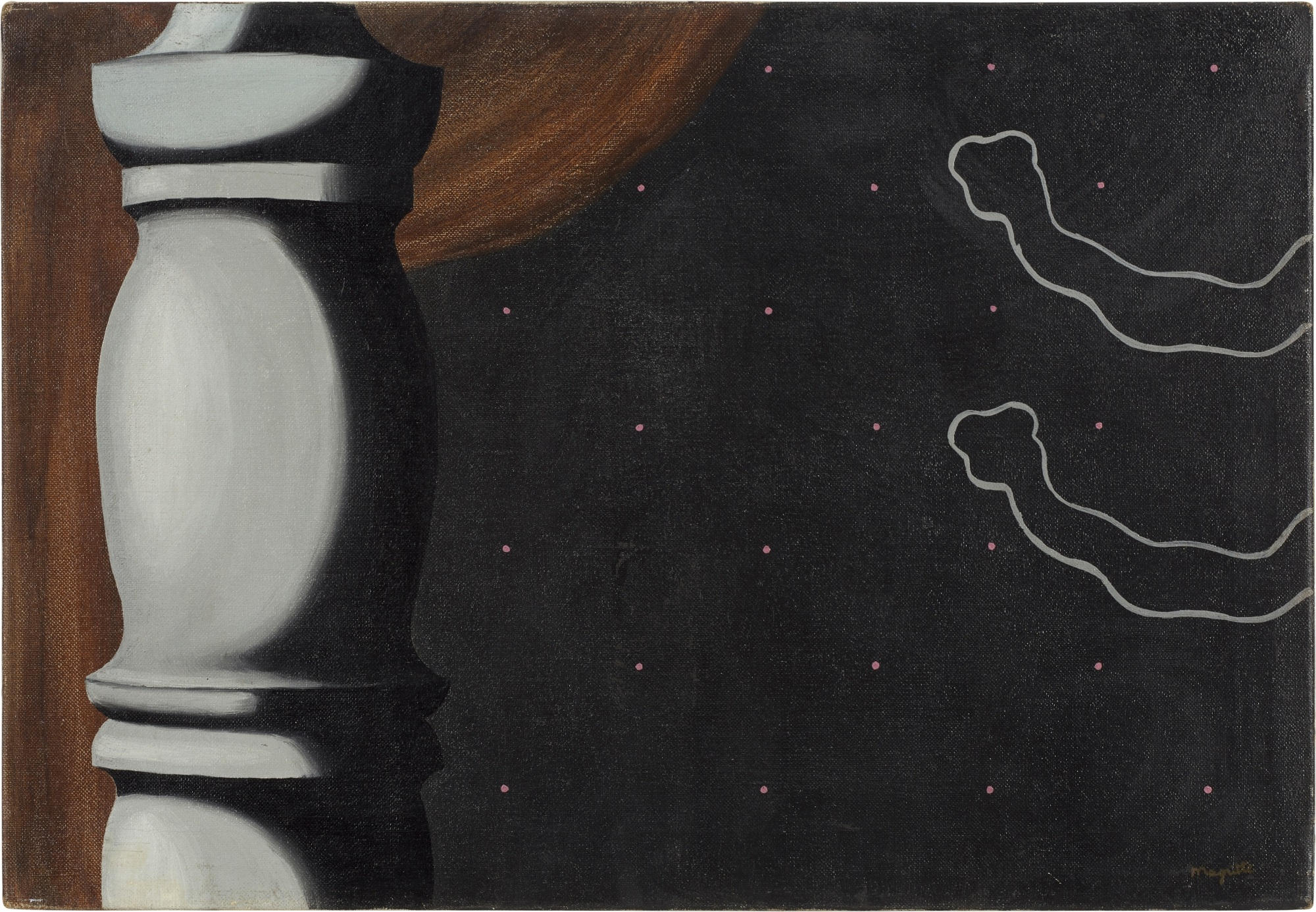
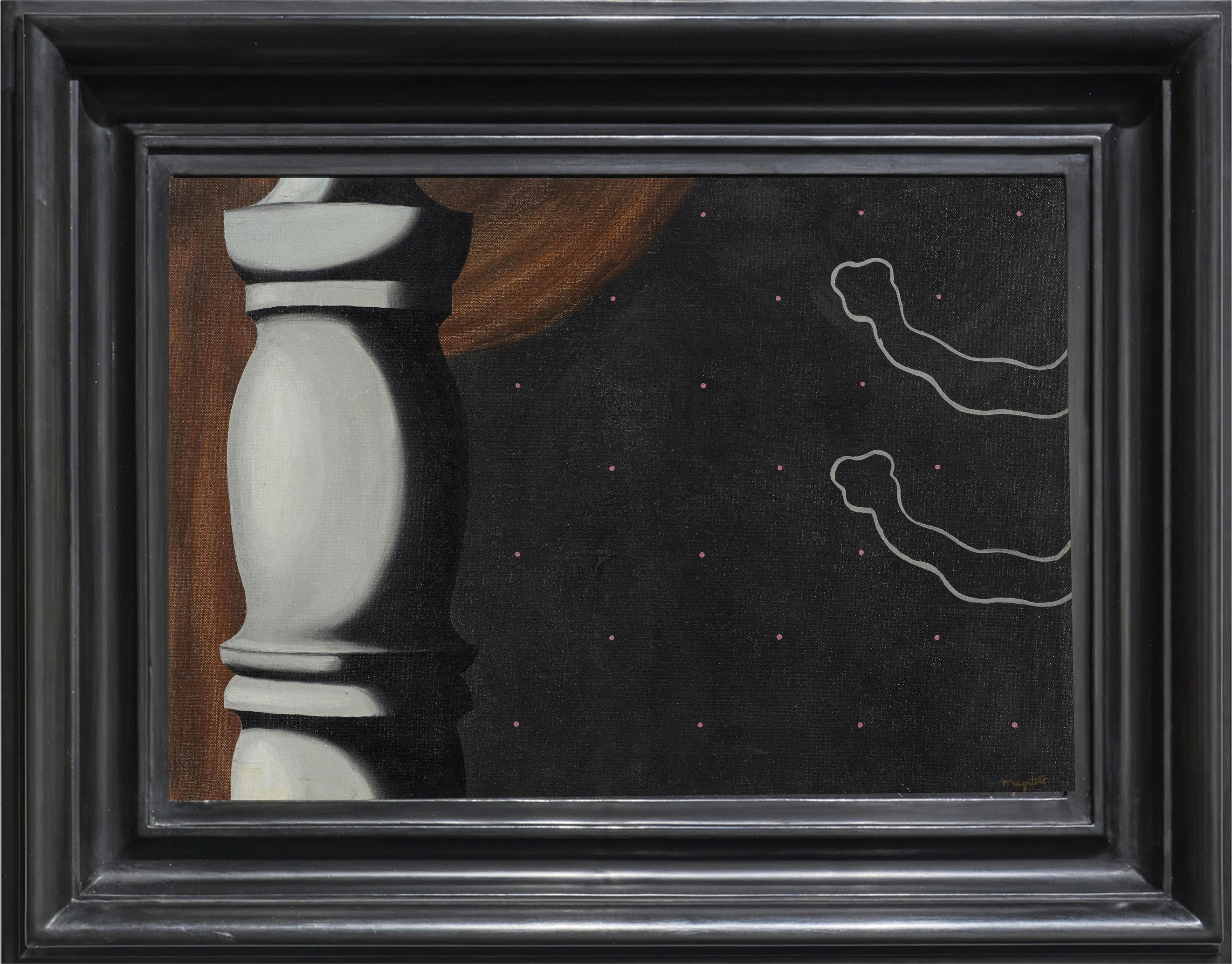
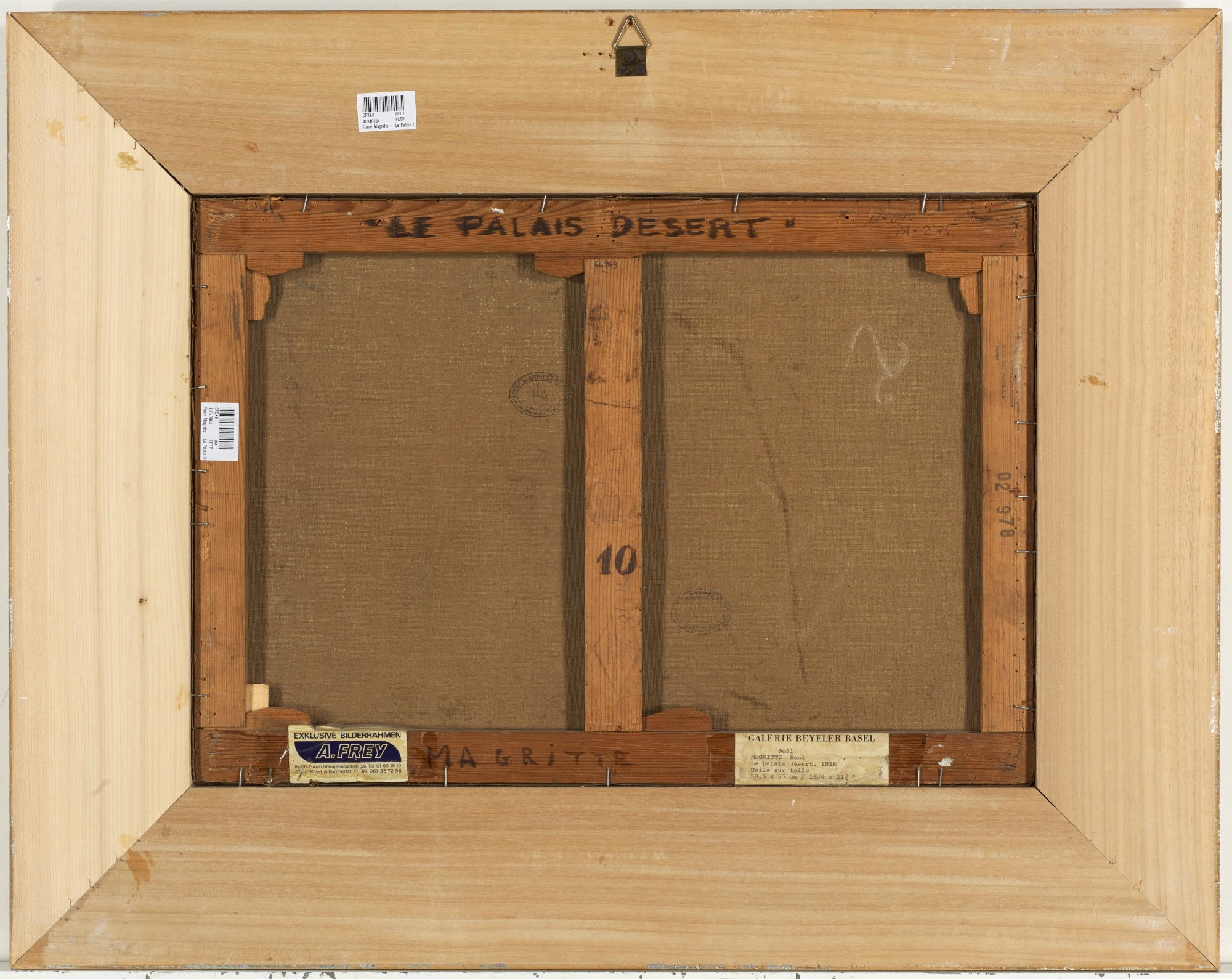
Le palais désert (The Deserted Palace)
1928
Oil on canvas
38.2 x 55 cm (15 x 21 5/8 in.)
Framed: 56.4 x 73.4 cm (22 1/4 x 28 7/8 in.)
Provenance
Private collection, France (end of the 1920s),
with Galerie Jean Chauvelin, Paris (from the above, as of 1978),
with Galerie Beyeler, Basel,
Stefano Romanazzi, Rome (as of 1986),
Farsettiarte, Prato, 29 November 2008, lot 783,
with Tornabuoni Arte, Milan,
Private collection, Italy.
Literature
Renato Barilli, I Surrealismi, Bologna, 1983, illustrated p. 40.
David Sylvester & Sarah Whitfield, René Magritte, Catalogue Raisonné, Oil Paintings, 1916-1930, London, 1992, vol. I, no. 203, illustrated p. 260.
Description
René Magritte (1898-1967), arguably the most important Belgian artist of the twentieth century, was one of the key painters of the Surrealist movement whose work was highly influential during his lifetime and beyond. Born in Lessines, Belgium, Magritte studied at the Académie Royale des Beaux-Arts in Brussels, between 1916 and 1918. His early work was influenced by futurism and cubism, but drawn to figuration over abstraction, he soon gravitated towards surrealism after encountering Giorgio de Chirico's metaphysical paintings, especially a reproduction of his painting the Song of Love (1914) in 1922. In 1926 he was part of the founding members of the Belgian Surrealist group, in the same year that he signed contracts with Paul Gustave Van Hecke (1887–1967), co-founder of the Brussels galleries Sélection and Galerie Le Centaure.
Magritte is renowned for his ability to render ordinary objects in altered and impossible ways, challenging the viewer's perceptions and the conventional understanding of reality, and for his redefinition of the relationship between images and words. His oeuvre is marked by recurrent objects that feature as visual tropes, such as pipes, birds, clouds and suited men. Unlike other Surrealist painters, especially the French group with whom he had close contact, Magritte sought to achieve the transcendental experience of reality through a meticulous manner of representation. This almost academic realism facilitates the complete clarity of each object’s identity – before the artist then subverts expected meanings and questions the said identity.
Magritte's influence extended far beyond the surrealist movement. His exploration of visual language and semiotics prefigured many postmodern artistic inquiries. His ability to merge the mundane with the mysterious inspired numerous artists, filmmakers, and writers, leaving an indelible mark on popular culture.
Le palais désert (The Deserted Palace) is a relatively early work in Magritte’s oeuvre, made in 1928 while living in Paris in close contact with the French Surrealist group, including figures such as André Breton, Jean Arp, Max Ernst, and Yves Tanguy. During his three years in Paris (1927–30), Magritte established his Surrealist vision and the artistic vocabulary that was to become so recognisable over the course of his career. The present painting incorporates some of Magritte’s most characteristic motifs, namely the draped curtain and the machine-turned balustrade, which is seen as close proximity, its ends extending beyond the edges of the canvas. Both the theatre curtains and the balustrade, or bilboquet, first appeared in Magritte’s oeuvre in the early 1920s, and were key features of his earliest surrealist works. Just a few years before this painting was made, these motifs appear in the painting Blue Cinema (1925, fig. 1), and again in a 1926 collage Le Jockey perdu (The Lost Jockey) (fig. 2) – the latter was viewed by Magritte as his first true surrealist work. He exhibited an oil painting of the same name at his first solo exhibition in 1927, held by Paul Van Hecke, which consisted of 61 works and, although not received favourably by the press, established the surrealist intentions of Magritte.
The inclusion of the specific imagery in Le palais désert might be explained by Magritte’s recent experiences: in the early 1920s, he designed theatre sets for the Theatre du Groupe Libre, Brussels, which inspired his depiction of draped stage curtains, such as appears on the left of Le palais desert. The wooden bilboquet (as Magritte called this form, referencing a children’s game with a wooden cup and ball) evokes the factory-made precision of objects, perhaps shaped by his time working as a draughtsman in a wallpaper factory in 1922–23. Later in his career, these wooden structures would take the place of shadows, mannequins, and nudes in his paintings.
Alongside these recognisable forms which the artist was establishing as part of his signature language, the present painting also features less common yet undeniably surrealist elements. The dark background, which initially seems like a night sky, is punctuated by small pink dots, like stars, set at regular intervals. The unnatural perfection of this background suggests that it may instead be a theatre set, consistent with the curtain on the left. However, any apparent comprehension of the scene is undermined by the two ghost-like forms at the right of the composition. These ambiguous shapes are unusually unidentifiable within Magritte’s work, indicating his experimentation and consolidation of his style. A painting made around the same time, L’usage de la parole (1927–29) shows a larger comparable organic abstract form, albeit containing words (Musées royaux des Beaux-Arts de Belgique, Brussels, fig. 3).
The year of Le Palais desert, 1928, saw Magritte produce works that are among his most iconic, including The False Mirror (Museum of Modern Art, New York, fig. 4), The Lovers I and II (Australian National Gallery; Museum of Modern Art, New York), and Tentative de l’impossible (Attempting the Impossible) (Toyota Municipal Museum, Japan).
Fig. 1 – René Magritte, Blue Cinema, 1925, oil on canvas, private collection.
Fig. 2 – René Magritte, Le jockey perdu (The Lost Jockey), 1926, Cut-and-pasted sheet music, watercolor, pencil, and ink on paper, private collection.
Fig. 3 – René Magritte, L’usage de la parole, 1927–29, oil on canvas, 41.8 x 27.3 cm, Musées royaux des Beaux-Arts de Belgique, Brussels.
Fig. 4 – René Magritte, The False Mirror, 1928/29, oil on canvas, 54 x 80.9 cm, Museum of Modern Art, New York.