
Pablo Picasso
b. 1881, Málaga, Spain
d. 1973, Mougins, France
Le Petit Déjeuner
1959
Ink and watercolour on paper
32.3 x 49.3 cm (12 3/4 x 19 3/8 in.)
Provenance
Galleria La Nuova Pesa, Rome, inv. no. 671 (c. 1961),
Galleria del Girasole, Udine, inv. no. 631,
Private collection, Italy.
Galleria del Girasole, Udine, inv. no. 631,
Private collection, Italy.
Literature
C. Zervos, Pablo Picasso, XIX, Paris, 1968, p. 28, n. 118 (illustrated).
Description
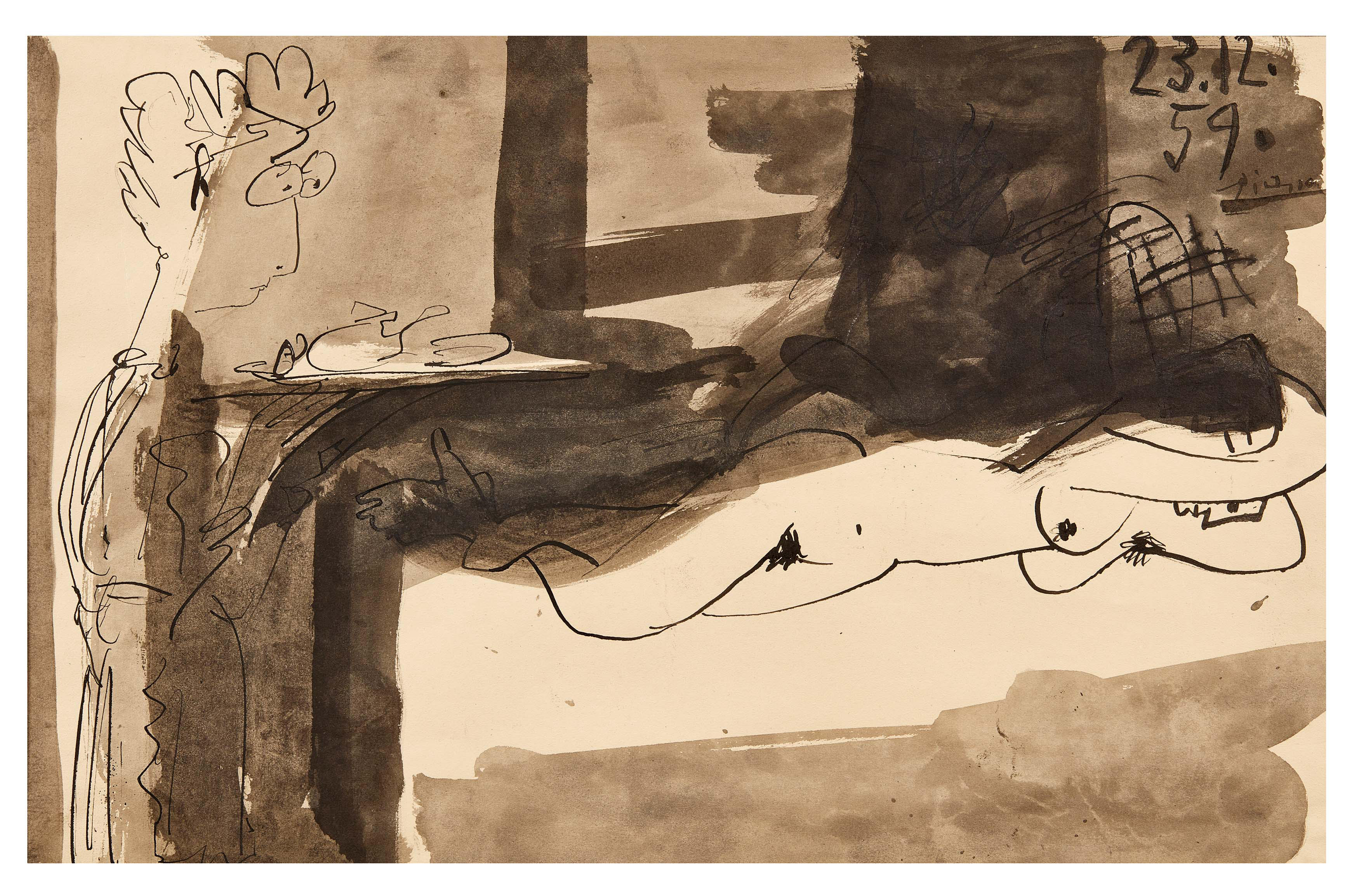
This pen and ink and watercolour drawing was created at a moment in Pablo Picasso's artistic production when he was becoming particularly fascinated with Edouard Manet's famous Déjeuner sur l'Herbe (1863). At almost 80 years old, in March 1959 Picasso embarked upon a body of work relating to Manet's painting, across two years creating 140 drawings, 27 paintings and 4 linoleum cuts inspired by the work. The painting had long fascinated the artist, who wrote a note about his reaction to it on an envelope in 1932: "I tell myself, tribulations for later."
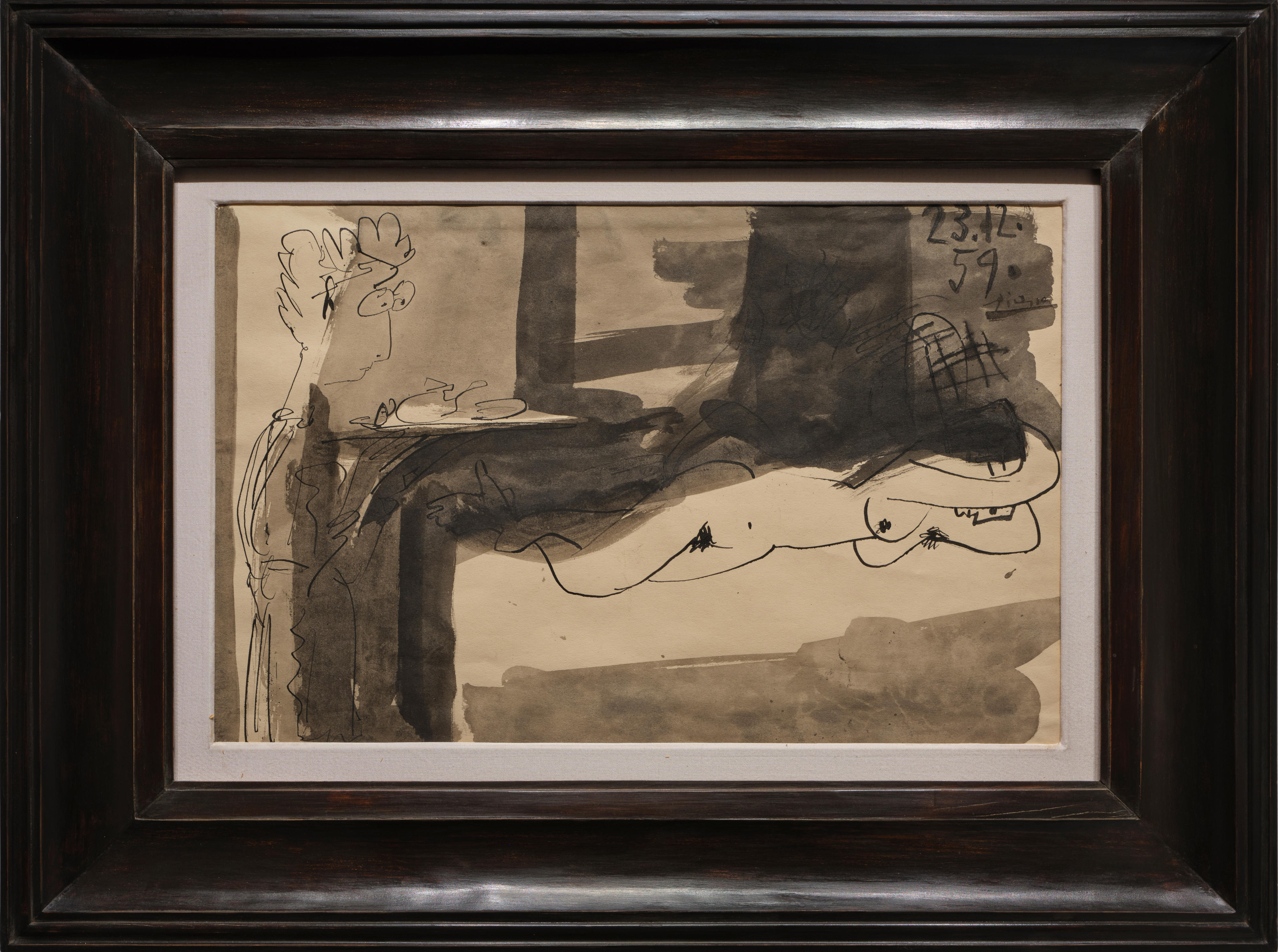
The present drawing, although not forming part of the corpus relating directly to Déjeuner sur l'Herbe, shows the artist's experimentation around the subject of food, meals and the human figure. As depicted in Manet's painting and Picasso's reinventions, Le Petit Déjeuner features a clothed male figure and nude female figure, described with rapid flourishes of ink against swathes of monochrome wash.
Although the relationship between the two figures is ambiguous, the woman appears to be sleeping, perhaps about to be woken by the male figure who carries a plate of food. The motif of the sleeping or reclining woman was also a favourite of Picasso, to which he returned across his career, from his Neoclassical period until his death.
Le Petit Déjeuner, exhibiting the master's unrivalled skill in conjuring the human form with the briefest of strokes, also encapsulates an important moment in his life when his creative energies – even at an advanced age – were as sharp as ever and were consumed by fascination of a single historic painting. This drawing gives an insight into Picasso's artistic vision and process, allowing for a deeper understanding of his inexhaustable creativity.
The present drawing, although not forming part of the corpus relating directly to Déjeuner sur l'Herbe, shows the artist's experimentation around the subject of food, meals and the human figure. As depicted in Manet's painting and Picasso's reinventions, Le Petit Déjeuner features a clothed male figure and nude female figure, described with rapid flourishes of ink against swathes of monochrome wash.
Although the relationship between the two figures is ambiguous, the woman appears to be sleeping, perhaps about to be woken by the male figure who carries a plate of food. The motif of the sleeping or reclining woman was also a favourite of Picasso, to which he returned across his career, from his Neoclassical period until his death.
Le Petit Déjeuner, exhibiting the master's unrivalled skill in conjuring the human form with the briefest of strokes, also encapsulates an important moment in his life when his creative energies – even at an advanced age – were as sharp as ever and were consumed by fascination of a single historic painting. This drawing gives an insight into Picasso's artistic vision and process, allowing for a deeper understanding of his inexhaustable creativity.