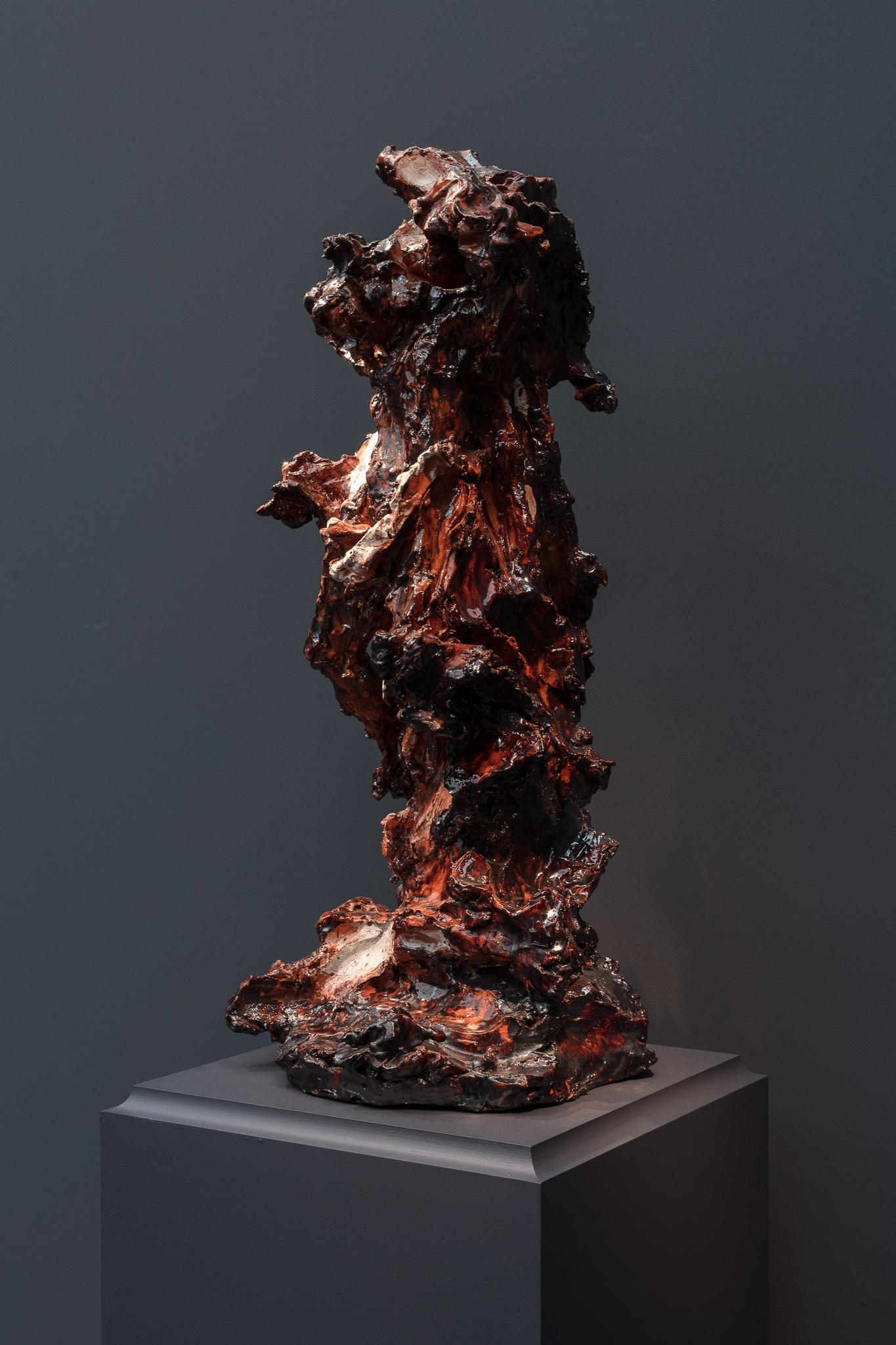

Lucio Fontana
b. 1899, Rosario de Santa Fé, Argentina
d. 1968, Comabbio, Italy
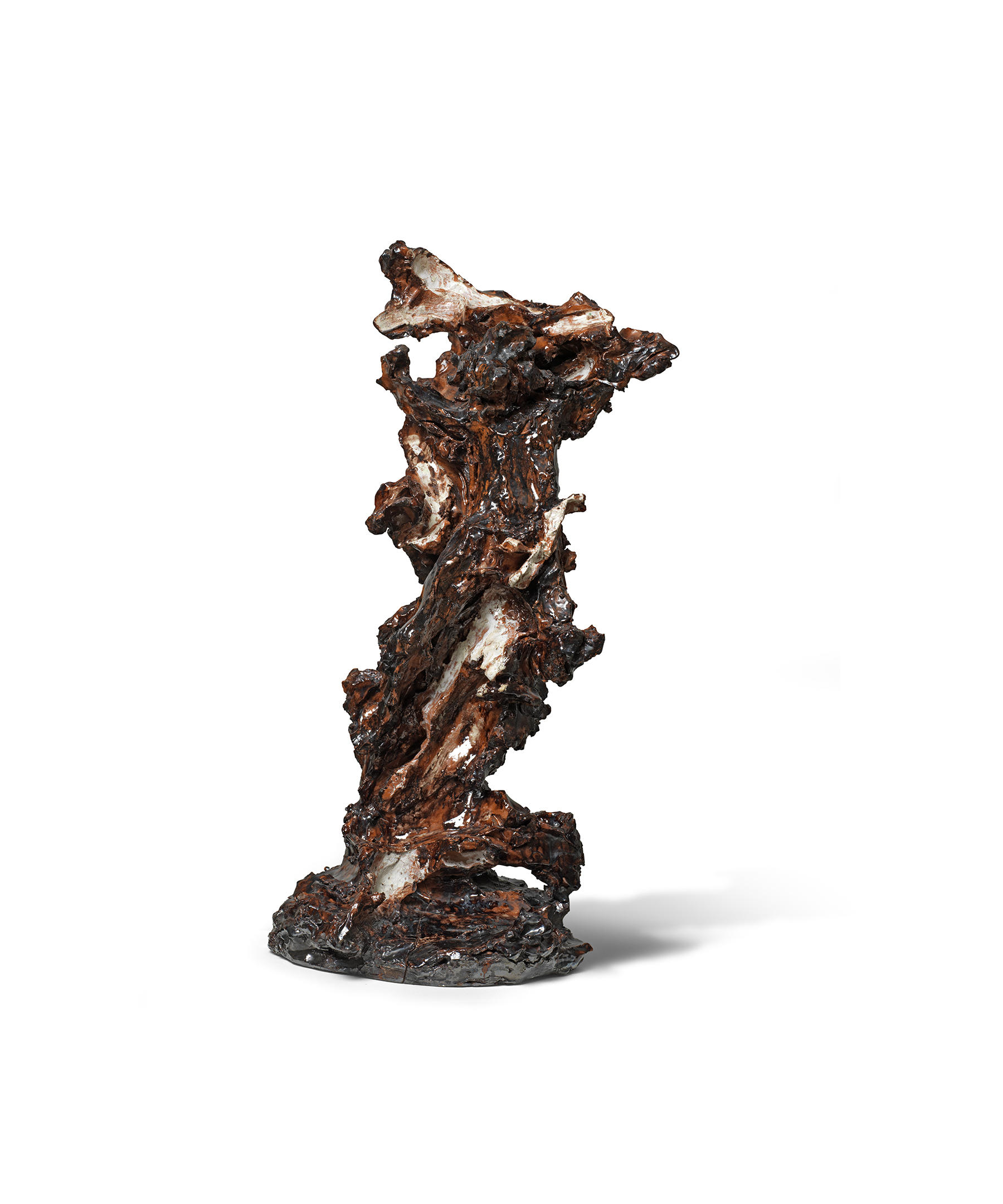
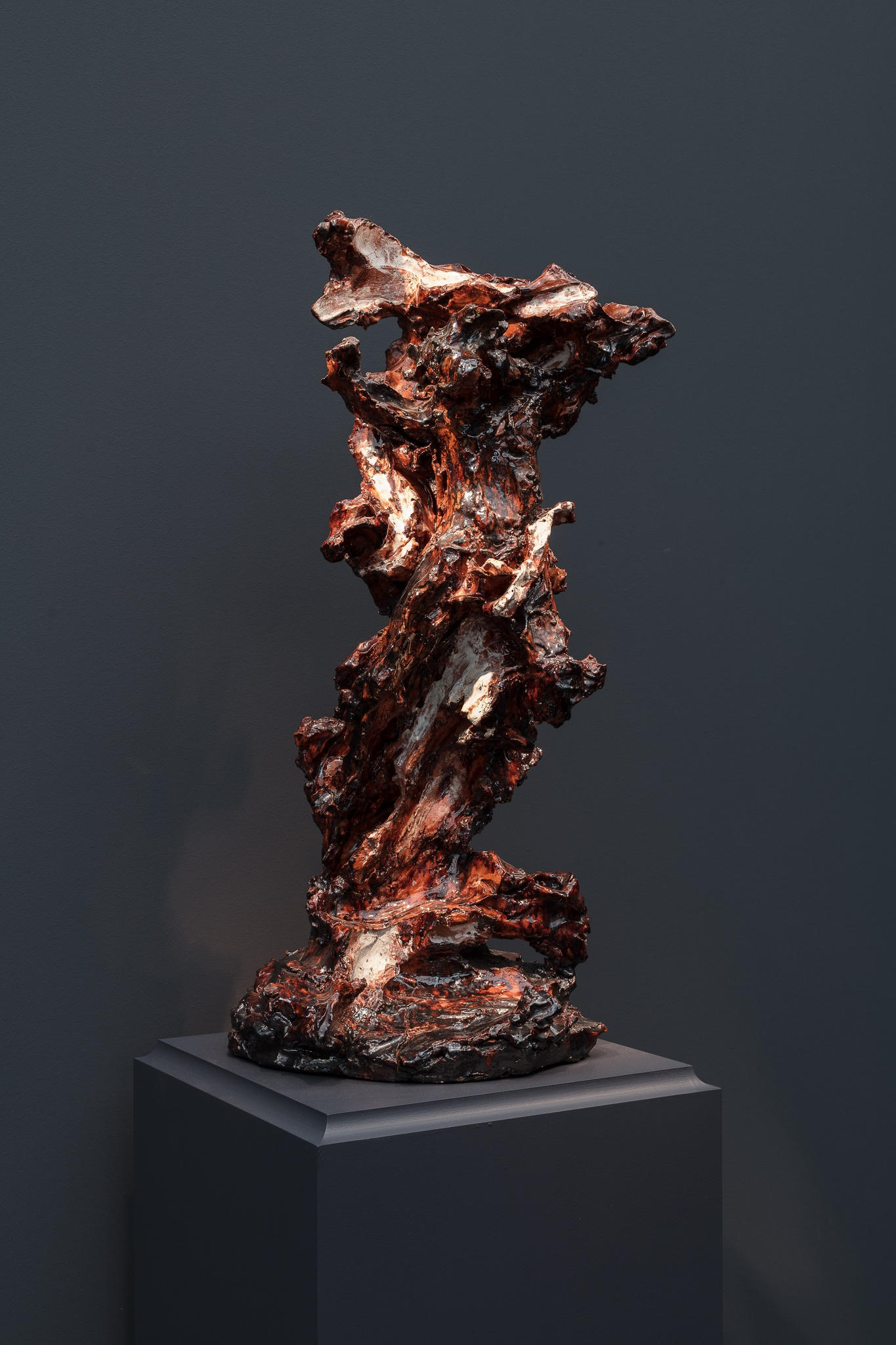
Crocifisso
1949
Coloured ceramic
81.5 x 37.5 x 32 cm / 32.1 x 14.8 x 12.6 in
Provenance
Galleria Niccoli, Parma;
Kodama Gallery, Tokyo;
Private collection, Italy.
Literature
E. Crispolti, Lucio Fontana. Catalogo ragionato di sculture, dipinti, ambientazioni, Milano 2006, vol. I, tav. CXVI (illustrated); p. 210, n. 47-48 SC 4 (illustrated);
G. Celant, Lucio Fontana Ambienti Spaziali, New York 2012, exhibition catalogue New York, Gagosian Gallery, 3 May - 30 June 2012, cat., p. 96, n. 75 (illustrated); p. 388, n. 75.
Description
'We do not intend to abolish art or stop life: we want paintings to come out of their frames, and sculptures from under their glass cases. An aerial, artistic portrayal of a minute will last for thousands of years in eternity'
(Second Spatialist Manifesto, in E. Crispolti and R. Siligato (eds.), Lucio Fontana, exh. cat., Rome, 1998, p. 118)
Executed in 1949, Lucio Fontana's Crocifisso is a powerful and dynamic glazed ceramic sculpture that combines expressive figuration with the concepts of nascent Spatialism, the bold and radical movement that the artist founded in Milan in 1947. Crocifisso is one of a series of ceramic, figurative sculptures that Fontana made in the years following his return to Milan from his native Argentina; other examples of these works are now held in a number of museums across the world, including the Museum of Modern Art, New York (Crucifixion, 1948) and Museum Ludwig, Cologne (Arlecchino, 1948). Glazed with deep umber tones, Crocifisso also conveys a visceral sense of corporeality, reflecting and embodying the powerful resonance implied by the work's subject.
'We live in the mechanical age', the artist declared in the Manifesto Blanco, published in Buenos Aires in 1946, 'Painted canvas and upright plaster no longer have any reason to exist' (Manifesto Blanco, 1946 in E. Crispolti and R. Siligato (eds.), Lucio Fontana, exh. cat., Milan, 1998, p. 115).
It was through sculpture that Fontana was initially able to realise his artistic aims, allowing him to explore the relationship and the dynamic interaction of matter in space. In Crocifisso, Fontana has clearly revelled in the physical properties of the material. Vigorously modelling and moulding the wet clay, he has created a highly textured, tactile and multi-faceted sculpture enlivened with protrusions and cavities that coalesce and integrate with the space surrounding them. In this way, Fontana achieved his aims at creating, 'neither painting nor sculpture, nor lines delimited in space, but continuity of space in matter'
(Fontana quoted in E. Crispolti and R. Siligato (eds.), Lucio Fontana, exh. cat., Rome, 1998, p. 118).
Near-abstract in its appearance, the subject of Crocifisso, and the gestural, dynamic and dramatic rendering of the sculpture also reflects one of the central areas of interest for Fontana at this time: the Baroque.
In 1946, just a few years before the artist created Crocifisso, Fontana and his avant-garde colleagues had declared, '[the] Baroque was a leap ahead it represented space with a magnificence that is still unsurpassed and added the notion of time to the plastic arts. The figures seemed to abandon the flat surface and continue the represented movements in space' (Manifesto Blanco, 1946, in ibid., p. 115).
The artwork described above is subject to changes in availability and price without prior notice.
Where applicable ARR will be added.
(Second Spatialist Manifesto, in E. Crispolti and R. Siligato (eds.), Lucio Fontana, exh. cat., Rome, 1998, p. 118)
Executed in 1949, Lucio Fontana's Crocifisso is a powerful and dynamic glazed ceramic sculpture that combines expressive figuration with the concepts of nascent Spatialism, the bold and radical movement that the artist founded in Milan in 1947. Crocifisso is one of a series of ceramic, figurative sculptures that Fontana made in the years following his return to Milan from his native Argentina; other examples of these works are now held in a number of museums across the world, including the Museum of Modern Art, New York (Crucifixion, 1948) and Museum Ludwig, Cologne (Arlecchino, 1948). Glazed with deep umber tones, Crocifisso also conveys a visceral sense of corporeality, reflecting and embodying the powerful resonance implied by the work's subject.
'We live in the mechanical age', the artist declared in the Manifesto Blanco, published in Buenos Aires in 1946, 'Painted canvas and upright plaster no longer have any reason to exist' (Manifesto Blanco, 1946 in E. Crispolti and R. Siligato (eds.), Lucio Fontana, exh. cat., Milan, 1998, p. 115).
It was through sculpture that Fontana was initially able to realise his artistic aims, allowing him to explore the relationship and the dynamic interaction of matter in space. In Crocifisso, Fontana has clearly revelled in the physical properties of the material. Vigorously modelling and moulding the wet clay, he has created a highly textured, tactile and multi-faceted sculpture enlivened with protrusions and cavities that coalesce and integrate with the space surrounding them. In this way, Fontana achieved his aims at creating, 'neither painting nor sculpture, nor lines delimited in space, but continuity of space in matter'
(Fontana quoted in E. Crispolti and R. Siligato (eds.), Lucio Fontana, exh. cat., Rome, 1998, p. 118).
Near-abstract in its appearance, the subject of Crocifisso, and the gestural, dynamic and dramatic rendering of the sculpture also reflects one of the central areas of interest for Fontana at this time: the Baroque.
In 1946, just a few years before the artist created Crocifisso, Fontana and his avant-garde colleagues had declared, '[the] Baroque was a leap ahead it represented space with a magnificence that is still unsurpassed and added the notion of time to the plastic arts. The figures seemed to abandon the flat surface and continue the represented movements in space' (Manifesto Blanco, 1946, in ibid., p. 115).
The artwork described above is subject to changes in availability and price without prior notice.
Where applicable ARR will be added.