
Francesco Botticini
b. 1446, Florence
d. 1497, Florence
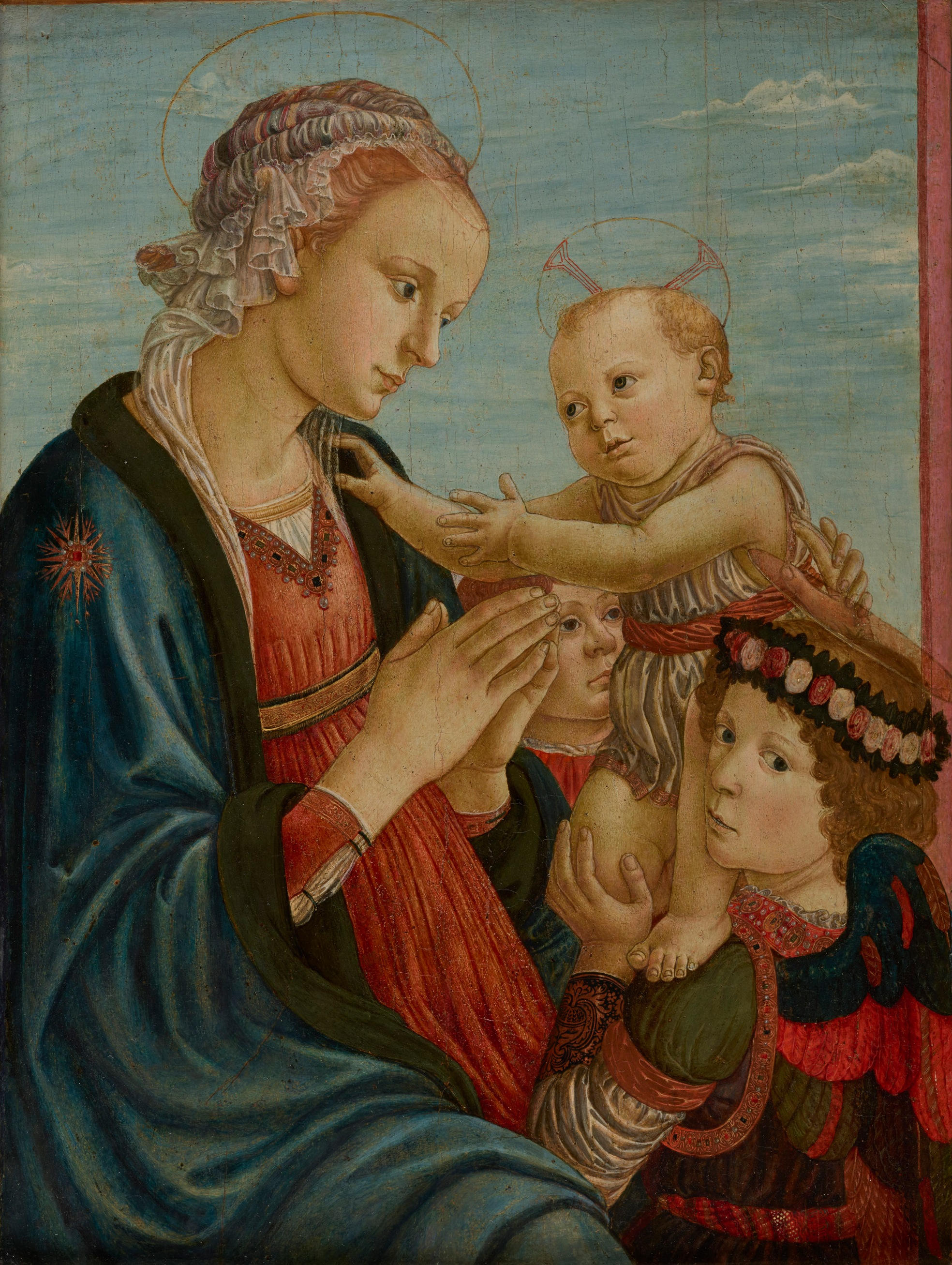
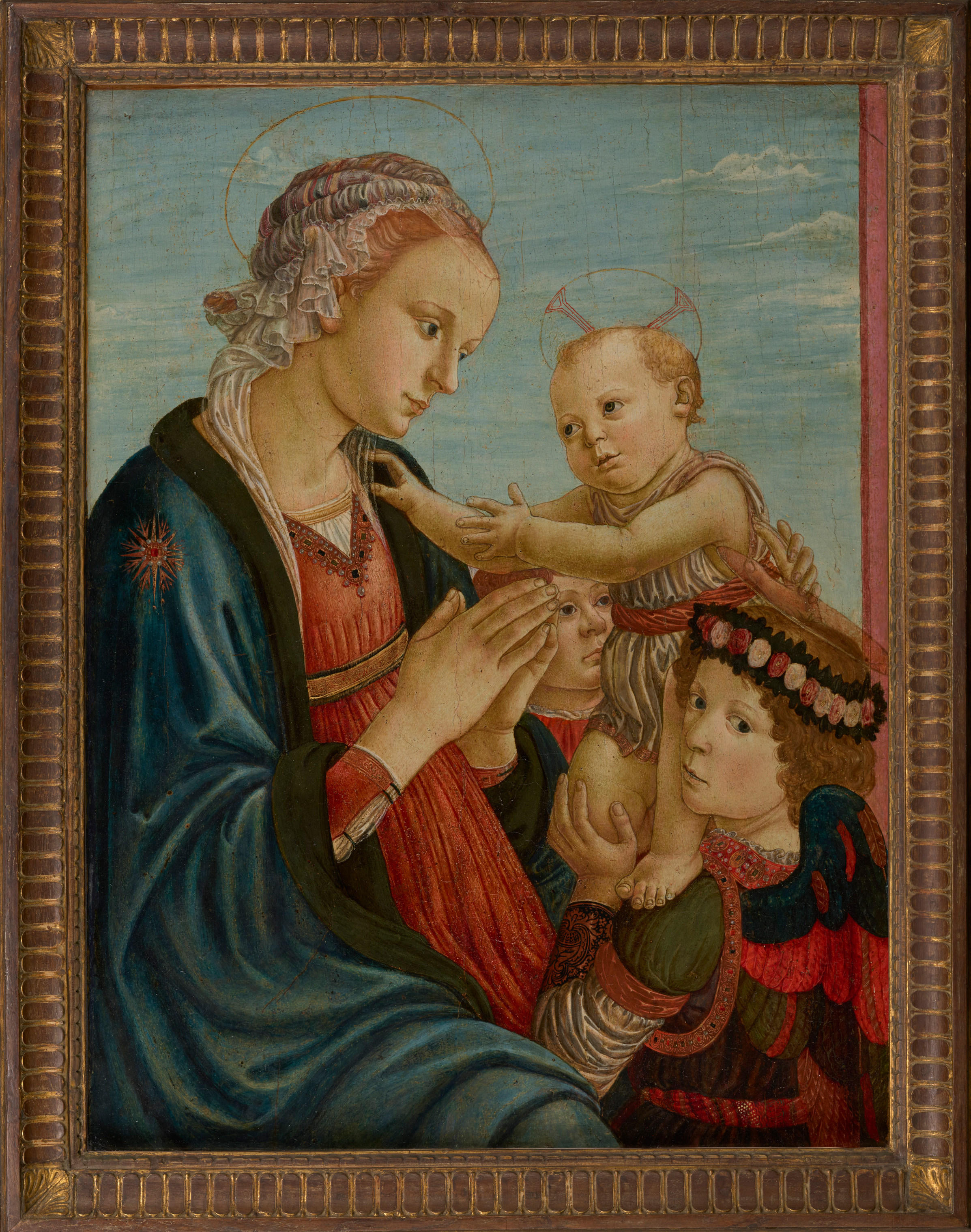
Madonna and Child with Two Angels
second half of the fifteenth century
Oil on panel
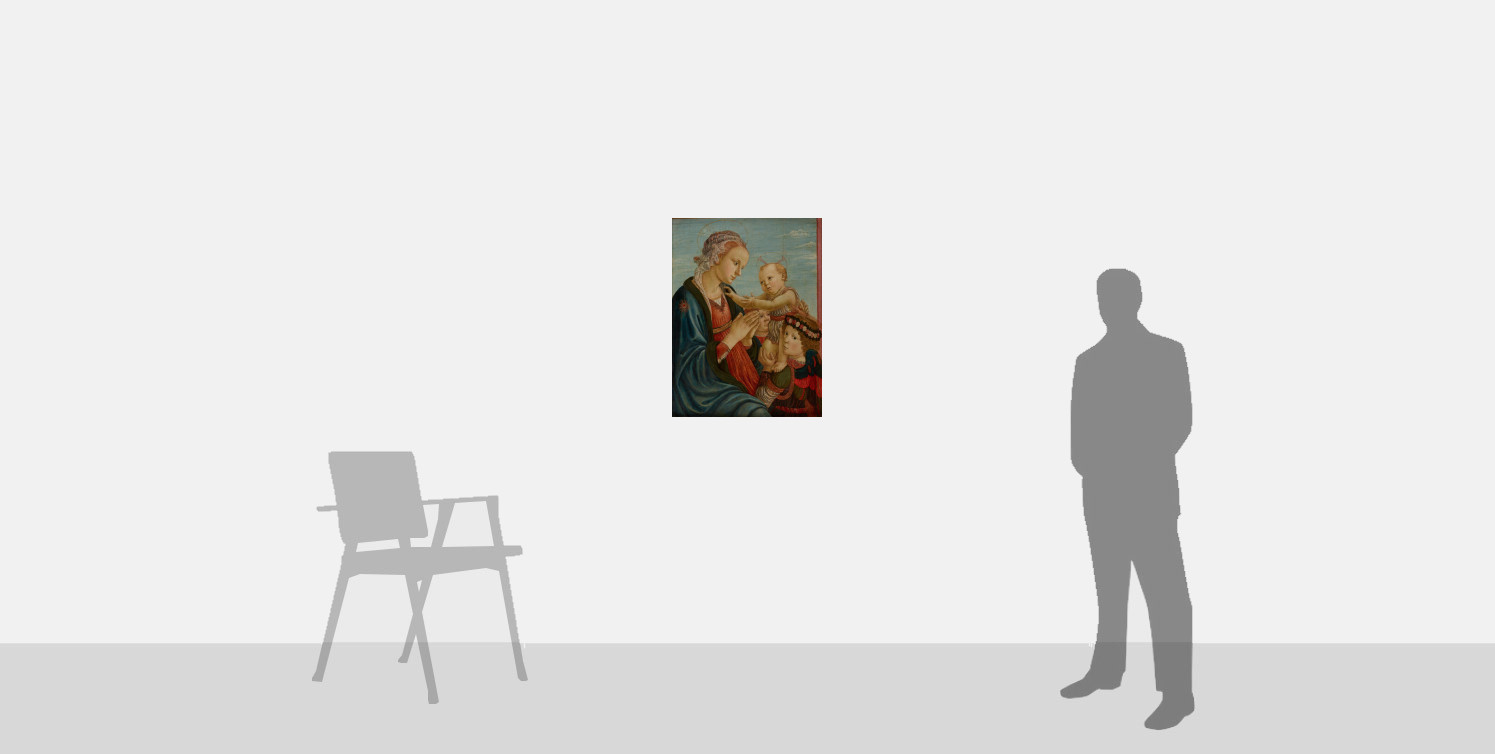
88.6 x 66.7 cm (34 7/8 x 26 1/4 in.)
Framed: 100 x 78 x 7 cm (39 3/8 x 30 3/4 x 2 3/4 in.)
Provenance
Cardinal Joseph Fesch, Rome, until 1837 (as Filippo Lippi),
By whom sold to Georges Spiridon, Rome (as Filippo Lippi),
Thence by descent to his son, Joseph Spiridon, Paris,
His Sale, Berlin, Cassirer-Helbing, 31 May 1929, lot 66, (as by Andrea del Verrocchio) for 240,000 Marks,
There purchased by Marczell von Nemes, Berlin,
His sale, Munich, 16 June 1931, lot 13 (as by Filippo Lippi),
Private Collection, UK,
Private Collection.
By whom sold to Georges Spiridon, Rome (as Filippo Lippi),
Thence by descent to his son, Joseph Spiridon, Paris,
His Sale, Berlin, Cassirer-Helbing, 31 May 1929, lot 66, (as by Andrea del Verrocchio) for 240,000 Marks,
There purchased by Marczell von Nemes, Berlin,
His sale, Munich, 16 June 1931, lot 13 (as by Filippo Lippi),
Private Collection, UK,
Private Collection.
Literature
R. van Marle, The Development of the Italian Schools of Painting, 1923-1938, vol. X, p. 459, no. 2 (as possibly ascribed to Fra Filippo Lippi).
Description
Francesco Botticini was the likely pupil of Neri di Bicci. His apprenticeship to Neri di Bicci was short lived, as he is recorded in the studio on 22 October 1459, and by 24 July 1460 as an independent artist. Though he did execute large scale commissions, such as the altarpiece depicting the Madonna and Child Enthroned with Saints and Angels (Metropolitan Museum of Art, New York, ace. no. 61.235) and Saint Monica and Augustinian nuns (San Spirito, Florence) Botticini also excelled in his execution of smaller easel paintings, of which this Madonna and Child with Two Angels is a superb example. His style is absolutely characteristic of the prevailing Florentine idiom of the late quattrocento in its employment of idealized forms and crisp linear draftsmanship. Similar to his teacher Neri di Bicci, his personal style appears to be an amalgam of those of his Florentine contemporaries. In Botticini's case these are Filippo Lippi, Cosimo Rosselli, Andrea del Verrocchio, and Botticelli. His close connection to these artists was such that the attribution of this picture has at various times been given to both Lippi and Andrea del Verrocchio (see Provenance). It is only in recent years, after renewed scholarly debate, that it has rightly been given in full to Botticini.
Though Botticini's style was very directly influenced by his Fiorentine contemporaries, this Madonna and Child with Two Angels takes as its direct inspiration Filippo Lippi's famous picture of the same subject, today in the Uffizi (fig. 1). Lippi's devotional work became a model of excellence not only for Botticini, but for many artists working in and around Florence; both the young Botticelli as well as Andrea della Robbia took Lippi's example as inspiration for works of their own. Painted during his stay in Prato (1452–66), Lippi's Madonna and Child could have been seen by Botticini when he worked in the nearby town of Pratovecchio. Though this composition is clearly derived from Lippi's prime example, Botticini did not simply execute a straight copy of that picture. Instead, he reinterprets it with a few significant compositional changes. Most notable is his exclusion of Lippi's rocky landscape, seen in the background through a trompe l'oeil window which frames the composition. Instead, Botticini depicts a simple sky with clouds to function as the picture's background. Furthermore, the position of the head of the angel standing behind the Christ Child has been adjusted, and he has also chosen to exclude the elaborate scrolled armrest which Lippi prominently places in the left foreground of his work. Additionally, the dress and facial types differ slightly from Lippi's example. Most notable in this regard is the angel which gazes out at the viewer. Botticini depicts him in a beautifully jeweled costume with passages of deep burgundy red. He wears a flowered laurel wreath, the colors ofwhich complement his wings and dress, as well as the drapery of the praying Madonna.
Technical examination of the present panel with infrared reflectography has revealed interesting aspects of its creation. The painting was prepared by Botticini by first executing a beautiful, freely handled underdrawing. Such freedom of execution strongly suggests that it was not a tracing, either of Lippi's work or any other, but rather a freehand interpretation of Lippi's example. The initial choices made by Botticini in this preparatory stage continue into the final painted surface, the overall effect of which is one of simplified beauty, achieved through an assured, refined, and elegant style.
The picture has formed part of some of the most important collections comprised over the past two hundred years. It is first recorded in the collection of Cardinal Joseph Fesch, half-brother of Letizia Ramolino Bonaparte, the mother of Napoléon Bonaparte. At the time of his death in 1839, his collection comprised nearly 16,000 works. While a number of paintings and works of art were sent by his heir, Joseph Bonaparte, to Corsica (the Musée Fesch in Ajaccio opened in 1852), a large number of works were sold prior to his death, including this Botticini. In 1837 Fesch sold the picture to Georges Spiridon, a well regarded collector whose son Joseph later inherited the picture. The Spiridon collection included a number of superlative old master paintings, including Joos van Cleve's Holy Family (Metropolitan Museum of Art, New York, ace. no. 32.100.57), Carlo Crivelli's Crucifìxion (Art lnstitute of Chicago), and Alvise Vivarini's St. John the Baptist (Museo Thyssen-Bomemisza, Madrid, inv. no. 426). The contents ofthe Spiridon collection were auctioned in Berlin in 1929, where this work was purchased by the legendary dealer and collector Marczell von Nemes. It belonged to von Nemes for only two years, as it was included in the important Berlin auction of a large portion of his collection.
The attribution to Francesco Botticini has been endorsed by Keith Christiansen, Luke Syson, Andrea De Marchi, and Miklós Boskovits, all in private communication.
Fig. 1 - Filippo Lippi, Madonna and Child with Two Angels, c. 1460-65, tempera on wood, 95 x 62 cm. Florence, Gallerie degli Uffizi.
Though Botticini's style was very directly influenced by his Fiorentine contemporaries, this Madonna and Child with Two Angels takes as its direct inspiration Filippo Lippi's famous picture of the same subject, today in the Uffizi (fig. 1). Lippi's devotional work became a model of excellence not only for Botticini, but for many artists working in and around Florence; both the young Botticelli as well as Andrea della Robbia took Lippi's example as inspiration for works of their own. Painted during his stay in Prato (1452–66), Lippi's Madonna and Child could have been seen by Botticini when he worked in the nearby town of Pratovecchio. Though this composition is clearly derived from Lippi's prime example, Botticini did not simply execute a straight copy of that picture. Instead, he reinterprets it with a few significant compositional changes. Most notable is his exclusion of Lippi's rocky landscape, seen in the background through a trompe l'oeil window which frames the composition. Instead, Botticini depicts a simple sky with clouds to function as the picture's background. Furthermore, the position of the head of the angel standing behind the Christ Child has been adjusted, and he has also chosen to exclude the elaborate scrolled armrest which Lippi prominently places in the left foreground of his work. Additionally, the dress and facial types differ slightly from Lippi's example. Most notable in this regard is the angel which gazes out at the viewer. Botticini depicts him in a beautifully jeweled costume with passages of deep burgundy red. He wears a flowered laurel wreath, the colors ofwhich complement his wings and dress, as well as the drapery of the praying Madonna.
Technical examination of the present panel with infrared reflectography has revealed interesting aspects of its creation. The painting was prepared by Botticini by first executing a beautiful, freely handled underdrawing. Such freedom of execution strongly suggests that it was not a tracing, either of Lippi's work or any other, but rather a freehand interpretation of Lippi's example. The initial choices made by Botticini in this preparatory stage continue into the final painted surface, the overall effect of which is one of simplified beauty, achieved through an assured, refined, and elegant style.
The picture has formed part of some of the most important collections comprised over the past two hundred years. It is first recorded in the collection of Cardinal Joseph Fesch, half-brother of Letizia Ramolino Bonaparte, the mother of Napoléon Bonaparte. At the time of his death in 1839, his collection comprised nearly 16,000 works. While a number of paintings and works of art were sent by his heir, Joseph Bonaparte, to Corsica (the Musée Fesch in Ajaccio opened in 1852), a large number of works were sold prior to his death, including this Botticini. In 1837 Fesch sold the picture to Georges Spiridon, a well regarded collector whose son Joseph later inherited the picture. The Spiridon collection included a number of superlative old master paintings, including Joos van Cleve's Holy Family (Metropolitan Museum of Art, New York, ace. no. 32.100.57), Carlo Crivelli's Crucifìxion (Art lnstitute of Chicago), and Alvise Vivarini's St. John the Baptist (Museo Thyssen-Bomemisza, Madrid, inv. no. 426). The contents ofthe Spiridon collection were auctioned in Berlin in 1929, where this work was purchased by the legendary dealer and collector Marczell von Nemes. It belonged to von Nemes for only two years, as it was included in the important Berlin auction of a large portion of his collection.
The attribution to Francesco Botticini has been endorsed by Keith Christiansen, Luke Syson, Andrea De Marchi, and Miklós Boskovits, all in private communication.
Fig. 1 - Filippo Lippi, Madonna and Child with Two Angels, c. 1460-65, tempera on wood, 95 x 62 cm. Florence, Gallerie degli Uffizi.