
Alighiero Boetti
b. 1940, Turin, Italy
d. 1994, Rome, Italy
Mappa
1978-1979
Embroidery on cloth
91 x 132 cm (35 7/8 x 52 in.)
Framed: 102 x 143 cm (40 1/8 x 56 1/3 in.)
Provenance
Private collection, Rome (acquired directly from the artist),
Private collection, New York.
Private collection, New York.
Literature
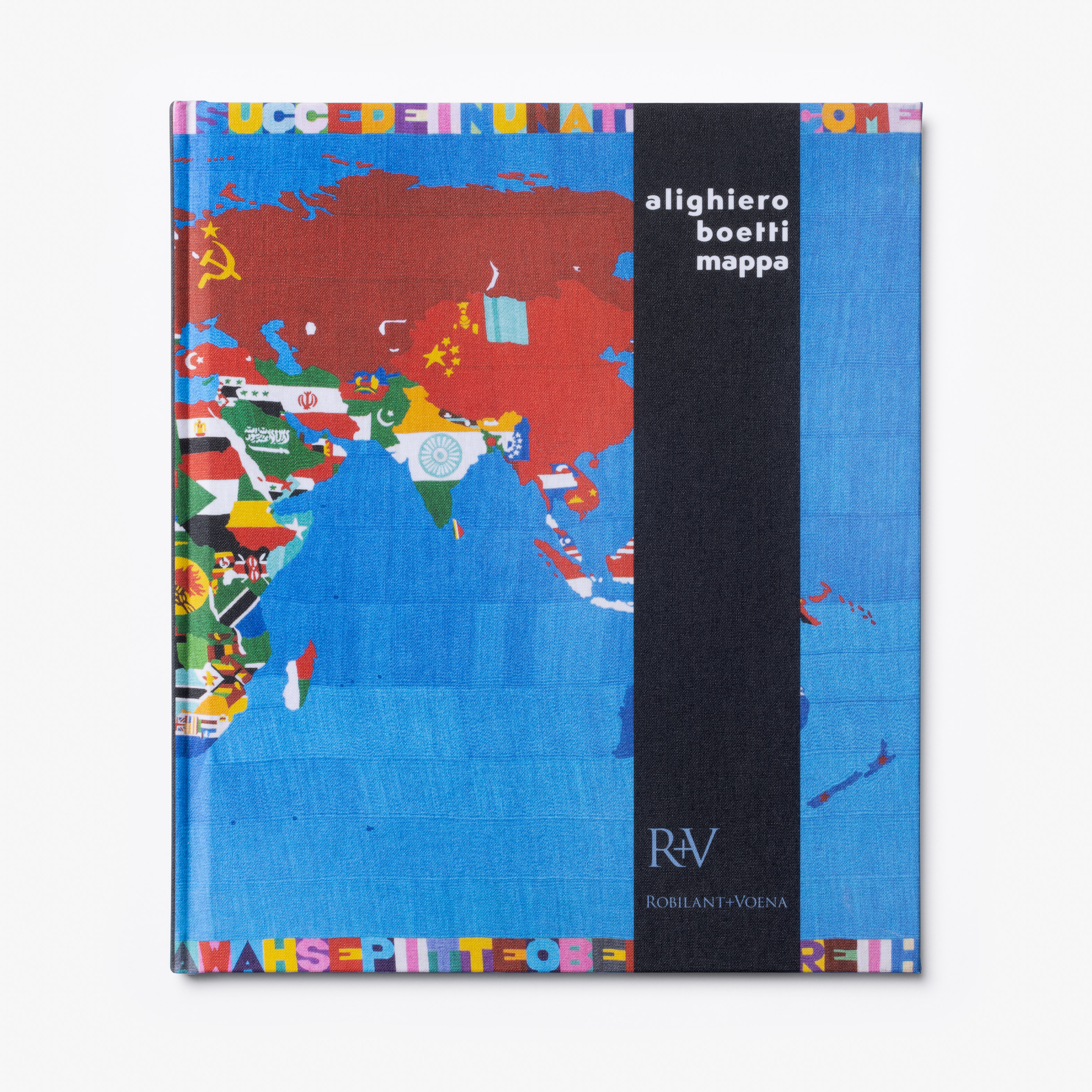
J.C. Ammann (ed.), Alighiero Boetti. Catalogo generale, vol. II, Milan, 2012, p. 335, no. 1078 (incorrectly illustrated with Mappa no. 1076).
Description
Boetti’s exquisitely crafted Mappa belongs to his most defining series of works. First instigated in 1971, the creation of his laboriously embroidered world maps – all based on the same idea, but utterly unique in their execution – spanned three decades. In total, over 150 Mappe were created, with each map taking over a year to complete. They bring together many aspects of Boetti’s intellectually diverse practice in a succinct and eloquent way, including an engagement with ready-made signs, processes of codification, collaborative exchange and his constant underlying interest in the dichotomy between order and disorder.
Boetti was particularly pleased with the Mappe because they seemed to be entirely self-determined, needing only his Duchampian, light-handed guidance to expose deeply complex issues in an extraordinarily simple and beautiful form. ‘To my mind, the work of the embroidered map represents the supreme beauty’ he said, because ‘I made nothing, selected nothing in the sense that the world is made the way it is and I have not drawn it; the flags are those that exist anyway, I did not draw them; all in all, I have made absolutely nothing. Once the basic idea is there, the concept, then everything else is already chosen (Boetti, quoted in Alighiero Boetti: Mettere al mondo il mondo, exh. cat., Frankfurt, 1998, p. 69).
Mappa is also a testament to Boetti’s important and enduring relationship with Afghanistan – a country fittingly known as an ancient crossroads of cultural interchange. He made his first journeys there in 1971 and opened a small hotel in Kabul that same year, which he used as a base to plan and organise his most famous works. Primary among these are the Mappe whose embroidered surfaces were inspired by the outstanding craftsmanship Boetti encountered in the markets and interiors of Kabul. His affinity for textiles had already been fostered during childhood via his mother, who supplemented her income with a small embroidery business run from her home. In 1969 he had also enlisted the needlework skills of his wife Annemarie Sauzeau to embroider a cloth with the shapes of Sinai, the West Bank and Gaza that Boetti had sourced from newspaper stories and used in his work Dodici forme dal guigno ‘67. These significant precursors paved the way for the ambitious Mappe project which developed over the course of almost three decades, and for which Boetti enlisted the skills of successive groups of Afghan women for the realisation of his work. In doing so, he established a form of relational aesthetics whereby he could explore the role of the artist as conceiver but not ultimate creator, and revel in the unexpected results proffered by chance, error or the peculiarities of the weaver.
The Mappe saw three phases of production: the first iterations of the maps being made through Afghanistan’s Royal School of Embroidery when Boetti was able to frequently visit Kabul; the second disrupted phase occurring in the years following the 1979 Soviet invasion of Afghanistan; and the third cycle being completed from the early 1980s until the artist’s death in 1994 by refugees who had fled to Peshawar in Pakistan. The present work was completed just before the Soviet invasion of Afghanistan. The extended Mappe project consequently spanned years of great upheaval, and became a geopolitical documentary of the changing world order from the middle of the Cold War until the fall of the Soviet Union. Indeed, it is only in Boetti’s final map, finished in the last year of his life, that we see the red Soviet bloc replaced by many different new nations.
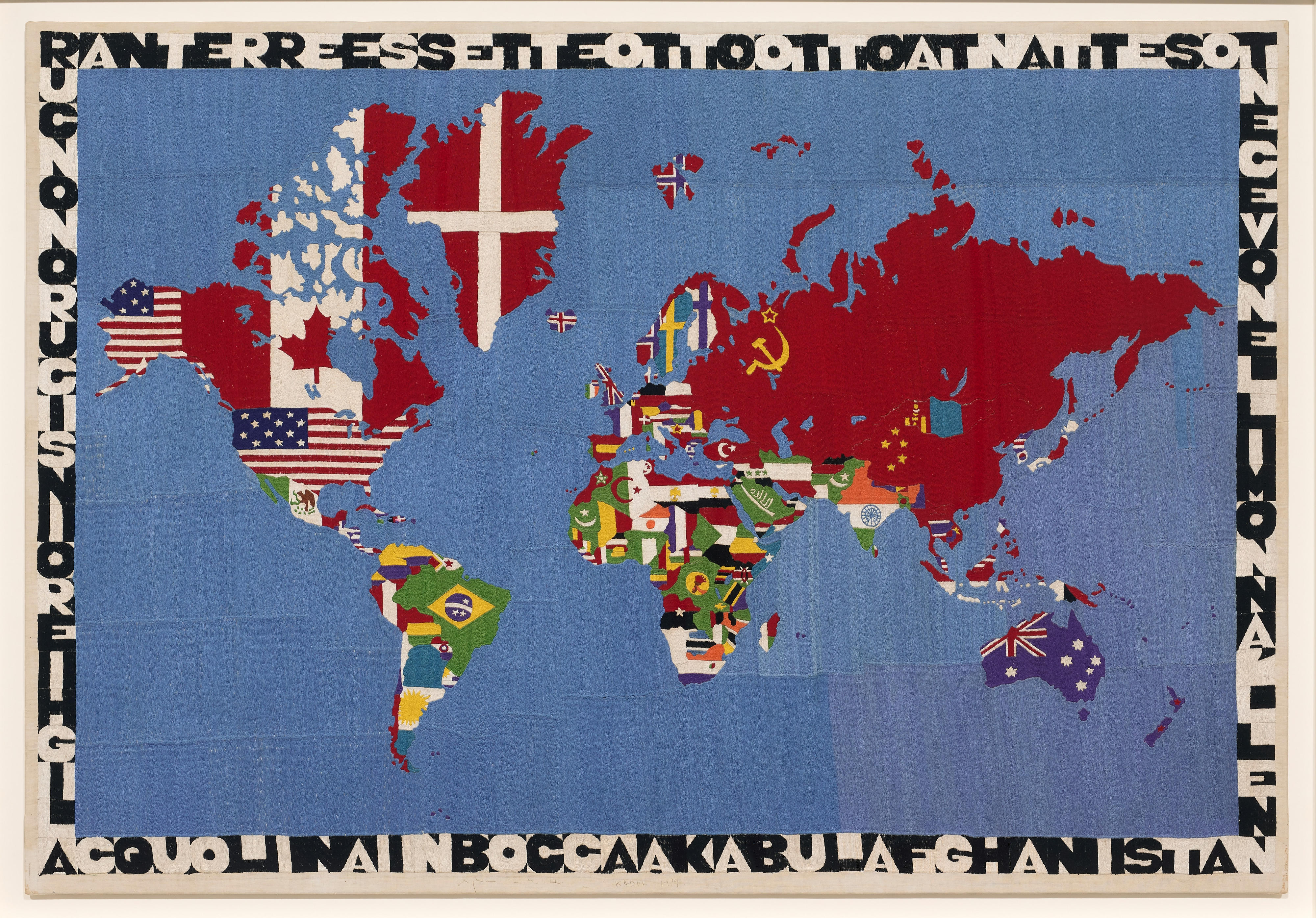
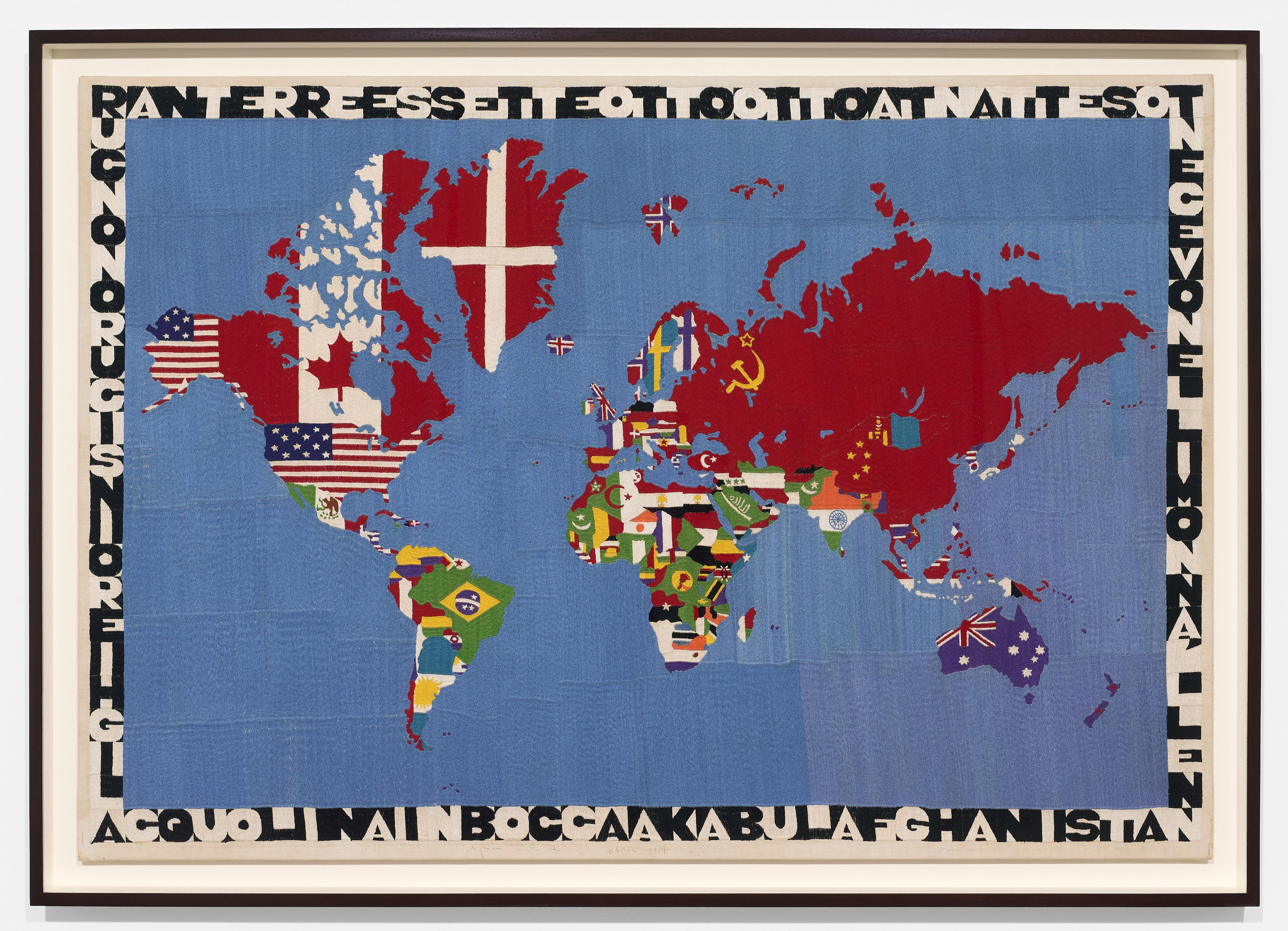
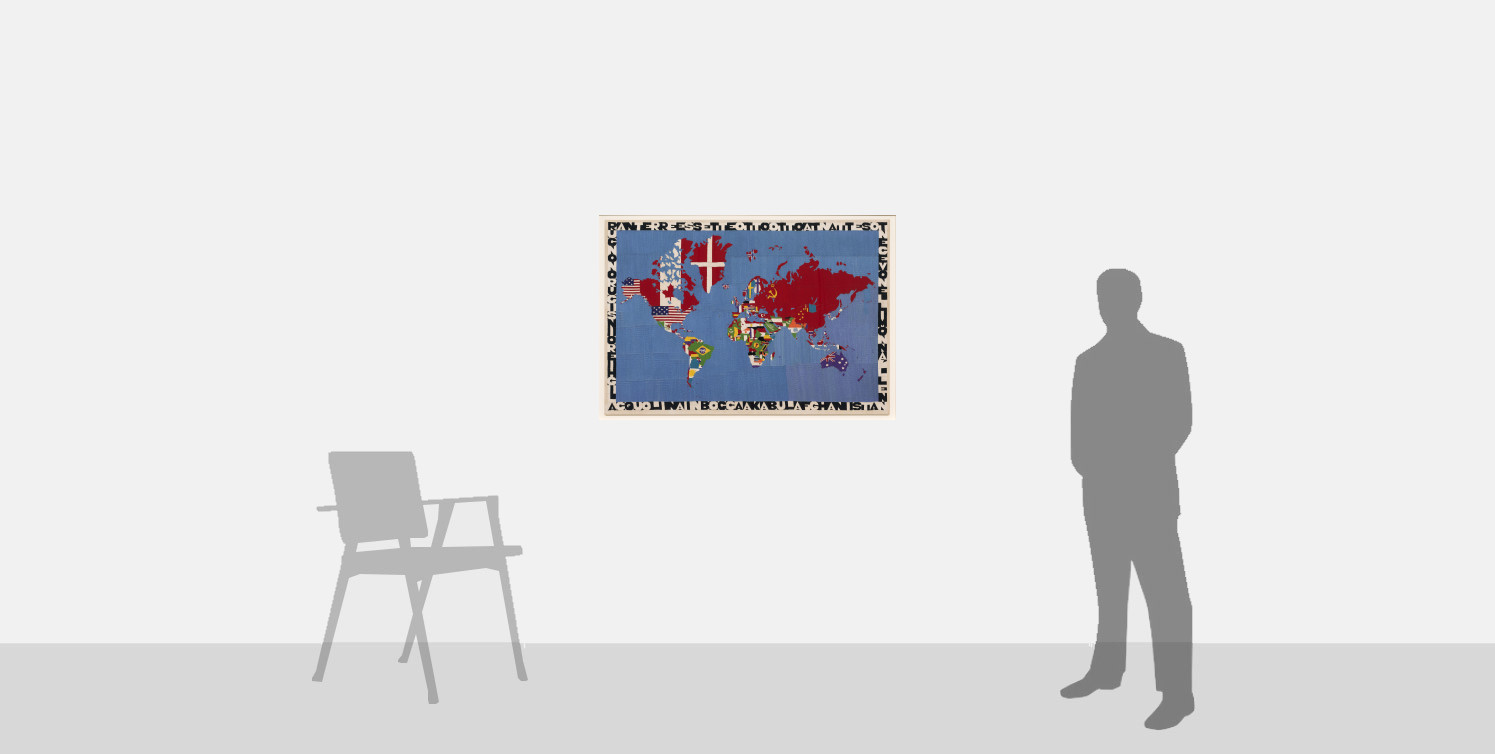
The present Mappa shows the Earth’s landmasses populated by flags that represent the arbitrary borders of human relations. Each country is defined by its flag’s vibrant colours, with the surrounding oceans densely stitched in shimmering blue. The geography is based on the Mercator projection – the standard map used in most schoolbooks and newspapers – that misrepresents the true areas of nations and continents, particularly exaggerating the higher latitudes. By the middle of the twentieth century, many pointed out that this projection made the powerful North appear more important than the poorer South, while also providing a way of visually exaggerating the threat of the Soviet Union. Later, Boetti would adopt the curved Robinson projection that gives greater and more realistic weight to the southern continents, thereby highlighting the biases embedded in these seemingly objective charts. Framing the whole are a specified number squares that carefully plot Boetti’s name, the place and date of the work’s origin, and a typically Delphic statement.
Mappa captures a frozen moment in time, depicting countries that no longer exist, and borders that are no longer relevant. With the massive weight of red to the upper right, the viewer can instantly perceive the contrast between the national borders of today with those in place over thirty years ago. Aside from the dominant presence of the former Soviet Union, we also see several changes in Africa, including the flaming torch emblem from the flag of Zaire, now known as the Democratic Republic of the Congo, and the now-independent nation of South Sudan still located under the flag of its northern neighbor Sudan. Yet the tale of political flux is most powerfully evident in the map’s two white spaces. In the southwestern corner of Africa, the nation now known as Namibia is deliberately shown as a white blank, in recognition of its ambiguous status at that time. Another white space, though, is far more closely connected to Boetti and his collaborators: that where the flag of Afghanistan should be. Unlike the absence of Namibia’s flag, which Boetti asked be deliberately omitted as an expression of his disagreement with the South African occupation, the embroiderers of this work were given the freedom to decide how their country was represented.
By defining the world’s nations in this embroidered artwork, Boetti has created a living embodiment of his concept of mettere al mondo il mondo (to bring the world into the world). It is one of the most persuasive and moving examples of the artist’s belief that the world constitutes a constantly changing flux of disordered chaos united by its own intrinsic nature into a greater whole. In creating Mappa, Boetti not only draws our attention to the political divisions that span the globe, but he has also engaged in a process of exchange that highlights humanity’s deep interconnectedness. This is, after all, a work conceived by an Italian artist based on a map purchased in England, which has been recreated with the finest Scottish embroidery threads by Afghan women, and has subsequently been shipped around the world for public exhibition. Implicit within Mappa, therefore, is a critique of artificial, national and ideological man-made borders met with a deliberate attempt to encourage the healing of such divisions through transnational trade, communication and cooperation.
This artwork is accompanied by a certificate of the Archivio Alighiero Boetti where it is specified that on the catalogue raisonné, the image of the Mappa (no. 6389) is mistakenly represented with the image of Mappa no. 1076.
Boetti was particularly pleased with the Mappe because they seemed to be entirely self-determined, needing only his Duchampian, light-handed guidance to expose deeply complex issues in an extraordinarily simple and beautiful form. ‘To my mind, the work of the embroidered map represents the supreme beauty’ he said, because ‘I made nothing, selected nothing in the sense that the world is made the way it is and I have not drawn it; the flags are those that exist anyway, I did not draw them; all in all, I have made absolutely nothing. Once the basic idea is there, the concept, then everything else is already chosen (Boetti, quoted in Alighiero Boetti: Mettere al mondo il mondo, exh. cat., Frankfurt, 1998, p. 69).
Mappa is also a testament to Boetti’s important and enduring relationship with Afghanistan – a country fittingly known as an ancient crossroads of cultural interchange. He made his first journeys there in 1971 and opened a small hotel in Kabul that same year, which he used as a base to plan and organise his most famous works. Primary among these are the Mappe whose embroidered surfaces were inspired by the outstanding craftsmanship Boetti encountered in the markets and interiors of Kabul. His affinity for textiles had already been fostered during childhood via his mother, who supplemented her income with a small embroidery business run from her home. In 1969 he had also enlisted the needlework skills of his wife Annemarie Sauzeau to embroider a cloth with the shapes of Sinai, the West Bank and Gaza that Boetti had sourced from newspaper stories and used in his work Dodici forme dal guigno ‘67. These significant precursors paved the way for the ambitious Mappe project which developed over the course of almost three decades, and for which Boetti enlisted the skills of successive groups of Afghan women for the realisation of his work. In doing so, he established a form of relational aesthetics whereby he could explore the role of the artist as conceiver but not ultimate creator, and revel in the unexpected results proffered by chance, error or the peculiarities of the weaver.
The Mappe saw three phases of production: the first iterations of the maps being made through Afghanistan’s Royal School of Embroidery when Boetti was able to frequently visit Kabul; the second disrupted phase occurring in the years following the 1979 Soviet invasion of Afghanistan; and the third cycle being completed from the early 1980s until the artist’s death in 1994 by refugees who had fled to Peshawar in Pakistan. The present work was completed just before the Soviet invasion of Afghanistan. The extended Mappe project consequently spanned years of great upheaval, and became a geopolitical documentary of the changing world order from the middle of the Cold War until the fall of the Soviet Union. Indeed, it is only in Boetti’s final map, finished in the last year of his life, that we see the red Soviet bloc replaced by many different new nations.
The present Mappa shows the Earth’s landmasses populated by flags that represent the arbitrary borders of human relations. Each country is defined by its flag’s vibrant colours, with the surrounding oceans densely stitched in shimmering blue. The geography is based on the Mercator projection – the standard map used in most schoolbooks and newspapers – that misrepresents the true areas of nations and continents, particularly exaggerating the higher latitudes. By the middle of the twentieth century, many pointed out that this projection made the powerful North appear more important than the poorer South, while also providing a way of visually exaggerating the threat of the Soviet Union. Later, Boetti would adopt the curved Robinson projection that gives greater and more realistic weight to the southern continents, thereby highlighting the biases embedded in these seemingly objective charts. Framing the whole are a specified number squares that carefully plot Boetti’s name, the place and date of the work’s origin, and a typically Delphic statement.
Mappa captures a frozen moment in time, depicting countries that no longer exist, and borders that are no longer relevant. With the massive weight of red to the upper right, the viewer can instantly perceive the contrast between the national borders of today with those in place over thirty years ago. Aside from the dominant presence of the former Soviet Union, we also see several changes in Africa, including the flaming torch emblem from the flag of Zaire, now known as the Democratic Republic of the Congo, and the now-independent nation of South Sudan still located under the flag of its northern neighbor Sudan. Yet the tale of political flux is most powerfully evident in the map’s two white spaces. In the southwestern corner of Africa, the nation now known as Namibia is deliberately shown as a white blank, in recognition of its ambiguous status at that time. Another white space, though, is far more closely connected to Boetti and his collaborators: that where the flag of Afghanistan should be. Unlike the absence of Namibia’s flag, which Boetti asked be deliberately omitted as an expression of his disagreement with the South African occupation, the embroiderers of this work were given the freedom to decide how their country was represented.
By defining the world’s nations in this embroidered artwork, Boetti has created a living embodiment of his concept of mettere al mondo il mondo (to bring the world into the world). It is one of the most persuasive and moving examples of the artist’s belief that the world constitutes a constantly changing flux of disordered chaos united by its own intrinsic nature into a greater whole. In creating Mappa, Boetti not only draws our attention to the political divisions that span the globe, but he has also engaged in a process of exchange that highlights humanity’s deep interconnectedness. This is, after all, a work conceived by an Italian artist based on a map purchased in England, which has been recreated with the finest Scottish embroidery threads by Afghan women, and has subsequently been shipped around the world for public exhibition. Implicit within Mappa, therefore, is a critique of artificial, national and ideological man-made borders met with a deliberate attempt to encourage the healing of such divisions through transnational trade, communication and cooperation.
This artwork is accompanied by a certificate of the Archivio Alighiero Boetti where it is specified that on the catalogue raisonné, the image of the Mappa (no. 6389) is mistakenly represented with the image of Mappa no. 1076.