
Matthias Stomer
b. c. 1600, Amersfoort, near Utrecht
d. after 1650, Sicily
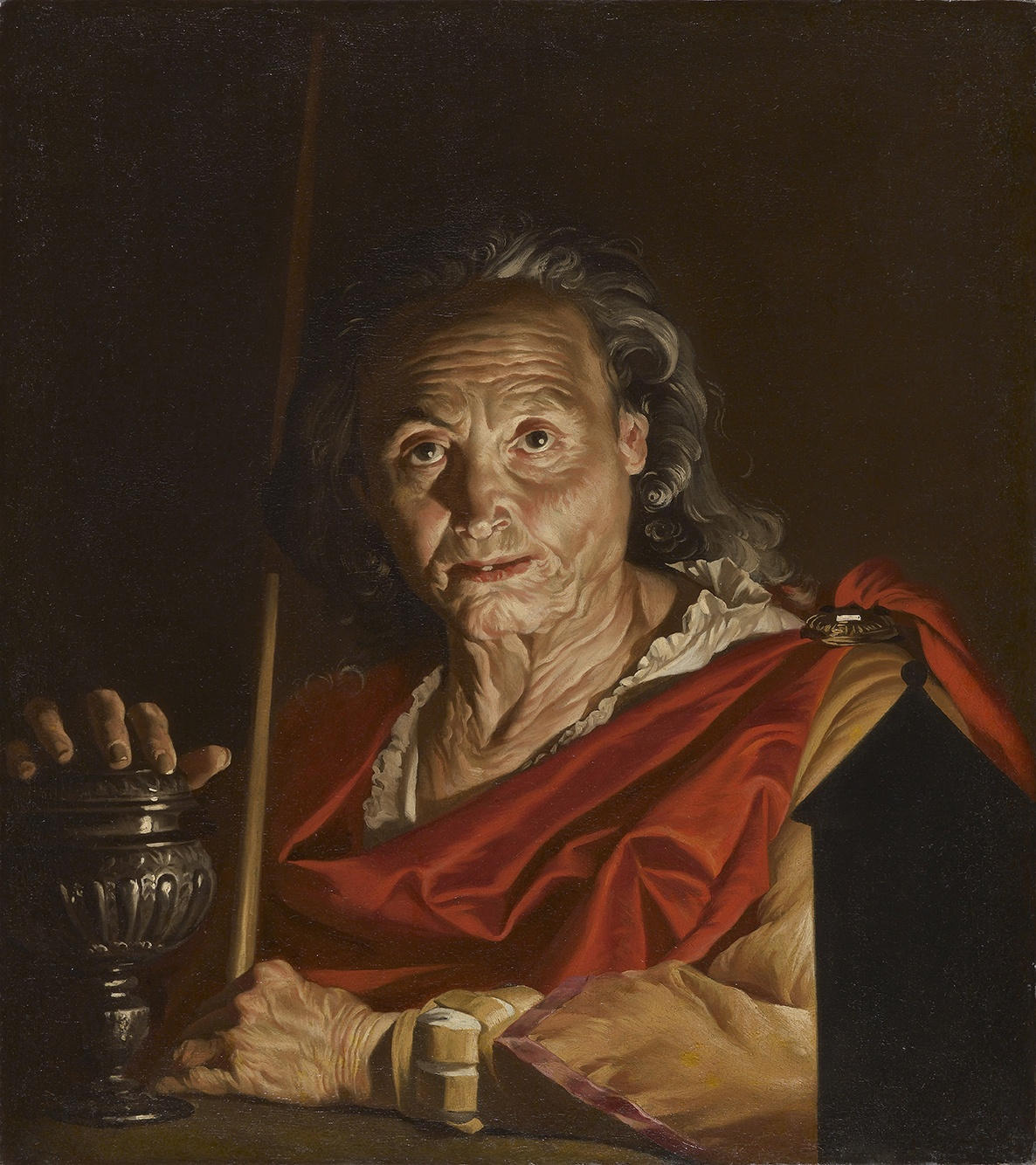
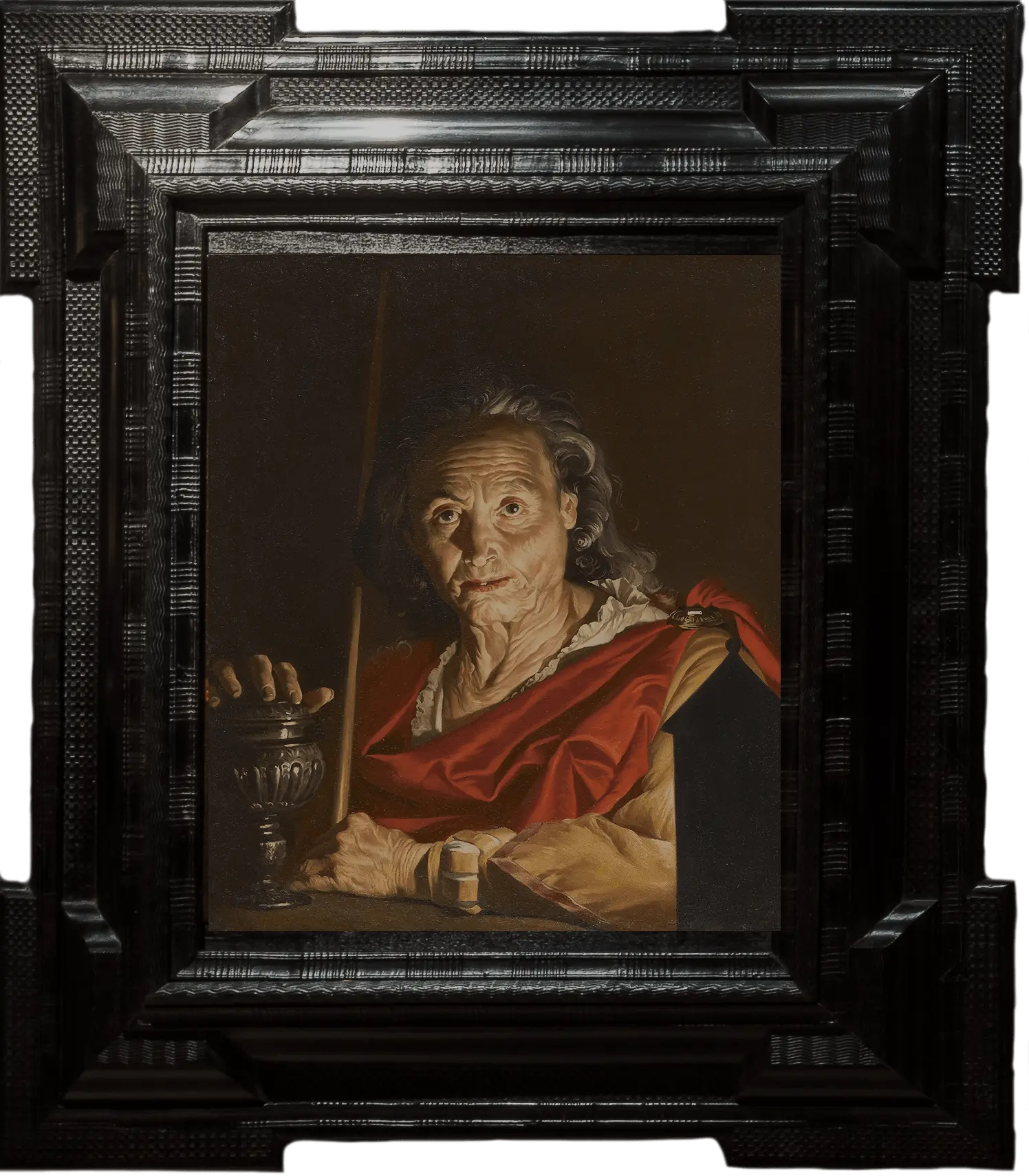
Old Woman With A Goblet
c. 1640–50
Oil on canvas
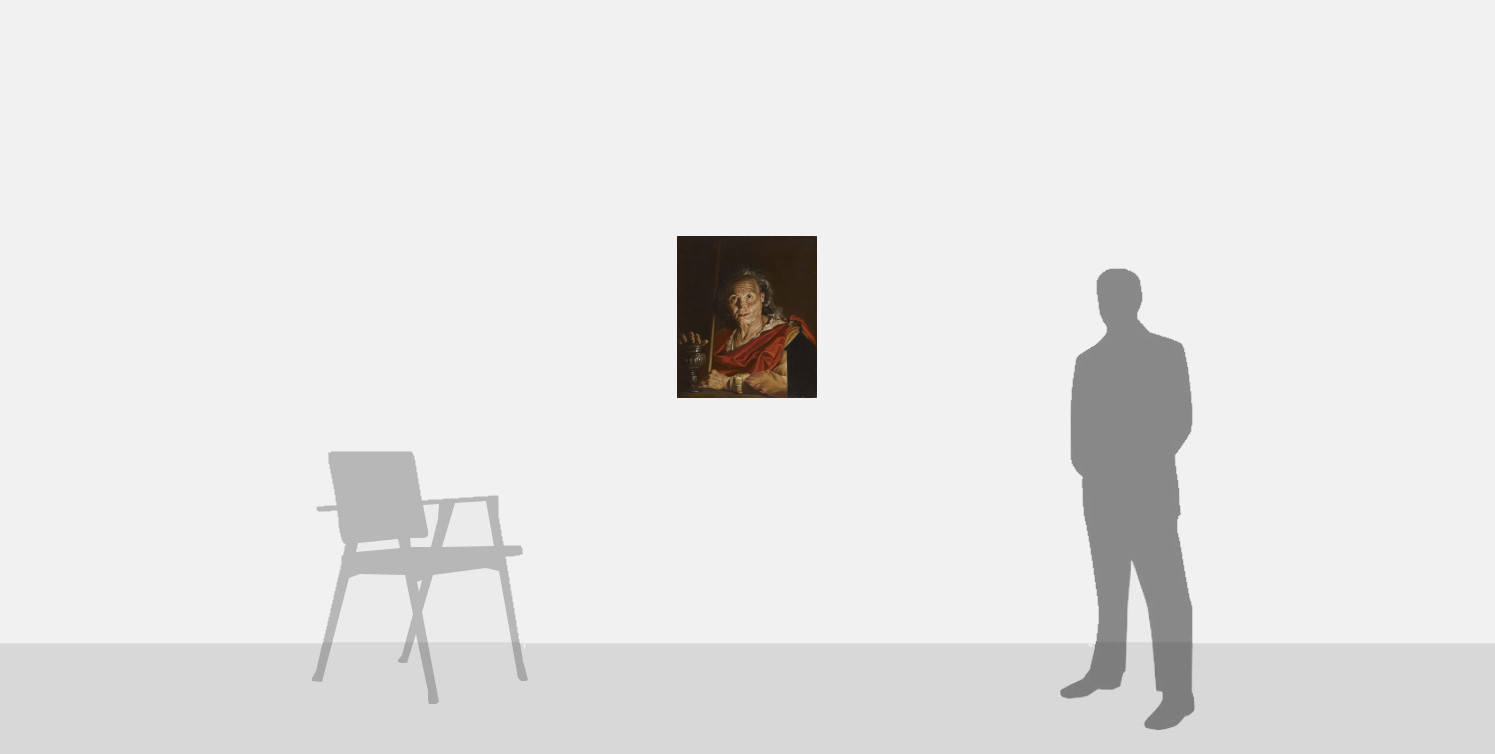
72 x 62.5 cm (28 3/8 x 24 5/8 in.)
With frame: 128 x 112 x 10 cm (50 3/8 x 44 1/8 x 4 in.)
Provenance
Sotheby’s, London 10 December 1975, lot 186,
Private Collection, Italy.
Literature
B. Nicolson, 'Stomer Brought Up to date', The Burlington Magazine, 1977, no. 144, fig. 22, pp. 243-5.
B. Nicolson, Caravaggism in Europe, II ed., Turin 1990, p. 187.
A. Galli in In Pursuit of Caravaggio, exhibition catalogue, Turin, 2016, pp. 66-67.
Description
The great patron of Rembrandt, Antonio Ruffo, Duke of Messina, purchased three paintings from Stomer between 1646 and 1649, illustrating the difference in the reception of the work of the Northern and Southern Caravaggisti.
Very little is known with certainty about the career of Matthias Stomer (Stom), old sources relate that he originally came from Amersfoort and stylistic details lead us to believe that he spent time in Utrecht around 1620, where he saw and was influenced by the work of ter Brugghen and Honthorst, both of whom had returned from Rome at that time. It was from these artists that Stomer learnt to pay special attention to the use of light and chiaroscuro in his paintings, which remained a characteristic of his style throughout his career. He is documented as being in Rome in 1630, when he was entered into the registers of the church of San Nicola in Arcione; around this time he also travelled in the north of Italy as is evidenced by the paintings he left there such as The Judgement of Solomon in Soncino, and in the mid 1630s he moved to Naples, where his paintings are noted in contemporary documents.
He ended his journey in Palermo, Sicily where in 1641 he executed the altarpiece depicting the Miracle of St Isidore The Farmer, in the Cathedral of Caccamo. He remained in Sicily achieving great success until his death.
One of the most intriguing aspects of the vast and varied oeuvre of Matthias Stomer, are his genre paintings. The pictures are characterised by figures dramatically lit by candles or torches. As was emphasized in 1977 by Benedict Nicolson, his work pays tribute to Flemish and Dutch painters of the preceding generation such as Honthorst and ter Brugghen but also Jacob Jordaens, from whose paintings Stomer adapted certain figures and presented them in completely new compositions.
Amongst his most notable works are a group of paintings of an Old Woman painted face-on whilst counting money, sold in 2010 at Christie’s (fig.1) and achieving a record price for the artist. In others she is depicted with a staff and with a goblet.
The largest part of of these compositions can be placed in the fully mature style of the artist, and Nicolson has hypothesized that they can probably be placed either at the end of his Neapolitan sojourn or at the start of his career in Sicily, between the 1640s and 1650s when Stomer was at the height of his career and was alternating between large public commissions and private works executed for collectors such as Antonio Ruffo of Messina.
The numbers of versions of this subject recorded by Nicolson, point to the success that this type of subject must have enjoyed amongst collectors of the time, who were attracted by the interest of the subject matter, a balance between genre and allegory, and of the extraordinary capacity of Stomer to faithfully render personality and drama over the light of a candle.
The attribution has also been confirmed recently by Professor Riccardo Lattuada after viewing the work in person. The scholar refers the painting to the painter's Sicilian period, between 1640 and 1650.
Very little is known with certainty about the career of Matthias Stomer (Stom), old sources relate that he originally came from Amersfoort and stylistic details lead us to believe that he spent time in Utrecht around 1620, where he saw and was influenced by the work of ter Brugghen and Honthorst, both of whom had returned from Rome at that time. It was from these artists that Stomer learnt to pay special attention to the use of light and chiaroscuro in his paintings, which remained a characteristic of his style throughout his career. He is documented as being in Rome in 1630, when he was entered into the registers of the church of San Nicola in Arcione; around this time he also travelled in the north of Italy as is evidenced by the paintings he left there such as The Judgement of Solomon in Soncino, and in the mid 1630s he moved to Naples, where his paintings are noted in contemporary documents.
He ended his journey in Palermo, Sicily where in 1641 he executed the altarpiece depicting the Miracle of St Isidore The Farmer, in the Cathedral of Caccamo. He remained in Sicily achieving great success until his death.
One of the most intriguing aspects of the vast and varied oeuvre of Matthias Stomer, are his genre paintings. The pictures are characterised by figures dramatically lit by candles or torches. As was emphasized in 1977 by Benedict Nicolson, his work pays tribute to Flemish and Dutch painters of the preceding generation such as Honthorst and ter Brugghen but also Jacob Jordaens, from whose paintings Stomer adapted certain figures and presented them in completely new compositions.
Amongst his most notable works are a group of paintings of an Old Woman painted face-on whilst counting money, sold in 2010 at Christie’s (fig.1) and achieving a record price for the artist. In others she is depicted with a staff and with a goblet.
The largest part of of these compositions can be placed in the fully mature style of the artist, and Nicolson has hypothesized that they can probably be placed either at the end of his Neapolitan sojourn or at the start of his career in Sicily, between the 1640s and 1650s when Stomer was at the height of his career and was alternating between large public commissions and private works executed for collectors such as Antonio Ruffo of Messina.
The numbers of versions of this subject recorded by Nicolson, point to the success that this type of subject must have enjoyed amongst collectors of the time, who were attracted by the interest of the subject matter, a balance between genre and allegory, and of the extraordinary capacity of Stomer to faithfully render personality and drama over the light of a candle.
The attribution has also been confirmed recently by Professor Riccardo Lattuada after viewing the work in person. The scholar refers the painting to the painter's Sicilian period, between 1640 and 1650.
Fig. 1 Matthias Stomer, Old Woman Counting Money. Christie’s, Milan, 24th November 2010, lot 68.