
Mattia Preti
b. 1613, Taverna, Calabria
d. 1699, Valletta, Malta
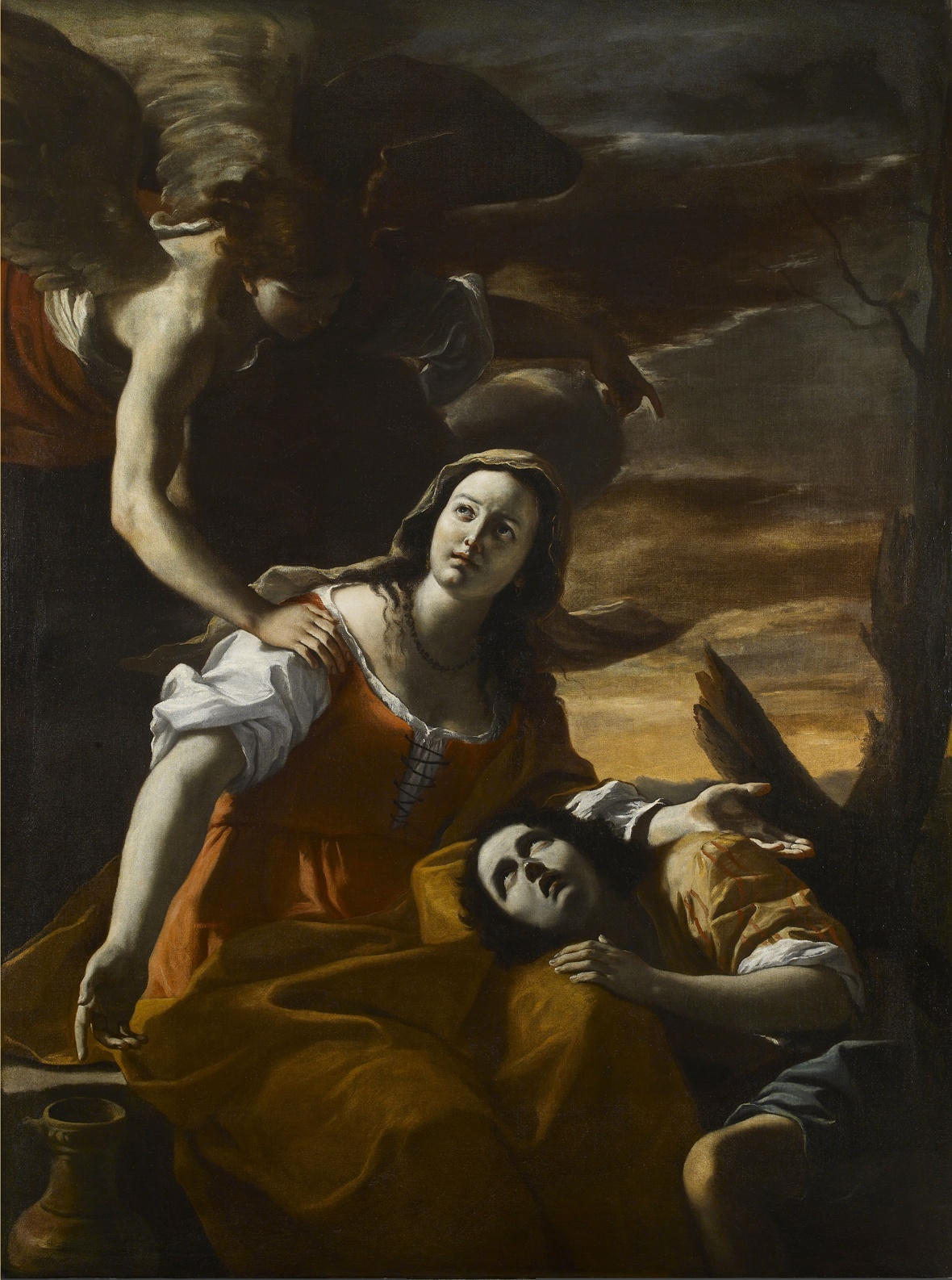
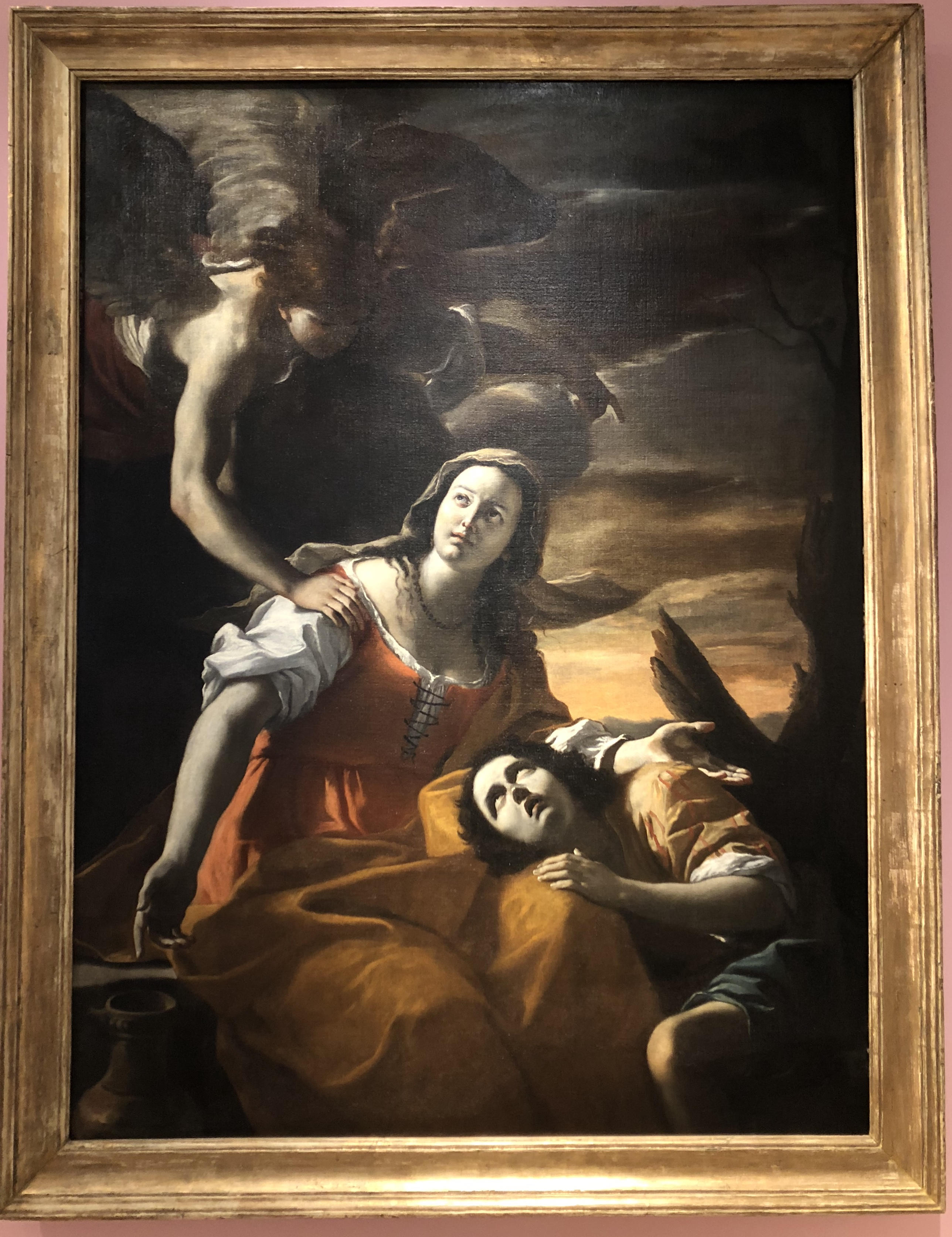
Hagar & the Angel
mid-1660s
Oil on canvas
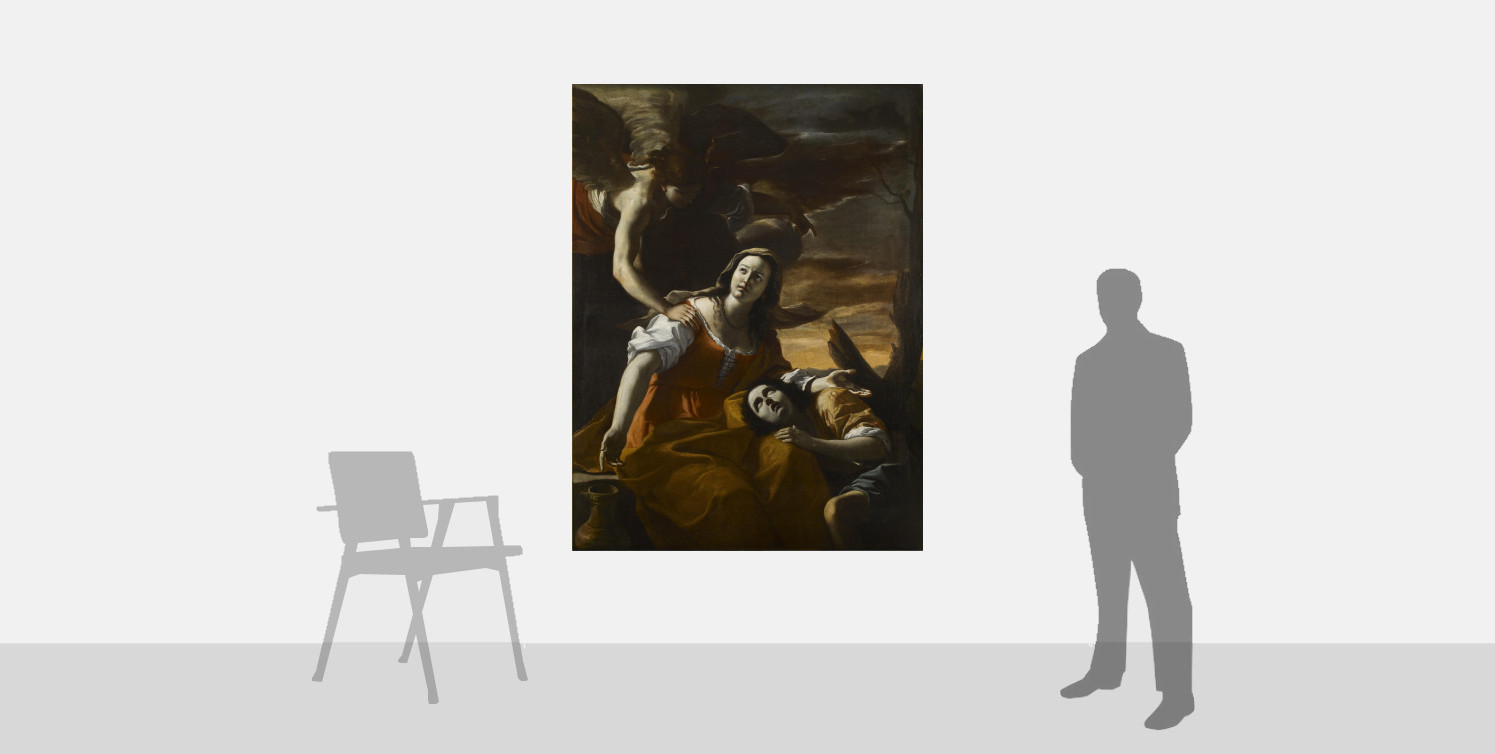
208 x 156 cm (81.9 x 61.4 in.)
Literature
S. Saponaro in Il cavalier Calabrese Mattia Preti tra Caravaggio e Luca Giordano, catalogue of the exhibition curated by V. Sgarbi – K. Sciberras, pp. 119 - 120.
Description
This painting depicts a famous story from the book of Genesis, the apparition of the angel to Hagar:
"Whilst lost in the desert of Beersheba, after being driven out of Abraham’s house, Hagar and her son Ishmael were visited by an angel: Early the next morning Abraham took some food and a skin of water and gave them to Hagar. He set them on her shoulders and then sent her off with the boy. She went on her way and wandered in the Desert of Beersheba. When the water in the skin was gone, she put the boy under one of the bushes. Then she went off and sat down about a bowshot away, for she thought, “I cannot watch the boy die.” And as she sat there, she began to sob.
God heard the boy crying, and the angel of God called to Hagar from heaven and said to her, “What is the matter, Hagar? Do not be afraid; God has heard the boy crying as he lies there. Lift the boy up and take him by the hand, for I will make him into a great nation.”
Then God opened her eyes and she saw a well of water. So she went and filled the skin with water and gave the boy a drink."(Genesis, 21, 14-19).
This episode, and the one related to it, namely The expulsion of Hagar, appear frequently in the work of Mattia Preti. A first version, which is clearly influenced by classical Bolognese painting and inspired by work he encountered in Rome in the early 1640s. Painted by the Calabrian artist in around 1643 for Prince Camillo Pamphili, nephew of Pope Innocent X, this version is still kept at the Palazzo Doria Pamphili in Rome. Interestingly Mattia Preti returns to this theme ten years later, with a painting which is compositionally very different, now part of The Bavarian State Painting Collections in Munich, in which there is clear evidence of the importance of the example of Lanfranco (fig. 1).
Our version, whose authorship has been confirmed by Professor Nicola Spinosa, can be attributed to a later period, during the mid 1660s, when Mattia Preti had recently arrived in Malta.
From a compositional point of view our work looks back to the version now in Munich which similarly shows the figures in the foreground. The light however is treated very differently, with strong rich contrasts and a predilection for iridescent, golden tones, all characteristic of the fully mature style of the Calabrian artist. It was during the period 1653 – 1660 when Preti was residing in Naples, that he created these rich masterpieces and also during his first years in Malta, where he went in September of 1661 to paint the frescos of the Life of St John The Baptist in the cathedral of St John. Despite this huge task, Preti also managed to execute numerous paintings on canvas during his first few years in Malta, amongst which is one of the works closest to Hagar & The Angel, namely the Lucretia, exhibited at Robilant + Voena in 2007 (fig. 2, cfr. N. Spinosa in Caravaggism and the Baroque in Europe, curated by A. Poggi – M. Voena, Turin 2007, pp. 52 -55). This work, which as well as having the same chromatic values, has identical measurements and a symmetry between the figures at the sides of the composition and the sky, shown striated with small, gilded grey clouds. The works have such a likeness that one is led to suppose that these were possibly painted as pendant pieces, a hypothesis which carries even greater weight given the difference of the subjects, one taken from Titus Livius and the other from Genesis.
The artwork described above is subject to changes in availability and price without prior notice.
Where applicable ARR will be added.
"Whilst lost in the desert of Beersheba, after being driven out of Abraham’s house, Hagar and her son Ishmael were visited by an angel: Early the next morning Abraham took some food and a skin of water and gave them to Hagar. He set them on her shoulders and then sent her off with the boy. She went on her way and wandered in the Desert of Beersheba. When the water in the skin was gone, she put the boy under one of the bushes. Then she went off and sat down about a bowshot away, for she thought, “I cannot watch the boy die.” And as she sat there, she began to sob.
God heard the boy crying, and the angel of God called to Hagar from heaven and said to her, “What is the matter, Hagar? Do not be afraid; God has heard the boy crying as he lies there. Lift the boy up and take him by the hand, for I will make him into a great nation.”
Then God opened her eyes and she saw a well of water. So she went and filled the skin with water and gave the boy a drink."(Genesis, 21, 14-19).
This episode, and the one related to it, namely The expulsion of Hagar, appear frequently in the work of Mattia Preti. A first version, which is clearly influenced by classical Bolognese painting and inspired by work he encountered in Rome in the early 1640s. Painted by the Calabrian artist in around 1643 for Prince Camillo Pamphili, nephew of Pope Innocent X, this version is still kept at the Palazzo Doria Pamphili in Rome. Interestingly Mattia Preti returns to this theme ten years later, with a painting which is compositionally very different, now part of The Bavarian State Painting Collections in Munich, in which there is clear evidence of the importance of the example of Lanfranco (fig. 1).
Our version, whose authorship has been confirmed by Professor Nicola Spinosa, can be attributed to a later period, during the mid 1660s, when Mattia Preti had recently arrived in Malta.
From a compositional point of view our work looks back to the version now in Munich which similarly shows the figures in the foreground. The light however is treated very differently, with strong rich contrasts and a predilection for iridescent, golden tones, all characteristic of the fully mature style of the Calabrian artist. It was during the period 1653 – 1660 when Preti was residing in Naples, that he created these rich masterpieces and also during his first years in Malta, where he went in September of 1661 to paint the frescos of the Life of St John The Baptist in the cathedral of St John. Despite this huge task, Preti also managed to execute numerous paintings on canvas during his first few years in Malta, amongst which is one of the works closest to Hagar & The Angel, namely the Lucretia, exhibited at Robilant + Voena in 2007 (fig. 2, cfr. N. Spinosa in Caravaggism and the Baroque in Europe, curated by A. Poggi – M. Voena, Turin 2007, pp. 52 -55). This work, which as well as having the same chromatic values, has identical measurements and a symmetry between the figures at the sides of the composition and the sky, shown striated with small, gilded grey clouds. The works have such a likeness that one is led to suppose that these were possibly painted as pendant pieces, a hypothesis which carries even greater weight given the difference of the subjects, one taken from Titus Livius and the other from Genesis.
The artwork described above is subject to changes in availability and price without prior notice.
Where applicable ARR will be added.