
Robert Jacques François Lefèvre
b. 1755, Bayeux, Normandy
d. 1830, Paris
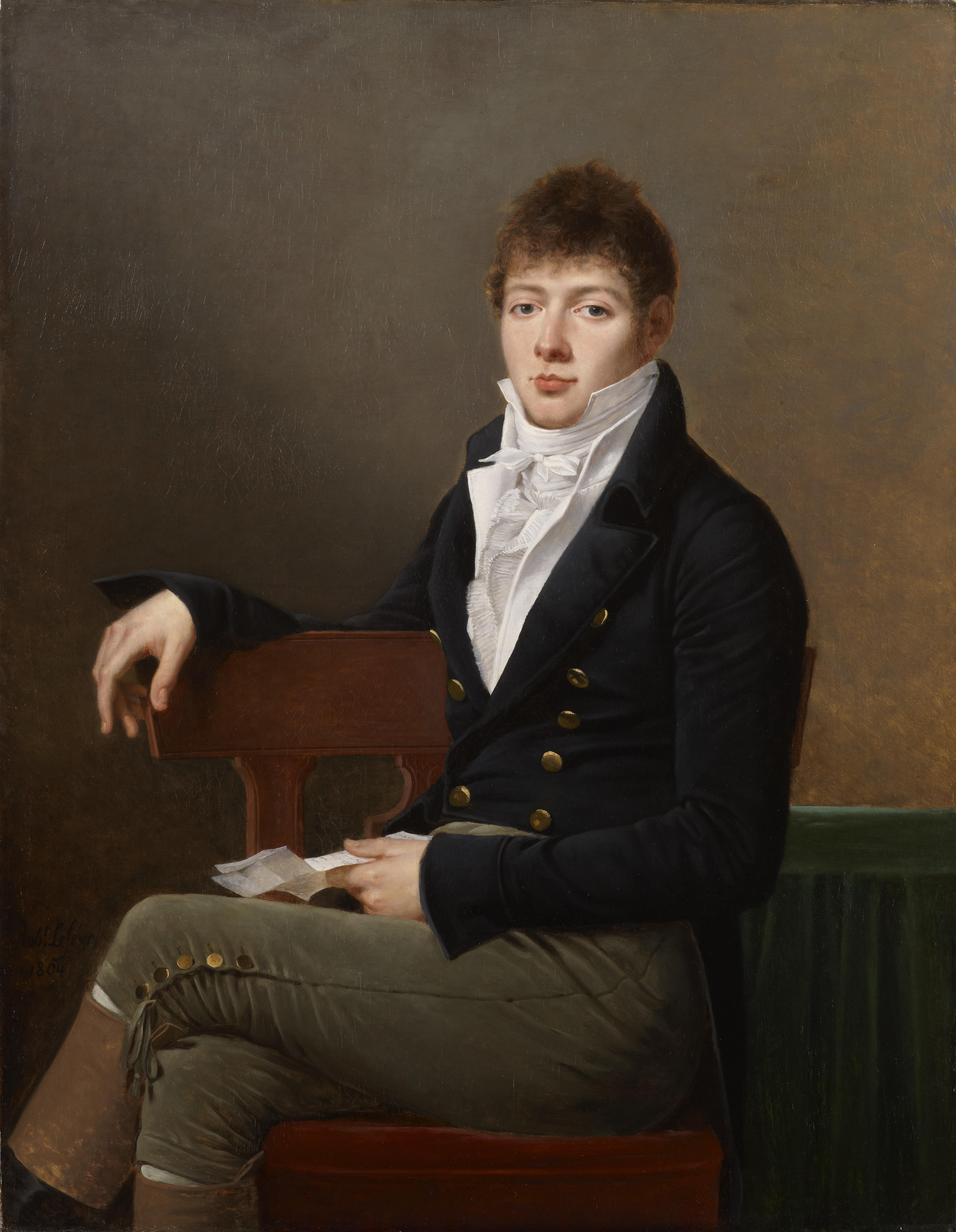
Portrait of Michael Elias Meyer
1804
Oil on canvas
116 x 89 cm (45.7 x 35 in.)
With frame: 137 x 111.7 cm (54 x 44 in.)
Provenance
By descent in the family of the sitter till sold
Lempertz, Köln, 19 November 2011, lot 1422
Private collection.
Literature
A. Galli in Portraits / Self – Portraits from the 16 th to the 21 st Century, Portraits / Self – Portraits from the 16 th to the 21 st Century, catalogue of the exhibition ed. by G.E. Sperone – M. Voena, New York 2012, pp. 74-75
K. Chrishman – Campbell in The Elegant Man, from Van Dyck to Boldini, catalogue of the exhibition ed. by C. Miner, London 2018, pp. 27, 52-53
Description
Robert Jacques François Lefèvre ranked alongside David and Gérard as one of the most celebrated and prolific French portrait painters of the Napoleonic period. Enjoying the protection and patronage of Dominique Vivant-Denon, the first director of the Louvre museum, Lefèvre became Napoleon’s official portrait painter. In addition to creating many portraits of the Emperor and the imperial family, the artist was also much in demand by the denizens of Paris society, portraying many of the most significant and stylish figures of his age. This elegant and sensitive likeness portrays the young merchant Michael Elias Meyer, who lived between Hanover and Paris.
The French Revolution incited a corresponding revolution in fashion, which had particularly lasting effects on menswear, a phenomenon the psychologist J. C. Kugel dubbed “the Great Masculine Renunciation” when men “abandoned their claim to be considered beautiful” and “aimed at only being useful.” The present portrait exemplifies the new simplicity and practicality of post-Revolutionary menswear, characterised by precise tailoring, sober colouring, and sporting influences, such as Meyer’s tall boots and tailcoat, originally designed for riding. All of these elements also attest to the widespread popularity of English culture and politics in France in the turbulent years after the Revolution, when it was observed that “the desire to imitate the English prevails alike in the cut of a coat, and the form of a constitution.” Meyer’s cropped, naturally-coloured hair marks a bold departure from the wigs and powder worn for most of the eighteenth century, evidence of the backlash against aristocratic modes and manners, as well as the vogue for art and dress in the style of the ancient Greeks and Romans, known as Neoclassicism.
The French Revolution incited a corresponding revolution in fashion, which had particularly lasting effects on menswear, a phenomenon the psychologist J. C. Kugel dubbed “the Great Masculine Renunciation” when men “abandoned their claim to be considered beautiful” and “aimed at only being useful.” The present portrait exemplifies the new simplicity and practicality of post-Revolutionary menswear, characterised by precise tailoring, sober colouring, and sporting influences, such as Meyer’s tall boots and tailcoat, originally designed for riding. All of these elements also attest to the widespread popularity of English culture and politics in France in the turbulent years after the Revolution, when it was observed that “the desire to imitate the English prevails alike in the cut of a coat, and the form of a constitution.” Meyer’s cropped, naturally-coloured hair marks a bold departure from the wigs and powder worn for most of the eighteenth century, evidence of the backlash against aristocratic modes and manners, as well as the vogue for art and dress in the style of the ancient Greeks and Romans, known as Neoclassicism.