
Carlo Bossoli
b. 1815, Lugano
d. 1884, Turin
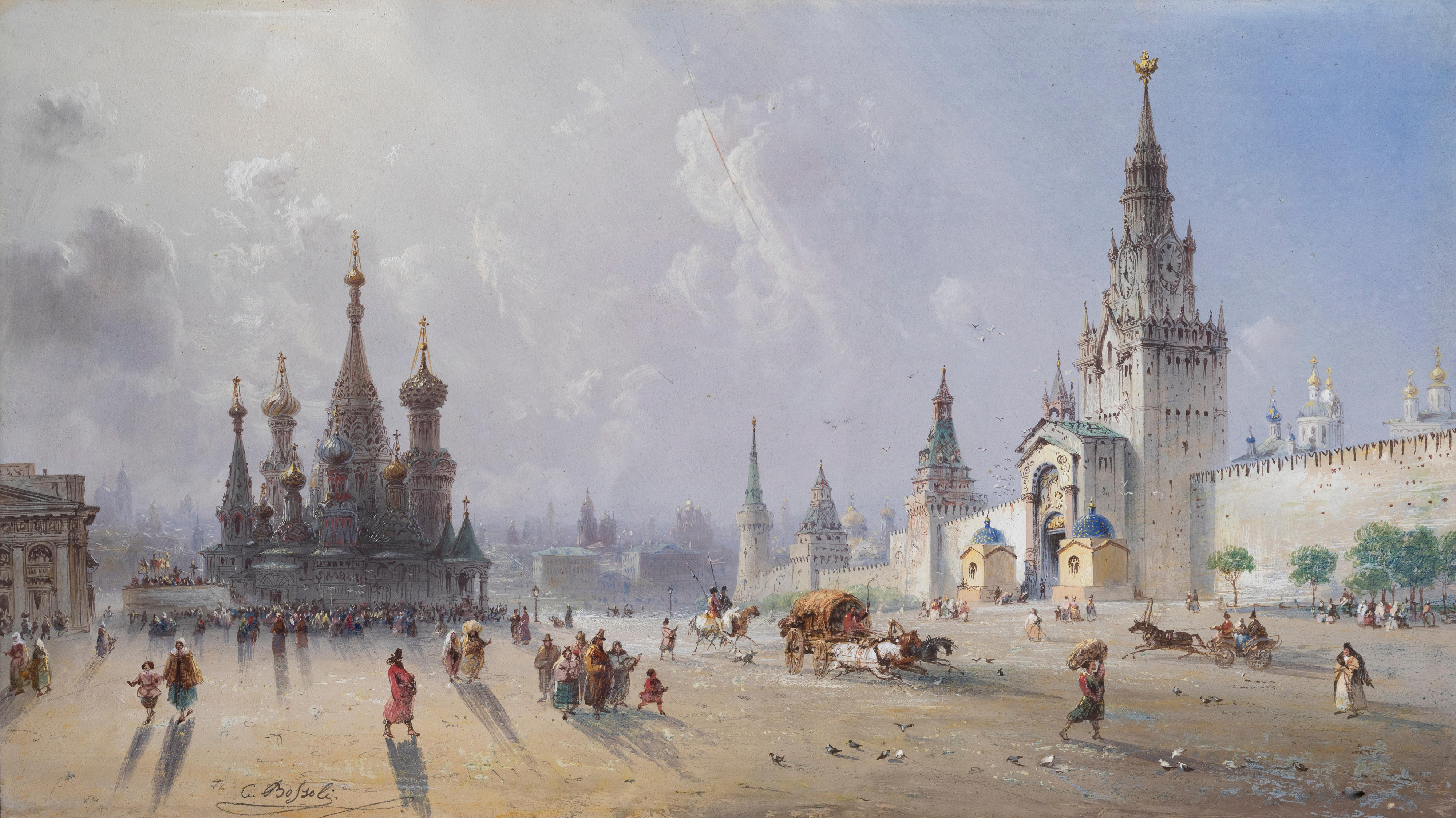
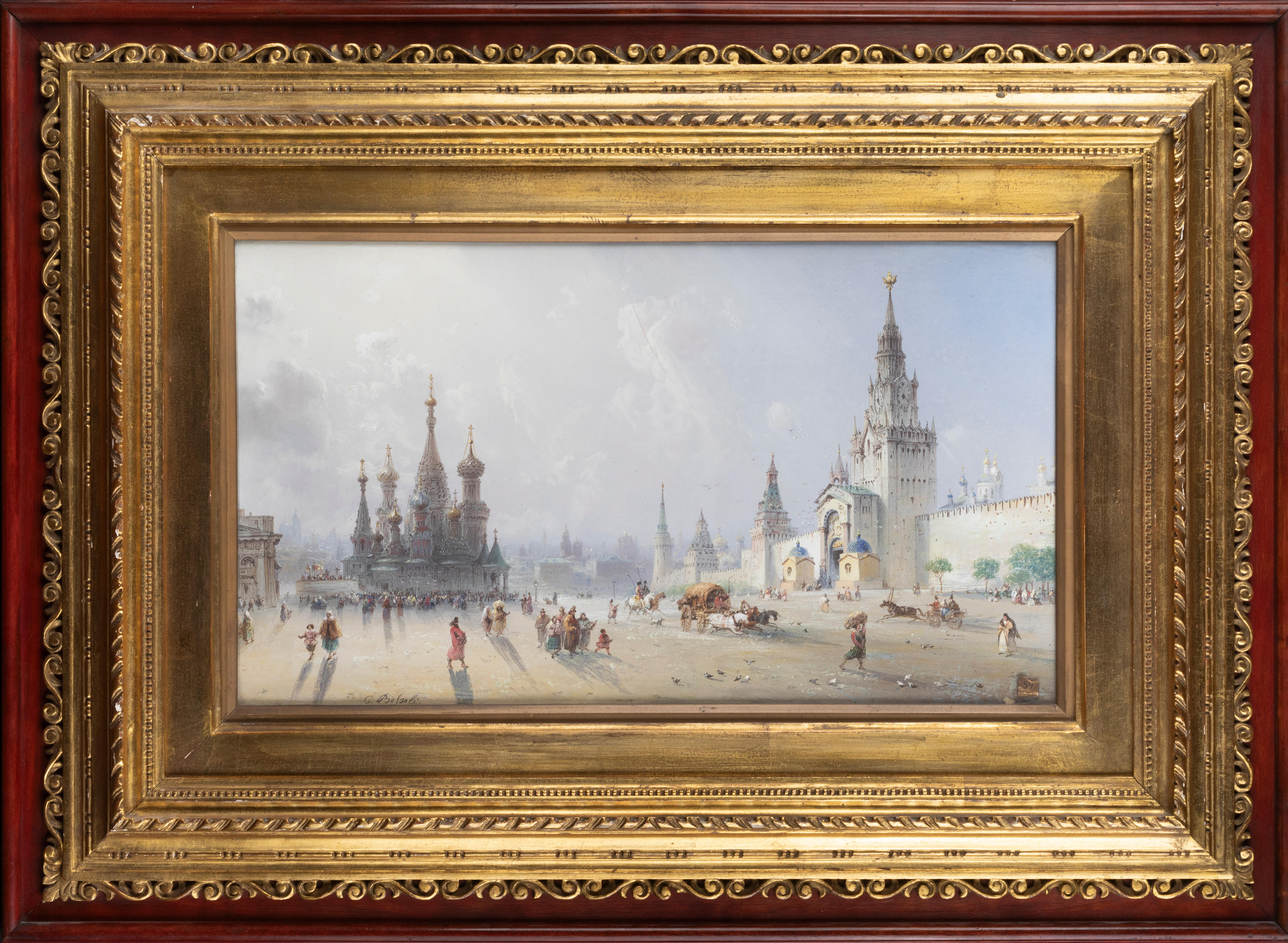
Mosca. La Piazza Rossa (Moscow. Red Square)
1857
Tempera on paper
26 x 47 cm (10 1/4 x 18 1/2 in.)
Provenance
Literature
Description
Born in Lugano in 1815, Carlo Bossoli (1815–1884) emerged as one of the foremost topographical painters in Europe in the second half of the nineteenth century. Renowned for his precise and atmospheric views, he received commissions from the most distinguished circles, among them Empress Eugénie, Prince Eugenio di Savoia-Carignano and Queen Victoria.
In 1820 the Bossoli family emigrated to Odessa in southern Ukraine, settling within the flourishing Ticinese community established there. Employed at first in a print shop, Bossoli soon devoted himself to drawing and painting. He swiftly revealed a precocious talent for topographical draughtsmanship, attracting the attention of Princess Elizaveta, whose husband, the Governor-General of Novorossiya, commissioned a series of panoramic views of Odessa. So impressed was he by the results that he sponsored Bossoli’s studies in Italy between 1839 and 1840. During this formative period Bossoli travelled to Rome and Naples, refining his watercolour and gouache technique among the painters of the School of Posillipo.
By 1853 Bossoli had settled in Turin, which remained his home for the rest of his life. The outbreak of the Crimean War in 1854 prompted him to travel to London, where his knowledge of Crimea proved highly advantageous, and enabled him to produce a series of fifty-two detailed views of the region. Between 1855 and 1859 he exhibited at the Royal Academy, and in 1857 undertook his most extensive journey, travelling through France, Belgium, Denmark, Norway, Sweden, Russia, Finland, Poland, Czechoslovakia, Germany and Switzerland, including a visit to Moscow. Each tour gave rise to a fresh body of drawings and watercolours recording the cities and landscapes he encountered.
In 1862 he was appointed Pittore Reale di Storia (History Painter to the King) by Vittorio Emanuele II, and over the course of his career he was invited to exhibit at Brera in 1845 and 1852, at the Promotrice di Belle Arti in Turin on numerous occasions between 1844 and 1884, reflecting the considerable success and sustained popularity of his work.
The present painting is a rare and finely executed view of the city of Moscow, created when Bossoli was at the height of his career, during the 1850s and early 1860s. Executed during one of his last great journeys through the Nordic countries and Central Europe, this depiction of the Red Square vividly conveys the atmosphere of nineteenth-century Moscow. The scene unfolds with meticulous topographical detail: from the right, the walls of the Kremlin guide the viewer’s gaze toward the luminous silhouette of St. Basil's Cathedral at the centre, around which a bustling crowd of animated figures gathers.
In his 1885 biography, his friend Luigi Torelli observed that Bossoli’s skills extended from the smallest miniatures, measuring only a few centimetres, to vast theatre curtains spanning hundreds of square metres. Bossoli’s unique ability to render each architectural element with absolute fidelity, allowing even the smallest details to be discerned, is particularly evident in this painting. The Kremlin’s swallowtail battlements, for instance, executed with extraordinary detail, were constructed between 1485 and 1508 after the model of the Castello Sforzesco in Milan. Such exactitude, combined with his refined treatment of light and shadow, reflects Bossoli’s extraordinary versatility in this particular work. This is also evident in the meticulous rendering of the carriage horses and the architectural details of the Spasskie Vorota, the main entrance to the Kremlin.
Moreover, the painting, described as “a poetic scene” by Ada Peyrot[1], envelops the square in a dusty haze, suggesting a sense of historical reality that almost merges with an imagined world. While several sketches of Moscow by Bossoli survive, few major painted views of the city from the 1850s are known, making this view a particular fine and rare example of his mature work. Related works include a preparatory drawing recorded by Ada Peyrot (Carlo Bossoli. Luoghi, personaggi, costumi, avvenimenti nell’Europa dell’Ottocento, visti dal pittore ticinese, Turin, 1974, vol. II, no. 785, p. 404), as well as the painting View of the Moscow Kremlin from Ustinsky Bridge, dated c. 1835–1840.
Fig. 1 - Carlo Bossoli, Study for Moscow. Red Square, pencil on paper.
Fig. 2 - Carlo Bossoli, View of the Moscow Kremlin from Ustinsky Bridge, c. 1835-1840, 104 x 206 cm, tempera on canvas.
[1] A. Peyrot, Carlo Bossoli. Luoghi, personaggi, costumi, avvenimenti nell’Europa dell’Ottocento, visti dal pittore ticinese, Turin, 1974, vol. II, no. 786, p. 404.