
Joshua Reynolds
b. 1723, Plympton
d. 1792, London
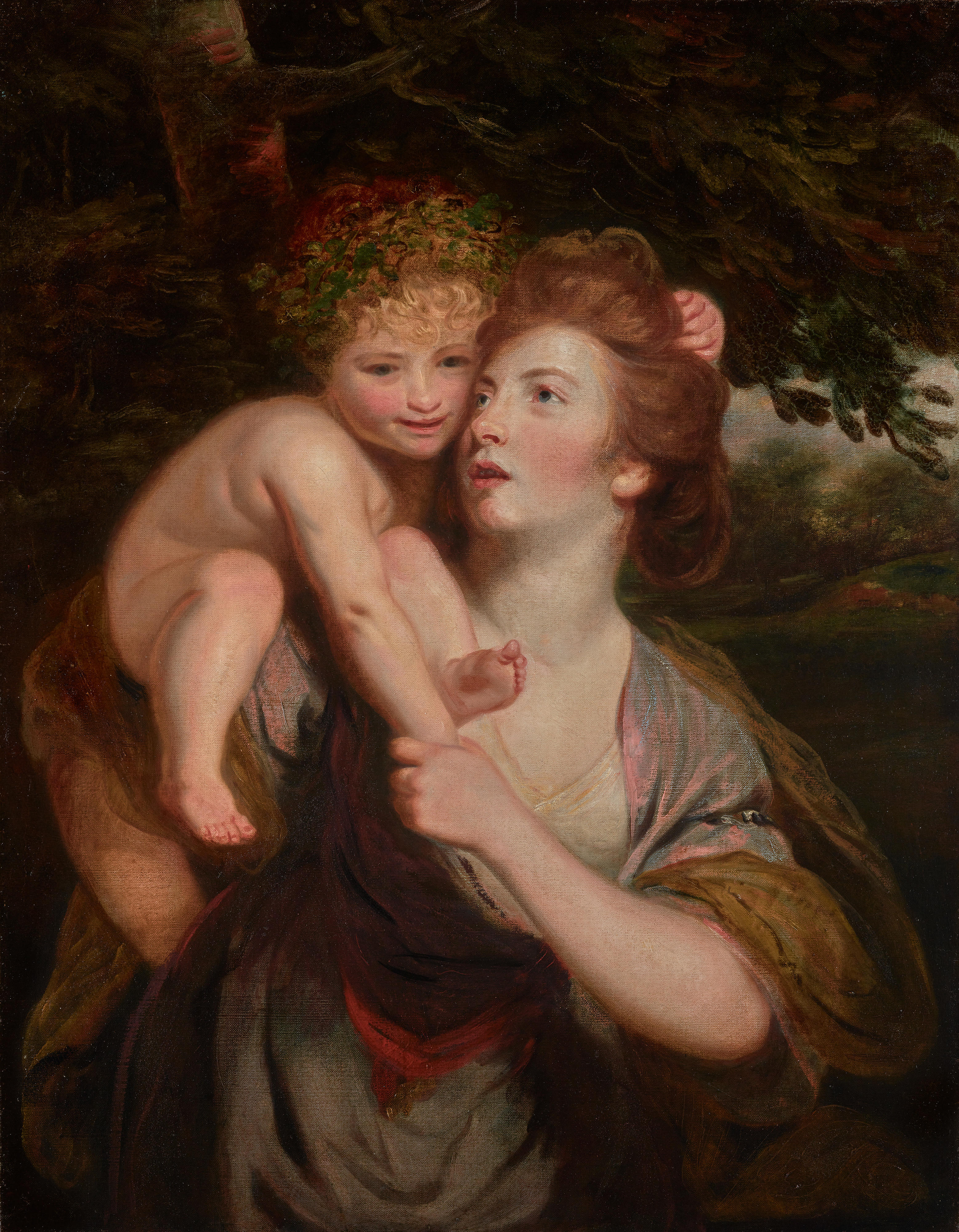
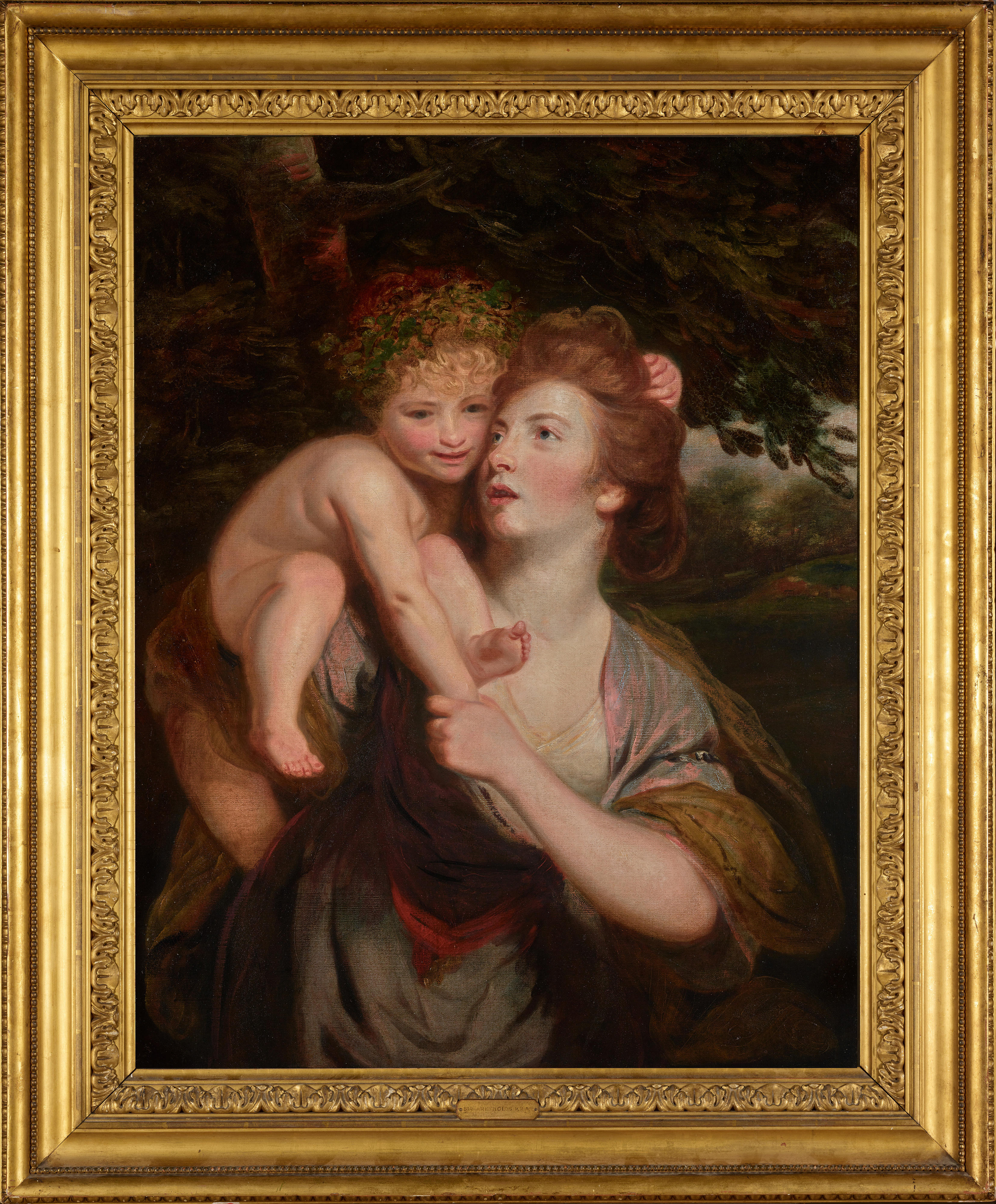
Mrs Hartley as a Nymph with the Young Bacchus
c. 1774
Oil on canvas
91.6 x 71.8 cm (36 x 28 1/4 in.)
Framed: 116.3 x 96.4 cm (45 3/4 x 38 in.)
Provenance
Sir Joshua Reynolds and by descent to his niece Mary, Marchioness of Thomond (1751–1820),
Her sale, Christie’s London 18 May 1821, lot 67, where purchased by,
Colonel Fulke G. Howard, by descent to,
His widow, the Hon. Mrs. Greville Howard at Ashfield Park, Surrey,
Sale (consigned by the above), Christie’s London, 4 July 1874, lot 80 as “Sir J. Reynolds, Mrs. Hartley and Child – the celebrated work. Engraved by S. W. Reynolds”, where purchased by Agnews for £2,520 (Stock Book 3, no. 8878),
with Agnews, by whom sold on 4 August 1874 to,
Richard Johnson,
Collection of Capt. Walsh (according to Christie’s 1928 catalogue).
Mrs. R.J. Walker, Bramshott Court, Liphook, Hants,
Her sale, Christie’s, 8 June 1928, lot 125 as “Sir Joshua Reynolds, P.R.A. Portrait of Mrs. Hartley and Child, in slate coloured dress, with white chemisette, red sash and brown scarf; carrying her child on her right shoulder”;
unsold, and by descent to,
Bernard Kelly.
Literature
A. Graves & W. V. Cronin, A history of the works of Sir Joshua Reynolds, 4 vols, London, 1899–1901, vol. 2, pp. 446-447.
D. Mannings, Sir Joshua Reynolds, A complete catalogue of his paintings, New Haven, 2000, pp. 245–246, no. 854 a & d.
Description
Elizabeth Hartley (née White) (c. 1750 – 1824) was a celebrated actress who appeared on stage in the 1770s, having a successful career that was possibly cut short by ill health. She was famed for her beauty, and – in addition to Reynolds – sat for artists including George Romney, John Keyse Sherwin and Angelica Kauffman (Kauffman’s painting of Hartley in the guise of Hermione from The Winter’s Tale is today in the collections of the Garrick Club, fig. 1). Many of these pictures show Hartley in various roles for which she was famous, or in mythological guises, as is the case with our painting.
Hartley was the daughter of James and Eleanor White of Berrow, Somerset and sister-in-law of Sir Henry Bate Dudley. It is unclear to whom she was married, if at all, but by 1771, she had adopted the name Hartley, when she was first recorded as appearing on stage in Edinburgh on 4 December of that year. The following year, she moved to Bristol, by which time her reputation had reached the ears of David Garrick, who commissioned the actor John Moody to attend a performance by her and report back. Moody wrote, on 20 July 1772:
‘Mrs. Hartley is a good figure, with a handsome, small face, and very much freckled; her hair red, and her neck and shoulders well turned. There is not the least harmony in her voice, but when forced (which she never fails to do on every occasion) is loud and strong, but such an inarticulate gabble that you must be well acquainted with her part to understand her.’
(The private correspondence of David Garrick : with the most celebrated persons of his time, London, 1835, I, p. 476)
Notwithstanding this suboptimal review, she shortly moved to London, where she made her debut at the Covent Garden Theatre on 5 October 1772, and where she would appear in numerous roles until 1780. She also performed at Drury Lane, in Stroud and in Liverpool. She retired from the stage after the 1779-80 season, after which little is known about her life; she died in 1824 and was buried in the Union Chapel.
The present painting depicts Hartley as a nymph, with a young Bacchus on her shoulder. It is a beautiful version of a painting today in the collections of the Tate, London (exhibited in 1773 as 'Nymph with young Bacchus, portrait of Mrs Hartley, and child' when Hartley was at the height of her fame in London, fig. 2). The composition is loosely based on Michelangelo’s Doni Tondo, today in the Gallerie degli Uffizi, Florence, as suggested by Edgar Wind (fig. 3).
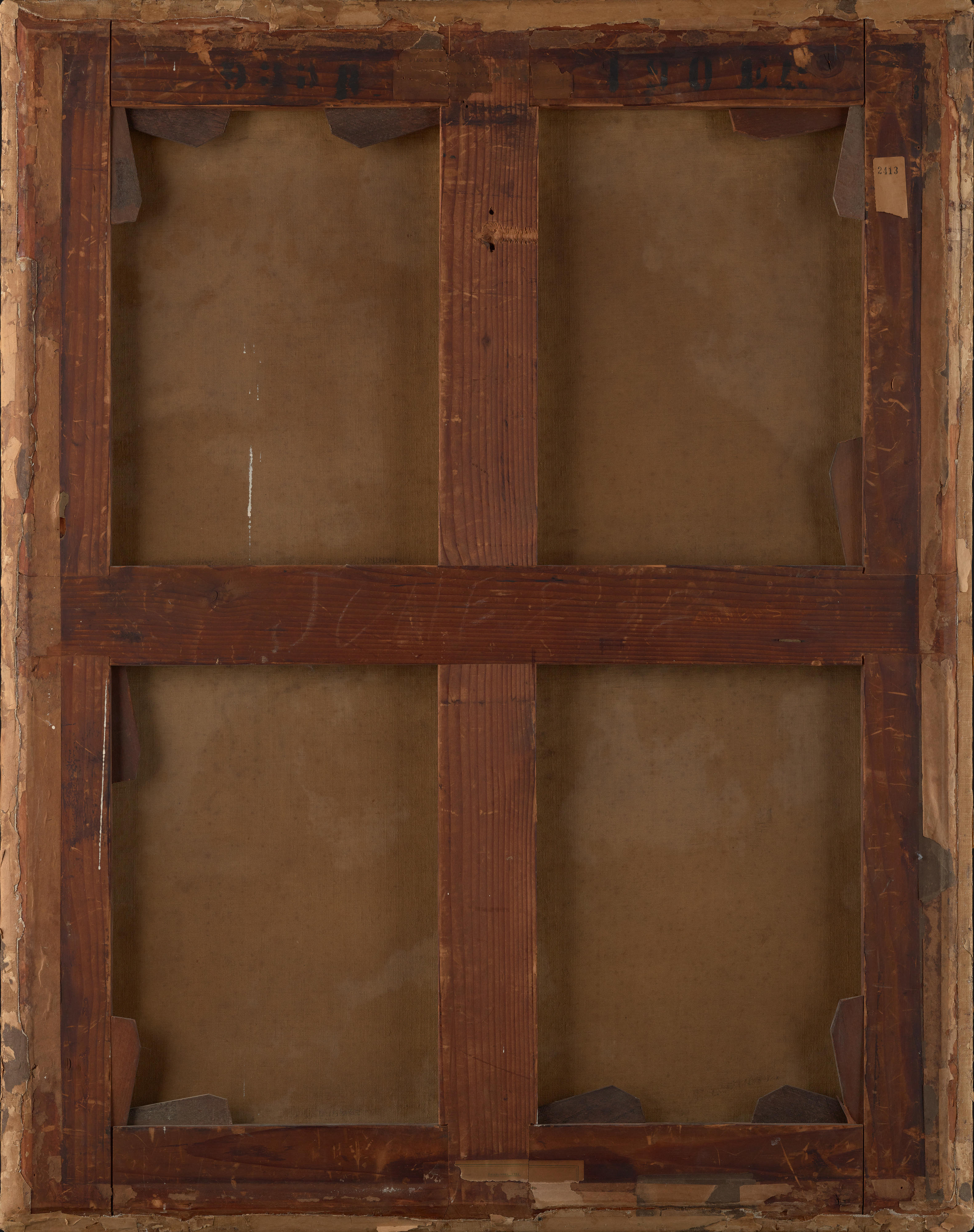
Although the Tate painting is almost certainly the initial version, our painting was engraved by William Nutter in 1801 as ‘the original’, reflecting its importance in Reynolds’ oeuvre (fig. 4). Indeed, the painting remained in the artist's possession until his death, indicating his high regard for the picture. The provenance of the painting, however, has been somewhat confused in the literature. Our painting is recorded twice in David Mannings’ catalogue raisonné on the artist under both 854a and 854d (which in fact both refer to our painting), with slightly different dimensions in each entry. Mannings did not have access to the reverse of the present painting and noted that some of the entries listed could refer to the same picture. Recently, it has been discovered that the stretcher bears the stencil numbers 993B and 190ER as well as the chalk mark “June 8/28”. These relate to the Christie’s sales on 18 May 1821 and 8 June 1928, giving a clearer picture of the provenance and thereby confirming that the two entries mentioned above in fact relate to this single painting (these sales are listed separately under 854a and 854d in Mannings). For the four possible versions listed in Mannings which are listed: (854) the Tate version, gifted by William Bart Agnew to the Nation; (854a) is the present painting; (854b) is incorrectly identified and is a different composition of a Satyr and Bacchante sold in the Thomond Sale as lot 24; (854c) is a 19th-Century copy of this painting in the Sudeley Castle Collection; (854d) is also the presentpainting. Further documentation about the history of the painting is preserved in the Agnews archive, who were in possession of both the present painting and the Tate painting simultaneously in 1874.
This portrait was recently viewed in person by leading Reynolds expert Martin Postle, Senior Research Fellow and the Paul Mellon Centre and author of Joshua Reynolds. The Subject Pictures (1995), who confirmed it as an autograph work by Reynolds.
Fig. 1 – Angelica Kauffman, Elizabeth Hartley, oil on canvas, 204.2 x 130.8 cm. The Garrick Club, London.
Fig. 2 – Joshua Reynolds, Mrs Hartley as a Nymph with a Young Bacchus, exhibited 1773, oil on canvas, 88.9 x 68.6 cm. Tate Collections, London.
Fig. 3 – Michelangelo Buonarotti, Holy Family, known as the Doni Tondo, 1505-6, tempera grassa on wood, 120 cm diameter. Le Gallerie degli Uffizi, Florence.