
Lucio Fontana
b. 1899, Rosario de Santa Fé, Argentina
d. 1968, Comabbio, Italy
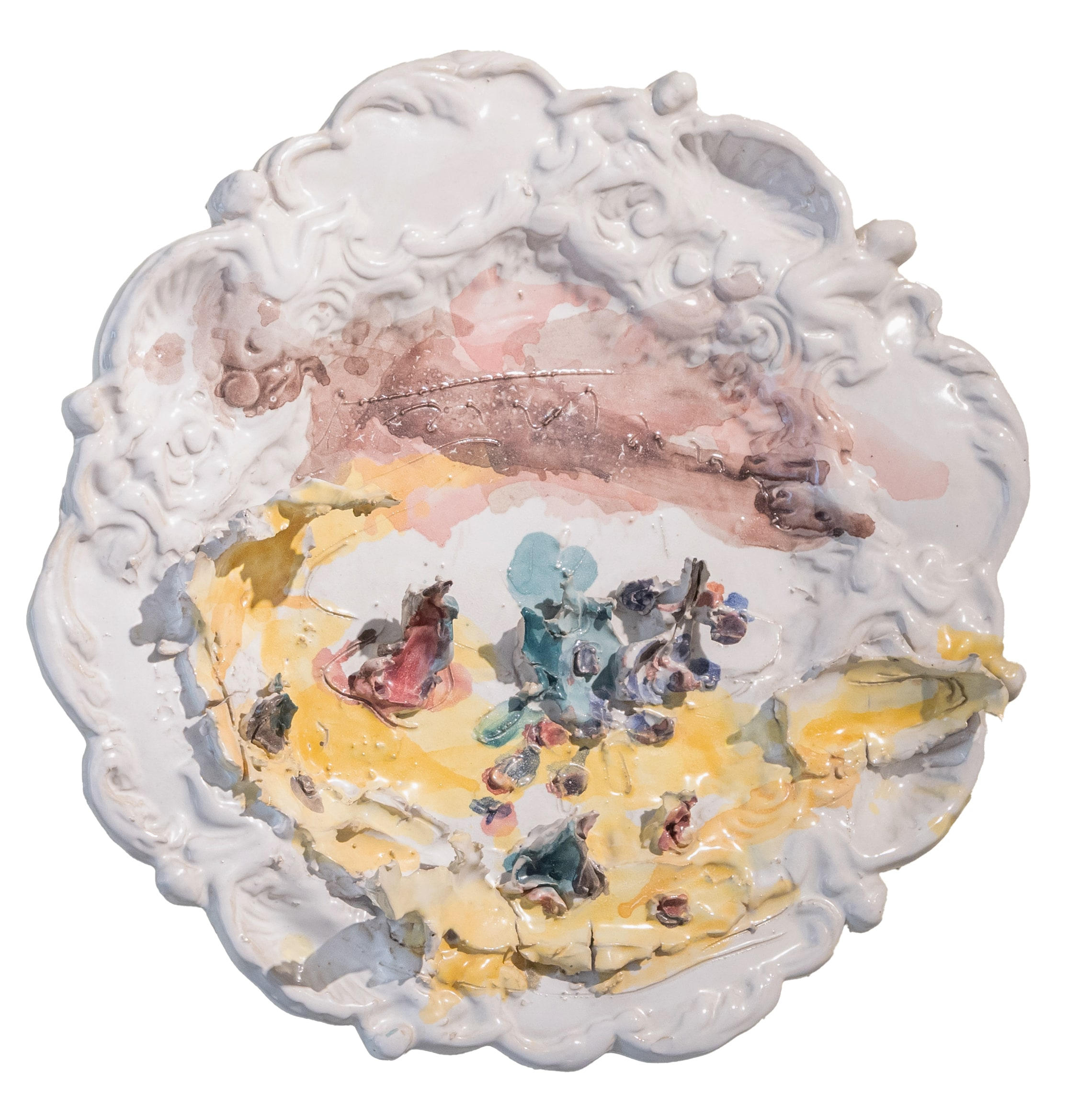
Natura Morta (Still Life)
1955
Painted and glazed terracotta
Diameter: 49 cm (19 1/4 in.)
Provenance
Private collection, Milan.
Literature
Description
‘Io sono uno scultore e non un ceramista.’
(I am a sculptor and not a ceramicist.)
Lucio Fontana, ‘La mia ceramica’, in Tempo, 21 September 1939
In recent years, the importance of Lucio Fontana's ceramic works as a vital element of his oeuvre has become increasingly widely recognised; indeed, these works are fundamental to understanding his artistic contribution, especially given that Fontana began his career as a sculptor. As a young man, he worked for his father's firm creating funerary busts from materials like plaster and marble, and in 1928 he began studying sculpture at the Accademia di Belle Arti di Brera, working in the traditional academic manner.
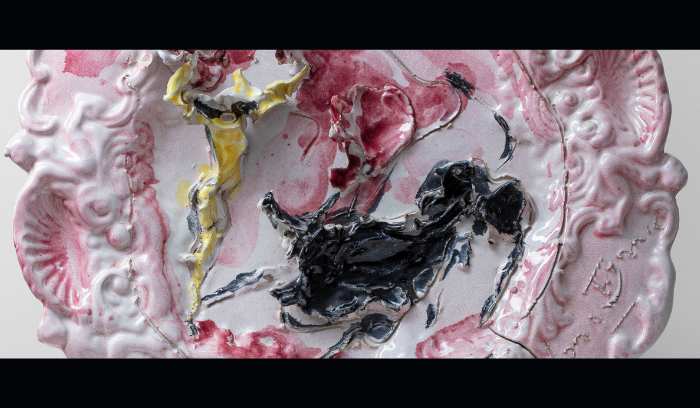
Fontana soon abandoned the classical idiom prescribed by the academy and began to explore sculpture-making more freely; in 1935, Fontana started working in the workshop of the Futurist ceramicist Tullio Mazzotti in the small town of Albisola. Vividly animating and rupturing the space around them, Fontana’s expressive, luminously coloured ceramics, both abstract and figurative, are among the artist’s most innovative and experimental works, at once gestural performances of artmaking and meditations upon its infinite potential.
This Natura Morta (Still Life), dating from 1955, sits somewhere on the boundary between object, sculpture and painting. It demonstrates the artist’s unique manifestation of the sculptural medium, not merely accepting the surface of the plate as a two-dimensional entity on which to paint his subject, but rather transforming the ceramic into both painting, subject and object, moulding three-dimensional forms that seem to burst forth and defy the confines of the traditional surface.
This sculpture is particularly noteworthy as it belongs to a specific group of ceramics that the artist created between 1949 and 1959, known as Antica or Vecchia Savona plates, and categorised in the catalogue raisonné as Figurativi Piatti Vecchia Savona. To create these unique pieces, of which only seven were executed in 1955, Fontana used existing moulds from various pottery workshops in Albisola and the Savona region, and radically changed their traditional decorative form, innovating through dynamic gestural handling of the clay. This seamless blending of his Spatialist ideas with an ancient process and traditional forms constituted what Luca Massimo Barbero described as ‘a significant technical and conceptual innovation into the creation of his plates’ (L. Massimo Barbero, Lucio Fontana. Catalogo ragionato delle sculture ceramiche, I, Milan, 2022, p. 85).
The subject of the still life, as in this example, further underscores the dialogue with historical precedent that Fontana engenders, approaching the timeless genre from a revolutionary Spatialist angle. The forms of the still life, verging on abstraction, speak both to a Baroque history and to the latest innovations of Fontana’s own day. Moulding the clay by hand, the artist is able to convey a detailed delicacy while remaining intensely tactile, the forms accentuated by the rich application of paint.
The present work was previously in the collections of the important furniture design company Arredimenti Borsani, Milan; the founder of which, Osvaldo Borsani, had a close friendship with Lucio Fontana, having first met while studying at the Accademia di Brera in Milan, and with whom he collaborated with on several design projects.