

Andy Warhol
b. 1928, Pittsburgh, PA, USA
d. 1987, New York, NY, USA
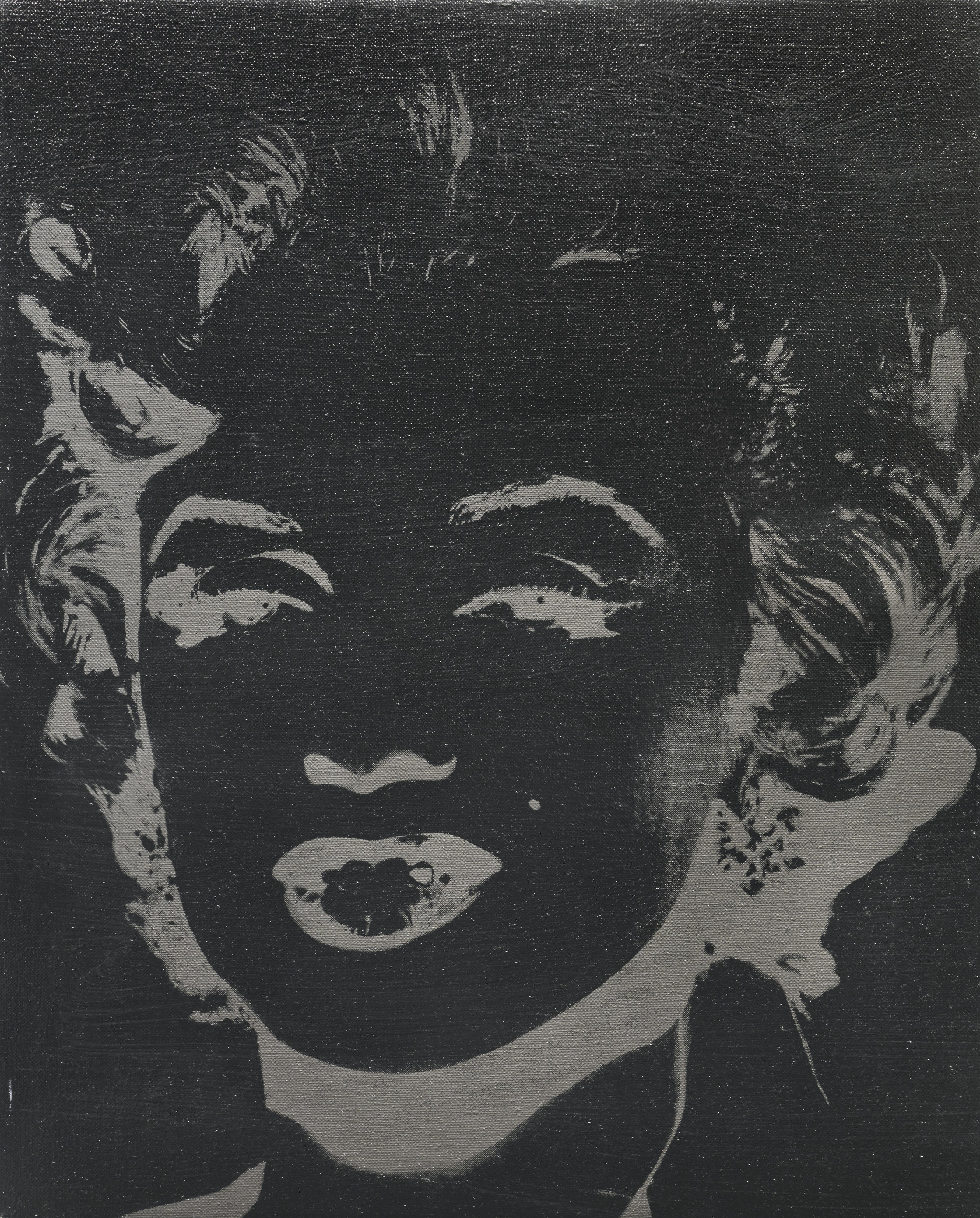
One Grey Marilyn
1986
Acrylic and silkscreen ink on canvas
45.6 x 35.4 cm (18 x 14 in.)
Provenance
with Staley-Wise Gallery, 1999,
Private collection.
Description
Emblematic of twentieth-century popular culture, Andy Warhol’s One Grey Marilyn is a study in contemporary iconography, an important homage to a commercial and fame-driven society captured through Warhol’s lens. Revisiting arguably his most renowned subject over two decades after portraying America’s femme fatale for the first time in 1962, Warhol reimagines Marilyn Monroe’s iconic beauty in sombre monochrome. The work reflects not only the end of the colourful age of disco, but also the artist’s desire to distinguish this later body of work from his earlier, boldly coloured silkscreen depictions of the actress. As the artist himself noted, ‘They always say that time changes things, but you actually have to change them yourself’ (quoted in K. Honnef, Andy Warhol 1928–1987 Commerce into Art, Cologne, 2000, p. 90). One Grey Marilyn is, then, the manifestation of this Warholian philosophy; in transforming the visual motifs that came to define the genre of Pop Art, Warhol reinvented himself and his work, once again exhibiting the artistic bravado that helped to establish his own cultural legacy.
Immortalising one of Hollywood’s most beloved and tragic figures, Warhol’s fascination with Marilyn Monroe extended beyond her celebrity and striking beauty. Considering the actress a kindred spirit whose talent was often underestimated by her peers, Warhol eschewed this prefabricated reputation, instead manufacturing a legacy of his own for Monroe, and in turn, creating one of the most enduring images of his career. Describing his enchantment with the legend and her persona, in 1966 Warhol explained, ‘As for whether it’s symbolical to paint Marilyn in such violent colours: it’s beauty, and she’s beautiful…’
Warhol returned to his images of the screen beauty throughout his career, rendering her broad lips and seductive gaze in the neon colours of Pop Art – a marked break from his New York School predecessors that ushered into the broader American consciousness the recognition of a new, artistic representation of commerciality. Re-examining his own imagery in the late 1970s, Warhol became acutely aware of his own celebrity and his role in the saturation of contemporary culture. Exploiting the visual discourse manufactured in the 1950s and 1960s, Warhol revived and inverted the colours of the his Pop Art subjects – from his own portrait to the pervasive Campbell’s soup cans – producing reimagined icons in the negative, as in One Grey Marilyn.
A ghostly rendering of an already iconic image, One Grey Marilyn is Warhol’s transfiguration of the Hollywood star in an inverted palette, relying upon the dark negative space of the canvas to recapture Monroe’s glamour. Elaborating upon the philosophy behind the production of his silkscreens, and the later Reversals, the artist noted in 1975: ‘I really believe in empty spaces, although, as an artist, I make a lot of junk. Empty space is never-wasted space. Wasted space is any space that has art in it. An artist is somebody who produces things that people don’t need to have but that he, for some reason, thinks it would be a good idea to give them.’
In One Grey Marilyn, the absence of colour intimates the legacy of a fallen idol, now etched into the collective memory of a bygone era: a shadow of her former self, the colours – or lack thereof – call forth the mystery and tragedy of Monroe’s persona. In this sense, Warhol invites us into his psyche, and that of his subject: ‘Warhol’s Reversals recapitulate his portraits of famous faces…but with the tonal values reversed. As if the spectator were looking at photographic negatives, highlighted faces have gone dark while former shadows now rush forward in electric hues. The reversed Marilyns, especially, have a lurid otherworldly glow, as if illuminated by internal footlights’. (D. Bourdon, Warhol, New York, 1989, p. 378).
Though One Grey Marilyn references the now ubiquitous publicity shot of Monroe used for her 1953 film Niagara, Warhol introduces his reversed version of this image with both irreverence for the past and anticipation of the future. Questioning the nature of art, particularly the self-referential implications of Pop Art, Warhol blatantly refuted the notion that his mass-produced images and vibrant reproductions of the mundane be elevated to the strata of ‘high art’; immediately accessible and created en masse, the broad recognition that Warhol’s work received only encouraged the artist to reinterpret his past vision. The genesis of his work, from appropriation to re-appropriation, the quotidian to the extraordinary, poetically culminates where his iconography began: with Monroe. Perhaps the most recognisable beauty of the twentieth century, Monroe was part muse, part cultural commentary for Warhol. It is then fitting that the spectral One Grey Marilyn, a simultaneously haunting and dynamic impression of the screen siren, represents not only the cultural zeitgeist of a generation, but the artistic apex of one of the twentieth century’s most influential innovators, ushering into our consciousness a renewed understanding of past and present.