
Fernand Léger
b. 1881, Argentan
d. 1955, Gif-sur-Yvette
Composition Murale (Mural Composition)
1953
Oil on canvas
146.4 x 96.5 cm (57 5/8 x 38 in.)
Provenance
Private collection.
Literature
Description
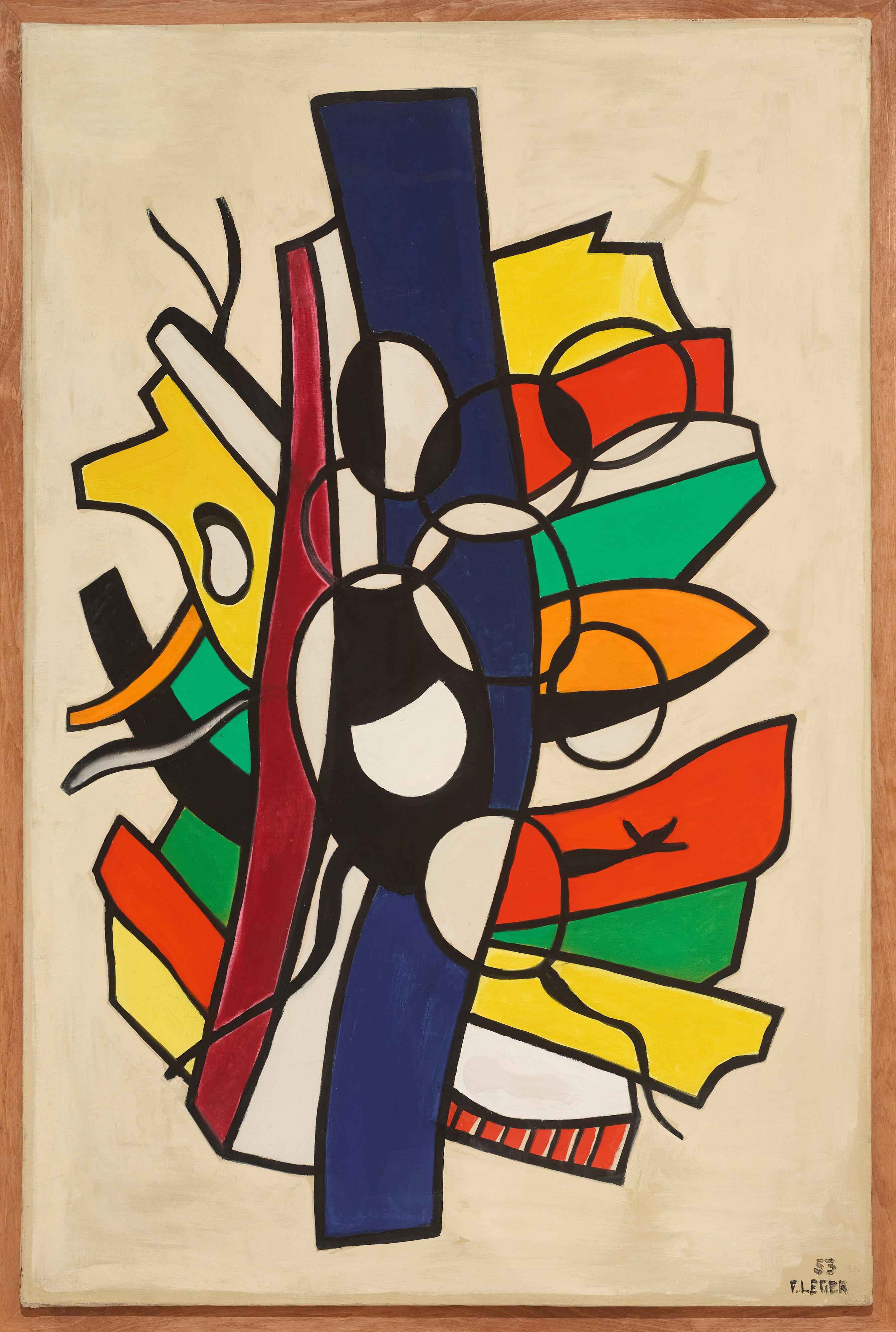
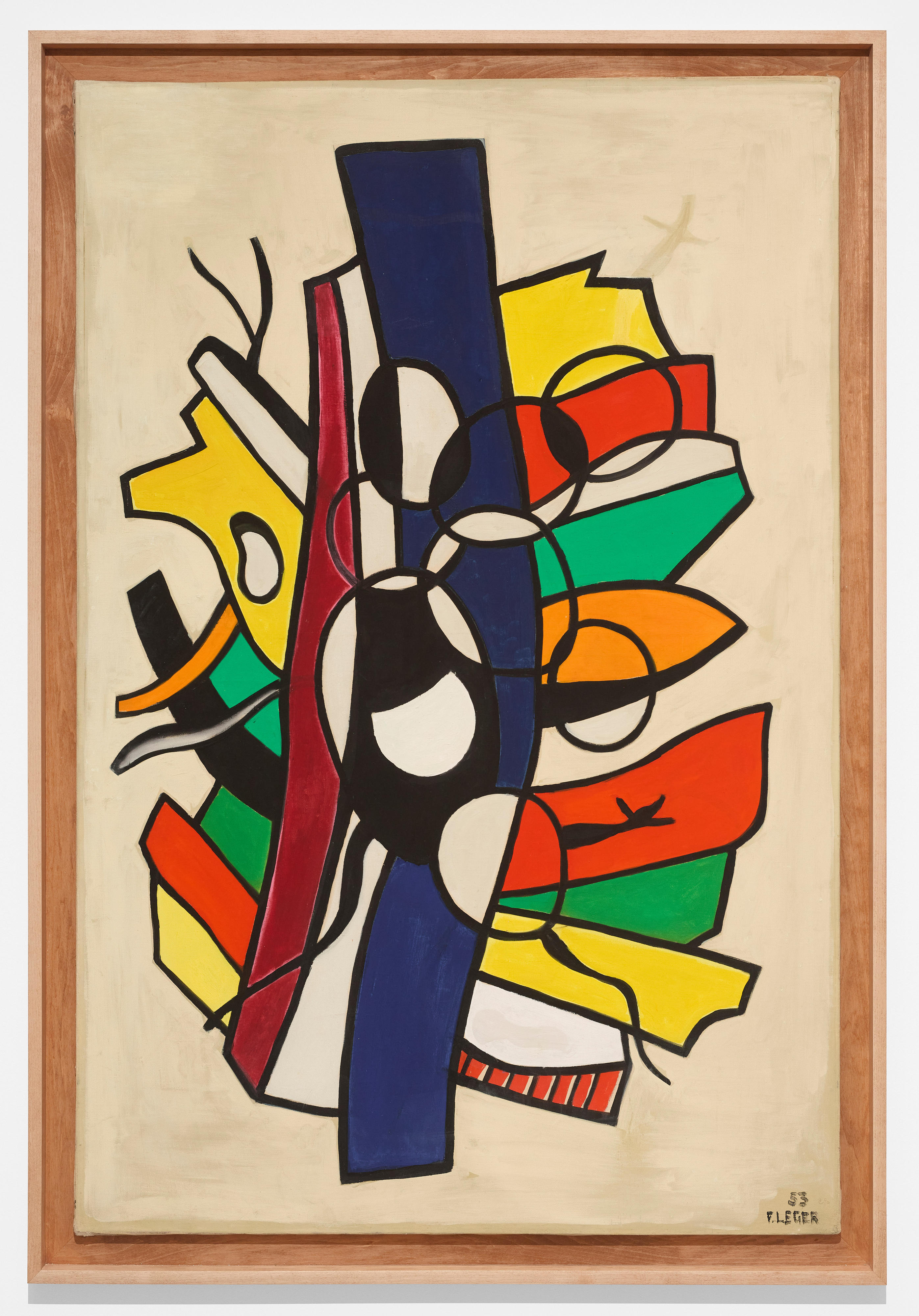
In 1952 and 1953 Léger painted several variations of Composition murale; the present example is notable for its large scale and particularly vivid hues, embodying the artist’s great mastery of colour throughout his oeuvre. The large and varied group of works depicting such compositions, of which the present oil is among the most tonally rich whilst still incorporating many of the artist’s signature forms and motifs, were related to monumental decorative projects, such as the large-scale mosaic mural at the Léger Museum, Biot, initially designed by Léger for Hanover’s stadium, but never realised (see fig. 1). Certain forms in Composition murale can be directly compared to elements in the Museum’s mural, as well as to passages in the mosaic’s façade (fig. 2) based upon compositions by Léger relating to creation for the Milan Triennale in 1951 (fig. 3) and the decoration of Caracas University in 1954 (fig. 4). The tall slender tube-like blue form extending vertically across the centre of the canvas echoes the same rich blue shape found in the design for the Milan Triennale project, and the irregular horizontal forms of pure colour delineated in black can be found referenced in both the Biot and Caracas mosaics.
The large blocks of solid pigment in the present work exemplify Léger’s belief in the key role of pure colour in his painting. Rather than representing a likeness of the world surrounding him, the artist used patches of colour that seemingly branch outward from the composition’s main artery. This conception was characteristic of his later years, during which he sought to create new spatial relationships within the two-dimensional plane of the canvas. While often considered alongside Georges Braque and Pablo Picasso as one of the artists instrumental in the development of Cubism, Léger invented a wholly unique abstract vocabulary using primary colours and disjointed, rounded forms, termed ‘Tubism’ by the critic Louis Vauxcelles in 1911. Composition murale demonstrates the mature manifestation of Léger’s singular artistic language, which during the last decade of his life, the artist increasingly translated into immense public works.
The present painting is perhaps best described by the artist himself: in 1950, Léger wrote: ‘The plastic life, the picture, is made up of harmonious relationships among volumes, lines, and colours. These are the three forces that must govern works of art. If, in organising these three elements harmoniously, one finds that objects, elements of reality, can enter into the composition, it may be better and may give the work more richness’ (quoted in C. Lanchner, Fernand Léger, New York, 1998, p. 247). Composition murale clearly exhibits all three of the ‘forces’ named by Léger, creating a work that is a veritable paragon of the artistic vision in his later years.
Fig. 1. After a design by Fernand Léger, mosaic mural at the Musée National Fernand Léger, Biot, completed 1955.
Fig. 2. After a design for the Milan Triennale 1951 by Fernand Léger, mosaic mural at the Musée National Fernand Léger, Biot, completed c. 1987-90.
Fig. 3. Fernand Léger, design for the Milan Triennale, 1951. Musée National de Fernand Léger, Biot.
Fig. 4. Fernand Léger, mosaic mural at Caracas University, Venezuela, 1954.