
Grace Gassette
b. 1871, Chicago, IL, USA
d. 1955, Woodstock, VT, USA
Portrait of a Lady
1907
Oil on canvas
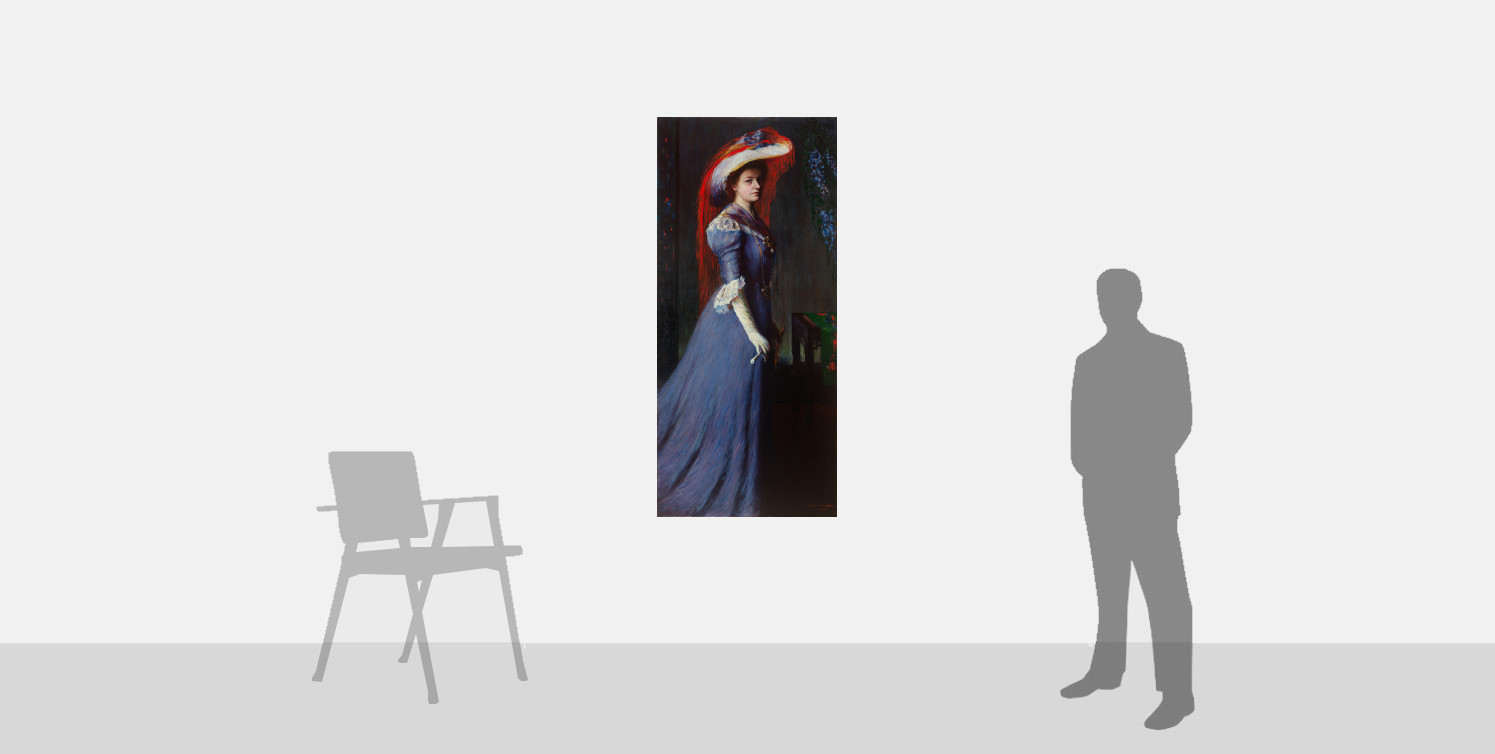
177.8 x 80 cm (70 x 31 1/2 in)
With frame: 201 x 102 x 8 cm (79 1/8 x 40 1/8 x 3 1/8 in.)
Provenance
Barbara and Martin Zweig, acquired from the above in 1987.
Description
Grace Gassette was born in Chicago, Illinois, in 1871. Norman Theodore Gassette, her father, was a prominent businessman and veteran of the American Civil War. Her mother, Martha Graves Gassette, died in 1873, and Grace, along with her brother Wirt Knickerbocker Gassette, was raised from childhood by her stepmother, Amelia Boggs Gassette. As a young woman, Grace was a well known figure in Chicago society. The president of the Young Fortnightly Club, a social, literary, and philanthropic circle founded in 1891, later in the decade, she became a founding member of the Women’s Athletic Club of Chicago, founded in 1898.
Gassette was also a budding artist, and in 1898 she exhibited a portrait of her stepmother in the Champs Elysées salon in Paris. By the following year, she had relocated to the French capital, and her entry to the 1899 Salon, a miniature portrait of a Miss Morris, records her residing in the rue Boissonade in Montparnasse, and notes that she was studying with the academic painter Raphaël Collin. A few years later, around 1906, she made the acquaintance of her fellow expatriate painter Mary Cassatt, who became a significant mentor—Gassette penned an article about Cassatt for the Chicago Post, and would later list as her teacher in the catalogues of exhibitions she entered.
Throughout the first decade of the 1900s and up until the outbreak of World War I, Gassette travelled back and forth between Paris and America, exhibiting her works in both her native and adoptive countries. She entered works into the Paris salons of 1903, 1909, and 1910, and her paintings were presented in America at the Eighteenth Annual Fine Art Exhibition in Chicago in 1905 and the Carnegie Institute’s Annual International Exhibitions in Pittsburgh in 1905 and 1907, among others. In 1910, her portrait Helen from the collection of Mr. Granger Farwell was exhibited in a loan exhibition at the Art Institute of Chicago. An article in the New York Times in 1910 notes that following an exhibition of nine of her paintings at the Women’s Lyceum Club in Paris, she planned to return to America to undertake no fewer than sixteen portrait commissions, mentioning that her works 'show a certain virile quality and a degree of strength and firmness that are quite distinctive.' Indeed, although she also produced domestic genre paintings, portraiture seems to have been at the centre of her artistic practice—at an exhibition at Rouillier’s in Paris in 1912, she presented over a dozen likenesses of both male and female sitters, French and American alike. In Paris, Gassette and her stepmother were part of the lively and largely female social circle of American expatriates around Gertrude Stein, which also included the writer Alice Woods Ullman and Emily Dawson, a cousin of Mary Berenson.
With the outbreak of World War I, Gassette’s life changed dramatically as she plunged her considerable energy into the war effort. Initially in charge of surgical supplies for the American Hospital in Neuilly-sur-Seine, in 1916 Gassette was made technical director of the Franco-American Corrective Surgical Appliance Committee. In this capacity, she used her extensive knowledge of anatomy, acquired through figure drawing, to design orthopaedic devices that helped countless soldiers injured in battle. In Gassette’s own era, her story was linked to women’s suffrage, with one magazine editor noting: “It will be strange indeed if any of the many right hands she has restored should ever cast a ballot against equal suffrage.” After the war, the French government awarded her the Cross of the Legion of Honour. Alongside the novelist Edith Wharton, she was one of the first two American women bestowed this particular honour.
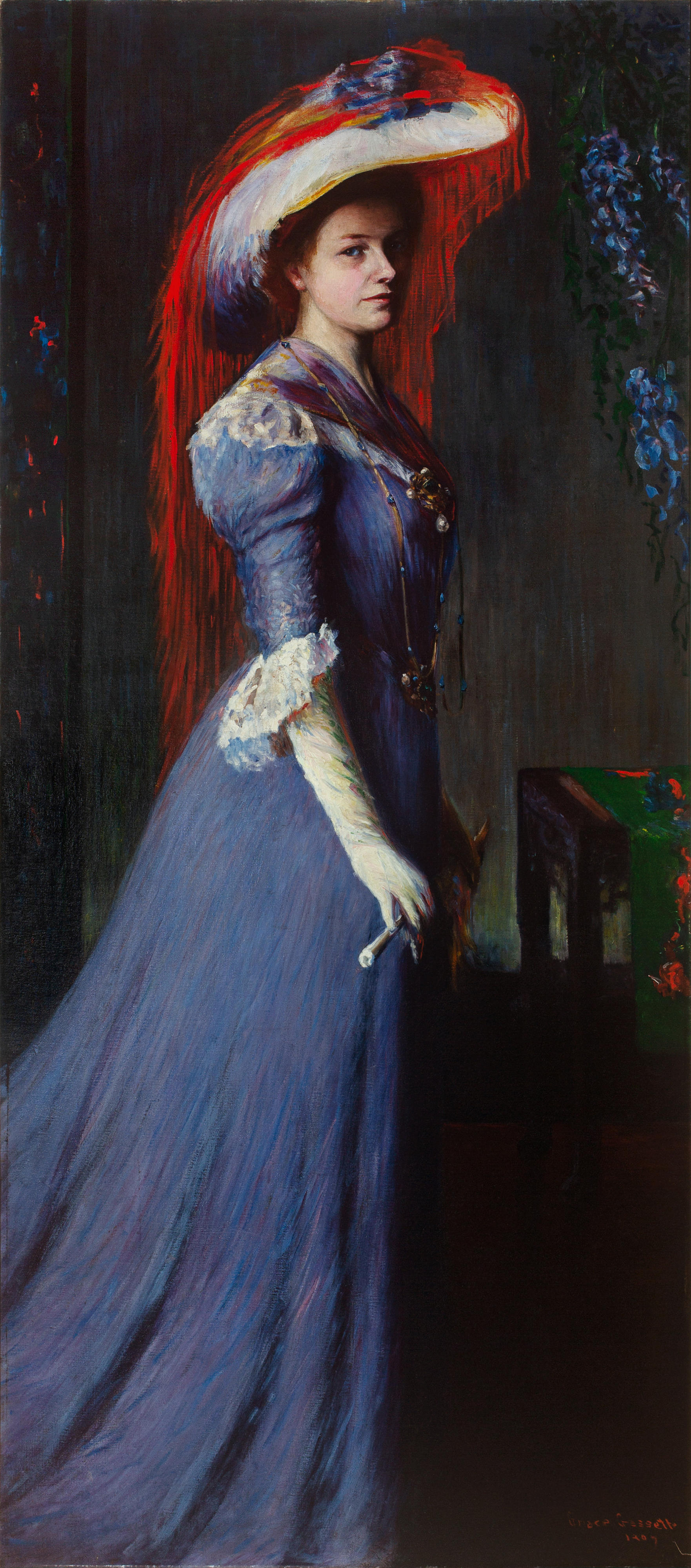
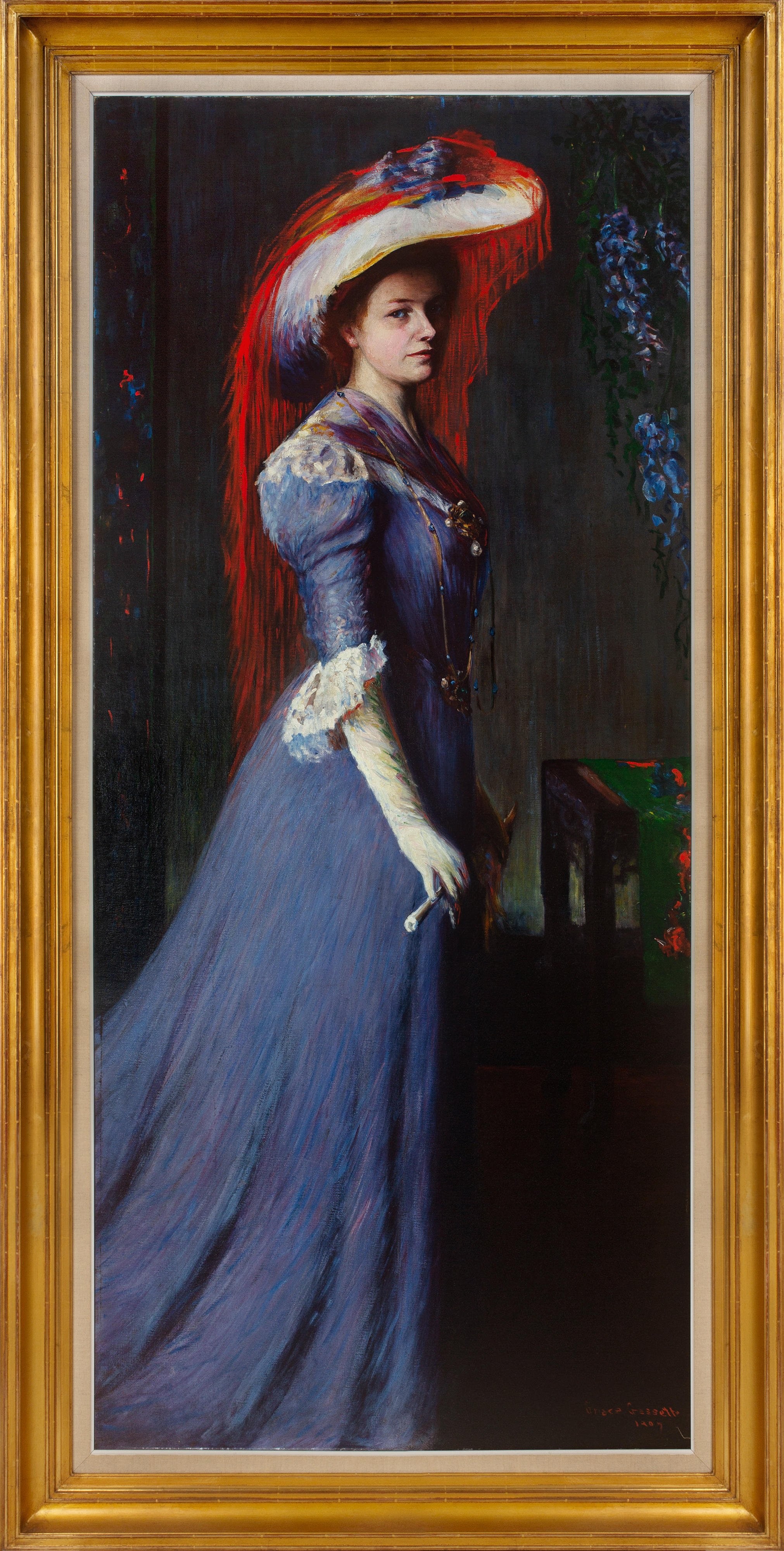
This elegant portrait of a young woman by Gassette is signed and dated 1907. The sitter is shown full length, wearing a blue gown, long white gloves, and a wide white and blue hat from which spills a brilliant red veil. She holds a parasol. Wisteria at the upper left complements the purple of her costume, while a Chinese table in the background was the height of fashion in Paris in this period. Although the sitter has not yet been identified, it is tempting to hypothesise, given the ambitious scale of the portrait and the prominence of the signature and date, that the painting is the one Gassette submitted to the Carnegie International in that year, the elusively-titled 'portrait of Madame A.'