
Bartolomeo Passerotti
b. 1529, Bologna
d. 1592, Rome
Portrait of a Scribe
Oil on unlined canvas
116 x 83 cm (45 5/8 x 32 5/8 in.)
Provenance
Private collection.
Literature
Bodmer, E, Un ritrattista bolognese del Cinquecento. Bartolomeo Passerotti, Il Comune di Bologna, XXI, 1934, p. 22, fig. 15. Hper, C, Bartolomeo Passerotti, Worms 1997, p. 236 [no. A 31].
Description
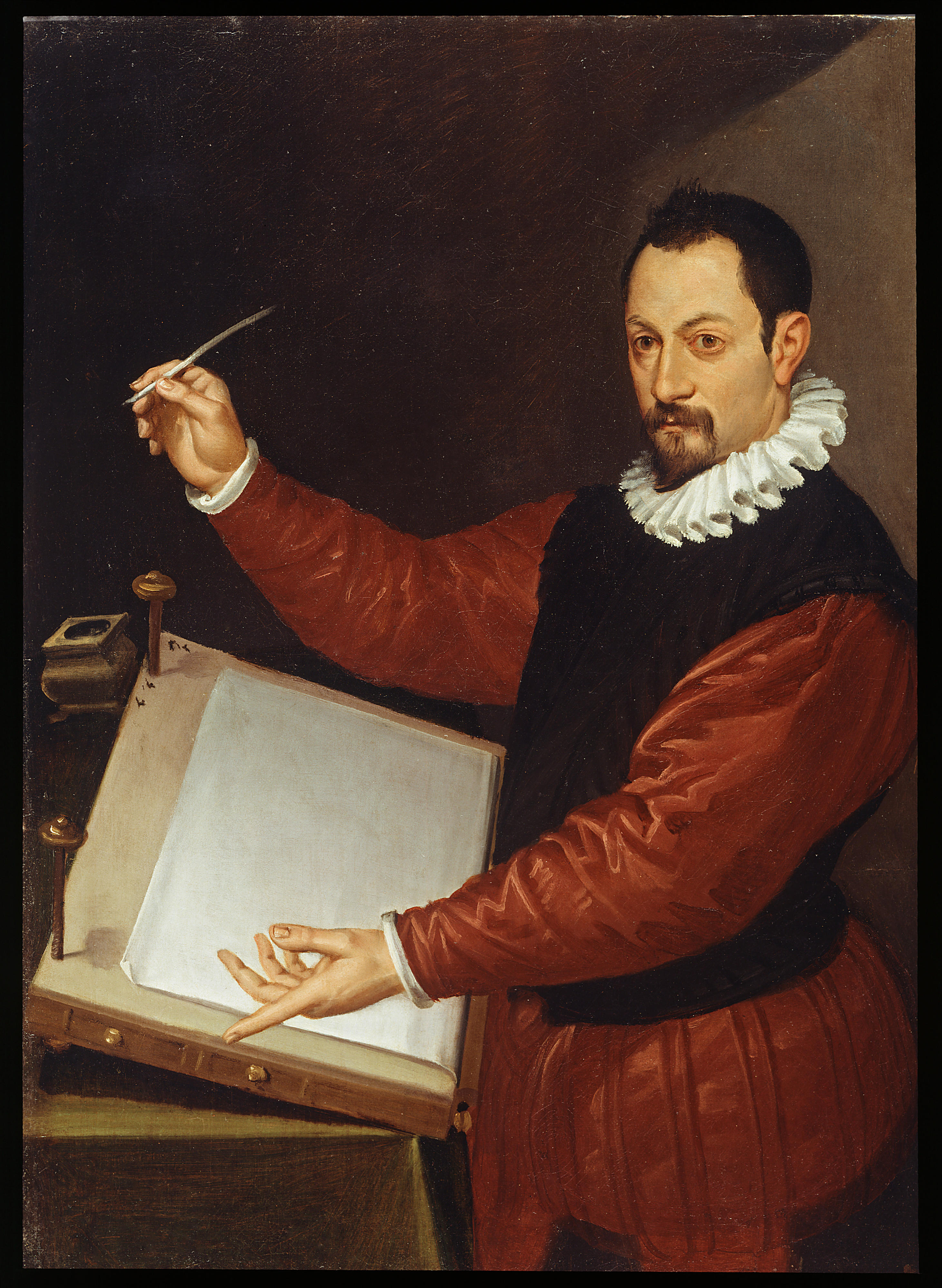
After having placed the sheet of paper on his complicated, adjustable writing stand, the scribe has dipped his pen in the ink well and now looks toward the spectator as if he were waiting for dictation. A notable place among Bartolomeo Passerotti's portraits is held by those which describe the sitters profession through mutely eloquent gestures which reveal their characters. Carlo Cesare Malvasi, who was always ready to underline literary implications in painting, happily caught this aspect of Passerotti's work when, after a rich play of verbal transcriptions, he called these portraits in azione e in moto (Felsina pittrice, 1678, Bologna, ed. 1841, I, p.191). Recent critics have further understood this characteristic which leads toward Baroque portraiture and have noted Passerotti's passages of real modernity of the genre (see Ghirardi, A, Bartolomeo Pasarotti, Rimini, 1990). Indeed, the artists research in this direction had important precedents (Parmigianino, the Venetians, Moroni), but Passerotti's merit consisted in studying with great coherence this naturalistic tradition and its implications throughout his career. The picture presented here is not new to scholarship. Heinrich Bodmer first published it in his article which signalled the modern rediscovery of Passerotti's work (1934, the text is that of a lecture given in 1932 at the Kunsthistorisches Institut in Florence). Differing with Wart Arslan who had previously studied the artist (Il Comune di Bologna, XXVIII, 1930, 3), Bodmer published this picture as like the master, but from his workshop, noting, however, that the raised arms point to Bartolomeo. Nonetheless, the photograph was published as B. Passarotti. Aside from the polemics which surely influenced his judgement, we should note that Bodmer did not yet know Passerotti's pictures in which his declamatory emphasis reached exaggerated, almost marionette-like, effects through the excessive gesturing of arms and in the enamel-like description of surfaces. Such pictures are typical of the artists work in the 1570s when, although not abandoning his interest in naturalism, Passerotti's painting reached an extremely stylised form. In addition to the altarpiece, dated 1575, at Scannello di Loiano, a picture that I first published (Una Lucrezia e altre proposte per Bartolomeo Passerotti, Paragone, 379, 1981, p.30, fig. 39), we could cite the Portraits of Men in Armor in the Musée des Beaux-Arts at Chambry (Benati, 1981, figs. 43-44: Ghirardi, 1990, p. 204, nos. 44a, 44b) or the Portrait of a Numismatist in a private collection (Benati, 1981, p. 31, fig.42; Ghirardi, 1990, p. 170, no. 20); these are all pictures which share the same characteristics. Furthermore, a firsthand study of the portrait, cannot but reveal a high quality of execution in, for example, the highlights on the sleeve. Such details are indeed the mark of Bartolomeo Passerotti himself. There is, also, a precise moral judgement. If the sitters of the Portraits of Men in Armor mentioned above are deliberately represented as caricatures, as members of a declining aristocracy, doomed to show the signs of its own vanished authority, then the seriousness with which Passerotti describes the calm and concentrated face of this scribe, a member of the solid, working middle class, makes of him a person who represents new, positive values based on the ability to absolve, conscientiously and competently, his own work fully aware of his exact role in society.
The artwork described above is subject to changes in availability and price without prior notice.
Where applicable ARR will be added.
The artwork described above is subject to changes in availability and price without prior notice.
Where applicable ARR will be added.